Japan
When the quake hit, most of the power plants that serve Tokyo went offline automatically. That was a very good thing because Tokyo is served with nuclear, thermal and hydroelectric power. Nobody wants a nuclear emergency due to an earthquake.
Unfortunately, we are having one.
TEPCO is handling it as professionally and safely as possible by evacuating 90,000 people in a 20 km radius of the the Fukushima 1 power plant, venting pressurized gas in controlled ways, and basically destroying reactor number one by pumping sea water and boric acid into the reactor to cool it and kill the reaction. Very likely, reactor number one will never be brought back online.
Reactor number three is experiencing a cooling system malfunction today as well, so the TEPCO folks are really hustling. I have confidence that they will keep things under control.
Nobody in Tokyo is at risk. Even if there is meltdown in either reactor, it is unlikely to affect Tokyo dwellers with radiation. Scare tactics aside, we are 200km away and the type of reactor that is in crisis isn't going to explode.
But the power plant shutdowns very may well affect us in another way. With so many sources of energy offline, TEPCO may not have enough electricity to meet peak demand. It said on Saturday morning that there might need to be blackouts and requested us to conserve energy as much as possible. But then they found some more electrons in a back closet or something and avoided having to cut any power. Today rumours of rolling blackouts and power loss are rampant and it's hard to find out the facts, so let's conserve as much as possible and hope for more back closets at TEPCO.
10 ways to conserve electricity
- Turn off your TV.
- Same goes for stereo, game consoles, computers, printers, etc.
- Disconnect your heated toilet seat.
- Move your computer server to an offsite host outside Japan.
- Unplug appliances you aren't using. Lots of them draw power even when they are off.
- Switch to compact fluorescent light bulbs.
- Turn off lights if you aren't using them.
- Use solar power to dry your washing.
- Turn down the heat and put on a sweater.
- Start a raw foods diet.
I will be implementing #4 today, hopefully before any rumoured or real power disruptions. But I expect that this hosting transfer isn't going to go 100% smoothly as I am also upgrading my blogging software at the same time. So I apologise in advance for any ugliness, broken links, or other discombobulations on mediatinker. I will strive to have it all up and running beautifully again asap.
The supermarket in my neighborhood has a lot of empty shelves tonight. People are panicking and hording, I guess. Here's what's missing:
- rice
- tofu
- eggs
- bread
- milk
- juice
- pasta
- leafy greens
- mushrooms
- eggplants
- pineapple
- bananas
- cup ramen
- retort pouch curry
- udon
- nabe sets
- bento
- sushi
- deli foods
- most meat and fish
There was a fair supply of tomatoes, fresh herbs, zucchini, beer, wine, cookies, ice cream, and yogurt. I have a feeling that produce is going to be hard to come by for the next few days as transport and farming are disrupted from the earthquakes, tsunamis, and the nuclear emergency.
Staff in our local grocery store, and also in the convenience stores (also bare of most fresh foods), were busy trying to restock the shelves with cup ramen. At least there will be something to eat. We won't have to add "famine" to our list of apocalypses.
Well, I think we just lived through the long-overdue, ever-feared "Big One" that seismologists have been predicting for decades. It didn't have its epicenter in Tokyo, but we sure as fuck felt it. I can't even imagine what it must have been nearer the epicenter. But let me tell you what it was like here.
Tod & I were together at home this afternoon when the quake struck at 2:45. It was scary. Our five story apartment building shuddered and rocked like a ship at sea.
After the first few seconds, when the initial shake started getting worse, I opened an exit to the balcony and we stood together in the doorway watching the birds flap confusedly, trees sway and every local structure rattle and moan. It was disconcerting and eerily beautiful at the same time. I was fascinated and calm while it happened and very grateful that I wasn't alone. It seemed to last for an eternity, though it was maybe less than two minutes in reality.
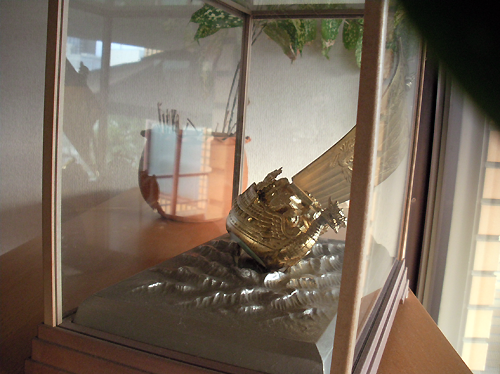
Our lucky boat capsized.
Even when the shaking calmed to a rolling wave and it seemed safe to move, things were still swaying. It felt like stepping back onto land after a long voyage and we were both feeling sort of seasick. I ran around the house to see what had happened. Stuff had fallen off shelves, counters and surfaces over all over the house, though amazingly enough nothing really broke. I put most of it to right in a few minutes.
The city made an emergency announcement over the public address system - the first time they have ever done that in my memory - though with the flapity-flap of helicopters and the echoing distortion off buildings, I could barely make out a word. Our apartment was still standing, so I figured we were fine to stay in it. We checked Twitter for the first details, updated Facebook status and more or less calmed down for a few minutes.
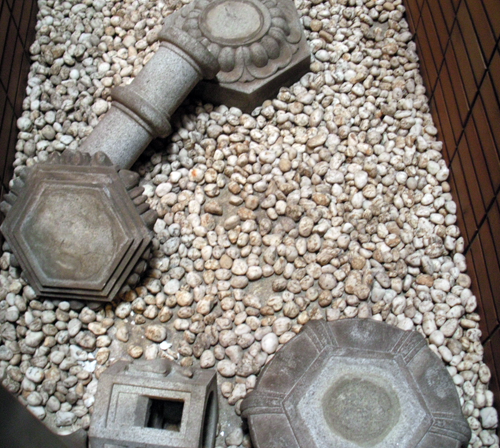
Japanese lanterns are stacked stones, now unstacked.
Then I wanted to go examine the what was up. In the hallway, the first sign of trouble. A stone lantern had fallen over and cracked the floor-to-ceiling plate glass window. Oops. Another stone lantern was toppled on the first floor, but that seems to be the extent of problems in our building. Amazing considering how loudly it was creaking and the amount of sway it experienced.
We went out to see the world. Really not a lot of damage in our area. A few unhitched cable TV wires and some crumbled old plaster. We stopped into the flower shop on the corner to check in with the store owner. She said she could see the big apartment buildings swaying. From one of the 13th floor balconies, someone's stuff had fallen to the street.
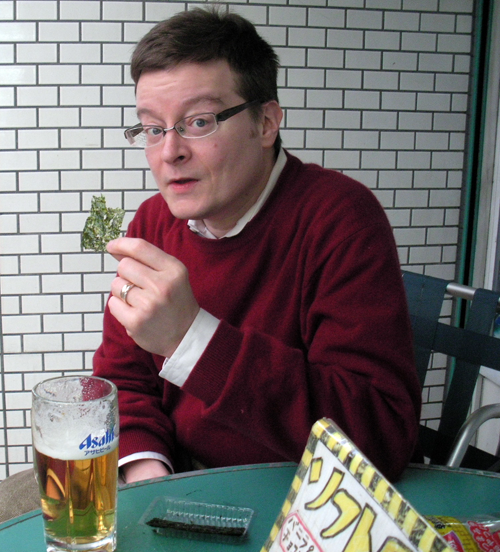
After the quake a beer to celebrate surviving.
We continued on to Kashiwaya, our local liquor store, to see how our friends there had fared and also to get a beer. Our friend and their shop were fine - two bottles of sake had toppled over and broken but that was all. We ordered two draft beers and sat at the table outside the shop to watch people go by. We got a lot of double takes and some envious smiles, the two of us calmly enjoying our drinks. The worse was over and we were safe together. It was going to be OK.
The sidewalk was crowded with commuters walking home because every train in the capitol was stopped. People were actually hurrying, unusual in a city where ambling is the norm. Kasuga Dori is a main emergency road and it was pretty much packed with people from the afternoon until well into the night.
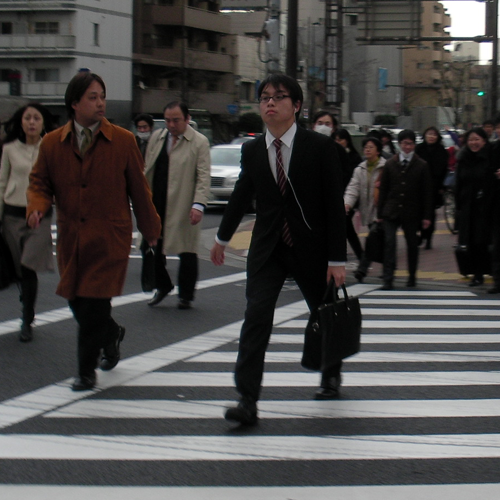
Determined walkers head home.
When it got cold after dark, I felt compelled to go out and give away my extra hats, gloves and scarves to all those people walking home a long way who needed them. I was oddly fearful to get too far from Tod so I pushed aside the feeling of needing to help and stayed inside. But the need to do something, anything to help people on this very strange day got too strong and I worked up the courage to go outside alone. It is hard to give stuff away in Tokyo, but I eventually found people who were cold enough to accept my mismatched accessories.
Now it's almost 11 pm. We are listening to the Japanese news radio reporting on people trying to get home. At Shinjuku station the trains are still stopped, there is a 100 meter long queue for taxis...and no taxis. The streets are gridlocked with traffic. All the buses are completely crammed. Hotels are full. Convenience stores are running out of supplies in some places. Some people are in for a long, cold night. The aftershocks continue to make everything shake and sway in Tokyo.
And we got off lightly in Tokyo. The worst happened more than 300 km north of here. The magnitude of the quake was 100 times stronger than the one in Haiti last year. It reached the highest level of the Shindo scale, 7, and was eventually given an 8.9 magnitude.
Every minute brings more horrible news from the north. There's a nuclear emergency in Fukushima with a reactor on the verge of melt down and people being evacuated; Kurihara, a town of 77,000, was entirely destroyed; 1800 people are taking refuge in an elementary school in Aomori; and the videos of the tsunami rolling inland are so disturbing that I can't watch them. The grisly discoveries of corpses are just beginning; the number will not be small.
Tomorrow some friends and I are getting together to hoop at Yoyogi to relieve our stress and brainstorm ways we can help even a little bit. Feel free to join us. 12:30 in the usual place.
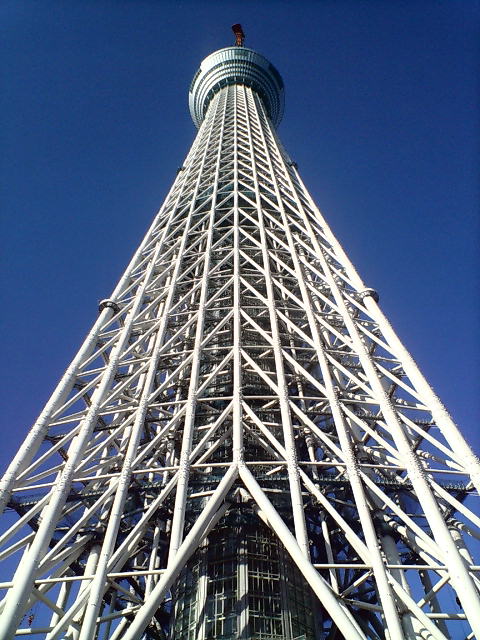
I've been sort of poo-pooing the fuss over the newest, tallest structure in Tokyo, the Tokyo Sky Tree. It's been hyped since before it was even begun in 2008 and ever since it got big enough to photograph well, it's been featured on TV, in magazines and well, everywhere you turn. Yeah, yeah. It's just another big tower to broadcast media. Whatever.
Well, today I caught a glimpse of it from the top of my street and suddenly, I just had to go there. I needed to make a pilgrimage to the Sky Tree and I couldn't stop myself. It didn't hurt that the day was almost 24 degrees, with blue skies and lots of fresh wind. I wouldn't be able to stay inside, even if I should be packing for Prague.
Destination Sky Tree!
So after checking the level of the river after this morning's huge rainstorm (it had risen, but only 30 cm or so) I took the bus to Ueno and the subway to Tawaramachi and walked to Asakusa. I stopped in and said konnichiwa to the deities, then crossed the bridge and walked to Oshiage.
The tower is huge and exceedingly impressive. It's gorgeous, a pure white lattice with oversize bolts and handles running up as far as I could see. The construction site is in constant motion with trucks crisscrossing the area, which will be a giant commercial complex with several buildings when Tokyo Sky Tree opens in Spring 2012. The tower is enormous. It will be the second tallest structure on the planet when it's finished (I had no idea) and at 511 meters currently, it is taller than the Empire State Building and Petronas Towers.
I wasn't the only one looking at the construction. There were dozens of sightseers taking pictures.I was surprised at home many people turned up to look at this unfinished tower. I can only imagine what it will be like when it is finished. Busy! I'll be there, for sure. I might skip opening day, though.
The surrounding neighborhood is taking advantage of this popularity. There are holiday lights in the shape of the tower, signs featuring the silhouette of the Sky Tree, and food specials in cafes'. A tiny storefront nearby selling calendars, keychains and other memorabilia was doing a brisk business today. I saw the manufactory where an old man was heat stamping wooden postcards with the Sky Tree logo. There seems to be a lot of secondary construction around, too - old buildings being rebuilt as money comes into the area.
I walked all the way around the tower site, taking in the back streets and viewing it from different angles until I'd had my fill of Tokyo Sky Tree. Then I walked all the way back to Ueno and caught the bus home.
It was a great day out and I shall poo-poo no more. Tokyo Sky Tree deserves the adulations and attention it gets.
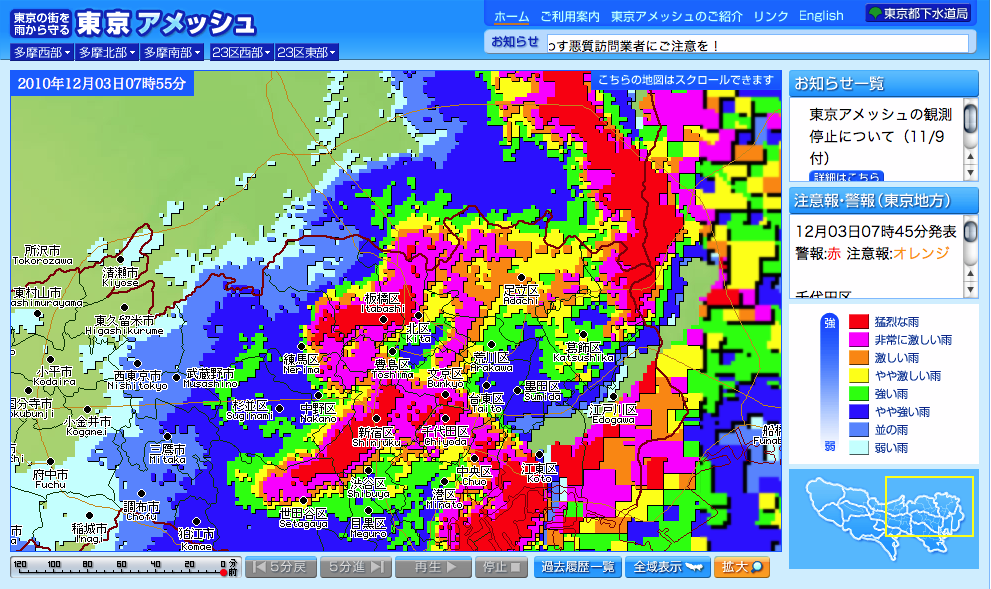
When Tod crawled into bed last night at 1, he whispered to me, "It's raining." I woke up and listened for a minute before being soothed back to sleep by the sound. When I woke again, it was dawn-dark but the clock said 7:30. I slipped out of bed to the crashing sound of a major deluge. Wow, it was going off!
The air was so thick with rain that it looked like a tap had been turned on. A slanted curtain of water veiled even the nearest building. There was thunder and lightning, but no rumble of trains or any traffic noise.
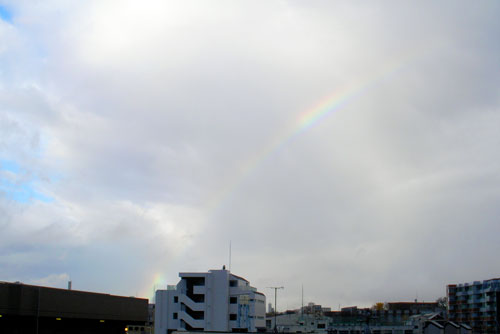
Within the hour, the rain had eased to a stop, the sky sported patches of blue, birds chirped an all-clear to their companions.
Now the neighborhood maintenance men are surveying the floods. I hear the sounds of stiff bristled brooms and shopvacs. I hope they look up.
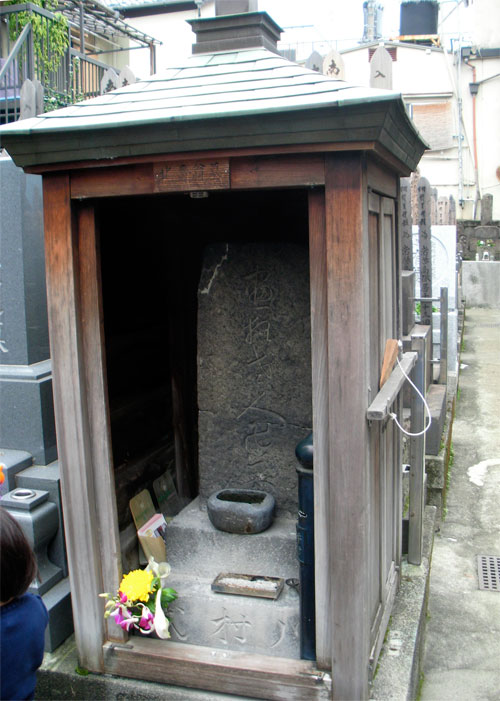
Hokusai's grave is specially protected with a roof.
Earlier this week, Tracey invited me to join her on a walking tour with a special theme - Haunted Tokyo. Just the right season for it and a lovely grey day to add to the atmosphere.
Lilly Fields, our tour guide, has lived in Tokyo for 25 years and knows her spooky back streets and alleys of shitamachi, those lower lying areas on the east side of town where the working folks traditionally live. Shitamachi is full of spirits and weird energy - ancient and new. We started the tour at Inaricho station and meandered through the blocks visiting temples and shrines and hearing legends and scary stories all the way up through to Asakusa.
I think my favorite bit of the afternoon was visiting the grave of Hokusai, one of Japan's most famous artists. It is tucked away down a narrow stone path in a postage stamp graveyard behind the side building of a really boring concrete temple. In addition to the famous wave woodblock print, Hokusai drew a lot of scary ghosts and demons. He believed that if he lived to 110, all of the lines and dots he drew would come alive. Fortunately for us, his demons live only on paper - he died at age 99.
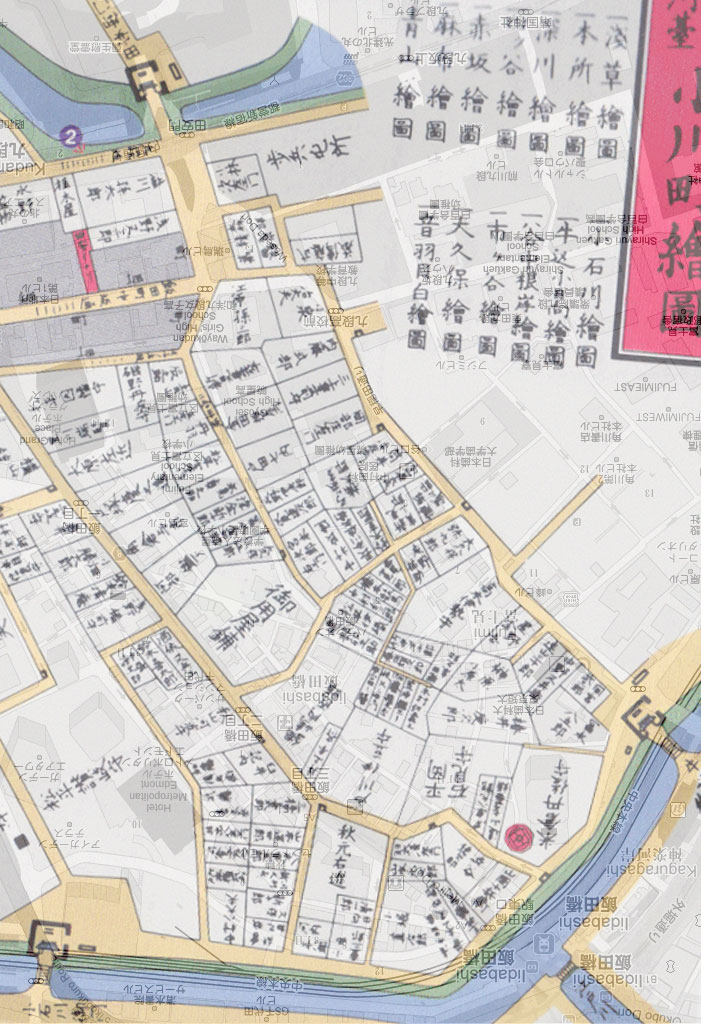
Yesterday afternoon, Tod & I were enjoying one of our Sunday rambles through local but unfamiliar territory when we encountered Nigouhan Zaka 二���, which translates to Two and a Half Measure Hill. Funny name. What could it mean? A historical marker gave us the answer.
Back in the day when Tokyo's buildings were a lot shorter, you could see the upper half of Mt. Nikko from the top of the hill. The "measure" in the name is of mountains. Japan's tallest mountain, Mt. Fuji, is divided into ten gou from the base to the summit. Since Mt. Nikko is half the height of Mt Fuji, it is 5 gou tall, and you could see only half of it from Two and a Half Measure Hill.
The sign gave an alternate explanation, as well. The hill is purportedly so steep that if you drink one measure of sake and walk up the slope, by the time you reach the top it feels as though you've drunk 2 and a half measures. The hill didn't seem that steep to me and I had no sake to experiment. Maybe next time.
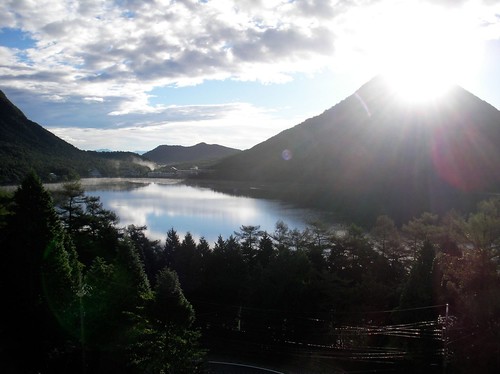
Sunrise over Haruna
I was dying for an interlude between projects, so we booked two nights in the mountains of Gunma to relax. As it turned out, it wasn't very relaxing at all for various reasons.
We started out after lunchtime on Thursday and missed the last bus to Haruna from the Takasaki train station. Tod was in tears as I was trying to stay calm and relatively positive. Fortunately we found a bus that got us about halfway along the 60 minute trip and the hotel rescued us at the terminal in Muroda. Thank you, Agatsuma Sou staff!
Once we were there, it was refreshing to breathe the fresh air and see perfectly blue skies, freshly rain-sprung mushrooms, flitting butterflies and gorgeous green trees. Haruna was once a very large volcano which has gone through several cycles of erupting and reforming itself. Today it has both a crescent-shaped caldera lake and a new cone. It's awesomely picturesque.
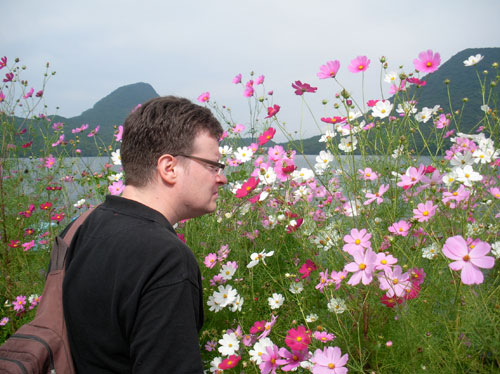
Stopping to smell the flowers
We filled our days with a lot of activity. On Friday, we circumnavigated the lake on foot, took a kitchy tourist lake cruise, rode the ropeway to the top of Haruna and hiked around the peak a little, rented a rowboat for half an hour so I could work my upper body after our long walk and simultaneously enjoy a beer on the lake, took a lot of baths and ate too much.
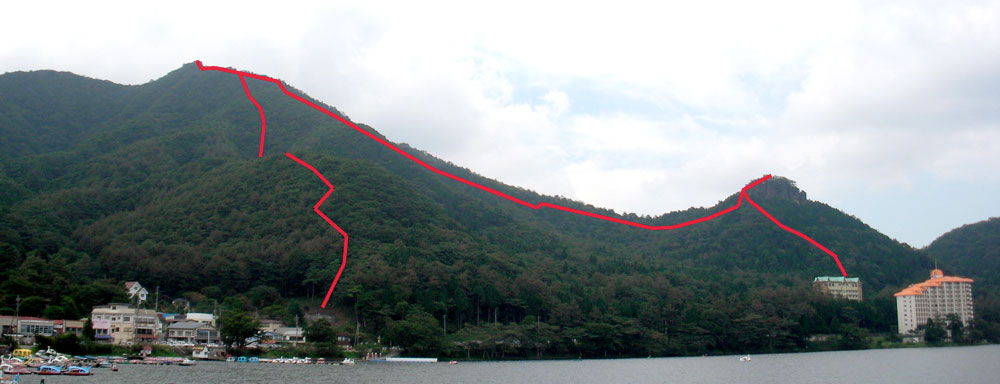
Saturday hiking route from hotel to park
On Saturday after breakfast, we decided to check out the exposed rocks on the mountain near our hotel. The cartoon map we'd picked up at the tourist center said it was about a 20 minute hike. Seemed reasonable, even with a migraine messing up my balance and vision. It was a pretty simple walk up through the forest to the rocks. The view over the lake was lovely and once there we opted to continue hiking - only another 800 meters to the next spot on the map. Doable. When we looked more carefully at our tourist map later, that spot, Kamon-ga-take, is the tallest mountain in the area.
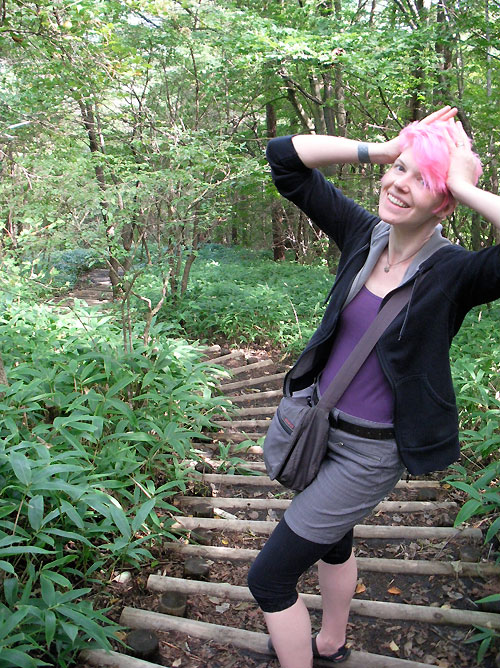
Mountain hiking with migraine. What am I thinking?
Three hours later after several near misses on the trail, a bit of short temperage, and some mountain peak yoga, we slid our way out of the well-blazed, excessively steep, muddy, short but seldom used side trail that lead to a park we'd visited the day before. We washed out hands and feet, Tod rescued a butterfly from the museum/atelier, and we went off to have lunch. Only my head hurt so much that I couldn't eat. So we collected out bags, got an ice cream and set back to Tokyo on the bus we'd missed on Thursday.
We'll be back to Haruna when the lake freezes over and the ice-karting season starts.
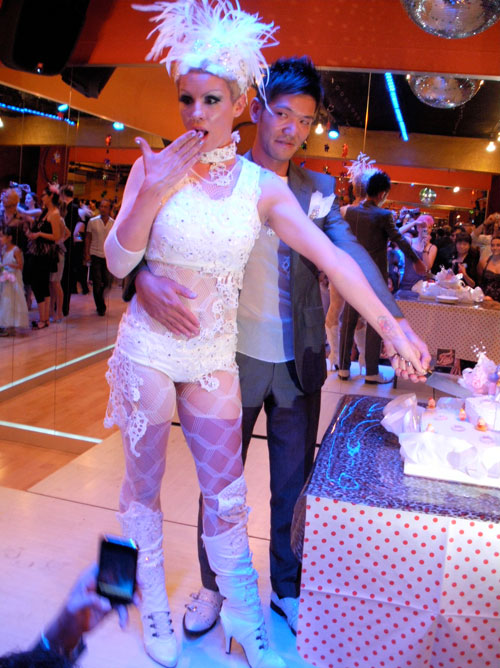
Congratulations, Deanne and Masao, on your wonderful weekend of celebrations.
The Kira Kira Circus at Inokashira Park brought together scores of well-wishers, including about 80% of my Japan-based friends. We costumed up in sparkly clothes and bright colors, gorged ourselves on popcorn, danced and hooped in the center ring, played with a parachute, had our bodies painted, kissed the bride at the kissing booth, and laughed the afternoon into an energetic frenzy. Sarah got some great photos of the circus picnic.
Sunday was the ceremony at FAB. The bride wore a simple outfit: white lace body stockings layered under a lace covered top and tap pants, with white boots, lace-encrusted spats and knee pad, a lace choker and a tall feather headpiece. An organdy over skirt with Polonaise draping and Japanese obi completed the ensemble. The entire outfit was covered in hundreds of clear Swarovski crystals applied by the bride herself. The groom wore a silver-grey suit with a mesh and lace shirt studded with crystals.
It was not a traditional wedding, by any stretch of the traditional imagination. The processional music was a live operatic version of Lady Gaga's Bad Romance by Akiko; the officiant was Guy, a professional vaudeville clown who performed magic, played a tune on the saw and kept the ceremony moving along with lots of laughs and help from his translation partner and beautiful assistant, Kana. The usual ring exchange was replaced by partner hooping. There was no veil to be lifted, but Kike dramatically removed the overskirt so that Deanne could hoop and dance. Later in the day, we enjoyed a burlesque fan dance by Cheery Typhoon and a dance number by Diana and Miki. And (of course) Deanne did a hoop performance, even though she did say it was her day off...
There were readings and speeches at the wedding - likely the most traditional part of the whole day - and every one of them was an original. We heard a welcome speech by Masao's father; two amazing poems from Jonathan and Melissa; the e-mail where Masao confided to his friend Maurice that he'd met a girl; a funny rant from Leila who couldn't make it.
I did a reading, too. Deanne and Masao are positive and fresh people but most wedding readings are stale and negative, so I wrote a piece that reflects things that they believe in. It also had to be something that I could recite without crying. This is it:
The marriage of two people reveals an unexpected third being. You are still your familiar, individual selves and you now are also part of Deanne-and-Masao.Deanne-and-Masao is the sum of Deanne plus Masao. It is all the interactions that make up your life together. It is the energy that you create and the feelings that you have for each other.
Deanne-and-Masao is fluid. It ebbs and surges like the tides. It flows to meet love. It expands and changes shape as you grow.
Deanne-and-Masao exists in the present moment. It lives for here and now, and it accepts everything as it comes.
Deanne-and-Masao offers astonishing freedom. It gives you all the space you need for exploration. Anywhere you wander, Deanne-and-Masao always guides you back when you're ready.
Deanne-and-Masao is uplifted by love, compassion and caring. It draws on your generous spirits, and on the affection of friends, family and loved ones.
Along with everyone here today I wish both of you, and Deanne-and-Masao, a gorgeous, bountiful, and energized life together!
[P.S. Yes, online friend, you have my permission to read this at your wedding. If you want to give credit, I'm Kristen McQuillin.]
Tod shot a 45 minute video of the whole ceremony (strong, steady hands!), but technical difficulties are hounding us. I'll post it soon.
The weekend was so full of smiles and love that I'm a little sad it's over. But I am looking forward to the next huge event that we create together.
This weekend I took a handful hoops on the Shinkansen to Shizuoka for a hoop picnic with Ellie and some of her local hooping crew. We had a fun afternoon getting silly in the spin. I had so much fun that I took no pictures or videos, as usual...
One of my Tokyo hooping friends, Arika, came up as well. Her family is from the area and it was a good excuse to visit. When she arrived at the park with her second cousins, Rina and Aki Ichikawa, she asked me if I'd like to come back to their house after for tea. Long story short, I ended up spending the night and crashing the family Obon feast the next day.
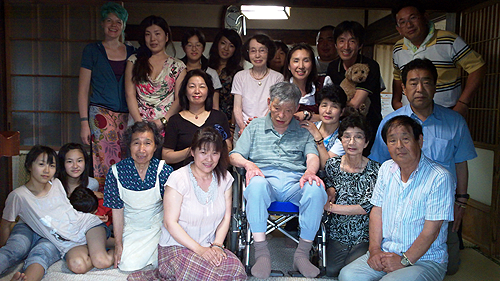
Three generations of the Makino family and an interloper
It was a treat to hang out with an family. Being a half of childless couple is a situation I love, but there is joy in the bustle of a three generation household hosting guests where cousins and sisters drop in. There was lots of back chat about how we'd get from point A to point B, phone calls made to arrange things, consternation over whether anything had actually been arranged, discussion of drink supplies, lots of laughter and endless talk.
The Ichikawas are a very talented family. Yoshiharu is an architect, Mayumi paints, Rina plays piano and dances and Aki is a budding actress. Sachiko, at 79, keeps everything together. Her husband, Seiji, is currently in Cambodia visiting a aid project he's part of.
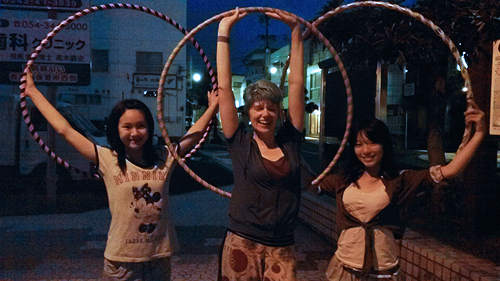
Eri, me and Rina with hoops in the rotary near Kusunagi station
We watched TV, played in the park, hooped in the rotary, and had conversations in Japanese and English (sometimes simultaneously). I was treated to a peach crepe in the family's cafe, ate four homecooked meals that I didn't have to prepare, borrowed pajamas from Mayumi, dried the dishes, and tried to participate as much as possible while simultaneously not causing any trouble. Ha!
I learned all sorts of things over the weekend. Thanks to some entertaining and educational TV shows, I finally know the difference between atsuage and aburaage, which are both deep fried tofu. And I learned about the subtypes of DNA that Japanese have - none of which originated in Japan (Take that, Japanese racists, your genes were made in China and Korea).
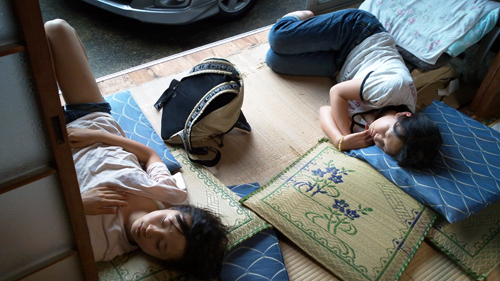
Cousins Aki and Eri napping on the engawa after lunch
On Sunday, I was moved to tears when Rina played a valse on the piano for me. I had a session of Ito Thermie, which blends elements of moxibustion, shiatsu and acupuncture into one treatment. What a lovely and relaxing therapy practiced by Mayumi's twin, Hiromi. At the same time, I learned a new word that will be very useful for hooping - tanden 丹田 - the energy center just below the belly button that corresponds to the 2nd chakra.
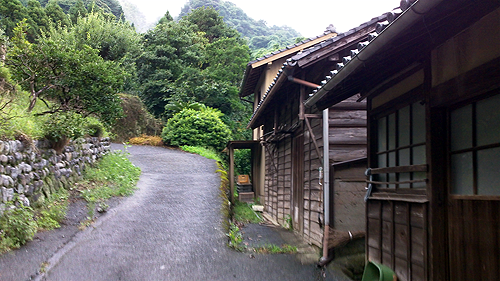
Buildings in the Makino family's farm complex
Then we drove out to the center of the family love - a mikan farm currently owned by the 4th generation of the Makino family. I met more than 20 members of the family including Arika's parents and siblings, paid my respects at the family altar, ate delicious foods from farm fresh produce, and mapped out the Makino genealogy after the Obon feast.
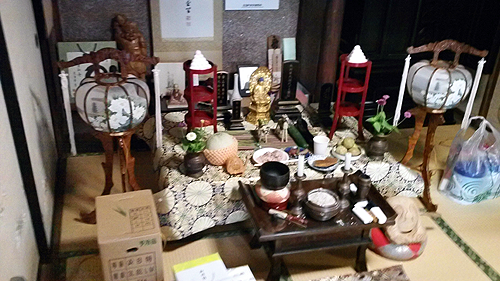
The Makino butusdan with Obon offerings
On the way home on the Shinkansen with Arika and Haruki after one last dinner at the Ichikawa's, we made as much happy noise as possible by being frightened by ghosts outside the train and pulling faces. (Next time you see Haruki or Arika, ask them to show you buta megane, pig glasses.)
It was the sort of weekend where, on returning home, you wonder that only 36 hours have passed. It felt like a week. Thank you, Ellie for organising the hoop picnic and getting me out of Tokyo, and Arika for keeping me away. I was very happy!
Bunkyo-ku is having a restaurant rally from 7/1 - 12/28. Seventy six of the area's designated 100 special restaurants are participating. By eating at these restaurants you can win prizes including hotels stays, restaurant vouchers and tasty treats. Prize drawings are on 9/30 and 12/28.
Tabe-aruki Course
You must collect stamps from 5 different restaurants or participating food shops. You can enter as many times as you like but each entry must be on a separate entry sheet. You must make a purchase to get a stamp.
Complete Course
Eat at all 76 restaurants! Don't try to cheat, you must make a purchase to get a stamp.
Entry forms and the 100 Best Food Brands in Bunkyo (食�文京ブランド100�) map are available at the Bunkyo Tourist Information Center the first floor of the ward office. Further details, including a PDF list of restaurants and prizes, is available on their website, but I've made a spreadsheet version of the 76 restaurants sorted by cuisine and address. There's the original Japanese plus an English version in the spreadsheet.
Bon apetit!
Every day is special and there is always a reason to celebrate. And if you look at the Japanese website, Kinenbi, you'll know exactly what's being honored or feted.
Today is "Aperitif Day thanks to a campaign by the French agriculture ministry in 2004. "Happy Aperitif" is the catchphrase of warm June evenings.
Tomorrow, 6/4, is 蒸�料��日 or Steamed Foods Day because the date sounds like mushi, the word for steaming. So steam some vegetables or fish for dinner to celebrate. It's also Cavity Prevention Day, because the word for cavity is mushiba.
Skipping ahead to Sunday, 6/6, we have an amusing conflict. It is Low-calorie Lifestyle Day" and at the same time is is also Roll Cake Day and Baby Cheese Day. If I had to choose, I'd pick the cake. Sunday is also 忙種, (boushu, a solar year observance to mark the forming of awns on grain.
So if you are looking for an excuse to enjoy your day a little oddly, check Kinenbi.
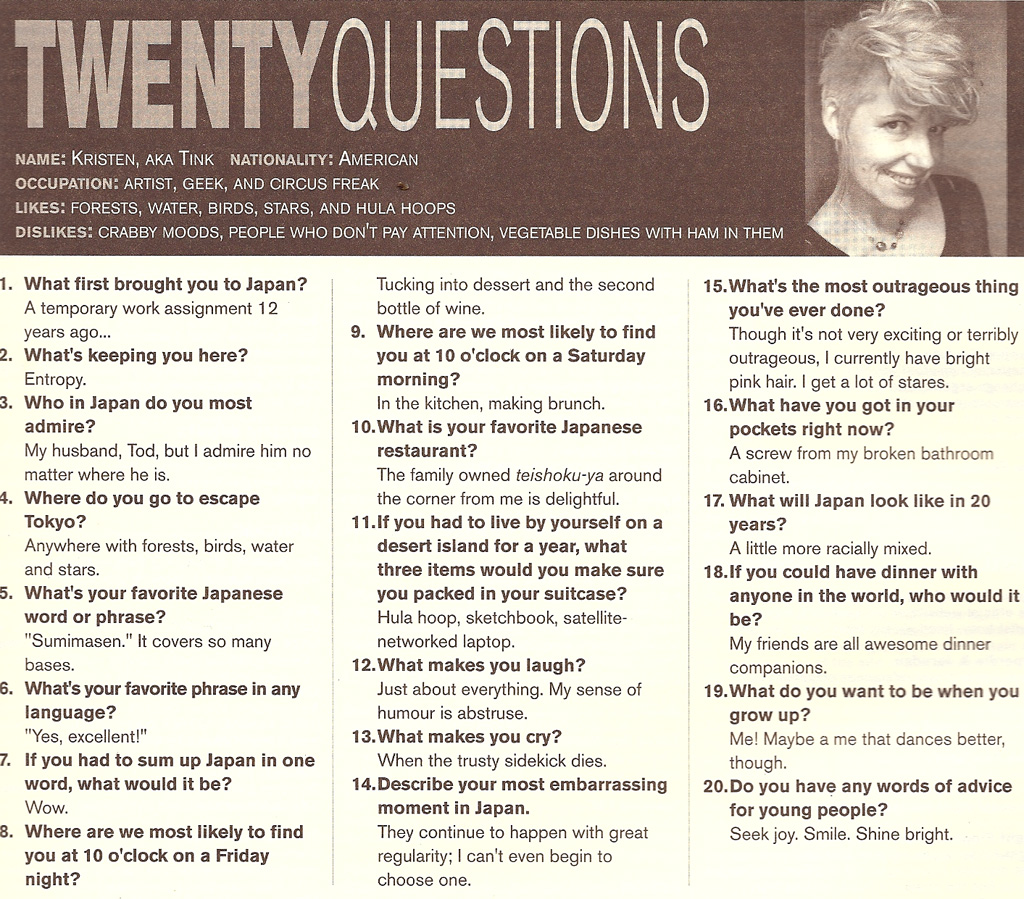
This time it's the "Back Chat" feature of J Select magazine's June issue. This may be the first Q&A interview I've given that didn't make me cringe when I read it in print. Thanks to Melissa for giving me the opportunity to appear in print again.
"Do you know the Japanese word for 'hair clippers'?" Tod asked me this morning as he stood looking at the Wahl box on the bathroom counter. I didn't know it.
They are called �リカン (barikan) after Barriquand et Marre, a French company that also made engines for the Wright Brothers and for early automobiles. They seem to have gone out of business a long time ago.
Clippers became popular in Japan at the beginning of the Meiji Restoration, when the Emperor decreed men must cut off their topknots and then started conscripting soldiers in 1873. Maruzen imported the first French "barikan" in 1874 and by 1888, Japan has its own clipper manufacturers in Osaka and Tokyo.
So now you know. And according to the box, Wahl is the world's #1 manufacturer of barikan.

Jack and I practice our different forms of physical fitness at the local park. He's 84 and certainly in better shape than I am. After his daily 900 strokes with a wooden kendo sword, he runs up and down the slope several times. Today he did 20 swings on the chin-up bar; I managed about 5 before my arms gave out. But I was able to hang and hoop simultaneously, which was fun.
Jack has lots of stories to share when we take breaks from our exertions. He's been all over the world, traveling to construction sites in South America and Asia. He tells me all about his experiences during the war and on the job. We talk about exercise, the people around us, our families, Japanese culture, and whether or not I should be a famous hoop performer. Often we are silly together, like in this photo where I am trying to make Tod jealous.
For the past few months, I hadn't seen him around and I wondered if he'd fallen ill, but I think our schedules were just off kilter a bit. I am sure as the weather warms, we'll see each other more.
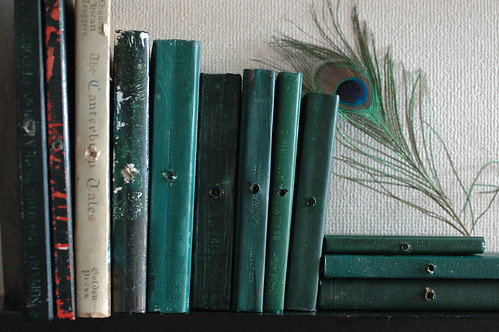
The hardcover tree is back on the bookshelf.
I am always keen to finish Christmas as soon as possible. I gather up my gifts the morning after and put them away, write thank you notes without delay, and take down decorations for storage until next time.
Japan agrees with me and I love the change in the vibe of the city after December 25th as everyone moves on from Christmas romance to the family-oriented new year season. By the 26th, Christmas decorations are totally gone and replaced by pine and straw charms. For the next few days everyone is going to be cleaning, paying bills and tying up loose ends before the calendar flips to 2010. People in every situation are cheery and excited. The mood is festive and pleasant in a way pre-Christmas is not.
I am looking forward to visiting the temple on NYE for some warm sake and a bit of soup, then strolling around a nearly deserted city on the first and second of the month. So quiet and peaceful. But for now, I have some cleaning to do!!
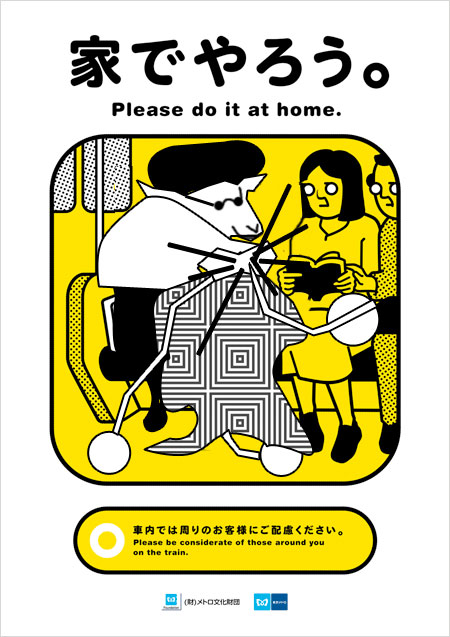
My interpretation of my own behaviour as part of the long-running series of train manner posters in the Tokyo Metro. Yes, I knit on the subway.
Autumn is on its way early this year. I have been hearing crickets since last week. Normally I notice them at the very end of August or the beginning of September. This year they have been chirping night songs since August 19th and early mornings for the last few days. I love autumn so this makes me happy, but it was a very short summer. What will this mean for food prices and winter weather?
Matsutake are creeping into the produce aisles now. These fragrant fall mushrooms will become more prominent on the shelves with their other fungal brethren in coming weeks, but I am always happy to see the early ones. Late summer is wonderfully abundant time for vegetables and fruits. As the weather cools I get hungrier and there is all this marvelous food waiting for me. Thank you, Mother Nature.
Election season is upon us as well. There are station-side rallies every day and loudspeaker trucks are driving around shouting out props to the people and politicians. Across the way a neighbor's pet beagle howls every time the female voiced trucks pass by. Poor puppy, I know how you feel. I want to scream at the political jargon and noise, too.
Nature's Scoreboard
| Day | Time | Event | Severity | Reaction |
|---|---|---|---|---|
| Sunday | 8 pm | Earthquake | M6.9; S4 | Surprise! |
| Monday | 7 am | Fierce Rain | 65 mm | Wow. |
| Tuesday | 5 am | Earthquake | M6.6; S4 | Again? |
| Tuesday | ?? | Typhoon #9 | Pfft... |
We've experienced two big earthquakes in three days - a magnitude 6.9 on Sunday at 8 pm and one of 6.6 this morning at 5, both felt in Tokyo as a 4 on the Shindo scale. These were good shakers; in the stationery store on Sunday, pens rattled in their displays. This morning the bed rocked like a choppy ocean and I heard our glasses clinking together in their cabinet. No damage done in either quake in Tokyo, but there are some fires and collapses nearer the epicenter in this morning's quake. NHK says we should be braced for further quakes, but not the Big One.
Following the quake Sunday we had a torrential rain yesterday morning. 65mm fell in under two hours. It was impressive. The river rose quickly at Iidabashi and I heard the flood warning sirens sound, though the river didn't flood.
This morning I am battening down for the main thrust of Typhoon #9. By battening down, I mean making a pot of coffee and turning on a light as the sky dims. The rain has started, but it's gentle so far. Despite that typhoons are equivalent to hurricanes, I rarely worry about them, which is probably completely insane. But so often the warnings come to nothing - the typhoon veers away before it reaches the city or it peters out. They are hard to predict accurately so there is a lot of wolf-crying. I think, though, this one might actually slam us.
Science says no, but I still think there is a link between rain and earthquakes.
The evening was unseasonably cool but our party staved off most of the chill with hooping, poi, and being silly. 14,000 fireworks were beautiful as always and we had a fun group of friends, old and new, to enjoy it with. Despite the other half a million people attending, we had a large space to spread out and run around.
It's fireworks season, with dozen of elaborate explosive displays packed into a few hot summer weekends.
On Saturday, we attended Shinji & Chako's annual fireworks viewing party. From their apartment balcony, we enjoyed the Sumida River fireworks popping up above the buildings in the distance. When the balcony got crowded, we turned towards the TV, where yukata-clad TV personalities commentated the fireworks with jests and facts in a manner similar to the Macy's Thanksgiving parade TV coverage.
Chako spent the whole time in the kitchen, preparing and refreshing a feast of sushi, salad, fried chicken, croquettes of every type, desserts and fruit. Shinji flitted amongst the guests, cracking jokes and sometimes confusing us all with his unique blend of Japanese and English. And at the end of the night, one of my favorite parts of the party - rakugo and shamisen from Yoshida-san. Every year, Yoshida-san arrives dressed in a somber blue kimono with a small case in hand, has a chat with everyone, drinks a few beers then sits down in front of his audience and acts out comic skits while he plays music. It is always such a treat to have live entertainment at a home party.
Next Saturday, I'm hosting a party for the Edogawa fireworks. No TV and no balcony, this one will be on the ground under the fire flowers themselves. If you'd like to come along, meet at Iidabashi station on the Sobu line platform at 4:30. We'll travel into the crowds together and find a place for a picnic & play before the show starts at 7:15. Bring some picnic foods to share, toys, and whatever else you think will make the evening fun (bug spray? sun screen? cameras?). A sense of camaraderie and goodwill towards strangers is a essential - these events are crowded.
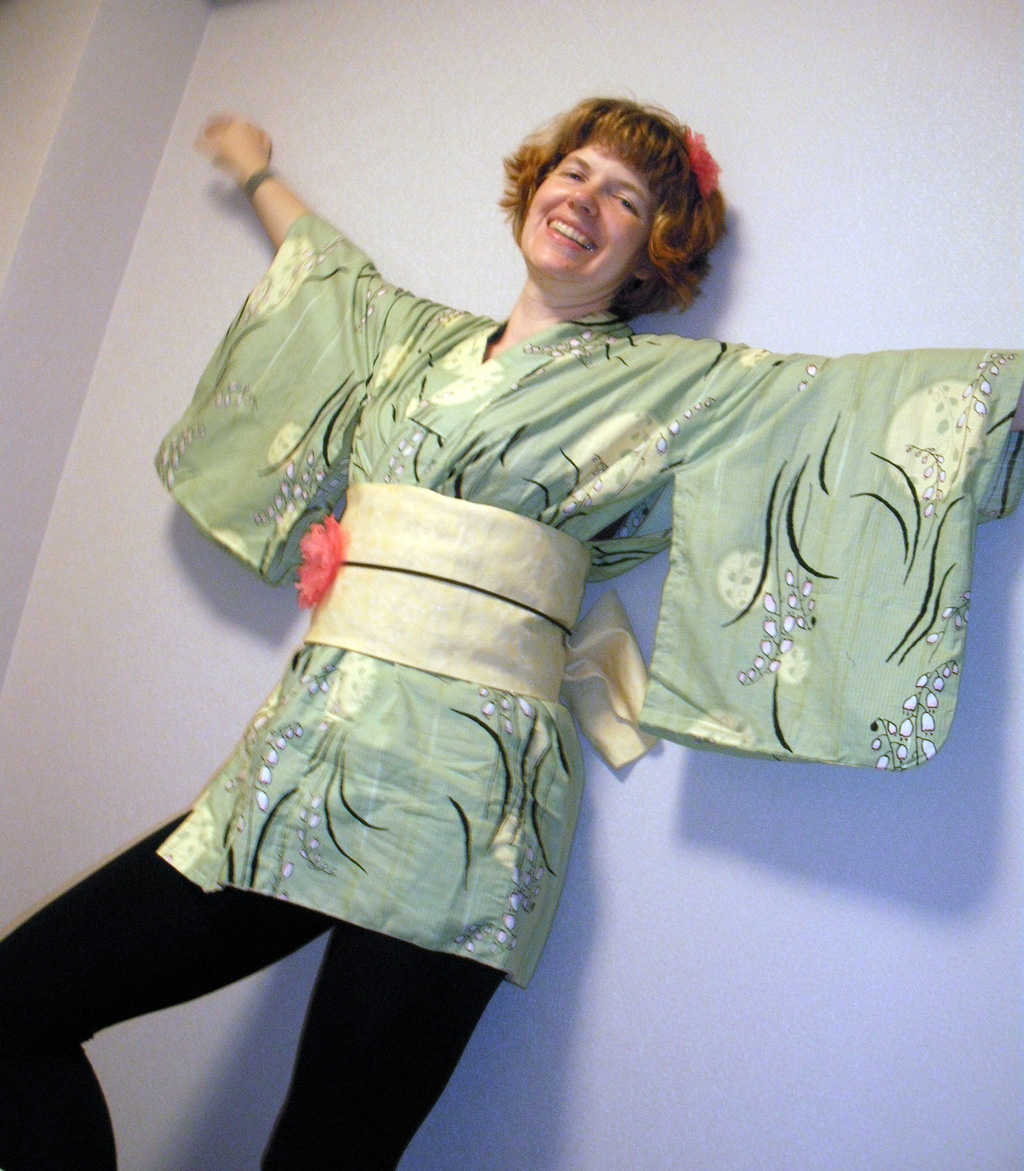
I wanted to dress up for the yukata festival in Nagahama, but even though I like the way summer kimono look, I really don't enjoy wearing them. They constrain my movement to mincing steps (or I face the consequences of flapping the bottom edges of the yukata and showing my legs) and geta - the traditional shoes - are so extraordinarily painful that I have vowed to never wear them again.
So I decided to make my own style. I cut an old yukata to tunic length and wore it with leggings. I tied my own obi and dressed it up with some flowers and cords. On top, traditional and pretty. On the bottom - freedom of movement!
I wasn't quite prepared for the reactions from passersby. In Tokyo, nobody would have looked at me twice - or if they did, it would have been discreet. In Nagahama, people gawked, pointed and laughed. Ouch.
A schoolgirl in sports uniform, leading a large team of similarly clad girls called back to them as we approached, "That's not Japanese! Look, that's not Japanese at all!" to which I replied - shouting across the intersection to her - "No, I'm not Japanese, am I?" in Japanese. She blanched and her friends tittered. Older ladies stopped me to ask if this was my original fashion. Yes, I told them, and it was so easy to walk in. They agreed with a smile. Some oddly coiffed teens looked askance at me, but I laughed because they were definitely more outlandish than I was. Maybe they will follow my trend for short yukata next summer in Nagahama.
After a while (and a few beers from the festival) I stopped noticing if people were looking and just enjoyed myself.

We enjoyed a summer get-away at Lake Biwa this weekend. I randomly selected a destination - Nagahama in Shiga-ken - from one of the travel websites and it turned out to be a great place to visit.
The town was bustling with tourism and activities, but not in the usual Japanese "100 omiyage shops in a row" way. This town was full of historical buildings and artisans' ateliers. There is an active hive of glass artists who have decorated part of the town with stained glass lights and kaleidoscopes. Shops around Kurokabe square sell wares ranging from lampwork beads to mouth-blown bowls and just about everything in between. I especially liked the etched constellation glasses, but didn't buy them. We enjoyed a lesson in burnerwork at the Kurokabe Glass Workshop, and made our own swirled glass drops.
There were interesting shops all along the fully occupied shotengai - a juice bar with handwritten illustrated signs touting the benefits of each ingredient, two independent clothing designers, two shops with minerals and stones, a bookstore where a writers group was meeting, a showcase of Senen-Q where a quick burn made me feel much better, a store selling nothing but tasty bean and nut snacks, a tiny old shop full of incense, a place with beautiful umbrellas, and of course a few omiyage shops for the unimaginative visitors.
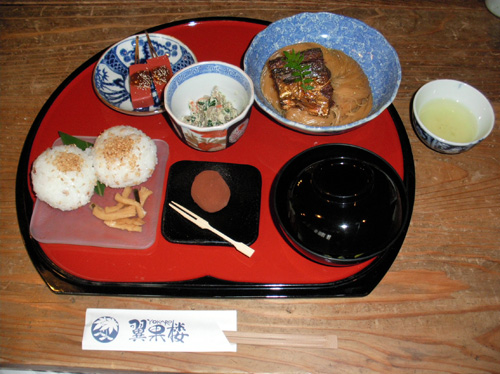
Nagahama has good food specialties, too: red konyaku, biwa masu (trout) fresh form the lake, saba somen, and chocolate-filled mochi all of which were quite delicious. They also have a local brewery that makes some very respectable beers including a golden ale that tasted faintly of teaberry.
Saturday night was a confluence of festivals (yukata, eco, & beer) and people were out having fun. We learned how to tie some new furoshiki wraps, watched awesomely costumed dance teams going through their paces in the street, met three young American men doing a summer program at the bunraku puppet school just outside town, and ran into a bunch of long-time Kyoto gaijin who were biking around Biwako. Drank with them at the beer festival before tottering our way back to the hotel.
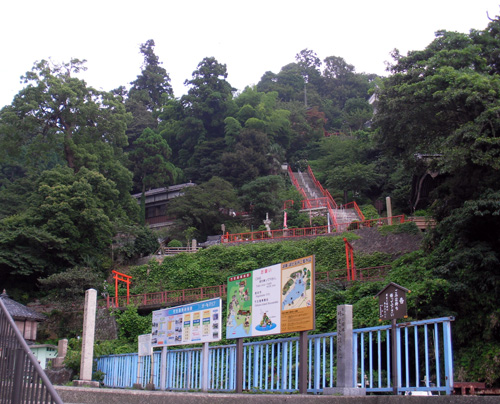
Sunday morning we took the ferry over to Chikubushima to climb the stairs to the top of the temple complex. I had my hoop with me, but there wasn't any room at the temple to use it. When we got back down to the pier, I hooped for half an hour while we waited for the ferry. I got a lot of strange looks and eventually convinced some people to share the fun - members of the band I'd danced to at the festival the night before.
It really was a refreshing weekend away. When we left Nagahama on Monday morning, it felt like we'd been gone a lot longer than two days. What a treat.
Rainy season officially ended yesterday, as the summer high pressure systems moved in 6 days earlier than average. This year tsuyu lasted from 6/10 - 7/13 and we received 233.5mm of rain in Tokyo, about 16 mm more than average. Many places had less rain than average which is bad news for rice farmers who rely on the rain for their crops.
So now we begin true summer and the thermometer is already ridiculous. It was 33 yesterday...
If you lose your mobile phone in Japan, it is quite possible that someone will find it and turn it in to the police who run a very friendly lost and found system.
But what if you've lost your phone while commuting 30km on a bicycle? This happened to one of Tod's coworkers last week. First he called the police box nearest his home. They didn't have it but they helped him compile a list of all the koban along his route so he could call each one. But after a few fruitless inquiries, he discovered that the police take the SIM card out of the phone, get its number, and report the lost phone to the mobile phone carrier.
So when you lose your phone, call your carrier. If the phone was turned in, they can tell you which police box you need to contact to get it back. What a handy thing to know.
Tod's colleague's phone had been found near the office in Marunouchi but was turned in at a police box in Kiba, a suburb nowhere near the office or his home. He never would have been reunited with it just by calling around to the koban on his route.
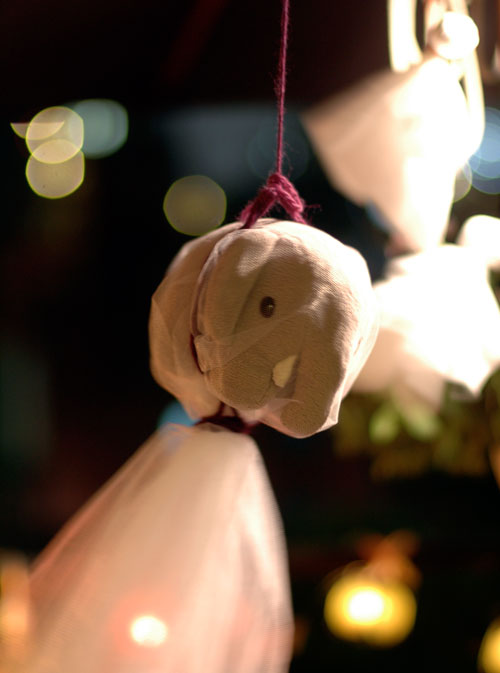
Tomorrow is Tracey & Ashley's wedding and the weather forecast is calling for rain. To try to ward it off, we've hung two teru teru bozu weather amulets, but Zoupi wanted to try to help, too, so tonight he is teru teru Zouzu. He's waving around in the wind, waiting for the weather to change.
So keep your fingers crossed, or better yet hang up a little ghosty friend and hope the bozu-tachi brings us good weather.
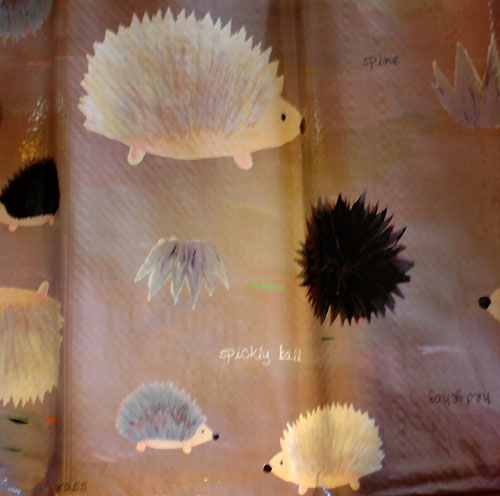
Tod came back from his long bike ride today bursting with excitement. "I brought you a present!" he proclaimed. He handed me a new "leisure sheet" printed all over with hedgehogs and words: shuffle, spine, grass, spickly ball. I am delighted to have such a cute picnic tarp.
Tobu is running an ad campaign for their Spacia train. It's a nostalgia CM - four adults revisit Nikko together after 30 years. They chat on the train, tour the sights, then take a snapshot together and the ad dissolves into a photo of them 30 years before. But wait...
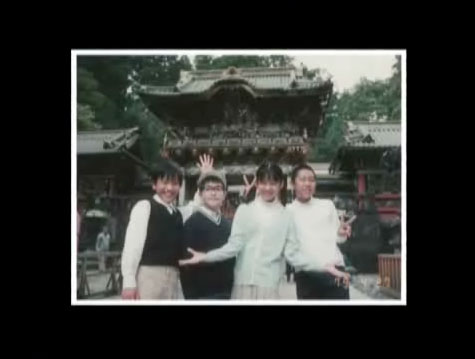
This is them* in 1979 (there's a date stamp in the lower right corner). I was 13 that year; they look to be a similar age, don't you think?
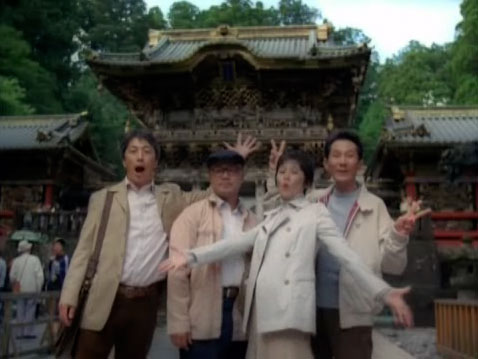
And this is them now. Did they age a lot faster than real time? They look a little older than 43 to me...
*In case you were curious, it isn't really the same people 30 years previous. Compare the photos - the tree line is exactly the same.

Kofu nestles in a basin valley near Mt. Fuji
Tod & I visited Kofu on our very first visit to Japan on a referral appointment from his eye doctor. We were such newbs back then we had a hard time directing the taxi to the hospital. Nothing much from those trips stuck with us, so we decided to give Kofu another visit.
It was a nice day trip. We had lunch at and a tour of Japan's oldest winery, Sadoya, then clambered up the local castle hill and around town for some photos.

The view of Mt. Fuji is framed by technology
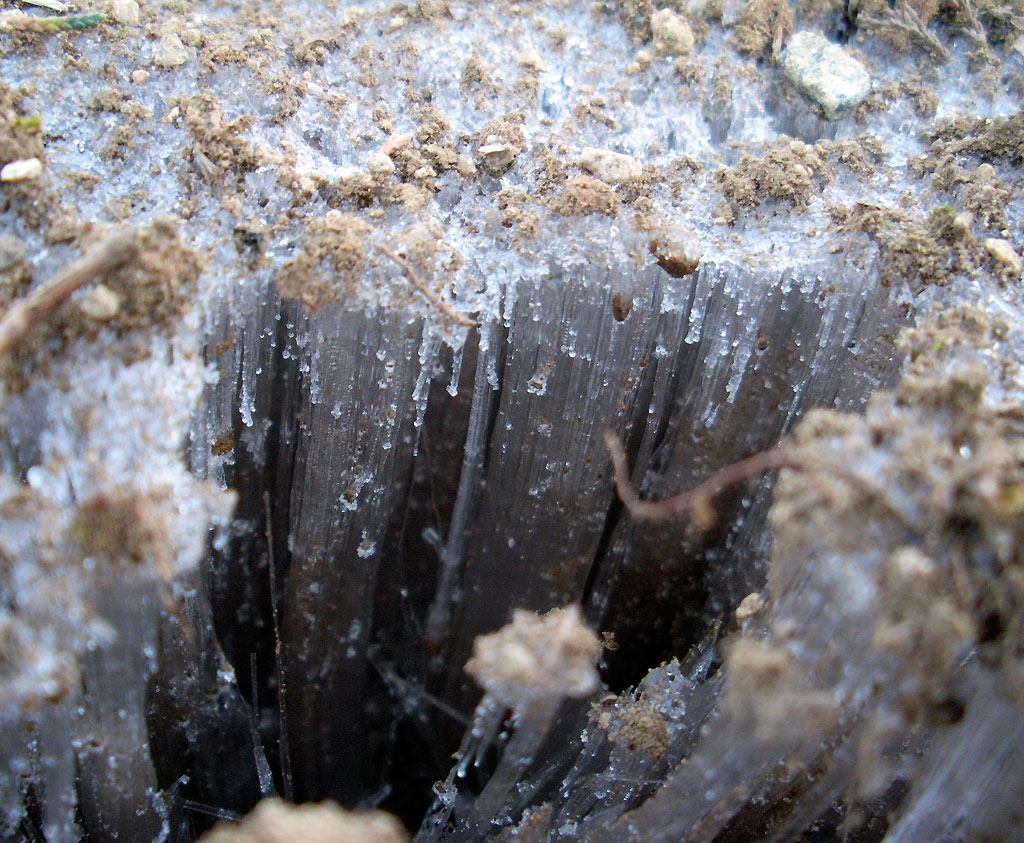
These strange ice needles rose straight out of the ground
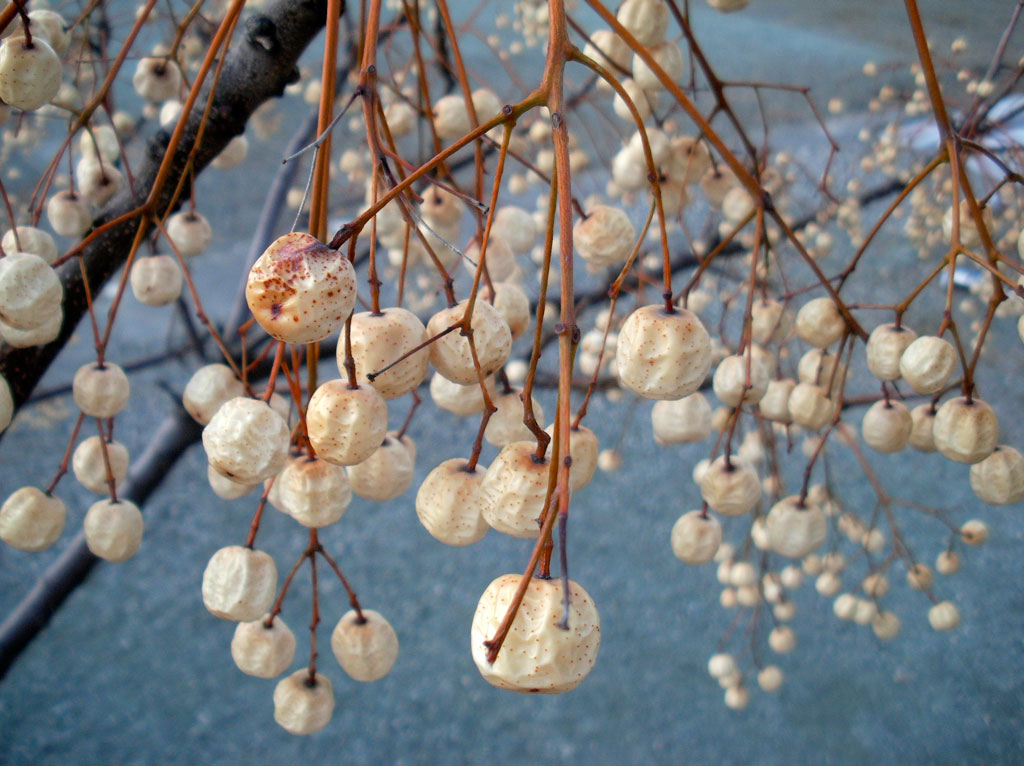
Cherry husks

sunlight in a kendo practice hall

Doesn't this look like a good place to hoop?
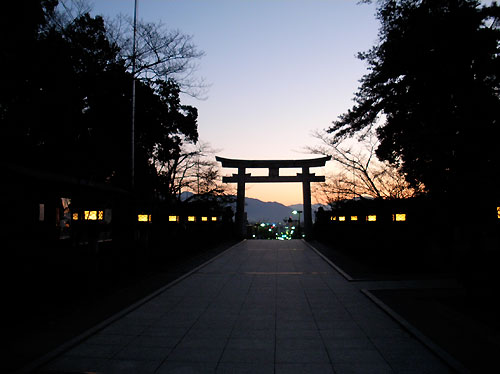
Chilly sunset view from a shrine
Late last year, Bunkyo-ku completely changed the composition of the Burnables list. We are now advised to put our plastics, rubber, styrofoam and vinyl items in with our food scraps and paper rubbish for burning. This is due to a new incinerator system that they are calling "Thermal Recycling."
So little material is now Unburnable (foil, metal lids, broken pottery, broken glass) that it feels like we aren't sorting our garbage at all. The Unburnable bin used to quickly fill with plastic bags and packaging. Now it sits there waiting for us to break a lightbulb or a plate.
Of course we recycle bottles, cans, PET and paper as well, so there is sorting to be done. But wow, does the Burnables bin fill up fast.
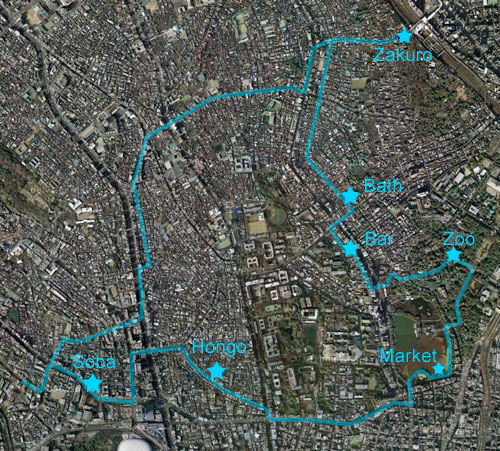
This was not a 10K run, but a day-long walk around town last weekend. It was probably even 11 km or a little more, but who is really counting?
We left the house to get lunch at a nice shop that sells hand-made soba. I was feeling a cold coming on, so I had the kake-soba - simple buckwheat noodles in a hot broth. It was just what I needed.
Then we walked through Hongo 4-chome, up a street we hadn't visited before, towards the zoo. Hongo has been part of Tokyo for a very long time and there are all sorts of historical markers and old walls and buildings to enjoy. The street we walked was part business, part residential in that lovely mix that older parts of Tokyo often have.
We wandered along the antiques market at Shinobazu Pond at Ueno. There are always lots of weird and tempting things there. Old coins, carvings, trinkets and toys of many kinds. I am not sure that we have ever bought anything, but it is great fun to browse.
At the zoo, Tod bought an annual pass, so now he can go visit the elephants any time he likes. We got to watch the elephants lying down to be brushed clean by their keepers before walking trunk-to-tail into their house for the evening. We love the elephants.
When the zoo closed at 5, we headed off, but we weren't sure exactly where we wanted to go. So we meandered the back streets until we saw a jazz bar called La Cuji. We stopped for a Guinness (only to help the cold, honestly) and ended up staying for more than an hour, enjoying some of the owner's 2500 jazz records and talking to Crazy Terry, a jazz lover sitting next to us at the bar. I asked the owner if he had Errol Garner's Concert by the Sea, one of my Dad's favorites. I hated it as a kid and hadn't heard it in a long time. I like it better as an adult, but I understood why I didn't like it when I was young. Anyway, I sat there thinking about Dad and the music until I cried.
After La Cuji, we traipsed tipsily toward dinner, but found ourselves outside Asahi no Yu, a beautiful old public sento. So we had a bath - an extremely hot bath - to ward off the incipient illness we both dreaded. My lungs were happily warmed and Tod chatted with the attendant on duty who told us all about the ghost stories associated with the bath. Spooky Halloween stuff.
We arrived at our dinner destination just in time for the dance show. Zakuro is a Persian restaurant with no tables or chairs, just carpets everywhere and some boards on the floor. The Uzbekistani dance performance was highly entertaining, with everyone dragged in by the maitre'd to dance in the middle of the room. After the dancing, we were brought a stunning array of vegetarian dishes. It was more than we could eat, though we did our best. I had forgotten the delights of Zakuro; we will have to go back soon.
Eventually we rolled ourselves away from the feast and walked the final leg of the day, passing by two of our old houses and many happy memories of places we used to live. It was a very good 10K (plus a bit), but we did end up spending the next two days sick and sleeping. The soba, Guinness, and bathing didn't do the trick.
On Halloween, Jim & I went for a spooky walk around Taito-ku to visit some of the grim old landmarks he has been researching lately. He took me to see Jokanji, the Throw-Away Temple that he wrote an essay about earlier this week. It has a beautiful cemetery full of memorials and markers that note a sordid past. We paid our respects to the 25,000 prostitutes whose bodies were left anonymously at the temple over the years.
They had been carried there across the rice paddies from Yoshiwara, the "licensed pleasure quarters" where so many young women lived out their lives in debt. A few became classy courtesans with rich patrons who looked after them, but most did not. Many died in natural disasters when earthquakes toppled shoddy buildings and fire ravaged the walled precinct. Others died of natural and unnatural causes, but with no families to claim them, were dumped at the temple.
I wanted to see how the old pleasure quarter looks in modern day Tokyo, so we wound our way over there - not through rice paddies, but via the city's busy roads and sidewalks.
I was surprised to discover that the area is still a pleasure quarter. It is no longer walled and the licensing rules have changed, no doubt, but the boundaries haven't budged. There is the same square grid of streets, 400 meters on a side, exactly as it has been for hundreds of years. A winding road still leads into the district from the main road.
Most of the streets within Yoshiwara (which isn't officially called that anymore) are lined with brothels. The buildings look like love hotels: garish exteriors in the shape of castles or fantasy villas, facades of old buildings, or glittering casino lights. The difference from love hotels is in the staffing and pricing. At a love hotel, you and your partner might choose a short "rest" for 5,000 yen, or an overnight "stay." The Yoshiwara rooms ranged from 7,000 yen to 35,000 yen and include a companion for the duration of your 100 minute visit. At most entrances a man in a suit stands watching the passersby. As we walked by one brothel, the doorman/bouncer greeted a returning customer and ushered him inside. Where the doors were open, I saw head and shoulder photographs of the girls on display.
And in the hours between 3 and 4 pm, the girls themselves could be glimpsed coming into work. Some were simply dashing down from the dormitories nearby. One group of three girls wearing velour mini dressed chatted as they passed in the alley. Another woman arrived on foot, but was preceded by a burly, dark-suited bodyguard carrying her designer purse and a shopping bag. At a tight corner, we gave way to a taxi carrying a beautiful young woman with a long lovely legs (Jim's observation) and a look of bored scorn (what I noticed). There were several women chauffeured in white SUVs. I imagine these girls are the equivalent of the classy courtesans of years past.
We walked out of Yoshiwara the back way towards the local shrine (which is not Jokanji), stopping first to take in the monument to an old pond and the people who sought refuge there after the 1855 earthquake. At Yoshiwara jinja, we discovered an extraordinary poster of local history, with four maps comparing the district during different eras, plus statistics, photographs, drawings and so much information it was impossible to take it all in.
After studying the poster for a quarter hour or more, we wandered out to the street to decide where to go next. We didn't need to go anywhere because history seemed to come to us. Jim has a Hiroshige woodblock titled Yoshiwara (from one of his many "53 Tokaido stations" series) stored in his iPod and comparing it to the street we were standing on - could it be the same place? The curve in the road certainly looks right. We were excited. But I wonder now...was this Yoshiwara a station on the Tokaido road between Tokyo and Kyoto? If so, lucky travelers (I guess).
After a rather dull autumn, winter is here.
You might not think so, since the leaves are still mostly on the trees and the daytime highs peak around 20 (68F), but there is a certain chill in the air now that wasn't present last week. Yesterday I got out of bed and my feet quickly became icy as I sat barefoot at my desk. But more telling of the change of season: all the moisture is gone from the air. From now til May, I won't go without hand cream, hair oil, and lip balm.
Definitely time to change the wardrobe to winter sweaters and warmer things. I want to knit again!
After a very busy week at work, we took a getaway weekend to Kotohira in Shikoku to celebrate our anniversary a little bit late. It was a total joy to be out of Tokyo and in beautiful, rural Japan.
This was our second time to pay our respects at Kompira-gu. We last visited in August 1999, well before we could converse with people. Being able to chat made the trip much more enjoyable.
Hooping at Kompira Temple
I took my hula hoop with me (of course) and hooped at the temple at the top of the mountain (1368 steps up!) The hoop initiated a lot of conversations, especially with elderly shopkeepers who all wanted a demonstration and with younger citizens and pilgrims who all had a try. The hoop spreads its love anytime it comes out to play.
After coming back down the mountain, we went to Nakano Udon Gakko to learn to make my favorite thick, chewy, wheat noodles. We learned two clever techniques and documented them.
Kneading Udon Dough
Rolling and Cutting Udon
We stayed at a lovely hotel with nice baths (to soak our aching legs after all those stairs), an evening enka show/bingo game, and a chef who had no trouble accommodating my vegetarian diet. For two days we feasted on seasonal vegetables in every form imaginable: tempura, salads, pickles, soup, grilled, fried, and simmered. He even made vegetable sushi for us. Vegetarians traveling in Shikoku, I recommend booking a room at Kotosankaku. I am sure it is equally great for omnivores. :-)
If you want to see a very long, unedited view from our train crossing over the Seto Inland see, I made a video of the Seto Ohashi Crossing.
Bandai has been developing bath products based on popular snacks for a few years now - bath salts in the shape and scents of Lotte gums, GariGari ice cream bars, and so on. But starting October 14th they will be selling a new one worth noting:
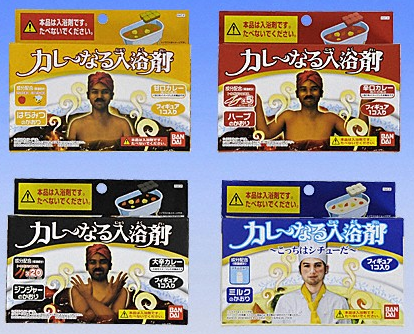
Curry flavored bath salts! Bandai claims "Even if you hate bathing now you will like it for sure with this product!"
They come in three levels of spiciness: Mild, Medium or Hot, and each contains chili pepper extract to warm your skin. The hot version is 20 times hotter than the mild one; medium clocks in at 5 times hotter than mild. Mild is enriched with honey and apples. If you prefer no chili at all in your bath, try the Cream Stew variety which is a soothing milk bath. I'm surprised they didn't make that one a lassi flavor.
If curry scented bath water weren't enticement enough, each package comes with a curry-related toy. If you collect all 12 of them, you will be able to cook and serve a tiny curry meal with miniature pots, dishes and utensils. If you are very lucky, you might win a naan shaped sponge!
All this for just 280 yen everywhere silly things are sold. Or you can get in on the fun in bulk by shopping online here: Happinet Online
Last week I participated in a mock trial held to demonstrate how lawyers work within a peer jury system. Japan will introduce "lay judges" to judicial system in May 2009.
I was one of five American mock jurors. Most of us were long-term Japan residents and none of us had ever been on a jury before. We all agreed that this felt like discharging our civic duty and took it seriously.
It was hard work! The event, with an audience of about 300 lawyers and law students, lasted 5 hours. There were two witnesses on each side and each was examined and cross examined about various letters, contracts, e-mails and internal business communications. The witnesses/actors and lawyers were prepared, but nothing was scripted. Paying attention to two eminent and persuasive trial lawyers (William Price and John Quinn from Quinn Emmanuel) both going full-on at one another while trying to keep the facts straight and the point of the lawsuit in mind was boggling.
During witness questioning, they highlighted sections of documents and enlarged them so that the rest of the page was obscured. What was the full context around the highlighted text? Sometimes the same document came up again and further detail could be gleaned with quick reading. But wow... There were a dozen key pages and I never managed to read one all the way through.
In addition soaking in details about the case, I was also meta-thinking about the trial system and the changes it will being to Japan's legal process. At the same time, I was noting how the personalities of the two lawyers affected the way I thought about their points. Mr. Price was very strict - he aggressively pushed semantic arguments and made lots of objections. Mr. Quinn was more personable; he engaged the witnesses gently and his questions usually aimed to help the jury understand the more difficult points. They both were able to sway my mind when they spoke.
By the time the closing arguments rolled around, I had completely forgotten what the opening ones were. I had formed an opinion, though, which I verified through my scribbled notes. The judge read us our instructions, a list of "If you think A, then B must be false. If you think C, then you also must believe D, E & F are true." It was very complicated and not written down. I hope that is different in real life.
We deliberated in the open, so that the audience could hear what a jury thinks. There were actually two juries - the Americans and another panel of five Japanese jurors. We deliberated separately and although we reached exactly the same conclusion, our methods were different. The Americans each briefly stated their view, "I'd find for the plaintiff because Y", then we discussed our differences of opinion. "You say X but did you consider Y? Because X seems to be an emotional argument, rather than law." Then we voted. The Japanese jurors each gave longer more detailed (it seemed) opinions, then they voted. No discussions. But that might have been a factor of time limitations.
It was a fascinating experience. But I am very glad this was only a mock trial and not a real one.
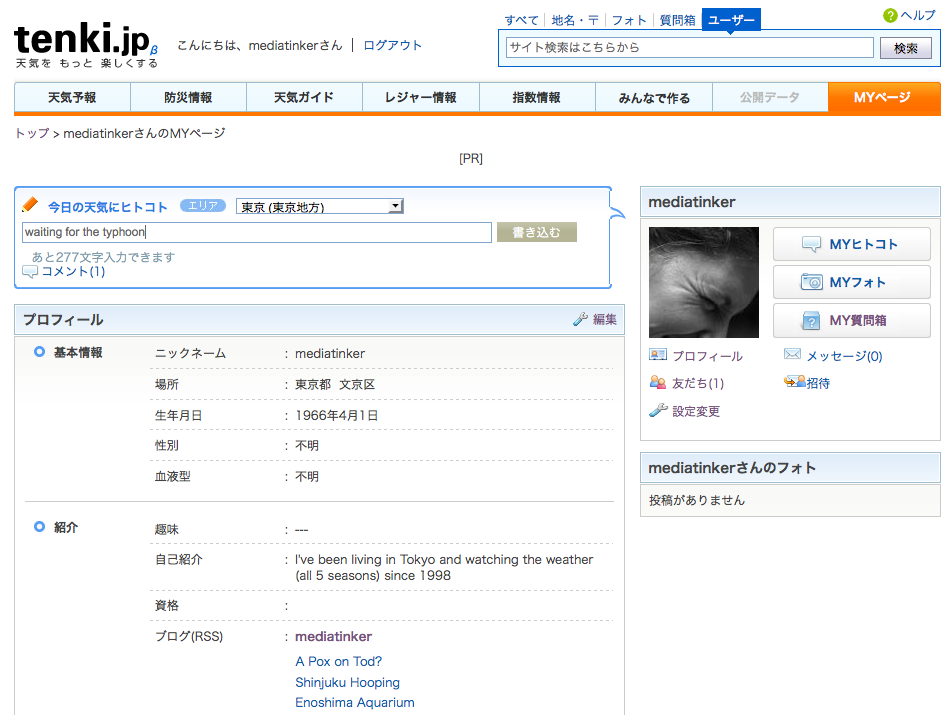
I am not quite sure why they've done this, but I am amused. The Japan Weather Association's website, tenki.jp, have included some social networking tools in their latest upgrade. You can twitter (hitokoto) about your weather, upload photos, add friends, ask questions.
Unfortunately, you can't do anything useful like set a particular area forecast as your start page or even create bookmarks to the pages you use most frequently. Maybe in the next release.
Tod was cursed two weeks ago by the god of the samurai.
Taira no Masakado was a traitorous go-getter who lived over a thousand years ago. After he was beheaded for having misstepped in politics and family life, his head was brought to the fishing village that would later become Tokyo. Masakado's spirit and his head in a wooden bucket were enshrined on a little hill overlooking Tokyo Bay. The hill is located in what is now Otemachi, the heart of Tokyo's financial district. Tod passes by on his bike almost every day.
Masakado is as powerful in death as he wanted to be in life. When his shrine is neglected or falls into disrepair, bad things seem to happen - businesses fail, natural disasters occur. Plans have been made to move him, but they are always canceled. People fear his spirit so much that the buildings around "The Hill of Masakado's Head" do not have windows opening towards it. In the surrounding offices, desks are oriented to face towards the shrine. In Tod's office the corporate services people have verified this and if you are unlucky enough to get a rare desk with your back to Masakado, they will give you a special amulet to attach to your chair to ward off any evil.
Shortly after Tod dug into this old legend, bad things began to happen to him. Someone ran into the street without looking just as Tod whizzed by on his bike. Both men went down, but only Tod was injured. It was quite dramatic as blood coursed down his arm while I patched him up at the convenience store.
He was halfway healed when he tumbled off his bike again. This second accident left him with another big scrape on his arm and a bruised imprint of the road the size of a dinner plate along his thigh.
When he mentioned these incidents to his Japanese teacher at class the next week, she was well aware of Masakado and his abilities. She urged Tod go to a temple and get himself a yakuyoke charm and an exorcism. He paid his respects at Masakado's shrine, and made a visit to our local temple for a more formal and powerful cleansing.
Since he bought his evil repellent charm and hung it on the bicycle, he's been safe. I hope that Masakado leaves him alone now and that telling this tale isn't going to get me into trouble.
MJ arranged an outing to Enoshima for Tracey's parents to meet Elliot Mason. We spent most of the day at the Aquarium, where Barbara took charge of the baby, Jim pushed the pram, Tracey figured out the show schedules, MJ shot still photos and I took a bit of video.
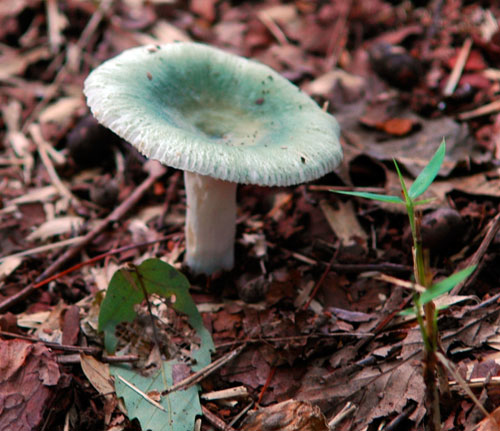
On Saturday, Tod & I went off to the edge of Tokyo to explore around one of the city reservoirs, Tamako. We wandered through a forested park and saw a surprising variety of mushrooms: the green one pictured above, a patch of bright red ones, a few shaped like snowmen, purple ones, orange ones, yellow ones, globular ones, and one as big as a dinner plate. They were delightful.
The rest of the exploration was mainly along 7km of long paved cycling route that runs around the reservoir. The lake itself is mostly drained as they shore up the dam, so that was a bit disappointing. Despite that, we observed nature on the boundary of the cycling road and the forest and had a good afternoon's walk.
News is making the rounds about the bunch of Ruby Roman grapes sold at auction for $910. Many stories quote the price, but fail to explain why they fetched that amount.
It's really nothing to do with the quality of the grapes, though I am sure they are wonderful. It is partially to do with the novelty of them - Ruby Roman grapes are a brand new variety that has been under development for the past 14 years. But mainly the selling price of the grapes goes to two factors: promotion and marketing.
The man who purchased the grapes is an upscale hotelier whose property, Kagaya in Ishakawa, charges up to $800 per person per night and is located nearby the grape growers. He paid a lot for the privilege of promoting the local product and wishing the growers luck and success, but in exchange, he made headlines and the evening news (and a few blogs, too)
$910 might be a lot for a bunch of grapes, but it is darn cheap nationwide (and international) advertising.
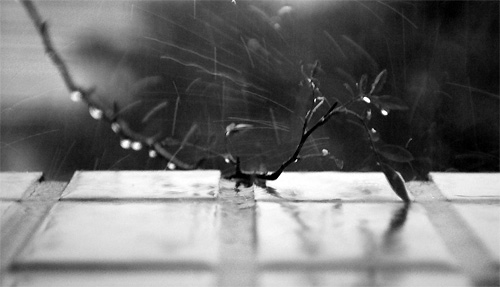
Since noon, Tokyo's received 108mm of rainfall, 73% of August's average, and experienced a series of intense thunderstorms. It feels as though the city is going to be washed away.
As the first storm began this morning, I decided to pull up a chair on the verandah and watch it. The lightning bolts behind my building reflected off the glass covered Toppan highrise across the way. Thunder echoed and rumbled and drew louder and nearer. Low yellow-grey clouds trailed scarves of rain in the middle distance. It was beautiful and awesome. Then I watched a bolt hit a lightning rod on a building nearby and scurried inside as the clouds opened up over me.
Not everyone was able to find shelter. Five sewer workers were washed down a manhole earlier today. One has turned up in the Kanda River about 3 km from where he started. I heard the rescue sirens and helicopters a few blocks from here. He didn't live. The other four are still missing.
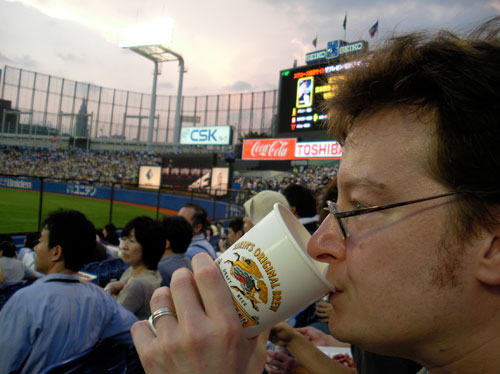
Tod settles into the game as the sun sets on Jingu Stadium.
The home team, the Tokyo Yakult Swallows, had a cheering section right behind us. They are chanting to encourage Aoki at bat, but in the end, he strikes out.
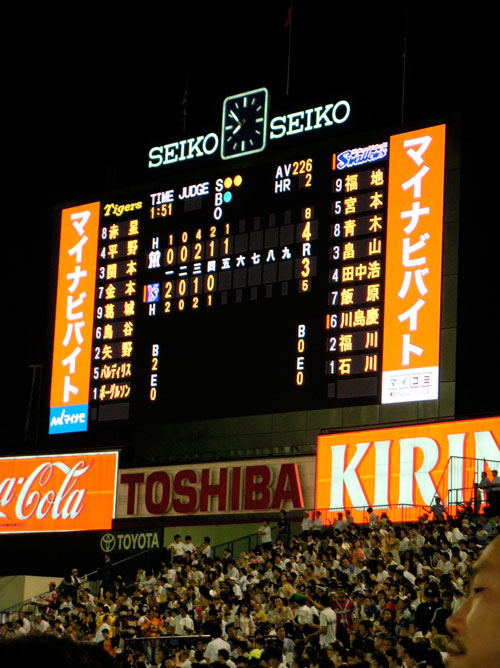
They were enthusiastic and hopeful, but in the slowly unfolding contest (here you can see that it's bottom of the 5th and almost 2 hours into the game), their team were behind most of the time. We left at 8:30 for dinner, and just missed a tremendous thunderstorm that halted the game in the 8th inning.
Before the rain started, the Hanshin Tigers' fans had a trick up their sleeve.
I stepped off the plane to a morning that felt like swimming in my own blood. The air in the city smells vaguely of chlorine like walking into the lobby of an indoor pool. I ought to enjoy it because I know it won't be long before I catch a whiff of the stinky sewers.
The heat and humidity really knocked me out after Adelaide's winter chilliness, so at lunch Tod took me out for eel to increase our summer stamina. Today is 土用丑�日 (one of two this year), considered to be the height of summer. Fatty grilled eel fends off summer blah and weight loss, though the tradition of eating it on this day started as a marketing gimmick 200 years ago.
Despite the dreadful weather, I am happy to be back in the city and at home.
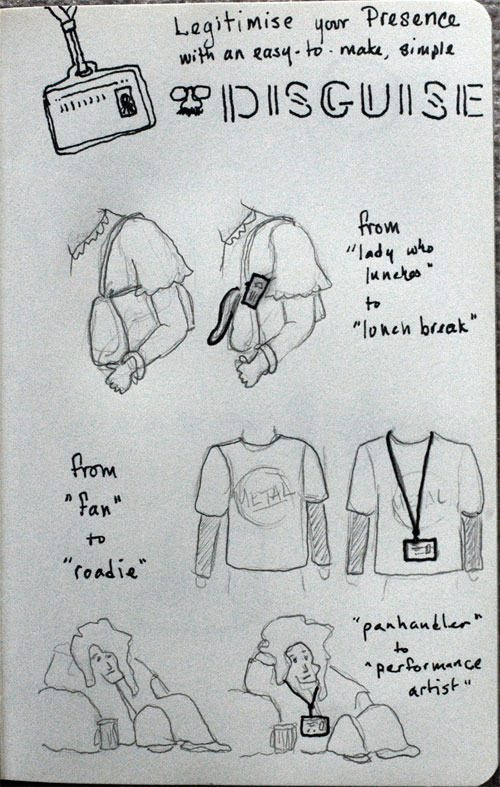
Twice a week, I walk to my Japanese lesson through busy lunchtime crowds and I've been people watching as I go. It is interesting that about 75% of the people I pass along the way are wearing ID/security badges on straps around their necks. Those cards are truly ubiquitous nowadays.
I've been playing a game with the other 25% of the people on the street. If you hung a security card around their necks, how does my perception of them change? The guy in the black jeans and funky styled hair goes from "college student" to "designer." Anyone moderately well dressed turns into an office worker if they have an ID badge.
Even unlikely prospects can become legitimate with an ID badge. The old lady with the cane tottering down the sidewalk is professor or a volunteer of some sort. The woman with the toddler is a flex-time worker on a day-care run. The multi-pierced goth chick now works at the record store.
What if as a tourist you wore a security card as a disguise? The perception of people passing you on the street would change. Not a tourist anymore, you become one of the crowd.
If you don't have an actual ID card from your current or former job, you can easily fake one. Since you aren't going to try to enter a building with it, nobody is going to look too closely, so make it neat but don't worry about being perfect. Use a computer, cut and paste, or draw the elements by hand.
1) Buy a strap and card holder. I've seen them in the 100 yen shops here; I'm sure any office supply store would have them.
2) The ID side of the card should include an image of you or someone else and a name printed underneath. It needs a company or building name and logo. It may have a decorative element like a colored stripe or a subtly patterned background. A barcode orreally long ID number is a nice touch.
3) On the back side of the card, make a fake magnetic strip. A 1/2" stripe in black pen will work fine. Add some tiny text as a disclaimer or "if found return to" section.
4) Put the card in the holder and test your new identity.
The weather was terrific today, so I walked to Ueno with my sketch box and did a bit of drawing.
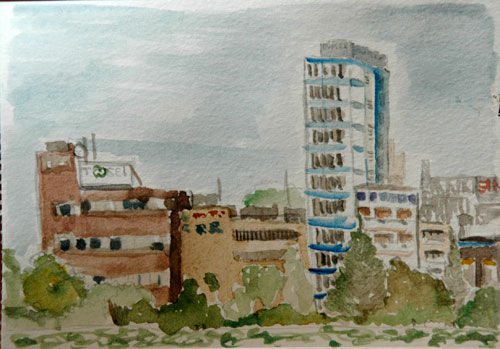
The Ueno skyline in pencil and watercolor
I am not a very good watercolorist and so I decided to take a photo to work from later. Maybe make some improvements to the piece later on at home....
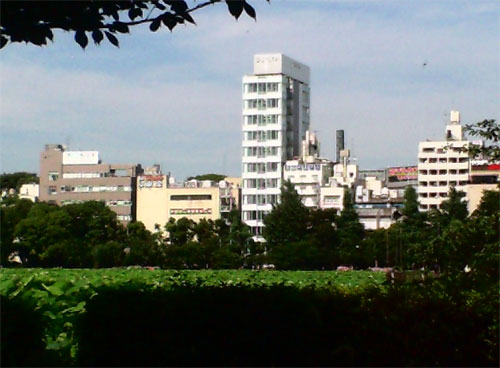
The skyline, photographed for reference
As it turns out, I did not too badly. My lines are not straight, but they never are. The perspective is off a bit, but overall, the painting is recognizable as that place.
But then I decided to play with the photo. I printed out a copy and used an oil pen to practice drawing the buildings in proper perspective and slightly straighter.
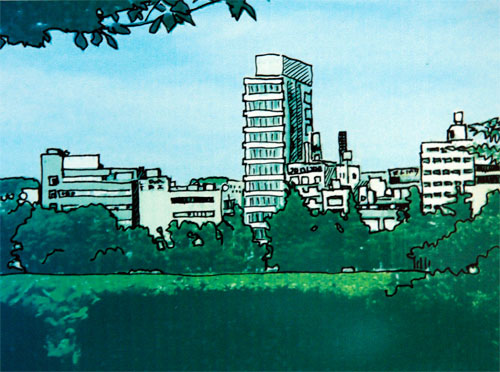
Drawing on photo
I like how the details and atmosphere of the three images differ, even though they are all the same place and time.
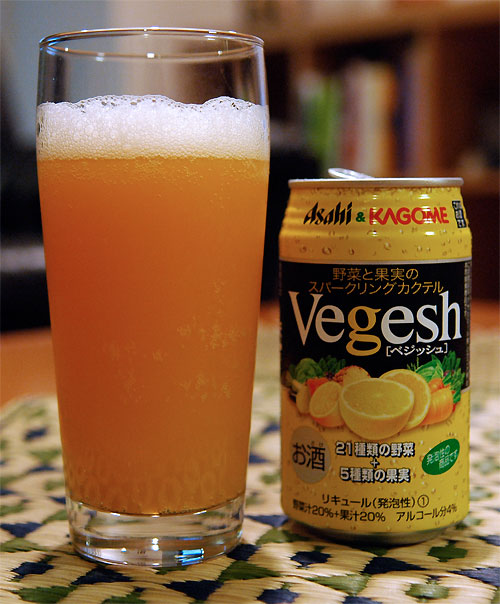
Vegesh is pronounced "veggie shu"
Meet Vegesh, a collaboration between brewer Asahi and vegetable/juice company Kagome. Yes, you guessed it, this is boozy juice. It is a "Vegetable and Fruit Sparkling Cocktail"
With 21 vegetables and 5 fruits in the juice mix, it tastes surprisingly like...juice. Juice with fizz and a kick, but almost healthy. Definitely better than the too sweet, artificially flavored chu-hi sparkling cocktails that are popular every summer.
The vegetables included are (in order from the label): carrot, spinach, asparagus, red pepper, komatsuna, cress, pumpkin, cabbage, broccoli, another kind of cabbage, beet, red shiso, celery, lettuce, chinese cabbage, kale, parsley, eggplant, onion, daikon radish, and a third sort of cabbage. The fruits are not the apple and grape juice that you might expect, but grapefruit, lemon, pineapple, banana and pear.
Overall it has a tangy-sweet grapefruit and carrot flavor, but there are touches of everything present if you taste carefully.
I bought it as a lark, but Vegesh is a lot better than I expected. I would drink it again. Unfortunately, it is way too easy to swig down like a big glass of juice, instead of the beer-strength cocktail that it is so I will have to be careful!
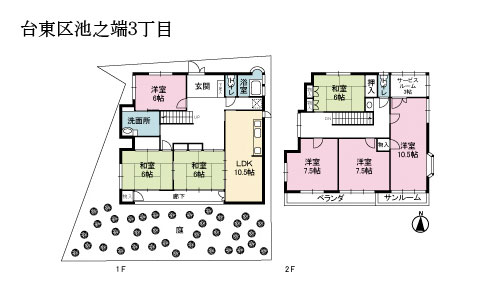
Way back during one of our many house hunting periods, we saw a lovely old Japanese house in Taito-ku near Ueno Zoo. It had tatami rooms over looking a garden, a cedar lined bath, a sun room, and a total of 7 bedrooms. It was big and drafty and I fell in love with it the moment I walked inside.
We were all set to rent it, but the owner's mother disagreed. She didn't like foreigners and didn't want her son to approve us. So we didn't get the place. It was very disappointing, but how can you argue against an old woman's prejudices? We kept looking.
Yesterday I discovered that it is on the market. All 7 bedrooms, the garden, the bath and everything for 15,680万円, or about 1.5 million US dollars. The house is around 160 sq meters (1725 sq/ft) on 172 square meters (0.04 acres) of land.
That's way over our budget, so I am destined to be disappointed once again. But seeing the floor plan flooded me with memories and for a few moments I daydreamed about living there. I could run a B&B. I could host an artist's colony. I could sit in the tatami rooms and gaze at my garden. Maybe someday, somewhere.
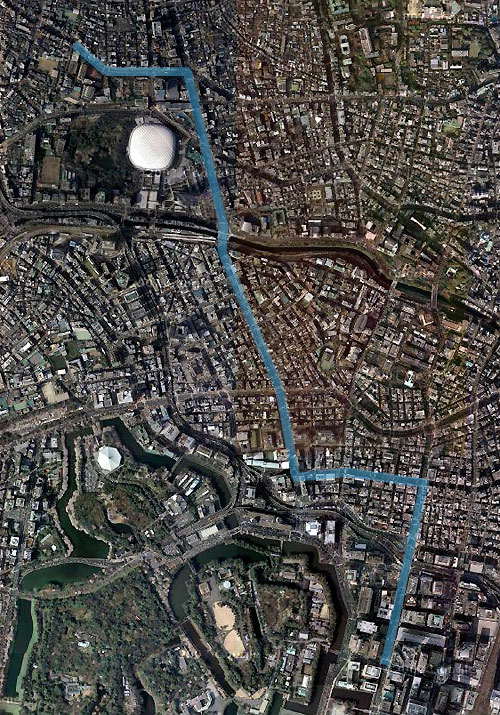
I am trying to make the most of the good weather between the rainy days in this early part of rainy season by getting out and walking. I know it will soon be more sodden and a lot hotter and I won't want to be moving around so much. So two of the last three days I have walked from home to Harajuku. It's about 90 minutes and just under 8 km.
The first 15 minutes from home to Iidabashi is a walk I make at least twice a week. It takes me though a formerly quaint neighborhood that has been ravaged by an 8 lane highway and a building project that ate an entire five blocks of housing. The building will be the tallest on in Bunkyo-ku and will block the view of Mt Fuji from the ward office. I am not a fan.
At Iidabashi, I walk along the Outer Moat down past Ichigaya Station to Yotsuya. If I walk on the canal side, with a view of the Chuo and Sobu lines across the canal, I am in Chiyoda-ku. If I walk on the building side of the street, I am in Shinjuku-ku. I prefer the tree-lined canal side as there aren't so many pedestrians so I can walk fast, and I like the shade. But sometimes it is too buggy over there and I walk on the building side of the street. I also have the option of crossing the canal and walking along a shady park path most of the way to Yotsuya. I usually don't do this unless I am with Tod.
At Yotsuya, I take the right fork towards the Akasaka Detached Palace. It is currently all covered in scaffolding and cloths, but usually the view of the palace through the black and gilt iron fence is quite regal. It's only a glimpse as I walk past and then I am on a green borderland. There is a stone wall and grassy embankment punctuated with guards posted at the palace gates, and various parks and planted buildings on the other side. The stretch of the road is a big dip so I get to walk downhill part of the way, then back uphill.
At the top of the hill, I am at the side of Jingu Gyoen. Although I'd like to be able to walk straight across the grassy park, I can't. I have to follow the road. The straightaway leading to Aoyama Itchome is lined with tall ginkgo trees. It's beautifully formal and upright.
It's quite a jolt to torn the corner onto Aoyama Dori. I'm back in the land of shopping and offices. From there, the route is new to me. The first day I walked it, I went straight down to Omotesando, then up to Harajuku. The route took me past all the insanely high-end shopping places and designer boutiques. The second time I walked this, I turned at Bell Commons and tried to thread my way through the back streets. But I didn't have a map, only a mental picture and I got lost! Not so lost that I missed my destination, but I was momentarily turned around and confused. Then I spied a streetside map and headed off in the right direction.
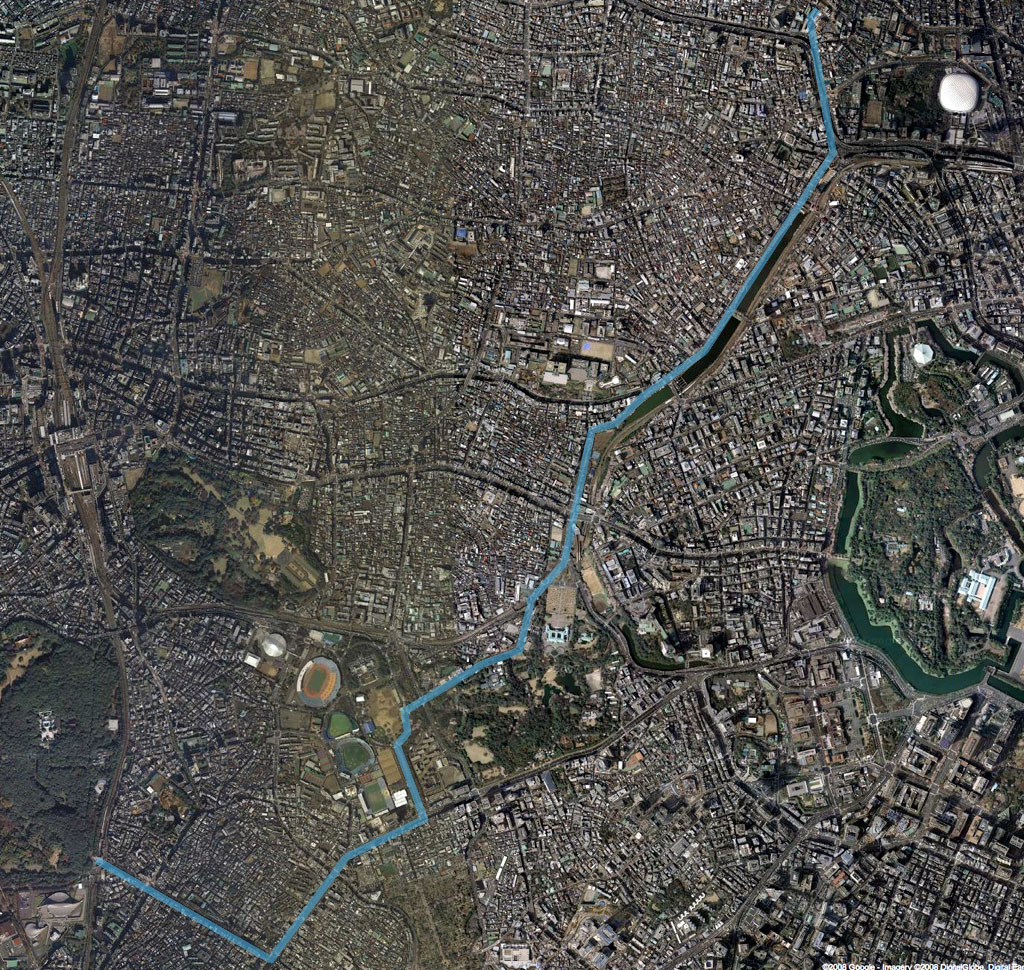
Yesterday I walked from home to Otemachi to meet Tod for lunch. I've done this many times and it is a lovely little stroll through diverse neighborhoods. Let me describe them to you.
The main street in Kasuga is Kasuga Dori, a busy four lane road. It was a pilgrim route to Kawagoe and it still leads there. Once I tried to walk there. Yesterday I turned my back on Kawagoe and headed down to Korakuen station and Tokyo Dome.
Within ten minutes of leaving my apartment, I reached a bright and cheery entertainment and shopping area. Tokyo Dome itself hosts baseball games and concerts. It is flanked by LaQua, a shopping mall with a hot spring, roller coaster, and Ferris wheel on its roof. On the other end of the Dome, Meets Port has an event hall and many restaurants. "Tokyo Dome City" is a man-made, marketed, commercial destination. I walked through it as quickly as I could.
At the end of Tokyo Dome City is the Suidobashi JR station and the more down-to-earth Jimbocho neighborhood. Jimbocho is famous for used books and sporting equipment. The buildings are a mix of low tenements and 20 year old highrises, but all of them have street front shops. It seems like about a third of them are bookstores, but there are all sorts of things to buy and great places to eat at reasonable prices, too. I like Jimbocho; it is a human-scaled place in a city that is sometimes overwhelmingly glittery or depressingly sterile.
But it doesn't take long to walk through Jimbocho and after skirting around some slow moving office ladies out for lunch, I turned east onto Kanda Keisatsu Dori. This strip is a broad street with bigger, taller buildings: a couple of schools, some minor corporate headquarters and the Kanda police station that names the street. Even though the buildings are blockier and larger than the ones in Jimbocho, the street feels sort of cozy. There are sculptures near several of the buildings and the cross streets are one-way. The street makes a good transition between Jimbocho and Otemachi.
Turning off Keisatsu Dori and crossing over the Kanda River (or is it the Nihombashi River at that point?) I reached Otemachi. This is where a lot of banking and business take place. Every building is a skyscraping office tower with a granite courtyard or a marble entranceway punctuated with a tree or two. It is modern and imposing and quite dull. I'm glad I don't work there anymore, but I am always happy to visit Tod for lunch.
Last year in mid-May, I wrote about a strange smell in the air that none of us quite agreed about. Wet dog? Smog? Sperm? Whatever it was, It's back again.
Also in the way of nature memoranda, yesterday the temperature hit 28.6 - hottest day of the year so far. Rainy season started in Okinawa and it won't be long before its here. Summer is certainly on its way. Bummer.
Because of the tainted pet food fiasco and other issues with foods imported from China last year, China has recently agreed to follow the higher food safety standards of the US in several categories including pet food, fish, low-acid canned goods, and raw materials like wheat gluten.
This makes sense, right? Imported goods should follow the safety standards of the nation they are being brought into. Americans shouldn't have to worry about eating substandard food. Or buying harmful things from other nations. Nobody should.
So why does the US keep insisting that Japan lower its standards and import American beef that isn't acceptable here? In Japan all cows, 100% of them, are tested for BSE (mad cow disease). In America, not even 1% of cows are tested. Even if you want to test all your American cows, you can't. It is illegal.
This really annoys me. How dare the US insist that exporting countries following their standards, yet also insist that importing countries abandon any stricter standards. You can't have it both ways. That is hypocritical.
Barak Obama lost any chance at my vote today when I read he told ranchers that Japan should lower its standards:
"You can't get beef into Japan and Korea, even though, obviously, we have the highest safety standards of anybody," he told a town hall meeting in Watertown, South Dakota. "They don't want to have that competition from U.S. producers."
"Highest safety standards?" Helloooooo? Test all your cows and you can export as much as you like to Japan. "Don't want competition?" No. Don't want disease. Honestly, Mr. Obama, get your facts straight here. You are wrong.
The US really makes my blood boil sometimes (lots of times). Do you know that they force Japan to buy rice it doesn't need? That's another post in itself. Maybe tomorrow.
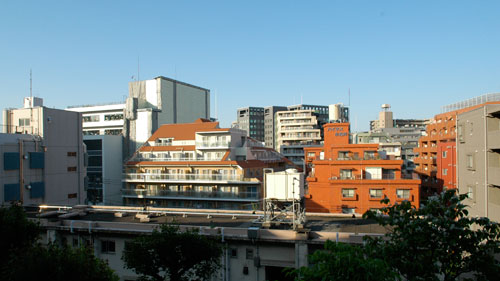
The city is so quiet this morning that I can hear wind through trees and chirping birds across the way. Everyone is still asleep. The highway is silent. The local roads are still. It even seems like the trains are rushing past less frequently.
Post-holiday exhaustion? People must be resting after their golden week blow out. I'm sure it won't be too long before everything and everyone starts moving again so I will go outside and savor these few last quiet minutes.
Tod says Niijima is a magical place and I think he is right. There were so many happy coincidences there this past week.
On the first day, Tod ran into some of his colleagues from UBS. They had sailed down from Tokyo and offered to take us sailing one day. Eight of us had a wonderful morning sail out into the ocean with Jason and Neil. They put us to work pulling lines and hoisting sheets, which was beyond fun.
On the last day, a convergence of stories brought two friends together. Our taxi driver had told Tod the day before about a guy who got off the boat mistakenly; he had no cash, his friend had the tent and all the gear and he had no idea what to do. The taxi driver gave him a room for the night. The next morning, a guy in our camp is talking to Tod about losing track of his friend on the boat. Voila! Two plus two = friends reunited.
And in between those connections we had an outing with the entire local elementary school, an arts and crafts day in my tent with drawing and jewelry-making during a rainstorm, we tried our hand at blowing glass, and experienced the usual Niijima combination of beautiful weather, great food, socialising with new friends around the camp, and friendly interactions with all the locals.
Going to Niijima is always a treat. Thanks to everyone who came along with us. Let's do it again soon.
As of the last census in October, Tokyo is home to 10% of the nation's population. 91,000 more people came to live in Tokyo during 2007. So if the trains seem more crowded, that's why.
This is the highest percentage it's been since 1979. The highest ever was 11.1% in the late 1960s.
Japan's shifting population is interesting. 37 rural prefectures lost population last year. People over 75 outnumber people under 14 in a half dozen prefectures. Deaths outnumbered births by 2,000 nationwide. What will the next census tell us?
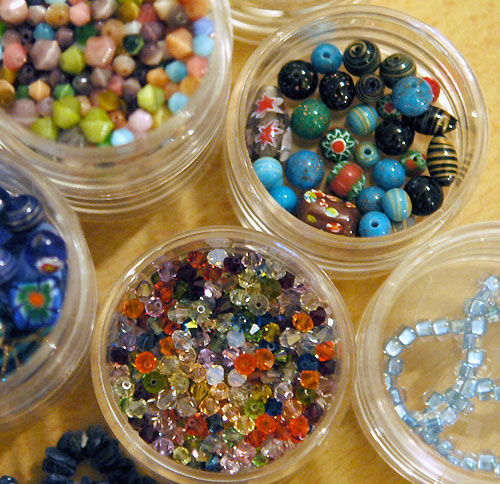
Some new members of my bead stash
If you want to buy beads in Tokyo, you must go to Asakusabashi. It's one stop east of Akihabara on the Sobu line. Where Akiba is all bright lights and electronics and men, Asakusabashi is low key shops with a decidedly feminine clientèle. There are dozens of shops, each one with a slightly different focus or catering to a different demographic: the older ladies, the kids, the fashionable hobbyists, the skilled bead masters. I encountered them all today.
Here is a shop list and map to guide you and here are highlights at the shops I visited this afternoon:
Choice specialises in stone beads. They have a very good selection at reasonable prices. There were some gemstones there I had never seen as beads before. It's all neatly arranged in row after row of racks by color.West 5 seems to be the mecca of Toho beads and findings. They had some good sale items outside the shop (lots of shops had cheap beads out front).
Craft Family Hint has a large selection of buttons and ribbon trims as well as beads. I will definitely come back here for the ribbons - everyting from velvet to leather and all sorts of fringes, lace and embroidered ribbons, too.
Beads Shop J4 has a special section of Japanese style beads and parts. They also offer a 12-class lampwork bead course. The store feels a bit like an atelier with workspaces tucked into corners and behind screens. Upstairs they have an enormous amount of acrylic beads on strings.
Accessory Hyotanya focuses on "deco" parts. They have lots of shaped pins and brooches that you can glue rhinestones to. Of course they have rhinestones and glue, too. They also sell some beads.
Parts Club has lots of parts, or as we call them in English, findings. All the shops have them, but Parts Club is nicely organised. And very large. They also have scads of beads and tools.
Kiwa got most of my business today. They had the nickel silver wire I was looking for, the nippers I needed, and a good selection of cords, too. And do I need to say they have a lot of beads? They do. And nice ones but oddly enough, I didn't buy beads there.
In four hours, I hardly scratched the surface of Asakusabashi's bead shops. I didn't even make it to Beads Factory, which is Miyuki Glass Beads's showcase. Fortunately, Asakusabashi is within walking distance of home, or a few stops on the train, so I can go any time.
Must stop posting and start beading now.
A few months back there were several news reports about ambulances in Osaka having so much trouble finding an ER to take their patients that the patients died before seeing a doctor. This week a survey by the Fire and Disaster Management Agency reported that nationwide in 2007, 24,089 ambulance patients were rejected by hospitals more than three times before being admitted somewhere. In 2006, a different agency reported only 667 such cases.
That is not good. But why is this happening and how can it be resolved?
Partly because hospitals are facing budget and staff crises and closing or cutting back their ER facilities. That seems to be a perennial, or perhaps cyclical, problem with hospitals.
Partly because hospitals rotate ER days. Not all ERs are open 24/7/365. The ambulances know the schedule and call ahead to confirm that there is a bed for the patient. If one ER is busy, or doesn't have the right kind of doctor on staff, they reject the request.
Partly because many ambulance crews are not trained in medicine. Some have training beyond basic first aid, but it is not a requirement.
So how can this problem be fixed? From my armchair vantage point, I see a few obvious things that would improve the situation right away:
- Staff paramedics and other medically trained people in the ambulances. This would give the patient timely triage and accurate reporting of the situation to the hospital.
- More hospitals on rotation in the ER schedule. This is a challenge due to budgets and staffing, but it is certainly the most immediate fix. No more ER holidays.
- Establish local "urgent care" centers for non-traumatic emergencies, like earaches and food poisoning. Right now, you have to find an off-hours clinic or go to the ER (in an ambulance). This would free up the hospitals to handle trauma and more complicated issues.
I am sure that people in power are thinking along these lines, and in Osaka earlier this year, this issue was at the heart of the gubernatorial campaign.. I just hope it gets fixed before I need to go to the hospital in a rush.
One of the charities that we raised money for at the Australia Day Gala Ball is Eco Future Fund. They do reforestation and forest maintenance projects in Japan, and also run forestation and wood-alternative projects overseas.
To help sell their mission, I created a short video that we played on the big screens on the night of the ball. I'm sure nobody actually watched it - I only caught a glimpse of it from the back of the room as I was running an errand - and that might be OK. It was a challenge to put it together in the free moments between my other work and I didn't have much material to use. But since I recruited MJ to narrate and wracked my brains to tell a positive story about how our auction earnings would be spent, thought I would put the finished piece on YouTube. Maybe someone else will see it and get involved.
Other videos from the ball are online, too, in my YouTube area
I love making little weekend trips to places in Japan. Every town has its charms and I am rarely disappointed, even when we choose at random. I wish I would remember this more often and make an effort to explore more of the country.
This weekend, I whisked Tod away for a Valentine weekend of "athletics and adventure." We went to Shuzenji, a 1200 year old onsen town in the middle of Izu. On the outskirts of the city is the Cycle Sports Center, a weird pedal-powered amusement park that also has several real biking courses. Tod had a great time; I fell off my bicycle on the 5K course. The wheeled things have it in for me. I bruised my knee and my ego, but no permanent harm was done.
I had a great time in the giant maze, though, and loved the "Interesting Bicycles" course where we tried out hand-pedaled bikes, an old fashioned big-wheel-in-front cycle, a sideways bicycle for two and a bunch of other novelties. The pedaled roller coasters and other rides were a kick, too.
We stayed at an Indonesian themed hotel called Yutorian. In addition to a lovely (but very chilly) rotenburo and the usual indoor bath, it has a mixed sex bath that is built in a natural cave. The story of the cave is an interesting one. One day in the late 80s, the owner of the hotel picked up a drill and started digging. After two years of daily drilling wit his family scoffing at him for being nuts, he broke through into the cave. He didn't know he would. I wonder what possessed him to start drilling the mountain outside his hotel?
After a dinner that featured too many scallops for my liking, Tod & I went out to look at the stars. With the advice of the hotel staff we had scoped out a really dark spot in the middle of a field near the elementary school. I wanted to give my Christmas toy, the Celestron SkyScout, its first real outing. It was freezing cold and the half moon was so bright it cast shadows, but we had a good time pointing the SkyScout at things and asking it to tell us what they were. Until my fingers were too numb to work the buttons, we also located the various planets (most of which were on the other side of the earth) and stars whose names we remembered.
Today we explored the onsen town, climbing the mountain to the ume forest-park at the top and enjoying a plum blossom festival, then descending to visit Shuzenji temple where I made my hatsumode (a little later than usual) and got a daikichi (big luck) fortune that tells me I will get ahead in the world. We stuck our feet in the legendary Dokko no Yu, climbed the tourist association's little tower, and just enjoyed wandering the village and seeing the sights.
At a shop near the train station, I scored a new teapot to replace the one we broke last year. The shopkeepers were wonderfully careful - unwrapping the brand-new pot and ringing the ceramic to make sure it was intact, then heating the rubber pour spout in hot water and adjusting the fit before running around to find a box for it. While we waited and watched the ceremony of the teapot preparations, I noticed that the couple's painted portrait hung above the door to the stockroom. Perhaps an anniversary gift... it was sweet.
All in all, we enjoyed a great weekend break from the big city.
Yesterday I went to IKEA to help buy table decorations for the Ball.
Although it's been more than a decade since I last shopped there (and that was in the US, not Japan), IKEA hasn't changed a bit. The strangely named products, the large displays in the meandering showroom leading to the easy impulse purchases of the Marketplace were as familiar as if it were 1991 and Tod & I were shopping for a kitchen table.
As Anna and I wove our way towards vases and dried foliage, I delivered a monologue to her 8 month old son. "Look how happy everyone here is. They are having the best time of their lives; forgetting their cares by buying bright shiny things made by people with worse lives than their own. Someday, you might grow up to be one of these happy people. Isn't that great?"
I made him giggle and I don't know how much Nicholas understood, but the lecture worked for me; I escaped with only a potted plant (for my office) and some cookies (for my lunch).
Foreign Minister Masahiko Komura is considering making Japanese ability a requirement for long-term gaijin. Of course the ministry haven't said what level of proficiency would be needed, who would be required to prove their language levels, or how and when any of this might be implemented.
With my still limited Japanese, this strikes a certain amount of terror in my heart.
But like all of Japan's rules and regulations, it will be approached with a certain amount of flexibility and "spirit of the law" that will be in the hands of each bureaucrat. So �ん�り��ょ��
Japan has a shocking amount of the world's precious and rare metals tied up in electronics, appliances and other consumer goods. Tokyo is an "urban mine."
A study by Komei Harada at the National Institute for Materials Science has uncovered that Japan has more gold than South Africa's reserves - 6,800 tons of gold, 16% of the world's reserves - and it's all in manufactured products that are likely to be discarded sooner or later.
It's not just gold. We have 22% of the world's natural reserves of silver, 8% of the world's copper reserves and a whopping 61% of indium, which is used for LCD displays. We've also got 5.6 million tons of lead, 38 million tons of copper and 1.2 billion tons of steel in small quantities scattered through out every household in the nation.
For example, according to an article in the Nikkei last week, "Each mobile phone handset contains 3-4 grams of copper, 0.1 gram of silver and 0.01 gram of gold, and with Japan now having 100 million cell phones in use..." Small bits here and there add up to a lot of useful materials.
How does one mine the metals after they are consumed? There are recycling programs for electronics here, but I don't know exactly what they extract. There's a 2005 report on the DTI Mission focused on electronics recycling in Japan, but it doesn't give many details.
It seems that there's a market for these metals, so it would be wasteful not to mine them. I want to do some digging and learn more..
I escaped my duties today to shop a few hours for a necklace to go with my gown for the Australia Day Gala Ball (tickets still available, but not for long!). Yuka accompanied me as my guiding star but even with her help, I am a very poor consumer.
After abandoning our first plan, we found a few options at one of the jewelry counters at Takashimaya in Shinjuku. I tried on at least six different necklaces, fell in love with one in purple and green (I *must* buy a green dress for the next event) and had good feelings about several black rhinestone pieces.
Until I turned over the price tags: 32,000 yen. 37,500 yen. 40,000 yen? This is glass. Pot metal. Plastic.
No way am I paying $400 for a piece of jewelry I'll wear only two or three times, no maker how nice it looks.
I must find the $50 -100 jewels. I know they have to be out there, somewhere.
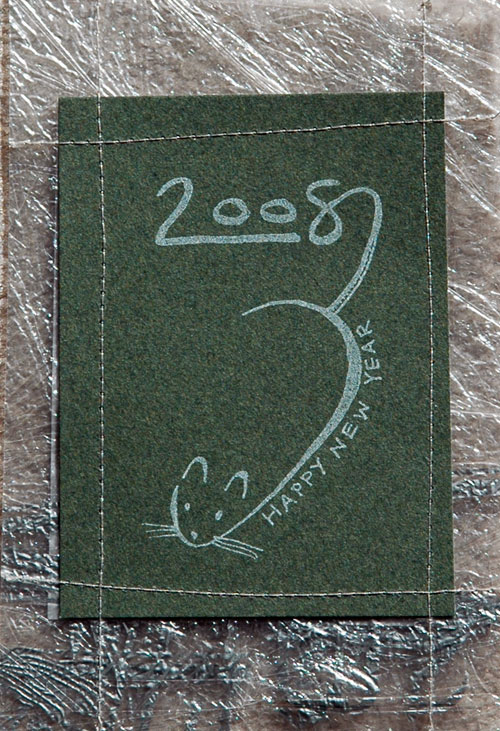
Best wishes for a prosperous and interesting year.
In Japan, Buddhists don't eat Christmas cookies, but Shintos love them. That's because they're jinja-bread.
KRISTEN DRQUFUTAI on a delivery notice from Nippon Express.
I think I shall spam people using this name:
Hello, my new friend. I am KRISTEN DRQUFUTAI, a citizen of the Republic of ZOGISTAN where my family was persecuted when my father hid 14.3% of the national debt in our attic. The total sum in gold, which I have removed from the attic upon my father's death, etc...
This morning, I had the pleasure of commuting in one of the Women Only cars that run on the Chiyoda line before 9:30 am. What a contrast to the train I'd transfered from. On the Women Only car this morning:
- Nobody was sneezing or sniffling and I heard only one muffled cough.
- Everyone in the car was awake and alert.
- The women who were speaking (quietly) near me were talking about kittens.
- No one had their newspaper or book spreading into another rider's limited space.
I think I like the Women Only car.

Imagine the ochre red of desert sand dotted with grey-green gums and lit by a starry sky. The stillness of our outback night is punctuated by the resonance of a didgeridoo and the rhythm of dance.
Add black ties, gorgeous frocks, a delicious meal and drinks, followed by energetic entertainment and a charity auction and you are part of a memorable Australia Day celebration.

Friday 25 January 2008
7 pm – late
Grand Hyatt Tokyo, Roppongi
black tie
Tickets on sale now. You'll find more details and a booking form at http://www.australiasocietytokyo.com
Interested in sponsoring the event? Please email ball-sponsorship@australiasocietytokyo.com
Today I experimented with fusing together plastic bags to form an expanse of fabric. There are plenty of tutorials around on the 'net, (see EtsyLabs or Craftster or this video on YouTube for a start) but you really have to try it yourself to discover what works. I tested out three different kinds of plastic today.
- プラPE - Polyethylene. Fusing point: 70 - 110°C. Unlike in the US, this doesn't seem to be divided into HD and LD types. It's all marked "PE" even though it is, of course high and low density plastic. Grocery bags are LDPE and should fuse at about 70- 90°C.
My High-Medium-Low iron's lowest setting must be well above 90°C because the PE started to shrink quickly almost as soon as I touched the iron to the layers of plastic and waxed paper.
Wrinkles in the fused PE indicate too much heat.
Six layers of this heavier smooth LDPE bag worked better but I still wrinkled it .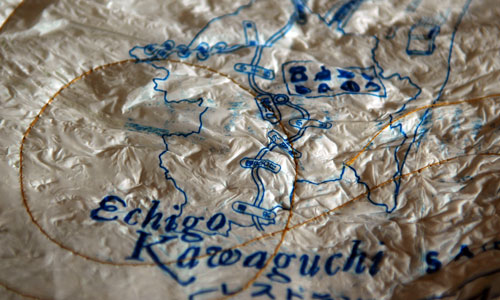
Another wrinkly PE attempt, but this time oversewn as a test swatch. - プラ1 - PET. Fusing point: 80 - 150°C. I played with the stiff PET labels from PET bottles. They shrink down to a small fraction of their size in no time and they do not fuse together. It's cute, but not very useful for making fabrics.
A former 500 ml bottle label - プラPP - Polypropylene. Fusing point: 110 - 160°C. This worked much better for me, my hot iron isn't so hot as to totally melt PP. Tod's dry cleaning bags now have a second life as translucent fabric.
The completed 4-layer fabric is too stiff to use for clothing (unless you were making something really structured) but ideal for bags and things like that.
PP fabric is smooth and easy to work with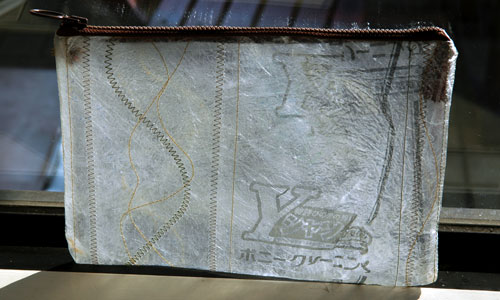
I made a PP zippered pouch with machine sewn embellishments
The rain started at about 6 pm, just on schedule with the predictions. By eight pm Typhoon #9, called Typhoon Fitow elsewhere in Asia, was dumping down and trees were whipping around, but we and the other diners at a Marunouchi restaurant didn't seem to mind - most hardly noticed. We waited a few minutes for a taxi at nine o'clock, so that we wouldn't have to walk home from the station.
I went to bed just before the eye of the storm passed over the city and I slept until about 3, when a door in the apartment slammed shut in the wind. Tod had gone outside on the verandah to watch the storm a while. He was soaking wet.
This morning the rain's falling in gusty bursts, trains are delayed and around town (but not too near us) are the expected post-storm tree falls and flooded areas, but the storm is speeding up north and the sun's due to shine this afternoon. The sky will be beautifully clear and pollution free.
One of the interesting things about Japanese lessons is learning new things about my own language. Here's somethign I learned last week.
In Japanese, each sort of sugar-based sweet treat has its own name: chocolate is �ョコ (choco) ; old fashioned hard candies are 飴 (ame); soft chewy sweets are カンディー (candy) and so on through jelly beans, caramels and gum...each one is its own thing and there's no general category into which they all fit except the very broad category of "snacks"
So I figured that "candy" as a category was an English language thing. But I am wrong. It's an American English thing. In Australia, candy is chewy gummy things just like in Japan, and each sweet stands on its own. I don't know about the Queen's English. Is there a general category for all sugar-based treats in the UK?
I'm reading Ruth Benedict's book The Chrysanthemum and the Sword for the first time. It is a study of Japanese culture written in 1946 as a way for Americans to understand their Oriental enemy. It's rather academic, but mostly on target even today. That is pretty amazing because Ms. Benedict didn't have access to Japan at that time (we were at war) but conducted interviews with Japanese Americans, read Japanese books, and watched Japanese films instead.
The book is mainly concerned with what motivates the Japanese behaviours that can seem so contradictory to Westerners. Some of the concepts she details are things I already understood to a certain extent just from having lived with them for nearly a decade. But having them well-described in writing gives me a further and fuller understanding.
For example, yesterday when we were handing out Morsbags at Alishan Market Day, many people accepted the bag and said "Sumimasen," which is a way of saying thank you, but also "I'm sorry." This may seem a little weird, but it makes sense when you understand the Japanese idea of obligations. Benedict explains it charmingly:
In English, sumimasen is translated 'Thank you,' 'I'm grateful,' or 'I'm sorry,' 'I apologize,' You use the word, for instance, in preference to all other thank-yous if anyone chases the hat you lost on a windy street. When he returns it to you politeness requires that you acknowledge your own internal discomfort in receiving. 'He is offering me an on [a favor and an obligation] and I never saw him before. I never had a chance to offer him the first on. I feel guilty about it but I feel better if I apologise to him...I tell him that I recognise that I have received on from him and it doesn't end with the act of taking back my hat. But what can I do about it? We are strangers.'
And that's what happened to us yesterday. We handed out bags to strangers and some of them felt uncomfortable accepting this favor from us. A few refused the bags but most took them. They seemed more cheerful when we didn't hand them out directly but let them choose as if they were shopping.
Some of the stall owners repaid the favor by giving us produce. Even though we wanted to give our bags no-strings-attached, it is really impossible to do so here. I certainly accepted the return gifts with happiness. We got all kinds of vegetables, some crackers and this huge cabbage!

Now I may understand why many Japanese find volunteering a strange concept. If you volunteer your time to a cause, who repays the favor to you? The world at large? The organizers? The simple cycle of obligation and one-to-one repayment is broken and that is out of step with the usual way of doing things.
Which means I may owe a debt to all the people who have volunteered for Morsbags. It's easy enough to give a fabric donor a bag and clear the debt - but how does one repay the people who volunteer their time and talent? Do fruity drinks and our post-Morsbag dinners count? Is that a payback in equal measure in a reasonable amount of time? Maybe I'd better keep reading Benedict's book and see if she has a suggestion.
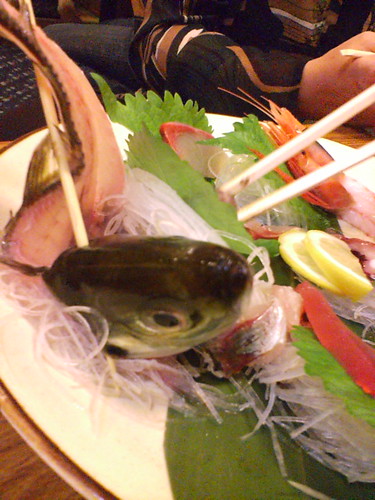
Friday night, Tracey & Tod ordered a sashimi plate at dinner. It arrived at the table and as they were admiring the choice cuts of fish, the head of the fish that decorated the plate started to gasp for air.
Ack! Horrors!!
It continued intermittently gasping and lashing its tail as well for at least 15 minutes. I was horrified and too distressed to eat my salad. Tod & Tracey were distressed, too, but it didn't stop them from enjoying the fish, which they declared very fresh and delicious.
A week ago, Tod heard the first crickets of the season down along the water near Kachidoki. Now they are singing their happy, cooling song every night in our neighborhood.
During the day the cicadas are still making a ruckus but with the temperature finally below 30, I don't think they'll be shrieking much longer.
Welcome, autumn!
You may have seen in my Flickr stream a lot of photos of Morsbags and friends who come together to make them.
Well on Saturday, we're going to start giving them away. I have a suitcase stuffed full of about 100 handmade fabric shopping bags and we're heading out to Koma, Saitama to participate in the Alishan Market Day. This is out first big bag giveaway.
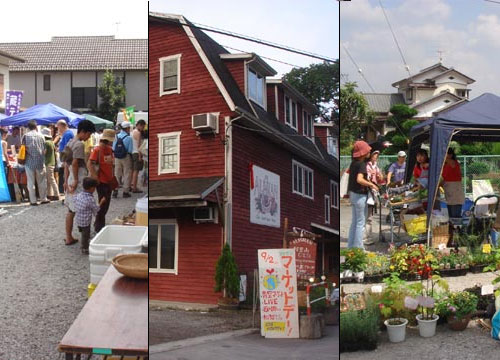
We and 30 other eco/organic/vegetarian friendly groups and shops are forming a "Blue Sky Market" with items from homemade bread, organic vegetables, fair trade goods and lots more.
There will be live music performances, workshops, local nature tours, 15% discounts at Alishan's fabulous Tengu Foods store and excellent veggie food in their cafe. Alishan's Japanese page has details, but here's a summary of the schedule in English for you:
Alishan Market Day
Saturday, September 1
10:30 - 16:30
Alishan Organic Center, Koma, Saitama (directions)
Workshops & Events
10:30 - 11:30 Make your Own Natural Toothpaste (500yen)
11:30 -13:00 Mountain Hike (free)
11:30 - 13:00 River Hike (free)
12:00 - 13:00 Handmade Ideas to Change the World (free)
12:00 - Organic Cotton Fashion Show
13:30 - 14:30 Japanese and International Eco-recipes (300 yen)
15:00 - Organic Cotton Fashion Show
15:00 - 16:00 Food Banking in Japan (free)
For more details or to reserve a space in the workshops or hikes, mail Ai Morikawa
Got back last night from a five-day camping vacation - our (nearly) annual journey to Sado, Niigata for the Kodo Earth Celebration. I brought my sketching things and while we were there, I worked on a little art swap with the theme of self-perception. The three sketches I completed are also camping-related.
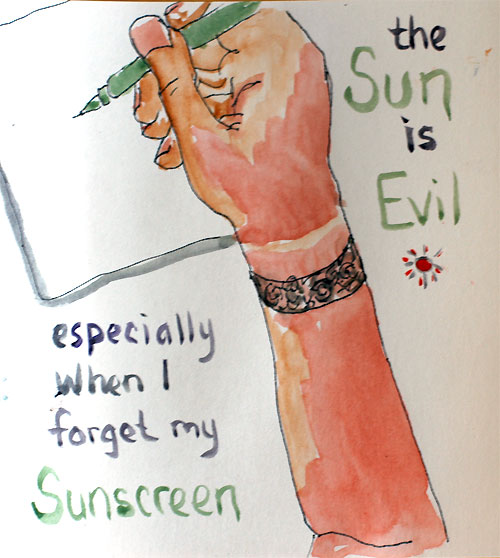
Self-perception: easily burned
We drove overnight to Sado and arrived in the early morning. I forgot to slather on sunscreen before we made camp at 10 am, and ended up with an annoying sunburn. I especially despise the little white ring where my hair band was wrapped around my wrist.
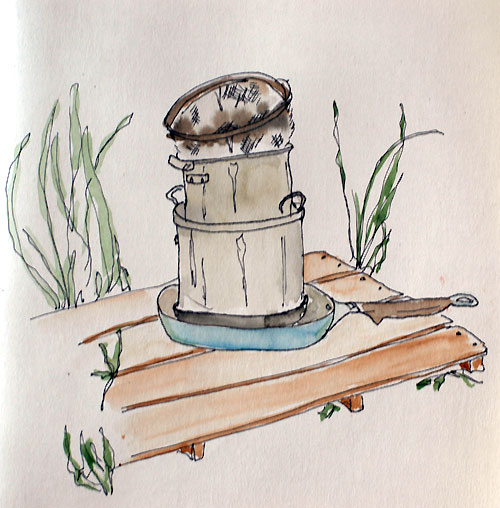
Self-perception: provider of tasty food
Our camp kitchen was excellent again this year. We cooked breakfast and lunch for as many as 11 people over the weekend. Luke brought curry for the first day and later in the trip we had lentil soup, banana pancakes, and a full English breakfast. My favorite meal was the grilled saba with vegetables that Tod & I made for lunch on Sunday. A number of us are vegetarian/veg-aquarian, so our meals were quite vegetable-laden and healthy.
Self-perception: lopsided
I hadn't drawn a self-portrait in a while, so as I waited for the coffee water to boil one morning before anyone else got up, I grabbed my little mirror and did a quick sketch. Maybe I'm not quite a lopsided as this drawing indicates, but I am not entirely symmetrical in real life. I also look tired, which I was.
Camp was fun; the music festival was great, and we are all looking forward to next year's camping extravaganza.
If I close my eyes and smile nicely, maybe summer will go away?
Poor Japan is stuck under a weather system that is bringing us lots of sunshine and high temperatures. The last few days have brought record highs (in the upper 90s) to places around the country. Tokyo's had ten days over 33C/91F with no relief in the forecast until next week.
Every morning shortly before his shift begins, our building's maintenance man takes a pair of golf clubs to the little patch of lawn below our balcony and practices his golf swings. Often I'm watering my plants while he's down there, but we have never acknowledged one another. I feel like I've peeked into his secret life beyond the building's trash cans and dust.
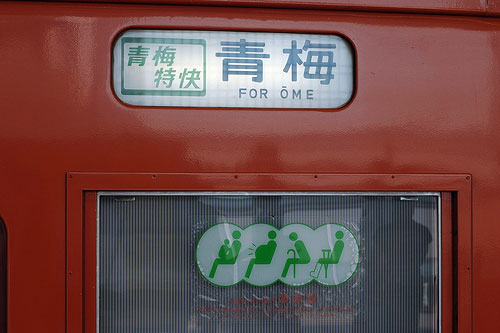
Using the invented rules I described in the previous post, we ended up a Chuo Express bound for �梅
(Ome) leaving from track 9 at 13:51. Looking at the route map, we saw we'd be getting off at Tachikawa and transferring to the Nambu line. When we got on the Nambu line train, we scanned the route map for stations with 'koen" but there were none, so looked again for a station with a "water feature" in its name. Second stop: 矢� (Yagawa). That was our destination.
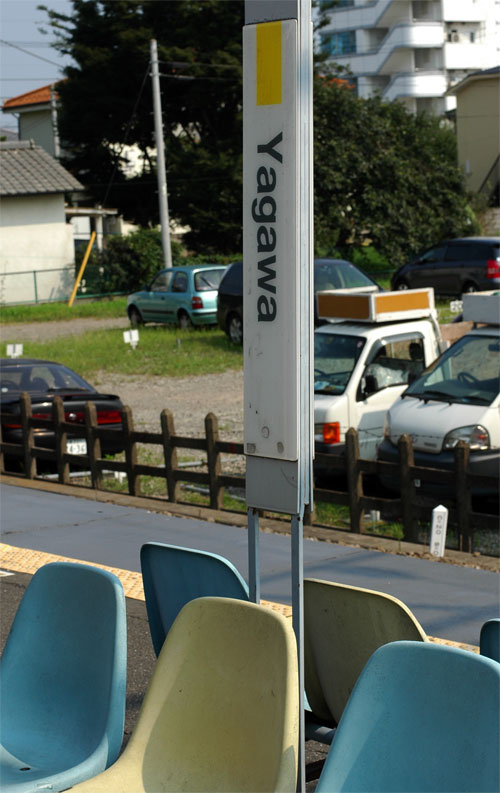
Yagawa is a suburb of a suburb of Tokyo. Like most places in Japan, though, it has its points of interest. We left the station and headed for our water feature, the Ya River, with a plan to stop at the Kunitachi Kyodo Bunka-kan and a forest park that were marked on the map at the station.
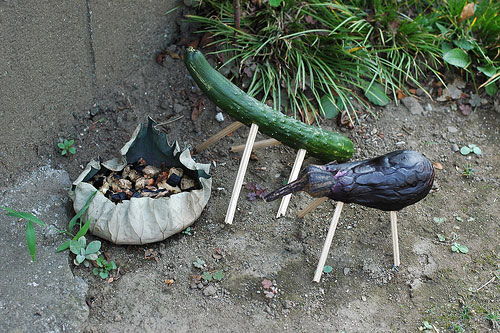
Within ten minutes we'd stepped into the country side. Fields and farmhouses lined the narrow roads. At some of the houses, we saw "veganimals" made from cucumbers, eggplants and chopsticks. I think they were part of a summer o-bon offering, but I don't know for certain.
The local museum was beautifully designed and full of local archaeological treasures and a history of the Kunitachi area. We had a great time in the library, leafing through books on flora, fauna and urban sightseeing. Libraries are always extremely entertaining.
Our next point of interest was the forest walk, which was refreshingly shady in the scorching afternoon heat. But we were soon through it an finally had our first sighting of the mighty Yagawa:
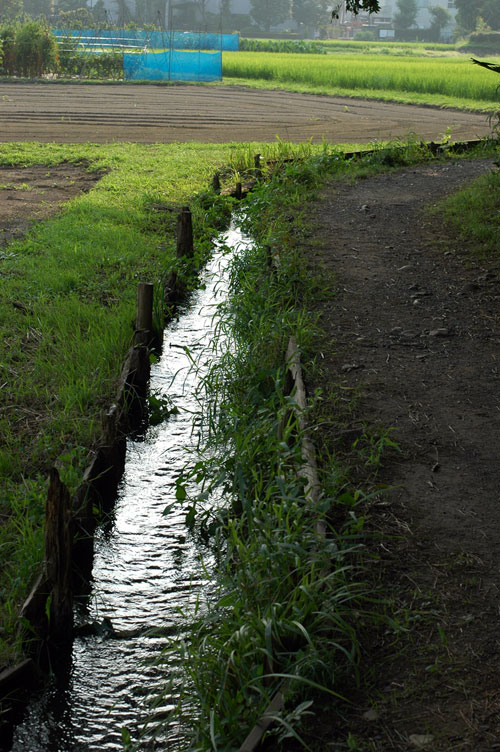
It wasn't much of a river, or even a creek. It was a stream. But I guess å·� can mean stream as well as river, so it wasn't a trick to fool visitors. We got a little lost on the way to the next station, but a helpful man set us straight and suggested we pay our respects at the Yaho Tenmangu shrine.
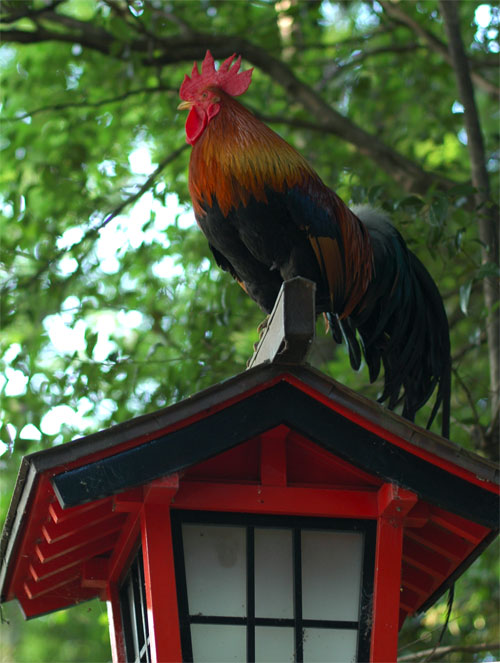
A flock of chickens greeted us very loudly as we approached the stairs. People came by to feed them while we took photos. They were perhaps my favorite part of the day - completely unexpected and so incongruous.
We walked from Yaho station up the perfectly straight Daigaku Dori to Kunitachi station, and along the way bought a steamer pot, popped into a tobacconist to inhale deeply, found fresh beets on sale, ate at an amazing restaurant (I'll tell you all about it tomorrow) and decided that Kunitachi, a college town established in the Taisho era, was a place we'd visit again.
But we'd never have come here if we hadn't traveled following our random rules.
Tod took a lot of photos.
Next time you wake up with the "I want to go somewhere today" feeling but don't have a specific place in mind, try this: make up some arbitrary rules(*) and go where they lead you. For example.
Start at the nearest major train station: Tokyo, Shinjuku, or Ikebukuro are ideal. Seed your trip by choosing some (but not all) of the following factors:
Fare (max/min)
Time to travel (max/min)
Terminal name on the train (specify a kana/kanji/letter that must be in it, or a number of kana/kanji/letters)
Destination station name
Track number (or range of numbers)
Train type (i.e. local, express)
Number of stations to travel
Number of transfers to make
Direction
Departure time
Train line/livery color
All the information must be knowable either when you start (i.e. maximum fare will be 800 yen) or as you travel (get off at the first station that starts with "ka"). You couldn't say, for example, "We'll get off the train at a station with a tudor facade," because you won't be able to see the facade until you get off the train.
We went out today starting at Tokyo station with the following conditions:
- Terminal name has be two kanji
- Track number is odd
- Express train
- Departure must be "next available"
- One transfer taken at the second possible transfer outside of the Yamanote Line
- Transfer direction must be towards the longer leg of the second line
- Destination station will be:
- station with koen (park) in the name or
- station with a water feature in the name (river, lake, beach, etc) or
- the seventh stop from the transfer station
- Travel time no more than 100 minutes
That might sound a little confusing, and there are definitely combinations of rules that work better together than others. But this worked for us today; we ended up somewhere interesting that we'd never have selected on purpose.
I'll tell you all about it tomorrow.
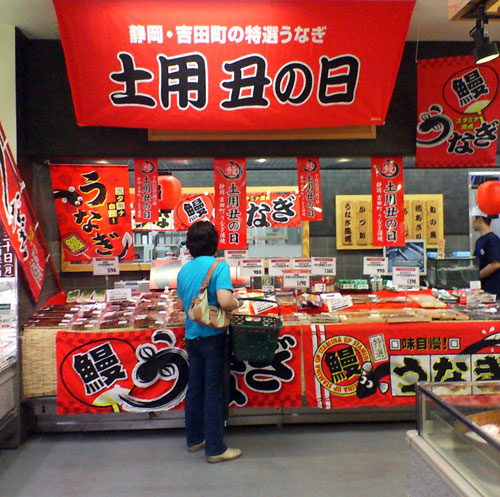
The local supermarket is ready for the evening onslaught of eel shoppers
Today is Doyo Ushi no Hi, which is the day the nation feasts on eel to increase stamina and to beat the summer blahs. Today is an unseasonably cool day but we're going to indulge in a bit of eel at dinner anyway as non-vegetarian insurance against the remainder of the summer.
If you want to know more about Doyo Ushi no Hi, my friend Elizabeth has an informative article about preparing and eating eel on her Taste of Culture site.
In April, Bunkyo-ku launched a community bus service that circuits the ward's public offices and major parks. It's a convenience for people who need to get across town to the tax office or are back-and-forthing between city hall and hospitals or taking their kids to the park. The bus runs every 20 minutes between 7 am and 8 pm and a full circuit of the ku takes 65 minutes.
I am delighted that this is how my tax money is being put to use. Not because I ride the bus, I haven't yet, but because I love the name of the service. The B in B-�る stands for Bunkyo and �る is the verb "to come" so that makes nice sense. The part that makes me grin is that B−�る is pronounced like beagle and the mascot is a a beagle wearing orange pants.
From August through October, B−�る is teaming up with local cafes to offer discounts if you show them your one day ticket. The campaign page has all the details and even tells you what stop is closest. And in another campaign, if you save up 12 one-day tickets, you can redeem them for a B−�る shopping bag or commuter pass holder.
Bunkyo-ku rocks. And rolls, too.
Summer started on Tuesday this week - rainy season ended and the temperature shot up - and I'm dreading the next three months. My plants are all wilty and so am I.
The home office was so hot this morning (32C by 11 am) that I turned on the aircon so that our server doesn't overheat and crash like it did all last summer. Now I feel trapped in the relative coolness because walking out into the rest of the house is almost oppressive. This is why I hate air conditioning.
Maybe I should just leave the server to cool alone, go out into the summer, and deal.
Although the Japanese idea of vegetarian food includes fish, there are some vegan and vegetarian friendly restaurants in Tokyo. Tod & I have been checking them out, one by one, and I'm posting my reviews so that I'll remember which is which.
Eat More Greens, Azabu Juban (Azabu Juban 2-2-5)
This may be the elusive vegetarian-restaurant-that-serves-actual-vegetables and it has outdoor dining, too! At lunchtime, the menu offers several specials including a bread, soup and salad set, and a filling rice and grains plate that is served in a huge bowl of salad. The menu notes which items contain wheat, soy and peanuts for the allergic among us. The dinner menu is more extensive with more than half vegan dishes. The desserts in the case by the register were tempting. Next time!
Nataraj, Ginza (Ginza 6-9-4)
This is the only pure vegetarian Indian restaurant in Tokyo. They note the dishes that have milk in them, offer a choice of brown rice or turmeric rice, and offer several macrobiotic choices, too. The spinach and lentil curry topped with fresh ginger was especially delicious. Tod's Nataraj curry of gluten meat and creamy red sauce was not as spicy as I expected it to be, but a treat nonetheless. At lunchtime they have a 1,000 yen buffet. There are branches in Minami Aoyama and Ogikubo, but the Ginza one is convenient for us.
Vegan Healing Cafe Shibuya (Udagawacho 6-20)
In a small storefront in the surprisingly quiet fringes of Shibuya, Vegan Healing Cafe serves up the usual beige vegan food - brown rice, bean stew, tempe sausages and falafel - a little over salted for my taste, but certainly not bad. They have excellent desserts, including a chocolate tart that would give any cream-based one a run for its money. In the review I first read of this place, the writer said "I knew I was getting close when I saw the PETA truck." Sure enough, as we were leaving after lunch, the PETA folks were coming in.
Fangsong Cafe, Akasaka (Akasaka 6-10-39)
This is Jim's favorite lunch spot, I think. They have low seating, an interesting variety of music, a dog hiding under a table and lots of lifestyle information. The lunch menu is limited to two options - a macrobiotic curry set or a vegetable plate with a variety of tidbits and delicious purple rice. Both are good and around 1100 yen. I particularly like the tempura battered soy meat on the vegetable plate.
Mother's, Jimbocho (Kanda Jimbocho 1-15-2)
Although Mother's bills itself as an organic foods restaurant, there is not a speck of meat to be seen on the buffet, though perhaps there is fish in the stock. I couldn't tell and didn't bother to ask. The all-you-can-eat buffet is 1260 yen and there are take-away options at a lower price. At Sunday lunch, they refreshed the table frequently with new items. Vegetable curry rice was my favorite, followed by a mix of fried root vegetables. All you can drink houjicha and coffee is a treat, too. Downstairs from the restaurant is an organic grocery store with a range of bento lunches, produce and the usual mix of crazy health foods and cosmetics.
Today was 海�日, the "Marine Day" holiday, so Tod & I headed down to Shonan to visit with MJ & Yoshi and enjoy the sea breezes under a cloudy post-typhoon sky. The waves were high and the beach littered with storm trash, but we sat above it all in the sand and played Catch-phrase (thanks again, Ultra Mom) and attempted badminton in the wind.
What we didn't know until later is that while we were en route, there was a huge earthquake in Niigata of the same magnitude (6.8) that destroyed so much of the area in 2004. I tried calling my friends up there, but the phone lines are congested or out of service. I'm confident they must be OK, but I will try again tomorrow until I can get through. Just like everyone else, I guess.
Today also marked the 9th anniversary of our landing in Japan. Hard to believe we were only going to be here for three months and we haven't gone home yet. Time has flown and it hardly seems like nine years could have elapsed so quickly.
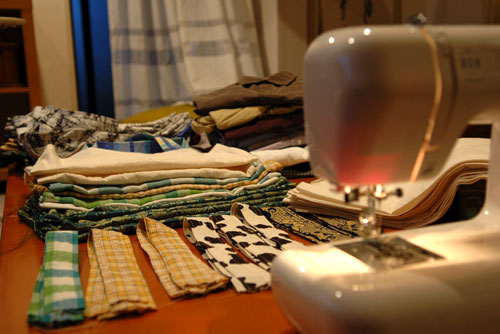
This afternoon's bagging output and future bag materials
Another TokyoBags session sees 11 completed bags for Morsbags, plus 8 pairs of handles and 10 bag bodies ready to receive them. Thanks to Blair who braved the remains of the typhoon to bring a heap of his gorgeous old shirts (and a coat!) and then manned the iron for two hours. I do rely on the kindness of strangers! Tod took care of music and snacks as usual.
Next time, we may have a special guest from London. Mark your calendar for July 29th and come over to save the world with shopping bags.
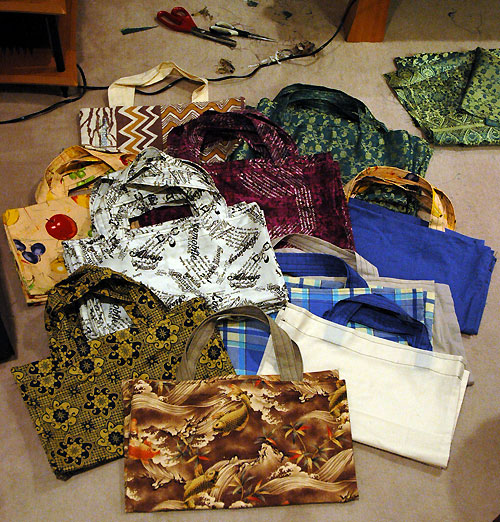
38 morsbags to date (minus the ones we've handed out to friends)
Sachiko and Tracey came over today to make morsbags. Tracey brought along three huge bags of fabric and we churned out 24 finished bags - plus a few in stages of completion that we'll work on next time. It won't be long before we have enough to start handing out to strangers. Thanks, ladies!
We used a wide range of fabrics today - a sari, some pillowcases, & cottons left over from other projects. It seems like we hardly put a dent in Tracey's fabrics, even though Sachiko took a piece home and I claimed one to make a winter skirt for work.
If you want to join in, the next session will be Sunday, July 15th from 2-6 pm. Everyone welcome, no experience required. :-)
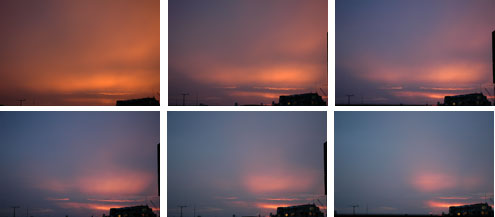
Four minute sunset
Just before 7 pm, I noticed that everything outside was glowing orange. The sun had poked through the rainclouds to give us a beautiful sunset. The sky was vivid but soon morphed into a grouping of bright spots in a shadowed blue.
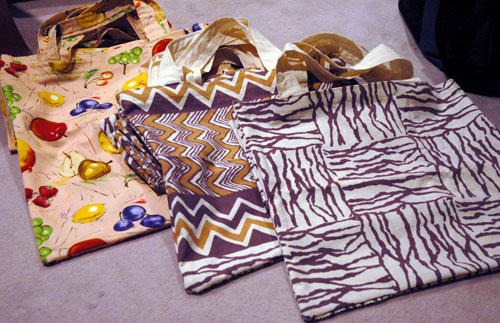
The first 14 bags!
Greg, Tod & I worked on eco-bags this afternoon and churned out 14 fruity and funky bags that we'll distribute for free in Tokyo later this summer. Thanks to Yasu for giving up his tablecloth!
The morsbags pattern is easy and ideal for doing in a production line. I'm looking forward to make more soon. You want to make some bags? Let me know when you have time and we can do it together. Or do it on your own - that's great, too!
Tod & I ventured out to Kawagoe today. Aside from my aborted attempt to walk there in 2004, I haven't been to Kawagoe since a day trip there in 1996 - the first time we came to Japan. It hasn't changed all that much but we have! Today we visited the usual tourist hotspots, but for us the real highlight turned out to be food.
Shortly after beginning our walk, we realised we were hungry. On the next utility pole, Tod spotted an ad for a soba shop called Kamakura directing us to "turn right at the next light." So we did and followed the signs another ten minutes. It was worth it. The homemade soba with was delicious.
But it was a meal short on vegetables, so when we spotted the "cucumber on a stick" stall at Kitain Temple, we stopped to share one. So simple. Very refreshing. Gave me enough energy to visit the 500 Rakan statues in the garden.
We'd walked about 200 meters out of the temple when we found a little restaurant serving organic, healthy foods. Not exactly vegetarian, but on the right track, so we got some 15-grain onigiri to take away and while we waited discovered homemade dried yuba (tofu skins) that can be used as a meat substitute. The nice lady running the place explained how to cook with it (soak it, squeeze it, dress it with shoyu, (and/or mayo) and dredge it in flour.) I love yuba nd friendly people, so we bought some.
There's a pickle shop in Kawagoe that we visited in 1996. This time, armed with nine years' more eating experience, we realised just how good it was! And we know the name is Kawamuraya. We sampled happily and bought some whole onions pickled in red wine.
Next stop: "candy alley" where there are dozens of shops selling old-fashioned sweets and crackers. We picked up some treats, including Tod's #1 irresistible food item, fancy imported salt. We had another cucumber-on-a-stick, too. This one was slightly salt pickled. It was even better than the first one.
As we wandered along Kurazukuri street, Tod spotted a shop specialising in beans. Wow, did they have lots of beans! Not only dried, raw beans, but many differently flavored prepared beans - fried wasabi beans, chickpeas soaked in sweet sauce and dusted with cocoa, freeze-dried red beans, semi-dried black beans. We tried them all and we walked away from Mame-ya with seven different kinds for home and a handful of recipes, too.
I thought we were done with food as we walked the final leg to the station. I mean, hey, we're on a diet, we're vegetarian, and what is there for us to eat? I should know better. We walked past an olive oil and wine shop. We backed up and entered the olive oil and wine shop (Tasty Globe), enjoyed a degustation and conversation with the owner, then left with two bottles of oil and two of wine!
Now we are home and I'm making dinner. I'd better get back to it - it's time to squeeze the yuba.
Recently I've jumped on board the eco-trend of using my own reusable bag when I shop. It seems like everywhere you turn, shops are selling (or giving away) lightweight fabric bags, that are foldable, rollable or otherwise containable. I have two. One in each of my purses, folded up and ready for shopping trips of all kinds. It is more comfortable to carry a fabric bag that can be slung over a shoulder than a plastic bag and ever so much better for the environment.
But I don't see so many people using them, even though they are easily available in shops, so I was excited to find a movement to recycle fabric into shopping bags and hand them out for free to friends and strangers. Here's a blurb from the website:

Let’s do something positive to reduce the hideous number of plastic bags being used - 1 million are consumed per minute globally - of which hundreds of thousands end up in the oceans.
The idea is to get together with people in your local community, drink wine and make reusable cloth bags (from old duvet covers, curtains from charity shops etc) and hand them out to the unsuspecting public for free on specified dates outside different supermarkets.
Meet new people, do something marvelous for the planet and beat other pods (groups) of baggers with your morsbag tally.
go to www.morsbags.com to be a part of a wonderful thing!
p.s. non-commercial/ non-profitable - just full of beneficial things for everyone, especially whales!
I'd like to start a "pod" of morsbag makers in Tokyo. I've got a sewing machine, an iron, and some fabric, but more people and more fabric would make the creation more fun, easier and more productive, too. Would you like to play? I'm thinking about starting this Sunday. Send me an e-mail or leave a comment.
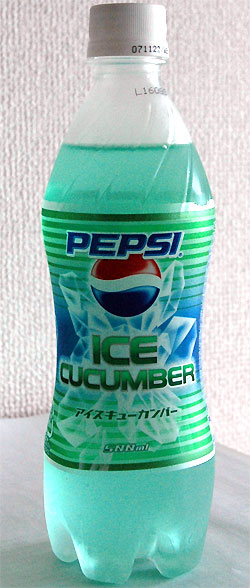 This is Pepsi's limited edition summer drink for Japan - Pepsi Ice Cucumber. It went on sale yesterday and seemed so strange that I had to buy a bottle. Tod saw it near his office and bought one, too!
We tasted tested it last night, splitting most of one 500 ml bottle among three glasses with a lot of ice. None of us finished our glasses but I think that was the shock of the sugar more than the drink itself.
Ingredients: liquid grape sugar, flavorings, acidifier, preservative (benzoic acid), caffeine, coloring (blue 1, yellow 4). Neither water nor carbonation makes the list, but Japanese labeling laws are a little different than the US ones; the product type is "carbonated beverage" and that covers the carbonated water bits.
Ice Cucmber very sweet, but probably not any sweeter than other fizzy drinks. Its color is pale mouthwash, as you can see for yourself through the clear bottle in the photo. That color sets the tone for the taste. Its flavor is a combination of light ginger ale and diluted Scope with a slightly fresh aftertaste that is reminiscent of cucumbers the same way cherry flavor reminds you of the real thing if you squint your brow and think really hard.
Pepsi Ice Cucumber is not unpleasant and it's definitely different to other fizzy drinks. I'd say that I might even buy it again, but we still have the second bottle.
Dai Cast's Design Festa 25 video is online today. Ian captured a lot of the fun of the event and interviewed several of the artists, including me. Since he edited it so well that I don't seem totally dorky, here's the direct link to the video file: http://www.tiltyhouse.com/dai-cast//Design-Festa-25.mp4
This is the Robot Nation video I showed at Design Festa this weekend. I opted out of doing sound for it (DF is so noisy that nobody could have heard it anyway) but might revisit it to add some sound effects now that it's onlnie. The Japanese version is online at YouTube, too.
During the weekend, thousands of people just passed by without pausing, but a few hundred stopped and watched it all the way through. Reactions were either expressionless viewing or laughing at the right places. A few people got to the racy scene and turned away. A handful of people (mainly men) watched it several times in a row. One young man called his girlfriend over to watch it - that pleased me.
I'm not sure if the message got across to everyone, but I hope it did to at least a few people.
Day 2 Stats
31 capsules vended
9 friends greeted: Bob & Tomoko, Sayaka and her daughters, Jim & Yuka, Tracey & Ashley (thanks for coming!)
2 interviews given
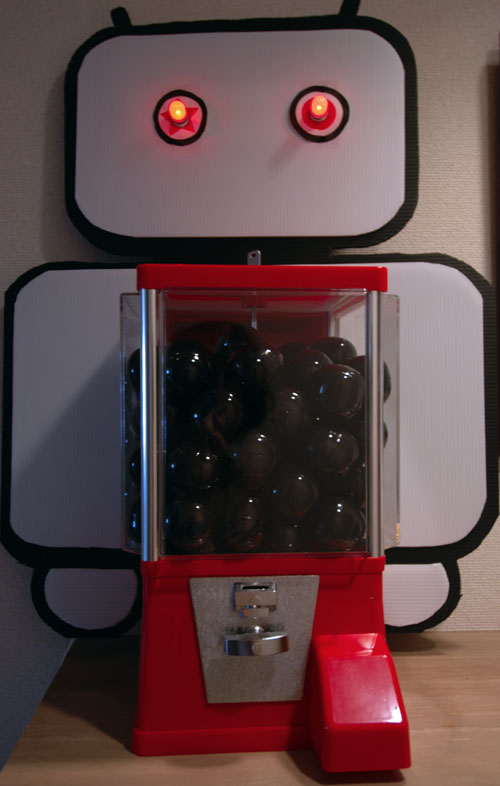
The birth-giving device is almost ready...
My exhibit for Design Festa is coming together: the birth-giving device is nearly finished; I have 211 "robot babies" ready; and the video is nearly complete. A final frantic push tomorrow and I should be all set.
The show runs this weekend, 11 am - 7 pm at Tokyo Big Site. Ill be at Booth C-202. I hope you'll stop in to say hello! There will be 2600 other booths to visit, too, so plan to enjoy the day (and do some shopping). Design Festa details are all here.
Yesterday, Tracey asked me if I thought the air smelled like wet dog. I didn't smell anything doggy and attributed her odd sense of smell to a headcold. But on Tuesday I thought the air was fresh and salty like the seaside.
At dinner last night, Jim asked if we thought the city smelled like old shoes. Tod agreed that it smelled weird; he described it as "cut grass that's been sitting around." Yuka suggested the scent reminded her of sperm. I sniffed long and hard but couldn't smell anything over our newly planted lavender and mint.
Everyone seemed to feel unusually sleepy, too.
OK, something was definitely going on with the air.
Yuka says it's from a tree, but she couldn't remember the name. There are a lot of them near the Chinese Embassy, she says, and they smell bad when they are flowering. I wonder what tree it is...anyone know?
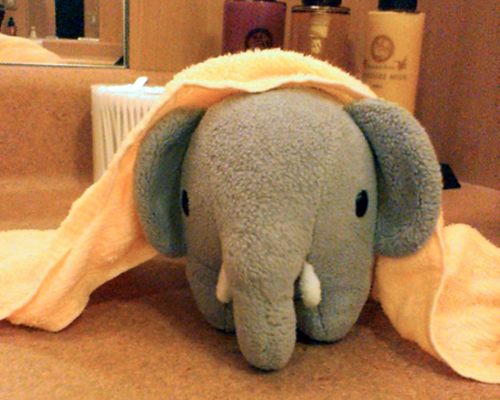
Zoupi towels off after the onsen
Yesterday, I found myself at Oedo Onsen Monogatari, a hot-springs bathing theme park at Odaiba. It opened 4 years ago and I'd never heard of it. Camilla and Liz, visiting friends, told me about it and we went together for a five hour bathing extravaganza.
We did the full round of baths twice, had a sand bath, sat and enjoyed the outdoor foot pond, wandered around the Edo-themed complex and tried the doctor fish. As great as the baths and the retro decor were, the fish were the highlight of the day.
Doctor fish nibble the dead skin off your body - in this case our feet - leaving them smooth and fresh. It feels very strange to have a horde of fish surrounding your feet and sucking on them, but it works. Once you get over the giggles (it tickles), it settles into a tingling sensation as the fish have their dinner.
In Turkey, where these hot-water dwellers come from, they are used for treating psoriasis. Here in Japan they are more cosmetic than medical. Why do they dine on your skin? The fish are starved so that they'll go for your crusty bits. Maybe it's cruel, but I appreciate the effect. I can still see the pale pink demarcation just above my ankles where the dozens stopped dining. I sort of wished they'd worked on the rest of me, too.
Oedo Onsen Monogatari does not allow persons with tattoos, but they didn't notice mine and I spotted another foreign woman with a tattoo. They didn't seem to have a problem with Zoupi or his friend Moe, either. Maybe they were feeling lenient on a weekday afternoon without too many customers. In any case, tattoo'd folks attend at your own risk.
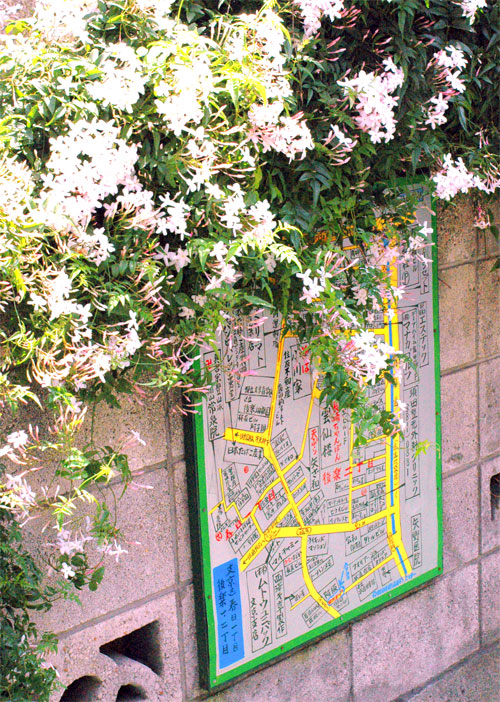
Jasmine blooming along a Shinjuku-ku street
It's a another beautiful day. Our Golden Week weather has been stunning this year and we've enjoyed so many pleasant, sunny days that I wish the summer heat and humidity would never come. It's just around the corner, but I will relish every one of these perfect days until the dog days set in.
Our day is a luxury of idleness. This afternoon's agenda: consume a bottle of sparkling wine. Tonight we'll grill a chicken and vegetables. We've been out for a walk, enjoyed lunch at St. Martin (they were out of chicken roti so I finally tried another dish from their menu), wandered around Kagurazaka a bit. I love the holidays.
In a couple of weeks, I'm exhibiting a new artwork at a huge creative arts event. I'm sure it will be lost in the crowd, but I'm enjoying putting it all together.
It's a reaction to Yanagisawa's boneheaded "women are birth-giving machines" speech in January. What if all Japanese women turned into machines and had little robot babies? This is the idea I'm exploring in a short animation and an interactive sculpture.
I was working on the animation today. It's very simple. Maybe embarrassingly simple, but I don't mind. It gets the message across. Here is a 15 second clip (currently silent) from the beginning of the program.
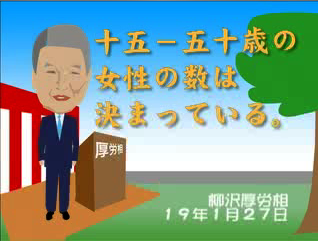
If you want to see the rest of the animation or to play with the sculpture (more on that in a future post) why not plan to come to Design Festa? Not only will I be there, but 2600 extremely talented artists and craftspeople, too! Bring your wallet, there's lots of amazing handmade stuff to buy.
Design Festa vol 25
May 26-27, 2007
Tokyo Big Site
In looking for potential new abodes, I have considered buying an apartment in a yet-to-be constructed building. Places like this put out advance notification, set up model rooms to show off their plans and generally give prospects the idea that their new building is going to be a great place to live.
A few months ago, I saw the advance notice for a building in Rokubancho, near Yotsuya and Ichigaya stations. It fit the requirements I was looking for so I put my name on the mailing list and waited for the model room to open. Yesterday we paid a visit to the Marubeni Grand Suite Rokubancho showroom.
We sat down with an agent, Sakata-san, and told him our budget and wishes. He pulled out the building plans and showed us an apartment that was not quite 50% more than the price we're willing to pay. The apartment he wanted us to consider would cost 1.25 million dollars. Too expensive but we toured the model room anyway, getting a feel for what that level of luxury would include.
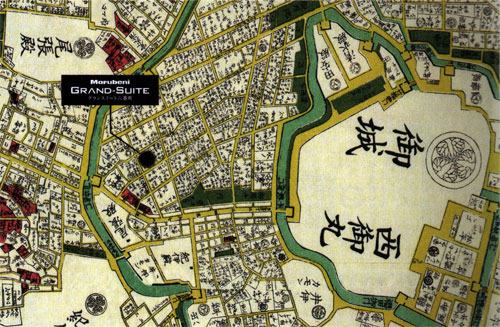
A new building on an old map
First of all, it pays for the address. This is a prestigious neighborhood a stone's throw from the Palace and within the outer moat. Next door to the new building is an elementary school the Imperial family has used. There is history all around. These are things, Sakata-san assured us, that Japanese people will pay more for. OK but what about the building itself?
Concept drawing of the exterior
It is nine stories with views towards the moat (all taken) roof balconies (all taken) and southern exposures (all taken). There is triple security into the building beginning with a key that recognises its lock and automatically parts the outer sliding doors. And of course, the building construction is earthquake resistant.
The public spaces are decorated in rich woods and marble. In addition to a lounge area, there is a concierge desk where you can arrange package deliveries, tickets and even have lightbulbs and batteries sent up to your apartment. I don't think I'd want to live in a place where people where too lazy to walk to the conbini for batteries.
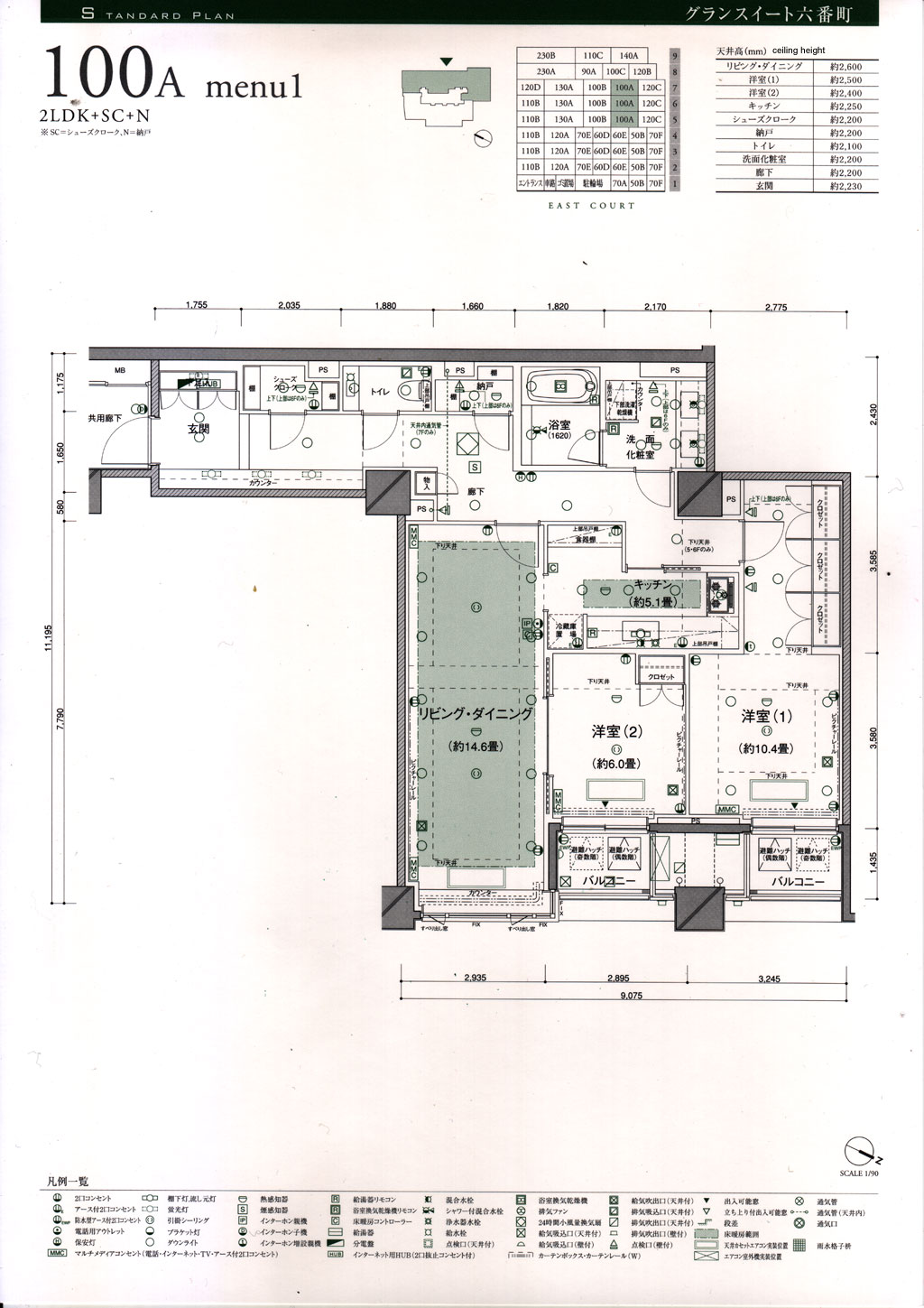
Layout 100A. Click for larger view.
This is the room layout that was suggested to us. It's about 100 sq meters (1076 sq ft) with two bedrooms, a coat closet and a storage room/pantry. It's a fair size, but the layout is awkward. Look at the toilet in relation to the bedroom: you'd have to walk through your closet to the hall and nearly to the genkan before you could pee. Imagine doing that if you're not feeling well. This is a middle apartment, so the windows are only on one side - east. Morning light only.

Detailed legend, translated. Click for larger version.
Check out the detail on the legend. It lists every outlet, light fixture, remote control. I've relabelled it all in English so you can see what level of detail you buy in a luxury apartment.
Premium and Standard versions of the medium brown colors
The apartments have many options and at a minimum level, you must choose among three color schemes (Brilliant Natural, Elegant Medium and Vintage Brown) in Standard and Premium levels. Premium has more wood; Standard uses shiny white finishes. The Premium carpets and wallpapers are a lot nicer and door handles have face plates.
Included equipment and fixtures (Premium and Standard). Click for larger version.
The fixtures differ between the Premium and Standard apartments, too. Premium apartments have beautiful faucet handles, a larger dishwasher, separate washer/dryer, and more holes in the shower head. And note that in the photos, the Standard options have a single stem of greenery, where the Premium photos show big, bushy plants. Subtle but effective upselling.

The price list mapped onto the building. Click for larger view.
And in the end, applying for an apartment doesn't guarantee you'll get one. After the first sales period deadline next month, they will hold a lottery to see who will get to buy the units that were on offer. Then the slate is wiped clean and another sales period begins for the remaining units.
On the map above, the rooms marked with prices are available to the public now (the red one is what we were recommended). The ones without prices will be sold in the next round. The grey ones are reserved for "members" during the first and second sales periods.
This is definitely not where we will be living. But I'm glad we went and saw the model room. Now we have another data point to compare. I still think we need to buy land and build a house.
Ashes & Snow is a photography and film exhibit in a temporary building at Odaiba. Gregory Colbert has a vision and he's spent years travelling the world capturing interactions between people and animals: monks and elephants; a dancer and a hawk; women and anteaters. Sounds strange? It is, but so quiet and meditatively wonderful, that I cried pretty much the entire two hours I was there.
The photographs are printed huge and hanging in space forming the walls of the corridors that lead to and from the film. They are not labelled, inviting you to actually look at them and figure them out. I took my time with them, and was rewarded with echoing patterns and little surprises hidden in reflections. Although the 60 minute film, which is related to the photographs, feels a little too contrived, it was so beautiful to watch that the moment after I started drifting off and thinking "OK, this is going to be over soon, right?' or "How did he manage to do that?" i was pulled back into the moment by a new and beautiful scene. Personally, I think he could have cut out some of the repetition of similar scenes in different locations, but really, that's a small editorial niggle.
The temporary museum structure is breathtaking, too. It's vast but clever lighting arrangements make it feel cozy. A contradiction built of cargo containers, tenting and cardboard.
In short, you must go to this one. It runs through June 24th in the parking lot near Venus Fort and Decks at Odaiba.
The Mind of Leonardo - Universal Genius at Work is showing at the Tokyo National Museum. I got a free pass from a friend who works at the museum and spent an enjoyable hour and a half exploring.
The first part of the exhibit is a single painting - the Annunciation, the first painting completed by Da Vinci after his apprenticeship. He was in his 20s. It's a lovely painting, more beautiful close up than far away, but you don't get to spend too much time with it as you and everyone else shuffle past in a slow queue. But getting up close is totally worth the line, though I was there on a day when it wasn't too busy. I suspect that on a weekend, the wait might be intolerable.
The second part of the exhibit is in another building entirely and it tries to take a holistic view of Da Vinci's thinking and philosophy. Although he studies and worked in many disciplines - motion, anatomy, painting - he didn't think of them as different things. They were all interconnected. That didn't seem like a major revelation to me, but then I dabble in different things and I know they for me they are interconnected, so why not for DaVinci, too?
I particularly enjoyed looking at some of the Codex that was on display. It reinforces my idea that you should keep notebooks and journals and record your ideas in them. His were greatly interesting and surprisingly not beautiful works of art, but working sketches and notes. They looked very little different from things I've seen in my friends' Moleskines.
The exhibit included were numerous video explanations of things - simulations of how his inventions would have worked and his ideas on anatomical geometry were quite illuminating and entertaining.
If you're interested in a well-presented multi-disciplinary exhibit, this one is for you. Runs through June 17th at the Tokyo National Museum in Ueno.

Masterpieces of the State Russian Museum from Late 18th Century to Early 20th Century (what a title!) may the the summer sleeper of museum exhibits. I went to the opening yesterday (courtesy of my friend, again!) not quite sure what to expect. I find that the Tokyo Metropolitan Art Museum generally bites - its rental galleries are often full of art club exhibitions.
But this exhibit was good. Well-documented and organised, the exhibition takes you from classical paintings in the time of Catherine II through later portraiture of "regular people" into the dark depressing times of poverty and Dostoevsky and back into the light with bold colors of the early 20th century.
There are heroic ocean storms, humorous insights into village life (Hen Party was a favorite), and heart-string tuggers of ragged beggars. If you pay attention, you get an overview not only of the changing style of art, but the changing lives of Russians during this period.
And at the end of the gallery walk, you'll find a shop that sells Russian breads made in Yokohama. Needless to say, I bought some. How can I pass up bread?
This show runs through July 8th at the Tokyo Metropolitan Art Museum, Ueno. There's a theremin concert on May 12th. Maybe I'll see you there?
Saturday began the campaign period for local elections throughout Japan. The Bunkyo-ku council elections will be held next Sunday. There are 34 seats and 45 people running according to the big poster-covered signboard down by the station.
Tod & I stopped to read all the campaign posters. They were interesting. Lots of raised fists (a symbolic "I'm trying hard" pose), many smiling faces, one guy shooting hoops and another in his karate gear. Most were vertical posters, but 5 or 6 renegades designed theirs in landscape orientation. Colors are similar to American campaign posters - strong shades of blue, yellow, red and green. One was orange. In addition to party logos, some candidates have their own personal logos, especially the 13 women running: a red tomato, a four leaf clover, a shrimp. Some candidates listed their ages: 30 years old, 25 years old. One claimed 'I have been working for my community since I was a baby."
Each and every one of the candidates seems to have a minivan fitted out with loudspeakers. They are driving around town announcing their candidates' name and asking people to vote. From where I sit, I can hear overlapping echoes of competing trucks and an occasional direct hit as one cruises up our street.
Just around the corner from us an incumbent candidate, Shiraishi Hideyuki, has taken over a derelict shop as his campaign headquarters. When I walked past at lunchtime, he was standing under his awning, looking youthfully political in a suit and a white sash with his name and campaign slogan hand lettered on it. He bowed politely to a crowd of older women huddled under umbrellas in the rain. He said something and they giggled like schoolgirls.
Shiraishi-san is a member of Shinsei Club, a political faction. Of our 34 current councilors, 9 are affiliated with Shinsei Club. I can't find out much of anything about it, except that it seems to be quite popular among city-level officials across the country.
I like the diversity of political views in our town. Bunkyo-ku currently has 6 Communist council members, 5 members of Japan's ruling party, the LDP, six Komei affiliates, three in Shimin, and two independents. You can take a peek at their pictures and profiles on the Bunkyo-ku website.
Since I can't vote, I'm going to grab my earplugs and try to get some work done. Good luck to everyone who is running.
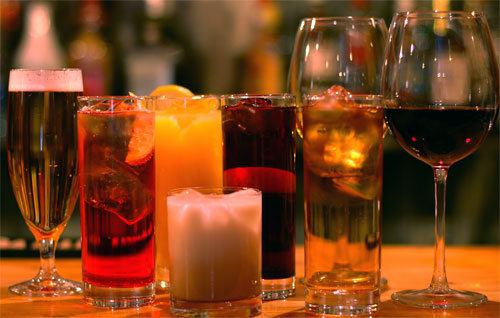
If you're staggering around Shinjuku as dawn breaks, or just awake at 6 am (or anytime until noon) and looking for an unusual place for Sunday brunch, come over to Araku in Shinjuku's Golden Gai. The local shopkeepers' association is having a flea market and some of the bars are staying open for breakfast.
Ours will be the best brunch on the block, I'm certain. Tracey, Ashley and I will be manning the bar and kitchen. Have a bloody mary and some meat pies, or a mimosa and an omelette, or go all out and cure your hangover with Vegemite on toast.
For a map and more info, visit the Araku website
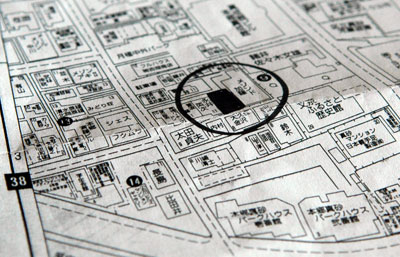
Perhaps the site of a new abode
A little more than a week ago, we saw an interesting piece of land not too far from where we live - just on the other side of the station, in fact. It's nestled into the corner of an alley in a charmingly run-down historic neighborhood. The lot is about 100 square meters in size, with an 80-year-old house atop it. It may soon be ours, because now we are in the throes of getting a mortgage and a home loan.
When you are buying property in Tokyo, there are a million things to know. Here are a few I've learned along the way:
- Roads legally must be 4 meters wide, but many of Tokyo's streets are narrower. If you buy land on a street narrower than 4 meters, you effectively donate the difference to make up your half of the 2 meters. This is called setback.
- You may only build on a certain percentage of your land. Generally this is 80% or 60% and the amount is determined by the zoning category. This rule is called kenpei ritsu.
- Another building restriction is the maximum square footage your building can be. This is determined by the width of your road and the zoning. On a wide street in a commercial district, you might be able to build 600% of the land's area. In a residential area, it's likely to be 150% - 300% depending on the road but basement rooms are excluded from the square footage total. This rule is called youseki ritsu.
- Zoning rules also include a maximum height for your building - narrow lots and residential areas have lower maximums. If your building is taller than ten meters, you must follow additional guidelines about sunlight and shadows falling on neighboring buildings.
- Some neighborhoods, where wooden building are tightly packed, require special construction precautions for fire (called bouka chiiki). According to the current laws, all buildings must be built 50 cm away from the edges of the lot. Eventually, if everyone follows this rule (and I've seen many cases where they did not), there will be at least a 1 meter gap between all buildings in the city.
- Not all property has ownership rights - some plots in Tokyo are still on an old leasing system. These places are dwindling, but there are still a few on the market. They always look like a good bargain...
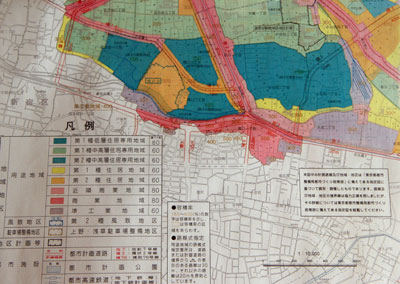
Bunkyo-ku zoning map
Gaijin-friendly Lenders
After you wade through the rules and find a property that suits your needs then, unless you are very rich or have been saving for decades, you have to get a loan.
Obtaining a mortgage in Japan is not the easiest prospect if you are a foreigner with neither permanent residency nor a Japanese spouse. If you don't meet those conditions, many banks won't even say hello. Rightly so, as there is a risk that your future visa renewals will go sour and you won't be in Japan to repay your debt. Fortunately for those of us with a desire to settle down in Japan, it's not a completely impossible prospect. There are a few institutions that will loan to non-PR foreigners.
I don't want to jinx our chances (and this purchase is hardly a done deal - we are still negotiating with the property owner) but I do want to share what I've learned about the process so far, just in case you were thinking of buying property in Tokyo. Or if I ever need to go through this again...
For a land purchase where you plan to build your own home (as in our case) you need to take out two separate loans. I don't think it's done that way in the US, but this is normal in Japan as it saves you the cost of repaying the construction loan until the building phase gets underway. But it means two loan applications and I assume two sets of loan fees, stamp tariffs and other closing costs, which are considerable.
- Shinsei Bank.
- Shinsei is known to be foreigner-friendly and they have English-speaking customer service so that puts them in my good graces. Loans to non-PR foreigners are possible, but there is scads of paperwork. After you turn in your last two years' income and tax statements, the contract for land purchase, foreign registration cards, and the application forms, the bank perform an appraisal on the land before granting the mortgage. They will knock down the loan amount or refuse outright if they find fault with the property.
- They also do a "pre-appraisal" on the planned house before the land loan is granted. This is unusual, according to our architect, who is scrambling to get us preliminary plans and a budget for the bank. For non-PR foreigners, Shinsei require a second mortgage on the property until you become a permanent resident, and you must beg a favor from a Japanese friend to accept mail for you in the event you leave Japan (and the friend has to attend the closing to make it an official favor).
- Mitsubishi UFJ.
- Acting on a clue from Danny Choo's account of purchasing property in Tokyo, I filled in a form on the UFJ website and received a huge application packet in the mail. The forms and instructions are entirely in Japanese - fine-print legal Japanese. Ouch. I will see how things go with Shinsei before I delve in there too deeply. I think there will be lots more paperwork than just this inch-thick application.
- Suruga Bank.
- They lend to anyone through their "Gaikokujin Home Loan" program. It's very nearly "no questions asked" though they require the transaction to be conducted in Japanese. However, for Suruga's minimal paperwork you pay maximal interest. Their current rate is about 4.5%, or 2 percent more than typical Japanese banks.
- New City Mortgage.
- I have not thoroughly investigated this option, but they do loan to foreigners without PR status. Interest rates are not he most favorable from what I've been told.
Let's hope all this explanation hasn't ruined our application karma, that the owner will accept our offer, that the bank will approve our loan, and that all of this will be quickly concluded so that we can move on to the fun part - designing the house.
We went out to a live performance of jazz manouche tonight. Note Noir is playing Tokyo again in April. I think we might go.
We went out looking at land and houses again last weekend. I'm growing disheartened. Everything is expensive and imperfect.
The best place we saw was 115 sq m for about $680,000. It included a house we'd have to tear down. It was accessed by a private alley (dirt!). To the south was a tall apartment building that shadowed the house for most of the day.
After returning home and slumping in defeat, I made a list of the bad points we keep seeing in all these properties. Tod & I each ranked them, then combined our scores for a final list.
Compromises To Be Accepted
- Far from station: we're not going to be able to live 5 minutes from the station; it will be more like 10-15.
- Small lot: we will do the best we can within our budget. If we have to sacrifice size to gain a point below, so be it.
- Far from friends: far is a relative term, but we might not be able to be stay within walking distance of anyone.
- Inconvenient train to work: this is most critical for Tod and means we want the Marunouchi, Chiyoda, Mita, Tozai or Hanzomon lines. Yamanote and Chuo/Sobu are also possibilities.
- Neighborhood with no amenities: If the grocery store is far away, or there's no cleaner nor a decent restaurant, then we will hate it there. I still remember feeling stranded in Himonya.
- Bad light and air: I cannot live happily in the shadow of other buildings. No sun is a no-go.
So now that we know a little better what we can tolerate and what we can't, we can continue to look for places. Maybe we search a bit further afield. There are cheaper blocks of land in Ikebukuro and Sugamo and other neighborhoods on the edge of the Yamanote line.
Or we just go buy a mansion. (That's an apartment in Japanese, not a palatial home.)
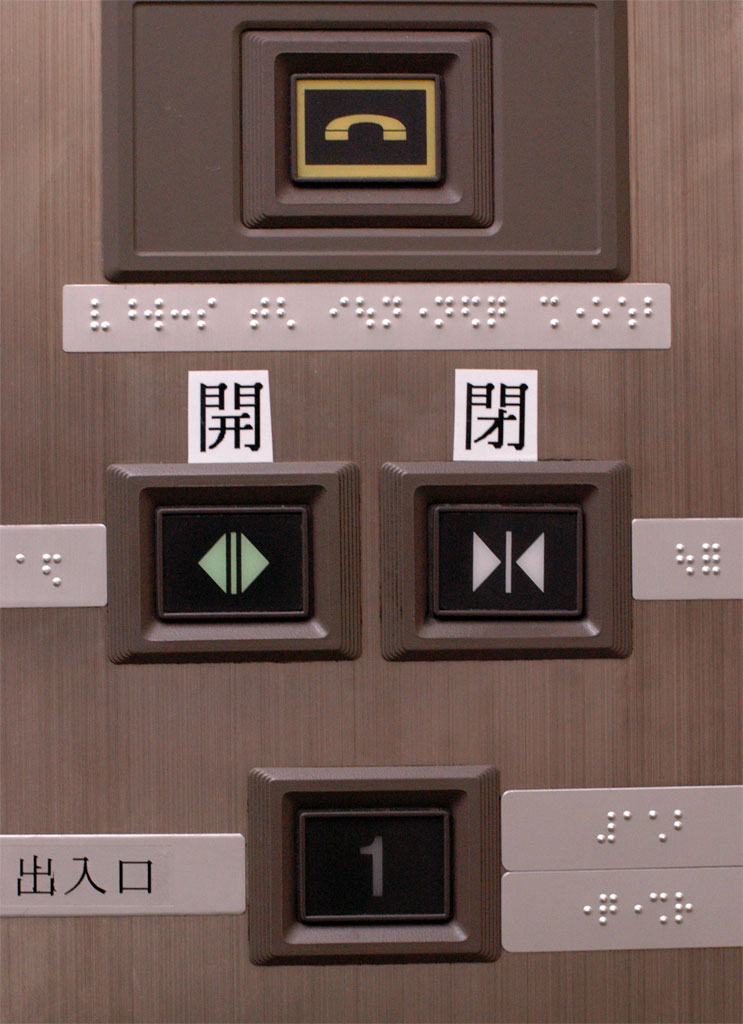
I guess the icons on the buttons aren't clear enough to indicate open & close.
In December, Tod took the Japanese Language Proficiency Test, 2nd level. The test results arrived today - we sat together on the sofa while he carefully peeled back the sheet covering the scores. He passed.
This means that he "has mastered grammar to a relatively high degree, knows around 1,000 kanji and 6,000 words, and has the ability to converse, read, and write about matters of a general nature."
�����������Congratulations, Tod! I'm proud of you.
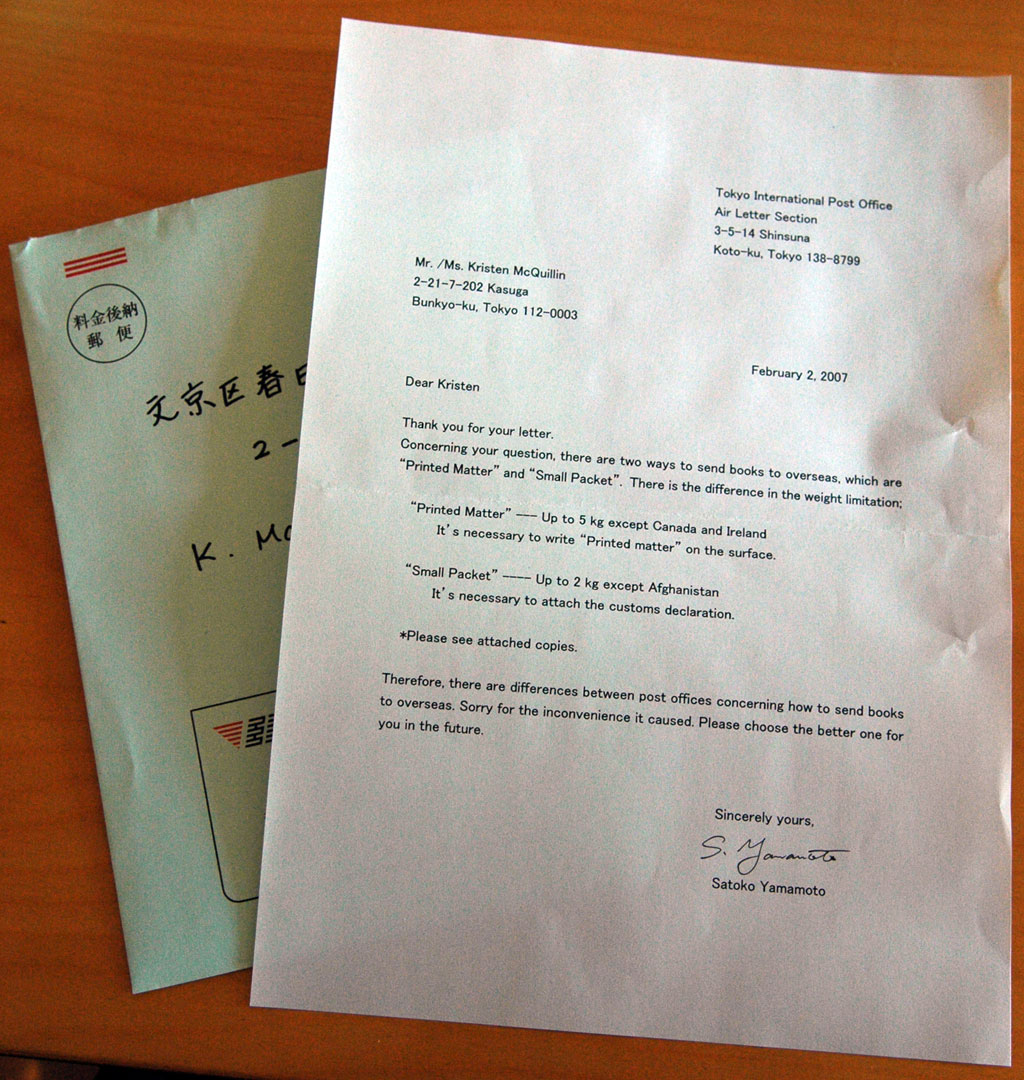
The official reply (click for a larger version)
In the previous post, I forgot one other letter I sent last week - a note to the post office headquarters. I got a reply this morning - a speedy three day turnaround. Hooray for Japan Post!
I had asked them why some post offices required me to fill out customs forms when sending books overseas, and others just stamped them with Printed Matter. I wanted to know which was the correct way.
It seems both are correct. Printed Matter can weigh up to 5kg, except for Canada and Ireland; Small Packet (which requires a customs form) is up to 2kg and valid everywhere except Afghanistan. The letter suggests I use whichever post office interprets this the way I want. So flexibly Japanese!
"The number of women aged between 15 and 50 is fixed," Japan's Health Minister, Hakuo Yanagisawa (71) said in a speech to LDP party members earlier this week. "Because the number of birth-giving machines and devices is fixed, all we can do is ask them to do their best per head … although it may not be so appropriate to call them machines."
Did Yanagisawa think he was being clever? Did he believe that calling women birth-giving machines was going to encourage them to reproduce? His government profile says he is married, but mentions no children. He ought have consulted with Mrs. Yanagisawa before giving that speech.
Prime Minister Abe chastised him and told him to "be more careful" in the future. I think someone with such a disregard for women really ought not be Minister of Health and Labor at all. Mr. Prime Minister, if you really want the birth rate to increase, chuck out Yanagisawa, and bring in someone who won't offend the birth-giving machines.
Geesh.
As if the Turning Point Exam last April wasn't enough of a clue, I got another clue today that I've graduated into Japanese middle age.
Walking home from lunch, I saw two high school students walking their bikes up the hill near my house. One laughed and opened a couple of those prize-filled globes that you buy from bubblegum machines. Then he threw the hemispheres on the sidewalk.
I was outraged. How dare he litter my neighborhood? I stood in the path of his bicycle and stopped him.
"Sumimasen ga..." I pointed at his trash and paused to conjure up the right words in Japanese.
"Eh? Excuse me?" he answered in English before I could say anything else.
"You dropped something. You should pick it up."
"Oh. Sorry." He called to his friend to wait for him as we marched over to his trash.
"This is my neighborhood. I like to keep it neat." I tossed two clear plastic tops into his bike basket as he picked up the colored bottom halves.
"I'm sorry."
"That's better." I smiled and went on my way.
I totally rained on his toy parade, but I'll bet he doesn't do that again soon. Confronted by a middle aged gaijin lady! The shame, the shame.
Our very kind realtor, Mr. Matsudate, and his kohai sidekick, Tobe-kun, picked us up this afternoon for a tour of some houses and a visit to their office to discuss future possibilities. Five hours later we rolled back home, having looked at four properties. Let me describe them to you a bit, so you can imagine what we're experiencing.
"2 Flat" was an older house on a quiet street in a high-class neighborhood. It looked like the poor relation of the adjoining houses. Each of the two stories was its own self-contained apartment. Not even in the running, except that the neighborhood is a good one.
"Mickey House," not far from an elevated highway, was obviously owned by someone with children and poor taste. The living room had a chandelier, the walls papered in English florals, the kitchen backsplash was tiled in embossed Mickey, Minnie and Donald profiles. I think we'll leave it for another happy family.
"The Nade" is an top-floor apartment just around the corner from our current place, so it is the perfect location. It has two big roof terraces, plenty of windows and a nice kitchen but too many built in cabinets in the other rooms that limit the way our furniture will fit. It feels cramped and I can't imagine living with the sofa in the exact same position for 20 years.
"Yakuza Poi" was the most interesting of the four. It has a stunning view towards Tokyo Tower and an interesting layout of 2 large bedrooms and a tatami room plus a pretty enormous LDK. Unfortunately, I think the place was a mob hangout because it has marble floors with brass trim, hotel lighting fixtures, and a urinal in the bathroom.
So we struck out today. But we'll go out again next week. There are three intriguing floor plans, including an apartment just a minute's walk from Hanzomon, a house near Yotsuya 3-chome and an apartment in Kagurazaka. Stay tuned for more details...
Our host poured it from a "Hawaii Deep Sea Water" bottle, but it was definitely not water. It was thick, milky and slightly chunky. We were drinking Japanese moonshine, illegally home-brewed sake. It packed a wallop but not from the alcohol as much as from the chili pepper used to prevent spoilage.
Looking forward to having some more of that soon. Maybe I'll make some myself...
A trip to Niseko, Hokkaido, is like visiting a foreign country. Almost every restaurant, hotel, pension, public service and service-worker caters to a horde of (mainly) Australian tourists on summer ski holidays. I got so confused, I couldn't figure out when to speak English and when to use Japanese. It was strange, but not unpleasant.
Tod and I made up the weak links of the sporting group, but we gamely tried our best on the itty-bitty "family slope." Tod had his first ever downhill skiing experience and enjoyed it. Skiing was good for both of us. Snowboarding, on the other hand, is not as easy as it looks. If you manage to hit the groove it's really fun, but most of the time I was just hitting the snow - hard. Yesterday's 2 hour lesson has me aching and bruised today.
Everyone else in our party was an expert skier or snowboarder: Tim flew in from London to ski with our mutual friend Simon, and Tracey and Ashley are naturally athletic with good balance. They were zipping down from the top of the mountain for a few days before we arrived and will stick around Niseko til the end of the week.
I made up for my lack of snow skills by cooking a lot of meals for the assembled group. I hope nobody minded that I hogged the kitchen most of the time.
My mail spam is nearly all downloaded and I'm going to drop my twinge-y tailbone into a tub of hot water for a soak before I head to bed. I hope you all had a happy new year!
Wiggly piggly new year wishes from me & Tod.
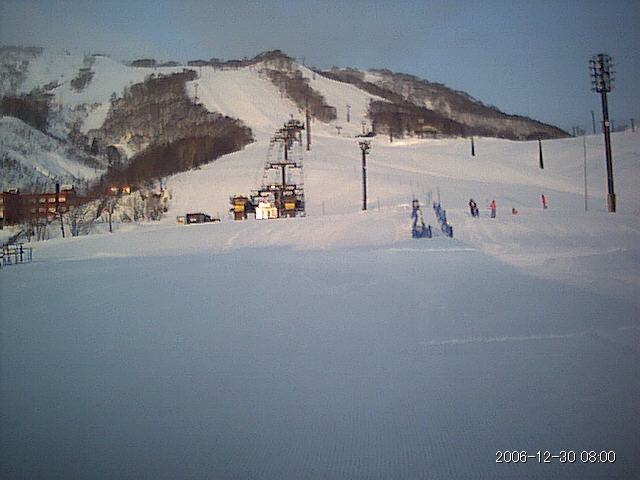
Morning at Grand Hirafu
Today we're traveling to Hokkaido for a New Year ski holiday, which is silly because neither Tod nor I ski much. Last time I hit the slopes (quite literally, several times) was 1998 and I lasted half a day. Tod's not skied in the entire eighteen years I've known him.
So this should be interesting. The area is renown for its superb powder skiing but I think we'll mainly be cooking for the snow-bunny friends we're accompanying, and soaking in hot onsen baths. The town is also famous for attracting many Australians, so I'm sure we'll have a good time regardless of our activities.
P.S. I'd be very grateful if you would chant "no broken limbs" once a day through Jan 3rd, please.
For the 1964 Olympics, Tokyo reinvented itself to accommodate the needs of a world-class sporting event. The Shinkansen was completed before the opening ceremony; a network of elevated highways sprung up over Tokyo's rivers; a neighborhood was razed to build a stadium and park. The Tokyo we know today was shaped by the needs of the Olympics.
And Tokyo is redesigning itself again, partly in anticipation of hosting the 2016 Olympics (the location will be decided in October 2009, but the city is hopeful) and partly to fill the needs of this still-growing city.
On the 22nd, the Tokyo government unveiled its 10 year plan for Tokyo. It's a huge and detailed document in Japanese, well worth perusing. Here's my brief summary in English:
- Reviving Tokyo's Beauty by Wrapping it in Water and Greenery
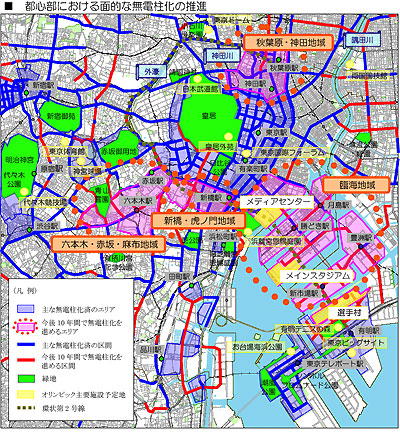
Blue indicates areas with underground power lines; red/pink shows planned burials. The yellow areas are possible Olympic sites.
Much of this plan involves building park areas along the Arakawa and Tama rivers (which weren't covered by highways in 1964). Plans also include burying power lines and creating more bright and open spaces in the city.- Refreshing Tokyo with Three Ring Roads
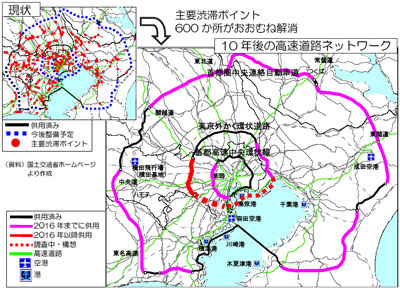
Ring road plans. The pink roads will be completed by 2016. In the inset, the red dots show current congestion points.
Ringing Tokyo will improve traffic to the airports and ports and connect the outlying areas, including the "Tama Silicon Valley," to one another more effectively. Also in the plans are reductions to CO2 emissions and high tech safety controls on highways.- Reducing the World's Environmental Burden
- Tokyo plans to aggressively reduce CO2 levels through use of traffic management and biodiesel public transportation, bringing levels to 25% less than the 2000 measurements. They will build advanced water purification plants along the Tone River to produce 100% of Tokyo's water and they will create new recycling systems and work with private sector recycling businesses.
- Boosting Confidence with Disaster Preparedness
-
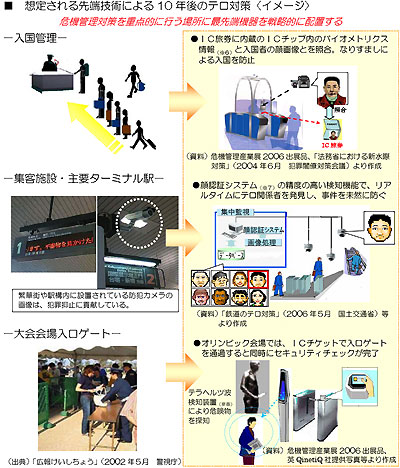
Three terrorism prevention techniques: biometrics at immigration, facial recognition in train stations; IC chipped tickets at event venues
The main goal is to improve not only earthquake safety measures in new construction, but to build flood control and more thorough disaster prevention plans. For instance, along emergency evacuation routes, new hospitals and public works building will be erected. Terrorism will be combated with the latest technology (yes, this is as lame as I make it sound). - Creating a Model City for an Aging Society
- Japan is about to experience a surge in elderly as the post-war babies reach 60. Tokyo has noted that "the elderly have renewed the 'elderly people' image by actively volunteering in the community" and this is something they want to encourage with support of volunteerism. Advanced health care, including robotics and IT networks, and supporting aging foreign residents is also in the plan.
- Establishing Tokyo as a City of Charm and an Industrial Power
- Tokyo will trade on Japan's pop culture and advertise more widely for foreign visitors, making improvements to areas visitors frequent. This section has many comparisons to culture programs in other Olympic cities.
- Creating a Can-do Spirit in Everyone
- This is a soft goal, revolving mainly around encouraging students to seek higher education and for everyone to participate in NGOs and volunteer activities.
- Sharing the Dream of Sports with the Next Generation
The future of Japanese sports.
Japan's kids are getting fatter and less athletic. Where will the future Olympians come from? Tokyo will support youth sports clubs and establish a network of volunteers to train kids in sports.
My good friends Bob & Tomoko held their wedding ceremony at a reception hall on the Kanagawa coast earlier this month. I taped the ceremony and party and have been editing together a couple of highlight reels for the happy couple.
Throughout the celebration, several staff members - I've started calling them the Japanese Wedding Wranglers - kept things on track by guiding the bride and groom through the space, handling props and timings, setting up microphones and doing all the background tasks you would expect - though perhaps to an extreme not usually seen in the US.
Here's a short film highlighting all the work they did that day.
I have always been proud to say, "There are no beggars in Tokyo." But two incidents in the past month have made me a liar.
The first took place at Shibuya station a couple of weekends ago. Tod was buying a ticket for the Hanzomon line. When I looked to see if he was done, there was a balding man dressed in grey pants and a blue jacket talking to him. He looked like a do-gooder trying to help a confused tourist with the machine. I saw him talking to a different foreigner as we went thought the wickets a few minutes later. When I asked Tod about their conversation, he said the guy asked him for 500 yen. In English.
The second incident was also at Shibuya. As we passed along the street from the Hachiko side to the Toyoko side of the station last night, a filthy, dreadlocked rag-man got a bright look in his eyes and shambled in our direction. I watched in my peripheral vision as he walked along with us for a couple of steps, face angled toward us in a hopeful way, before he gave up and stopped. He didn't try this with any of the gazillion Japanese also walking along that way.
So it seems that foreigners are being targeted by panhandlers in Shibuya. Has this happened to you? What did you do?
Looking for shoes that fit your "big" feet in Tokyo? Over the years I've amassed a collection of shops that carry women's shoes in sizes 25 and above.
Shoes Ten: Long wearing standards and basics. Sizes 25-27. Moderate to high prices. Shinjuku; Shinjuku 7-8-13 (1F).
Washington: Basic, elegant and classic styles in shoes and boots. Sizes 25-26. Average to high prices. Ginza; Ginza 6-9-4 (6F). 03 3572-4985
Queen's Himiko : Fashionable, colorful shoes for casual, party, "recruit" and boots. too. Sizes 24.5-27. Average to high prices. Shinjuku; Keio Mall (B1F), 03 5324-7266
Kotuca: Designer and top brand shoes to buy in-store or online. Sizes 24.5 - 27. Above average prices. Omotesando; 3rd floor Harajuku Belpia (down the street from Fujimamas). 03-3406-8863
Nissen: Mail order shoes in a range of styles. Sizes to 27 and EEEE. Inexpensive. Online or catalog only.
Marui Model: A better selection than their horrid large size clothes. Sizes 24.5 - 26. Average prices. Shinjuku, Ueno, Ikebukuro, etc.
There are other shops, too, which carry selections mixed in with smaller sizes including many of the major department stores (particularly in the designer brands) and the "family" department stores like Ito Yokado. Zara has shoes up to 25.5 sometimes. There are small boutiques and shops tucked away here and there all over town that have larger sizes. If you find one you love, write me and I'll include it on the list.
I did go for a walk today to shake off the Sunday blah. I ended up taking a good long hike through central Tokyo that racked up 14,000 steps and 12 km according to my manpokei.
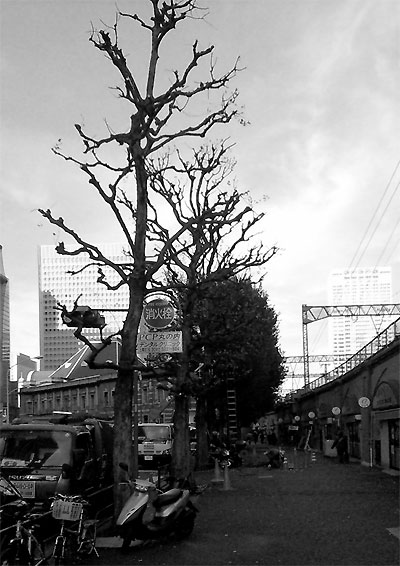
Winter gardening in Tokyo
While I was out and about, I stopped to watch a crew pruning trees near Tokyo station. Two guys in the trees sawed off leafy branches, leaving tree silhouettes in their wake.
And on Hongo Dori I saw a plum tree blooming. It must sit in a micro-climate that gets just the right dose of sun and warmth because I've seen this particular tree bloom out of season before. Sure is arresting to see the pale petals fall on top of the bright yellow ginko leaves that litter the sidewalk just there.
Just after the wedding both UltraBob and Tomoko caught colds so UltraMom and Heather were faced with a day stuck in the house or wandering Zushi on their own. That seemed rather dull to me, so I offered to show them a bit of Tokyo while the newlyweds rested.
At 14:06, I met them on the train platform at Tokyo station and we headed up to Asakusa to see the temple and do some souvenir shopping, followed by a stroll along the neon-drenched main drag of Ginza, then maybe a relaxing foot massage and dinner with Tod.
We never made it past the shopping!
The shops and stalls that line the street leading to Senso-ji are chockablock with gifts and foods. Standing at the big gate, you can barely see the temple in the distance, so highly decorated are the lane and the stalls. Everything is colorful and bright. There are crowds of people sauntering along, looking at samurai swords, key chains and rice crackers. We made it to the temple, sniffed the purifying smoke, got some mikuji, took pictures and then went back along the lane to shop.
I love visiting Asakusa, and it's been a long time since I have been there with newcomers. I did my best to balance storytelling and education with letting them explore and discover things on their own. And no trip is complete as a "tourguide" without learning something myself. One of the shopkeepers showed us how to tie an overflowing shopping bag's handles together to make it easier to carry.
We did meet Tod for dinner, but only after stowing all of the purchases in a train station locker! I didn't count exactly how many things they bought, but I know there were two huge shopping bags full, plus a plastic grocery bag stuffed with extras. Everyone on their gift list is getting something Japanese for Christmas, I bet.
Hope we'll have another chance to see some sights before they return to the US.
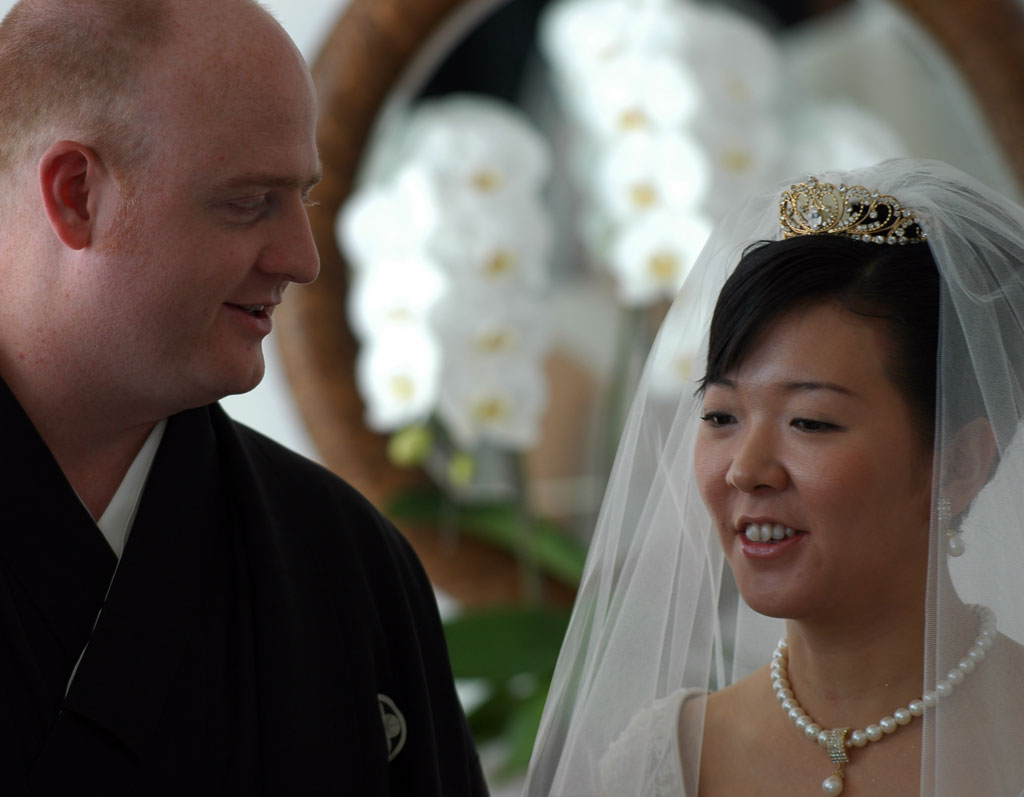
Bob & Tomoko in their finery
We attended UltraBob and UltraGirl's wedding party this morning at a seaside complex near Zushi. What a delightful day it was with sunshine and waves outside, and 50 happy guests enjoying the celebrations inside.
��婚�����������
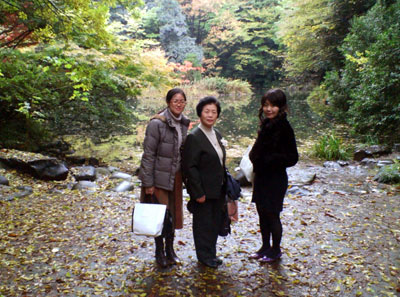
Sayaka, Kimie, and Hanako pose in front of the idyllic campus pond. Is this really Tokyo?
My friend Yanagi Kimie was visiting from Matsudai, so I joined her and Hanako's art crew for lunch. We ate at the University of Tokyo (Todai) "Metro" cafeteria. The food was typical (Japanese) college fare served on bright orange trays in a large room with scuffed walls, mismatched wall sconces, and vinyl tablecloths. The primary decor in the room are the large signs pointing hungry students to the correct counters for noodles, set meals, rice bowls and drinks. After eating, we scraped and dumped our dishes into a giant dishtray. Todai may be the most prestigious university in Japan, but it's campus meals are the same as every other uni in the world.
After lunch we had a stroll around campus. The leaves are starting to change color and it was quite lovely. We couldn't resist picking up a few red maple leaves and bright yellow sakura leaves. We stopped into one of the empty lecture halls and I found it a very odd mix of old and new. There was a modern computer-based lectern for the prof with wood and iron seating for the students.
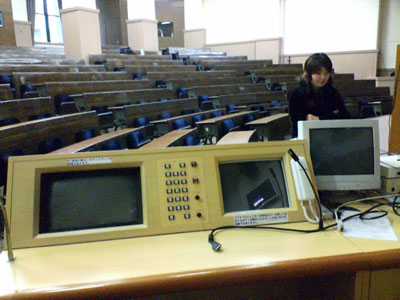
The lecture hall from the professorial point of view.
Velvet seats! The desks were marked Showa 30-something or about 1960.
The little boy dressed in brown corduroy pants and a red sweater stood at the stoplight. Two older girls in school uniforms called "Ebi-kun!" but he ignored them, intent on getting across the moment the light changed.
"Arrrrwah!" he growled and took off at a run, six-year-old legs pumping as fast as they could towards a large cluster of chatting middle school students on the opposite side of Kasuga Dori. He dodged their blue uniforms and turned left, running full bore through another rank of after-school conversations.
Two boys at the perimeter saw him coming and held out their hands, smiling. He tore through their barrier, turning to shout a greeting as his fuchsia tote bag flew behind him like a cape. He barely broke stride before swinging back towards his destination, a side street into a residential area.
By the time I crossed the Kasuga Dori and reached the street he turned down, he'd vanished. I wonder what compelled him to run so urgently? He seemed too happy to be late. Maybe his mother baked him cookies. Regardless, it really did look like a scene from a little European art film.
Tonight was one of the most interesting office parties I've ever attended. No bland cheese and syrupy wine.
We went to a cabaret of "new half," transvestites and showgirls at Kaguwa in Roppongi. It was a great performance running about 45 minutes of non-stop, high energy dancing in kimono, short skirts, spangles, and lots of feathers.
Kaguwa seem to have enthusiastic, long-standing, well-to-do fans (sugar daddies, perhaps) who were blown kisses from the star performers. At curtain call, waiters delivered folded money to the two post-op dancers and one of the transvestites who received it with winks and kisses.
After the performance we sipped drinks and wondered "was that one a guy or a real girl?" It was about impossible to tell. Except for the three guys in the show, the others were all hot and sexy dancers with female stage names and great legs.
The stage was as cool as the dancers. Thirty two hydraulic sections lifted and dropped during the dancing to create staircases, platforms, screens, and hideaways. It was beautifully choreographed and must have been interesting to dance on.
But there was a bit of a mystery about the stage construction. When all the sections were lifted to their maximum height, they formed four 2-meter tall boxes open all the way through with a platform above. Dancers were sometimes featured in those boxes while additional action happened on top. But when individual sections were raised for stairs or platforms, the front face of each section was covered with a solid panel, no matter how tall or short it was. Where did the panels go when the boxes were fully lifted?
"You should have some of those," Tod has prompted several times now, pointing to various young women in tailored shorts. I'd call those ladies "well-heeled," but they are all wearing boots and knee socks with their shorts.
Today I saw a woman whose boots were wider than her ass. I kid not. Her heavily fur-lined boots were folded over into cuffs, doubling their bulk around her calves. She was naturally bowlegged, so it didn't mess up her gait too much. With the boots she wore tailored shorts, a wide gold lame belt and a fur jacket with several layers of pearl encrusted t-shirts underneath.
I think this season, my a la mode will have to be pie.
I walked over to the Indian Embassy today to apply for visas for an upcoming trip.
I was disappointed that the consular wing didn't look very Indian. I was hoping for rich curry colors and the scent of incense. But the building is just a regular blocky office building with only a small but shiny brass plate to indicate that it's an embassy. No proudly waving flags, no armed guards.
The waiting room was drab and old - tobacco colored linoleum, asbestos ceiling tiles, dust-encrusted stucco walls. Three standing desks, the sort with attached pens and perpetual calendars, dominated one side of the room, backed by a green bulletin board covered with handwritten notices and printed information in Japanese and English. A huge air conditioning unit throbbed behind the ranks of 50 metal chairs. Across from the desks three service counter safety windows were curtained closed when I arrived.
The decor was minimal. One large printed cotton tapestry hung next to the air conditioner. Two cheaply framed promotional posters hung from glue-backed plastic hooks and two tourism posters (the Taj, of course, and an ironic "Incredible India") tilted like drunken holidaymakers. A metal shelf displayed half a dozen pottery bowls, two blue elephant statues, and the TV that tracked our "take a number" tickets.
Fortunately, I was near the head of the line and didn't wait long. The processing was brief and efficient and I was out of there in 25 minutes with a receipt for our visas which will be ready on Friday.
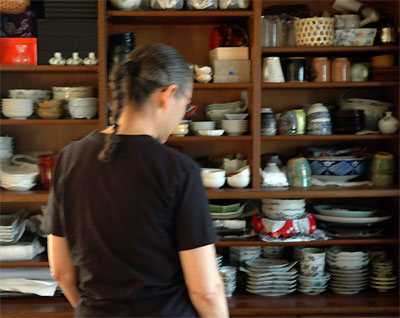
Elizabeth Andoh selects dishes for a photo shoot.
One of the many benefits to doing ad hoc creative work is that I sometimes get requests from friends to help them out in interesting ways. Yesterday I went over to Elizabeth's to take some pictures of ceramic dishes.
Her dish cabinet, which she says fit exactly the width of the room she and her husband lived in when they first married, is stuffed full of treasures to reflect the current season. She changes the cabinet's contents as the weather shifts. The off-season ceramics are stored in a weather-proof shed on the balcony.
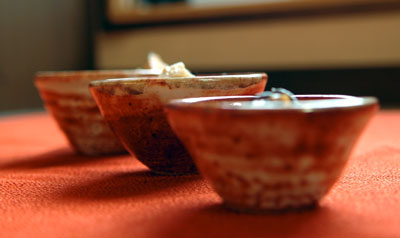
Jessica Wickham's nesting bowls
As she picked out her favorites from the cabinet, Elizabeth shared their histories - a 250 year old miniature bowl belonged to her mother in law, an original Bizen dish, pottery made by friends and famous associates, rare pieces and bargain finds from recycle shops. The mix is eclectic but perfectly harmonious and our photo session turned out some good results.
I replaced my slowly failing, five year old keitai with a brand new shiny handset, a D902iS. Wow, has the technology changed. My old phone made calls, sent mail, and accessed i-mode sites. Here's what my new phone lets me do:
- Take photos
- Shoot movies
- Videoconference
- Replace store point cards
- Collect digital flyers and coupons
- Pay for purchases in stores around town
- Browse the Internet
- Send and receive e-mail
- Play music
- Record sounds
- Look up words in built-in dictionaries
- Play games
Oh, yes, it makes phone calls, too.
I'm feeling sick of having my differences pointed out.
It's a condition I think most foreign residents in Japan suffer at some point. For some people, it gets so bad their only treatment is to return to their home countries. Others find a suitable remedy and recover with time. I've been relatively symptom-free for over eight years but all of a sudden, I'm struck down with Gaijin Complaint.
What are the indications?
- 1. "We Japanese" phrasing starts a raging fever.
- For example, a friend's Japanese teacher did it to me the other week. "We Japanese use those as sewing boxes," she said when I was showing my friend a beautiful Showa-era cabinet I intended to use as a jewelry box. Would she have said that to a Nihonjin? Certainly not. Did I need to be corrected? Certainly not.
Then a few days later, a shopkeeper called me mezurashii (unusual) because I filled in a form without actually looking at it and wrote my name on the address line. "Japanese people would have put their name here," he said, pointing. If I were Japanese, would he have said that? I think not.
- 2. Assumptions about my eating preferences make me lose my appetite.
- I do not want a fork with my conbini salad; I'd prefer chopsticks just like all "you Japanese." Thank you.
- 3. Excessive staring causes me to withdraw.
- I grapple with a desire to blend in and the knowledge that I never will. I am sized and colored differently to 99% of the population. I am a novelty who is tired of being noticed. On the other hand, I don't want to hang around the gaijin hot spots like the Pink Cow, Yoyogi Park or the foreign ghettos in Minato-ku
- 4. Presumptions about my comprehension make me to prickle all over.
- Whether it's what they are saying or some aspect of culture, it aggravates me when people think I don't understand. I'm sure in lots of ways I don't but I'm not entirely clueless.
For example, yesterday there was a handwritten notice in our lobby stating "Futons are bulky trash and need to be collected by the city for a fee; please contact the management office." When I left the building in the morning, the manager caught my eye and rose from his desk, which he only does if I am stopping by to pay the water bill. Did they assume that I had thrown away a futon? Ha, ha. It wasn't me.
I don't like this dis-ease. I love living in Japan. I want to be comfortable again, so of course I've been thinking of possible palliatives. Cheerfully embrace my gaijin-ness, or strive to behave more like Japanese? Improve my language skills, or bury myself deeper in my English-speaking bubble? Point out discrimination in a polite non-confrontation way, or pitch a screaming fit every time I'm offended?
Somehow I think some of these might work better than others. What do you think? How did you handle your spell of gaijin complaint?
Every resort town, holiday destination, theme park, and museum in Japan has a gift shop full of souvenirs- the obilgatory omiyage that travelers bring home for their family and coworkers.
Visit any of these shops, or the quaint village streets lined with them and you will see your fair share of Hello Kitty kerchiefs, brightly colored plastic doodads, and keitai straps with the sights printed on them, or if you are touring a place proud of its local history, some handmade textiles, pottery, lacquerware or basketry.
Many omiyage are edible and that's probably best, because how many phone straps does a person need?
Some of these tidbits are local specialties - dried seafood, artisanal sake, or jam made from produce grown in the district - but most are merely one of a half dozen types of popular sweets packaged up in easy to carry boxes and wrapped with appropriately themed paper. Most frequently seen boxed omiyage are chocolates, vanilla creme cookies, and the ever-green favorite, manju, steamed buns filled with sweet bean paste.
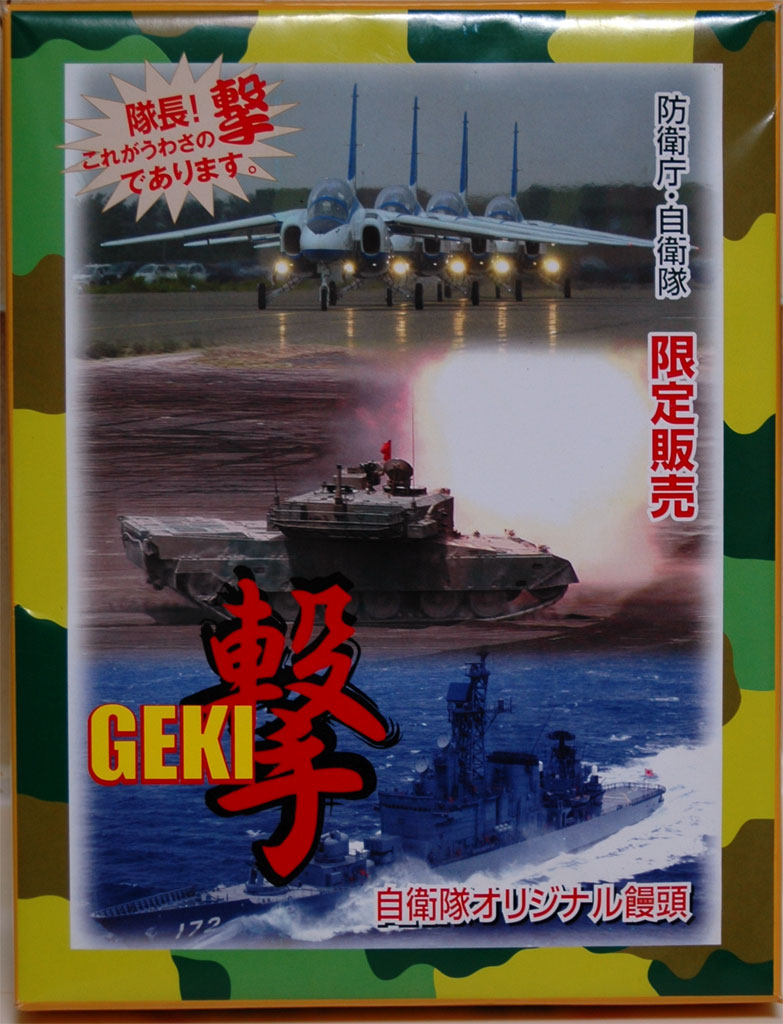
This box of manju I received last week takes the cake. These limited edition Geki Manju are the omiyage from the Self Defense Forces. I guess you need to have something to bring home to Mom when you're on leave.
My destination
Today is Sports Health Day, a public holiday commemorating the1964 Olympics in Tokyo. I'm going to go be healthy and sporty by taking a train to the beach (collecting MJ en route), enjoying a nice long walk, then soaking in an onsen this evening. The weather is beautiful today and I'm excited to get going.
The man who drove into Tod last week called to check up on him and asked if he could come to make a formal apology - owabi. Tod told him it wasn't necessary, but of course it really was important to Ootusbo-san.
So today we invited him into our house and sat with him for a few minutes. I wasn't sure what to expect; Tod hadn't given me any sort of description of him. He is my age or maybe a few years older. His hair is short and simply cut; his skin is tanned from outdoor work. He wore all white, like a spiritual pilgrim: white pants, new white sneakers, a white cap and a white t-shirt with a heather blue sweater vest over it. He had his keitai tucked into his back pocket, with various colored straps and characters hanging from it.
I think he didn't quite know what to expect, either. He came into the living room and commented on our stack of zabuton cushions. We put them to use, sitting on the floor at our low table. After presenting us with a box of rice crackers and dorayaki, Ootsubo-san gave us his account of the accident. He was driving back from a job in Kofu, Yamanashi prefecture, and exited the highway to escape the Friday evening congestion. In Otemachi, he turned at the intersection, then slammed on the brakes when his passengers all shouted "Abunai!" They had seen Tod in the crosswalk. Thank goodness he used the brakes. He asked several times after Tod's various body parts, all of which are healing fine, and apologised to me for causing me worry and trouble.
After the sembei and the chat, Ootsubo-san passed Tod an envelope. "It's really not much," he began. Tod tried to refuse the money, but Ootsubo insisted. "It's not about the money. It's about my own feeling. Please accept it."
Then he asked Tod if he could snap a photograph of the bicycle and explained that his car insurance company needed to see it so he could get the van fixed. He said they might call to verify the circumstances of the accident. Apparently Tod left a pretty big dent in the van. So Tod and Ootsubo-san went outside together, but only after Ootsubo-san gave us a deep bow and a pro forma "I have no excuse. I'm very sorry." I think he really was glad that it all turned out alright.
Today I was witness to a remarkable event.
While I sat chatting with Tod, our friend Shinji, and two of his "older sisters" in Sugimoto's kimono shop on the promenade leading to Nezu Shrine, two women popped their heads in the open doorway.
"Um, do you remember us?" one began. In a moment they revealed that all four women had gone to grade school together 62 years before. These 70 year old ladies turned into schoolgirls in the blink of an eye. They caught up over half a century in a flurry of words so entangled that I could not follow unless I looked at one of them at a time and read her lips.
How lucky I was to be there for that happy, once in a lifetime event. It made me wonder if I would recognise my classmates from 30 years ago in a chance encounter?

L-R: Yuki, the Yanagi's grandson; the man who taught me how to harvest; Kimie Yanagi, matriarch; Tsuchiya-san, exhausted student; Hanako Murakami, artist; Higuchi-san, of Yumatsuya; Higuchi-san's friend; Akria Yanagi, patriarch.
We didn't plan it, but six of us were leaving Matsudai on the same train. The Yanagis came down to see us all off, so I snapped this memorial photograph of our hostesses and fellow harvesters. I wish I remembered everyone's names. They were, without a doubt, formally introduced to me at some point.
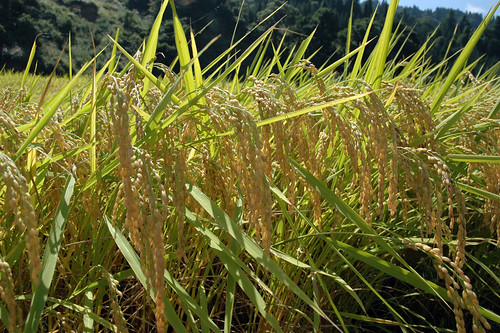
Mature rice, ready for harvest
Harvesting rice is a lot of work. I have a deep appreciation of each and every grain I eat now that I know what goes into just one day of rice production. The Yanagis, and thousands of other Japanese families, toil to feed me and I am grateful.
Sunday morning at 6:30 on the dot, Hanako, Tsuchiya-san and I sat down to breakfast prepared by our hostesses, who were awake and cooking at 5:30. At 8:30, we were called over to the Yanagi’s house to dress and wait for further instructions. The waiting made me fidgety and irritable. I wanted to go pick rice, but here were indoors with Kimie, who served tea and edamame and offered us our choice of hats and boots to wear outside.
By 9:30 we were finally in the field, where Akira Yanagi, his grandson, mother, neighbor and two young boys were already at work. After a quick demonstration of harvesting skills we’d need to use, we were set to work.
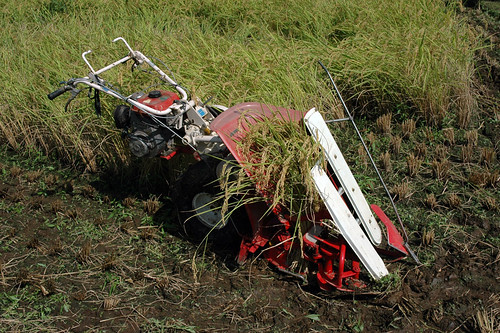
The machine harvester
Akira has a harvesting machine that growls like a lawnmower, and it’s not far off in size. The harvester is pushed by hand through the rows, cutting the clumps of rice near the ground and binding nine of them together with twine before spitting the bundle out to the side.
My first task was to follow the harvester, picking up the bundles it spit out and gathering them into sets of seven. I cinched them together with a noose-like rope, then carried the 10 kilo bundle to one corner of the field.
It was hot – around 33 C (91F) - the sky was clear blue and sun beat down on us. In a few minutes, I was sweating buckets and so was everyone else.
The harvester doesn’t get all the rice; uneven rows or a misdirected push can leave clumps uncut. So someone has to hand-cut the clumps. After a while, I followed the hand-harvesters around, picking up their clumps of nine and tying them into bundles using rice straw from the last harvest.
The technique was simple and effective – belt a few strands of straw around the bundle, twist once, and then spin the whole thing around itself to tighten the twist, and finally tuck the ends under the belt. I kept getting the thumb of my glove stuck in the twist when I spun the bundle, but a good sharp tug always freed it.
Enjoying a much-needed drink
It wasn’t long before we took a break and everyone had a small bottle of tea. Japanese don’t drink much compared to Americans. Maybe because their diet is saltier and they retain water so don’t need as much going in. I don’t know, but one 300 ml bottle of tea wasn’t enough for me but nobody else was having more, so I didn’t either. Very soon it was back to work.
More tying, spinning, cinching and carrying got us one field cleared. We moved the piled sheaves from the side of the field into the truck, laying the bundles rice-end in and alternating the direction of the layers so that the rice was secure and the grains protected for transportation.
Three men took the rice off to hang it up to dry in the sun while the rest of us started on the second field. This time, I asked to try the hand-cutting. With a short, serrated curved blade in one hand, you grasp the clump of rice in the other hand and draw the blade across in one firm movement. The trick is to make your cutting stroke count - not to saw at the rice – while not pulling the clump out of the soft muddy earth while you cut. It took me a while, but I did eventually get the hang of it. I was not adept, but I managed.

Farmer Kristen
I cut out part of a corner for the harvester to turn in and a whole row along one side of the paddy, and then took a break on my own– cutting the rice was more intense than bundling and carrying – and drank the last little bottle of tea. I noticed that the sky was starting to cloud up on the horizon. The weather forecast called for afternoon rain, followed by a few rainy days in a row, so we wanted to get as much rice in today as possible. My energy was starting to flag, but I was determined not to fall behind.
The truck was back, but now parked further away, so I loaded up the wheelbarrows with Hanako and we loaded the remainder of the first field into the truck. Then I did some more tying and carrying before a break was called for lunch. We put what we had completed in the truck, tidied up our tools and rode back to the Yanagi’s for lunch.
Everyone was covered in mud and sweat. “Ladies shower first!� one of the men called out and that meant, really, that “foreign ladies� shower first. So I stripped down, surprised at how very, very wet my clothes were, and hopped into the shower. Hanako called in to me, “Do you have a change of clothes for the afternoon?� Oops, no. I hadn’t considered that. Kimie kindly loaned me an entire outfit, including a brand-new pair of her panties. I looked like a grandmother in her largest polka dotted polyester ensemble, but I was dry.
While we were in the field, Kimie had prepared a feast of tempura vegetables, simmered fish and tofu, pickles and cold somen noodles. It was plentiful and bountiful and everyone at the table dug in like they’d never eaten before.
Only I wasn’t hungry. My head throbbed, my teeth ached and my stomach hurt. Hanako noticed my lack of appetite and asked if I was ok. I wasn’t sure. I had goosebumps and was feeling cold. I’d stopped sweating and I was hot to the touch. Hanako lead me upstairs and put me to bed under a quilt. I slept while they finished lunch.
When Hanako back came upstairs to change into her field clothes, she told me I would stay there while they went back out. I sat up, sipped some tea and declared that I was fine, really. “Mom, I want to go out to play!� I pleaded jokingly. But she insisted I rest. She was right, of course, but I was terribly disappointed as I listened to their laughing voices piling into the truck and driving away without me.
I drifted off to sleep again to be awakened half an hour later by the pounding of hard rain on the tin roof. “Rain! Ah…Rain? Ah!! The laundry!� I leapt up to rescue the clothes and towels hanging outside the second floor balconies. Kimie raced up after collecting everything downstairs and we put the glass doors on their tracks and rehung the clothes – only slightly damp - on plastic racks inside the house to finish drying.
Kimiko wrings out her towel in the rain; Hanako laughs and drips into the house
That was the finish of the harvesting day, of course. Moments later the crew returned, soaked again but this time with rain. They were laughing and wringing out their clothes. We handed out all the towels and they changed – again – into clean dry togs.
Despite the heatstroke, I enjoyed the harvest immensely. I grinned like an idiot in the field, so happy to be joining in an aspect of life that is mostly hidden behind city supermarket price tags. And I hope this first harvest wasn’t my last.
(For more photos, see my Rice Harvest photo set on Flickr)
Mature rice, ready for harvest
Harvesting rice is a lot of work. I have a deep appreciation of each and every grain I eat now that I know what goes into just one day of rice production. The Yanagis, and thousands of other Japanese families, toil to feed me and I am grateful.
Sunday morning at 6:30 on the dot, Hanako, Tsuchiya-san and I sat down to breakfast prepared by our hostesses, who were awake and cooking at 5:30. At 8:30, we were called over to the Yanagi’s house to dress and wait for further instructions. The waiting made me fidgety and irritable. I wanted to go pick rice, but here were indoors with Kimie, who served tea and edamame and offered us our choice of hats and boots to wear outside.
By 9:30 we were finally in the field, where Akira Yanagi, his grandson, mother, neighbor and two young boys were already at work. After a quick demonstration of harvesting skills we’d need to use, we were set to work.
The machine harvester
Akira has a harvesting machine that growls like a lawnmower, and it’s not far off in size. The harvester is pushed by hand through the rows, cutting the clumps of rice near the ground and binding nine of them together with twine before spitting the bundle out to the side.
My first task was to follow the harvester, picking up the bundles it spit out and gathering them into sets of seven. I cinched them together with a noose-like rope, then carried the 10 kilo bundle to one corner of the field.
It was hot – around 33 C (91F) - the sky was clear blue and sun beat down on us. In a few minutes, I was sweating buckets and so was everyone else.
The harvester doesn’t get all the rice; uneven rows or a misdirected push can leave clumps uncut. So someone has to hand-cut the clumps. After a while, I followed the hand-harvesters around, picking up their clumps of nine and tying them into bundles using rice straw from the last harvest.
The technique was simple and effective – belt a few strands of straw around the bundle, twist once, and then spin the whole thing around itself to tighten the twist, and finally tuck the ends under the belt. I kept getting the thumb of my glove stuck in the twist when I spun the bundle, but a good sharp tug always freed it.
Enjoying a much-needed drink
It wasn’t long before we took a break and everyone had a small bottle of tea. Japanese don’t drink much compared to Americans. Maybe because their diet is saltier and they retain water so don’t need as much going in. I don’t know, but one 300 ml bottle of tea wasn’t enough for me but nobody else was having more, so I didn’t either. Very soon it was back to work.
More tying, spinning, cinching and carrying got us one field cleared. We moved the piled sheaves from the side of the field into the truck, laying the bundles rice-end in and alternating the direction of the layers so that the rice was secure and the grains protected for transportation.
Three men took the rice off to hang it up to dry in the sun while the rest of us started on the second field. This time, I asked to try the hand-cutting. With a short, serrated curved blade in one hand, you grasp the clump of rice in the other hand and draw the blade across in one firm movement. The trick is to make your cutting stroke count - not to saw at the rice – while not pulling the clump out of the soft muddy earth while you cut. It took me a while, but I did eventually get the hang of it. I was not adept, but I managed.
Farmer Kristen
I cut out part of a corner for the harvester to turn in and a whole row along one side of the paddy, and then took a break on my own– cutting the rice was more intense than bundling and carrying – and drank the last little bottle of tea. I noticed that the sky was starting to cloud up on the horizon. The weather forecast called for afternoon rain, followed by a few rainy days in a row, so we wanted to get as much rice in today as possible. My energy was starting to flag, but I was determined not to fall behind.
The truck was back, but now parked further away, so I loaded up the wheelbarrows with Hanako and we loaded the remainder of the first field into the truck. Then I did some more tying and carrying before a break was called for lunch. We put what we had completed in the truck, tidied up our tools and rode back to the Yanagi’s for lunch.
Everyone was covered in mud and sweat. “Ladies shower first!� one of the men called out and that meant, really, that “foreign ladies� shower first. So I stripped down, surprised at how very, very wet my clothes were, and hopped into the shower. Hanako called in to me, “Do you have a change of clothes for the afternoon?� Oops, no. I hadn’t considered that. Kimie kindly loaned me an entire outfit, including a brand-new pair of her panties. I looked like a grandmother in her largest polka dotted polyester ensemble, but I was dry.
While we were in the field, Kimie had prepared a feast of tempura vegetables, simmered fish and tofu, pickles and cold somen noodles. It was plentiful and bountiful and everyone at the table dug in like they’d never eaten before.
Only I wasn’t hungry. My head throbbed, my teeth ached and my stomach hurt. Hanako noticed my lack of appetite and asked if I was ok. I wasn’t sure. I had goosebumps and was feeling cold. I’d stopped sweating and I was hot to the touch. Hanako lead me upstairs and put me to bed under a quilt. I slept while they finished lunch.
When Hanako back came upstairs to change into her field clothes, she told me I would stay there while they went back out. I sat up, sipped some tea and declared that I was fine, really. “Mom, I want to go out to play!� I pleaded jokingly. But she insisted I rest. She was right, of course, but I was terribly disappointed as I listened to their laughing voices piling into the truck and driving away without me.
I drifted off to sleep again to be awakened half an hour later by the pounding of hard rain on the tin roof. “Rain! Ah…Rain? Ah!! The laundry!� I leapt up to rescue the clothes and towels hanging outside the second floor balconies. Kimie raced up after collecting everything downstairs and we put the glass doors on their tracks and rehung the clothes – only slightly damp - on plastic racks inside the house to finish drying.
Kimiko wrings out her towel in the rain; Hanako laughs and drips into the house
That was the finish of the harvesting day, of course. Moments later the crew returned, soaked again but this time with rain. They were laughing and wringing out their clothes. We handed out all the towels and they changed – again – into clean dry togs.
Despite the heatstroke, I enjoyed the harvest immensely. I grinned like an idiot in the field, so happy to be joining in an aspect of life that is mostly hidden behind city supermarket price tags. And I hope this first harvest wasn’t my last.
(For more photos, see my Rice Harvest photo set on Flickr)
Sekiya-san & Motohei-san in the rice paddy. May, 2006
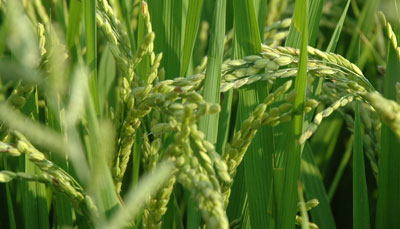
Maturing rice in Kanagawa
The rice harvest begins September 10th, and I'm off to Matsudai to help for a few days.
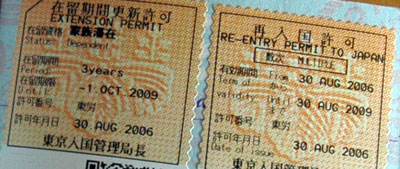
The visa and re-entry permit
Hard to believe it's been three years since our previous visa renewal, but it has and our papers to re-up were turned in a few weeks back. Yesterday evening Tod handed me our passports newly plastered with self-adhesive, QR coded visa extensions. We're good until 2009.
And then? Maybe an application for permanent residency.
I've been away from the computer mainly spending more time in Matsudai. So much happened last weekend that I'm hard pressed to recount it all, but here I go.
Thank you to Hanako Murakami for introducing me to Matsudai and its people. I really do love that town. And congratulations to Hanako for shepherding an amazing performance of mushroom dancing at Nobutai on Friday last week. "Kinseees!" was an energetic, delightful surprise.
Higashino-sensei's dance as the ã�ŠåŒ–ã�‘ã‚ンコ (mushroom ghost) was exactly the right complement to the old folks doing their dances. She encouraged them, teased out their special talents and made the evening flow. Motohei-san, at 82 the oldest dancer in the group, was so full of joy and humour that it was hard not to whoop and holler during all his little solos. I know how much work everyone put into creating the evening's entertainment, and I think all 160 of the audience members were impressed. I didn't take my camera that evening, choosing to enjoy the event without the lens between me and it - a wise decision, even though it means no pictures for you.
One of the items in the Kinseees! program was each dancer's favorite mushroom. The モグラ was often mentioned, but we don't know "mogura" as a mushroom - it's a mole. Now Tod does cutest impression of a mogura (the mole, not the mushroom) that makes me giggle and ask for encores.
The two days after Kinseees! were the Matsudai matsuri. We hung around town to tour the Triennial art and spent Saturday evening drinking and singing with the adult children of some of the dancers. I had my recording gear and turned the evening into the latest Hanashi Station podcast.
 Matsuri in Matsudai (10'15" 9.4 MB MP3)
Matsudai, population 4,000, is divided into three sections: Kammachi, uptown; Nakamachi, midtown; and Shimmachi, downtown. We were at the top of the hill in uptown most of the night, where the drunken karaoke and dancing took place. Midtown and downtown were equally lively, but more family-oriented.
Early in the evening, before the party really started, the skilled singers encouraged Tod & I get up and do a duet. You really cannot refuse people who ply you with sake and snacks. We flailed our way through John Denver's Country Roads - one of the few English songs in their midi-based karaoke system. Later on, we were called on to perform again - "Mr. Tod and Kristen dancing please!" - and foxtrotted clumsily to some beautifully sung enka.
The town reporter captured all of this and more with his camera, so I expect there will be at least one photo of us in the local newspaper. Horrors! But I wonder how I can get my hands on a copy of it?
Over the course of the evening, we were treated to many plates of food, cups of drink and little gifts. I was so stunned by the generosity that I took an account: 6 onigiri; 2 bowls of kenchin soup; 2 dishes of pickles; 10 sticks of yakitori; 4 shiso-cheese gyoza; 1 plate of fried octopus; 2 grilled sazae; 1 packet of otsumami; 1 harisen clapper; 1 pink stuffed monkey; 1 pair pink sequined devil horns; 1 pair of sequined devil horns; 2 glasses of tea; countless cups of sake.
All that, plus a few things I was actually allowed to pay for, made up the feast of the evening as we sat around the streetside fire pit. Thank goodness there were a lot of people in our little tribe to share the bounty. I don't think anyone went hungry that night.
After the matsuri, I rolled a very tipsy Tod down the street to Kimie-san's family's second house, where we spent the night with Hanako and her crew. In the morning, before anyone had a chance to sip their coffee, Kimie-san turned up with freshly cooked rice and laid our breakfast table of pickles, simmered dishes, soup and rice. She is such an amazing hostess.
We took our leave of Matsudai the next day, after watching the kids' parade of mikoshi (portable temples). Tod helped to pull one of the huge wagons full of kids. I turn turns with the local police are trying to catch fish with a paper spoon. I took photos which I will develop and post eventually.
If this were my last trip to Matsudai, I'd be sad, but I am hoping/planning to go back in a couple of weeks to harvest rice with Akira-san, Kimie's husband. I may be a liabiliity, but I will work hard and it will be a good experience. Matsudai always is.
I've been away from the computer mainly spending more time in Matsudai. So much happened last weekend that I'm hard pressed to recount it all, but here I go.
Thank you to Hanako Murakami for introducing me to Matsudai and its people. I really do love that town. And congratulations to Hanako for shepherding an amazing performance of mushroom dancing at Nobutai on Friday last week. "Kinseees!" was an energetic, delightful surprise.
Higashino-sensei's dance as the ã�ŠåŒ–ã�‘ã‚ンコ (mushroom ghost) was exactly the right complement to the old folks doing their dances. She encouraged them, teased out their special talents and made the evening flow. Motohei-san, at 82 the oldest dancer in the group, was so full of joy and humour that it was hard not to whoop and holler during all his little solos. I know how much work everyone put into creating the evening's entertainment, and I think all 160 of the audience members were impressed. I didn't take my camera that evening, choosing to enjoy the event without the lens between me and it - a wise decision, even though it means no pictures for you.
One of the items in the Kinseees! program was each dancer's favorite mushroom. The モグラ was often mentioned, but we don't know "mogura" as a mushroom - it's a mole. Now Tod does cutest impression of a mogura (the mole, not the mushroom) that makes me giggle and ask for encores.
The two days after Kinseees! were the Matsudai matsuri. We hung around town to tour the Triennial art and spent Saturday evening drinking and singing with the adult children of some of the dancers. I had my recording gear and turned the evening into the latest Hanashi Station podcast.
Matsuri in Matsudai (10'15" 9.4 MB MP3)
Matsudai, population 4,000, is divided into three sections: Kammachi, uptown; Nakamachi, midtown; and Shimmachi, downtown. We were at the top of the hill in uptown most of the night, where the drunken karaoke and dancing took place. Midtown and downtown were equally lively, but more family-oriented.
Early in the evening, before the party really started, the skilled singers encouraged Tod & I get up and do a duet. You really cannot refuse people who ply you with sake and snacks. We flailed our way through John Denver's Country Roads - one of the few English songs in their midi-based karaoke system. Later on, we were called on to perform again - "Mr. Tod and Kristen dancing please!" - and foxtrotted clumsily to some beautifully sung enka.
The town reporter captured all of this and more with his camera, so I expect there will be at least one photo of us in the local newspaper. Horrors! But I wonder how I can get my hands on a copy of it?
Over the course of the evening, we were treated to many plates of food, cups of drink and little gifts. I was so stunned by the generosity that I took an account: 6 onigiri; 2 bowls of kenchin soup; 2 dishes of pickles; 10 sticks of yakitori; 4 shiso-cheese gyoza; 1 plate of fried octopus; 2 grilled sazae; 1 packet of otsumami; 1 harisen clapper; 1 pink stuffed monkey; 1 pair pink sequined devil horns; 1 pair of sequined devil horns; 2 glasses of tea; countless cups of sake.
All that, plus a few things I was actually allowed to pay for, made up the feast of the evening as we sat around the streetside fire pit. Thank goodness there were a lot of people in our little tribe to share the bounty. I don't think anyone went hungry that night.
After the matsuri, I rolled a very tipsy Tod down the street to Kimie-san's family's second house, where we spent the night with Hanako and her crew. In the morning, before anyone had a chance to sip their coffee, Kimie-san turned up with freshly cooked rice and laid our breakfast table of pickles, simmered dishes, soup and rice. She is such an amazing hostess.
We took our leave of Matsudai the next day, after watching the kids' parade of mikoshi (portable temples). Tod helped to pull one of the huge wagons full of kids. I turn turns with the local police are trying to catch fish with a paper spoon. I took photos which I will develop and post eventually.
If this were my last trip to Matsudai, I'd be sad, but I am hoping/planning to go back in a couple of weeks to harvest rice with Akira-san, Kimie's husband. I may be a liabiliity, but I will work hard and it will be a good experience. Matsudai always is.
One evening last week in Matsudai, we heard the most delightful chorus of frogs - deep croaking, quick peeps, and a percussive almost wooden clapping. But as we approached the little garden pond for a closer look and listen, the frogs stopped their songs.
Kimie-san started talking to them. She called; they answered. We giggled. She called again and soon they were all chatting away. I was delighted. Her technique was simple.
She made a loud, hollow sound by closing her lips with air in her cheeks and in between her lips and teeth, then opening them quickly while sucking the air in. The resulting sound was a hollow, lip smacking pop. She repeated it a few times and the frogs talked back.
On another night, I went to the pond alone and tried it with the recorder running. It worked! Have a listen:
Frog Call 0'04" 72KB MP3
Camping on the cliff above Sobama beach, our group of eight did a lot of relaxing nothing this weekend.
After brunch each morning, we sat under the shadecloth talking for hours about whatever came to mind: halloween costumes, books, travels, work. Lukie showed me how to do contact juggling. Aya sketched. Everyone sweated. We indulged in ocean swims, cold showers, and lots of beverages until it was time to head into Ogi for dinner at the festival market and then to walk up the hill to the evening's Earth Celebration concert.
This year, Kodo played with a dance troupe called Tamango's Urban Tap. As always, each group took a bit of the other's style and incorporated it into their performance. I cannot say I'd ever expected to see four women in yukata and geta doing a tap dance, but they did - giggling like girls as they sang their own accompaniment - and did a fine job of it, too. Tamango led the audience in singing the Zousan song (which made Zoupi exceedingly happy) where he bungled some of the words, then led an African chant where the audience bungled most of the words.
Recording the Kodo concerts is strictly prohibited and I respected that, but I did capture some frenetic drumming at one of the after-concert fringe events. If you'd like to hear the noisy musical atmosphere of the festival market in the late evening on August 18th, have a listen to this:
Earth Celebration Fringe Drumming 4'59" 4.6MB MP3
Here I am blogging from the Matsudai dormitory where I'm spending the week helping Hanako with a mix of video editing and minding the Hotta Rakashi Memorial Museum.
Once again I am stunned by the generousity and friendliness of the townsfolk who have taken Hanako under their wings. We have been well fed from garden produce, given handmade treats, and chatted up every time we walk out the door. There have been offers of beds, invitations to meals and events, and photographs taken at every turn.
The town has transformed since the first time I came up here. It's busy all day. Nobutai is mobbed with people in the gift shop, participating in workshops and watching performances. There are scores of people visiting the village with "stamp rally" booklets in hand, collecting stamps at every place they stop to see the art. The shotengai (shopping street) is an art gallery itself with big and small exhibits up and down the street.
Speaking of which, I must return to mine and greet the visitors with a cheey "Irasshaimase!"
Will be back in Tokyo on Monday with stories to share.
Finally, finally, I've conquered the Lawson Ticket system. The trick is to say way far away from the complicated and confusing web page and to go use one of the "Loppi" machines in the convenience store itself.
Loppi does a lot of stuff - dispenses event tickets, tops up phone cards, even makes out cash loans. All I really cared about today was getting tickets to Earth Celebration and Kinseees.
At the machine, you can enter the L-code if you know it and jump directly to the ticket purchase, or if you don't know the code, you can search for the artist's name or the date of the event. You can pay with a variety of Lawson-based credit cards, or type in your name and phone number and receive a slip that you take to the register and pay. The cashier trades your cash for computer printed tickets and you are done.
I know I'm probably the last person in Japan to have figured this out, but I'm glad I did. It's been one of those niggling "I know I can do this, but argh!" hurdles for a long time.
Last night, Tod proposed that we make a picnic lunch and enjoy an afternoon in the park today. Great idea!
I got up early and baked some treats, made sandwiches and an variety of things to nibble on. Tod ran out to the supermarket for a bottle of wine - an exceptionally good 1997 St Emilion Chateau de Lussac. We packed everything up and headed out of the house at 1.
At 1:03, a raindrop smacked Tod in the forehead. We returned to the house for umbrellas. By the time we got to the park at 1:45, the rain had stopped and started and stopped again, but the sky was dark and we heard the rumble of thunder. We found a pavilion marked on the map and beelined there. Within ten minutes, the deluge began.
The shelter kept us dry, but we hadn't counted on the mosquitoes. I smote a dozen or more, smacked at fifty and was bitten by...I'm afraid to count. But the food and wine were delicious and the company was entertaining, so it wasn't as bad as it might have been.
After the rain let up and we'd finished our wine, we visited the Science Museum. It's just the kind of place I love - lots of interactive, hands-on exhibits. And surprsingly little language on most of the displays. You have to figure things out on your own just like a scientist. I laughed and giggled and took my turn with the kids until closing time.
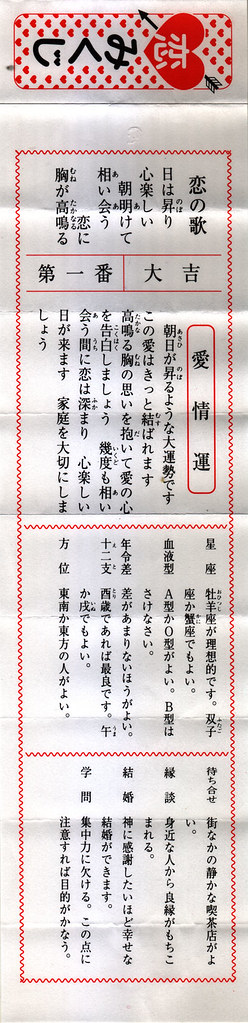
"First Rank, Big Luck" Love Fortune
I got this from a robotic dragon-puppet fortune vending machine at Yushima Shrine. Tod & I waffled about who would get one - would I buy one for him, would he buy one for me? In the end I got one for myself, but as you'll see it seems to suit him better.
Here's what it says:
Love Song
The sun rises
The heart rejoices
The dawn breaks
You meet your perfect love
Your heart beats loudly
First Rank * Big Luck
Love Fortune
As the morning sun rises, you will have incredible luck. You will be bound by this love. The drumming beat of your heart will confess your love. Every time you see your love, it deepens. Your joyful day will come. Be sure to treat your family well.
Star Sign
Aries is ideal. Gemini or Cancer are also ok. [I'm an Aries; Tod's a Taurus]
Blood Type
A or O are best. B should be avoided. [I'm type A; Tod's type O]
Difference in Age
It's best if there isn't much difference in age.
Zodiac Year
Rooster is best. Horse or Dog are ok, too. [I'm a Horse; Tod's a Rooster]
Direction
East-South or Eastern people are good. [I'm from the east coast of the US & so is Tod.]
Meeting Place
You should wait for your darling at a quiet coffee shop in your neighborhood. [I bring Tod coffee in bed nearly every morning]
Engagement
You will have the best relations with the people most familiar to you.
Marriage
Your happiness in marriage will depend on your desire to honor the gods.
Study
Your concentration will suffer, but if you can overcome this point, you will do well.

In my rented boat
We walked to Ueno Park and rented a rowboat for an hour. I love rowing around Shinobazu pond on a Saturday afternoon. Afterwards we stolled through a flea market, relaxed with a bath and karaoke, then had dinner and walked home.
Today is Umi no Hi, Ocean Day, and even though I'm nowhere near the ocean, water is playing a large role in my holiday weekend.
It's raining here in Matsudai where I'm helping Hanako to put together the Hotta Rakashi Memorial Museum for the Echigo-Tsumari Triennial which opens on Friday. We've been thoroughly soaked walking in an unexpected warm summer downpour. The room we are transforming into a gallery has transformed into a lake in one leaky corner. Everything this weekend seems to be damp, but battling the water is creating a sense of comaradarie.
One way water has not played a role in the weekend: no opportunity to bathe or shower since we arrived. Maybe I should stop writing and go upstairs to see if the dormatory's spiderweb coated shower room actually works. Or perhaps I'll simply step outside and wait for the next deluge...
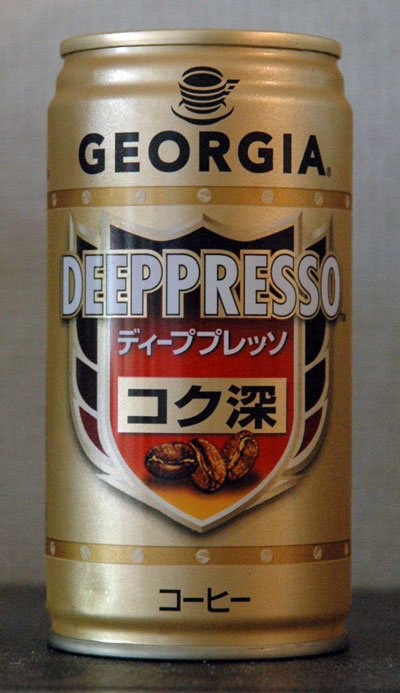
Coca Cola Japan presents...Deeppresso
At long last, I can say something about this product. I saw a preview of it months ago when I was doing a video edit for CCJC. I cracked up in the editing room and kept it in mind for all this time, though I recalled it with only one 'e'.
De-presso? Depressed espresso? Decaf espresso?
No. Deep-presso. Deep flavour. Intense.
Intensely typical, despite the "100% Brazilian, single origin, beans." It's the usual, grossly sweet, milky Japanese canned coffee. The ingredients list: milk, coffee, sugar, flavouring, casein, milk solids, emulsifier. I've sipped half a can and I'm buzzing like a kid on birthday cake and ice cream.
As much as I love Coca Cola Japan and its many excellent products, this is not one that I'll be trying a second time.
Even though Japan is not such a huge country and we try to travel around as much as we can, there are lots of places we've never been. Today we're going up north to Towadako in Aomori-ken to enjoy the caldera lake and woodsy mountain air.
This time, I know I'm getting on the right train.
I still don't know what it is, but I just saw my mysterious woodland friend from December 2002. Only this time he was in the garden below my veranda. He paused amid the overgrown lawn, looked me straight in the the eye, then moved on.
And I have witnesses. Unfortunately none of the gathered friends could agree on what it was. Anaguma? Tanuki?
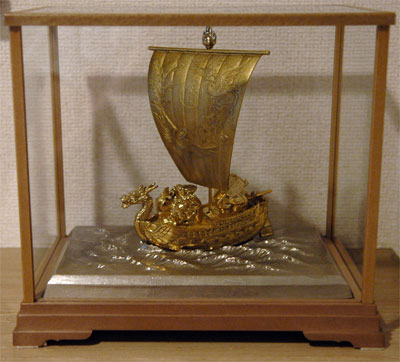
Takarabune, the treasure boat of the seven lucky gods
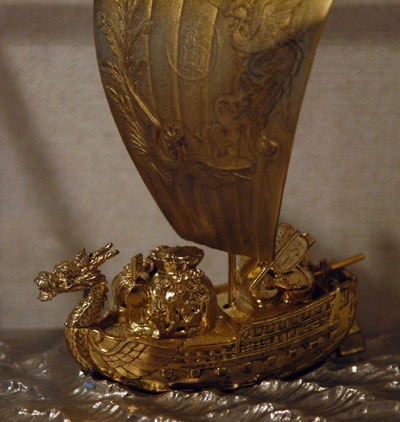
Each god is represented by his or her sigil.
As a surprise, Shinji gave us his takarabune as a present. He bought it thirty years ago to bring his good fortune. Now he has everything he wants, and he passed his lucky boat to us. It's a symbol of the Shichifukujin, the Seven Lucky Gods.
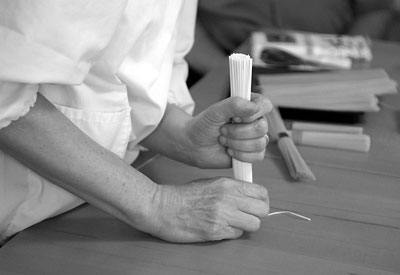
capable and practiced hands prepare somen
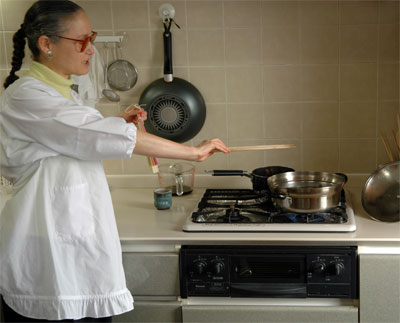
Elizabeth demonstrates the value of long chopsticks
Today I went to my friend Elizabeth's place to take some pictures of her teaching a class. Her publisher will send they photos to newspapers and magazines. It was a lot of fun and I got a few good shots - these two are from the reject pile, but I like them anyway.
"We'd say you are a 'boiled egg'," Shinji laughed last night. Is that a compliment, or an insult? I'm not entirely sure.
Am I turning Japanese? I really don't think so. Even if I do make dashi from scratch.
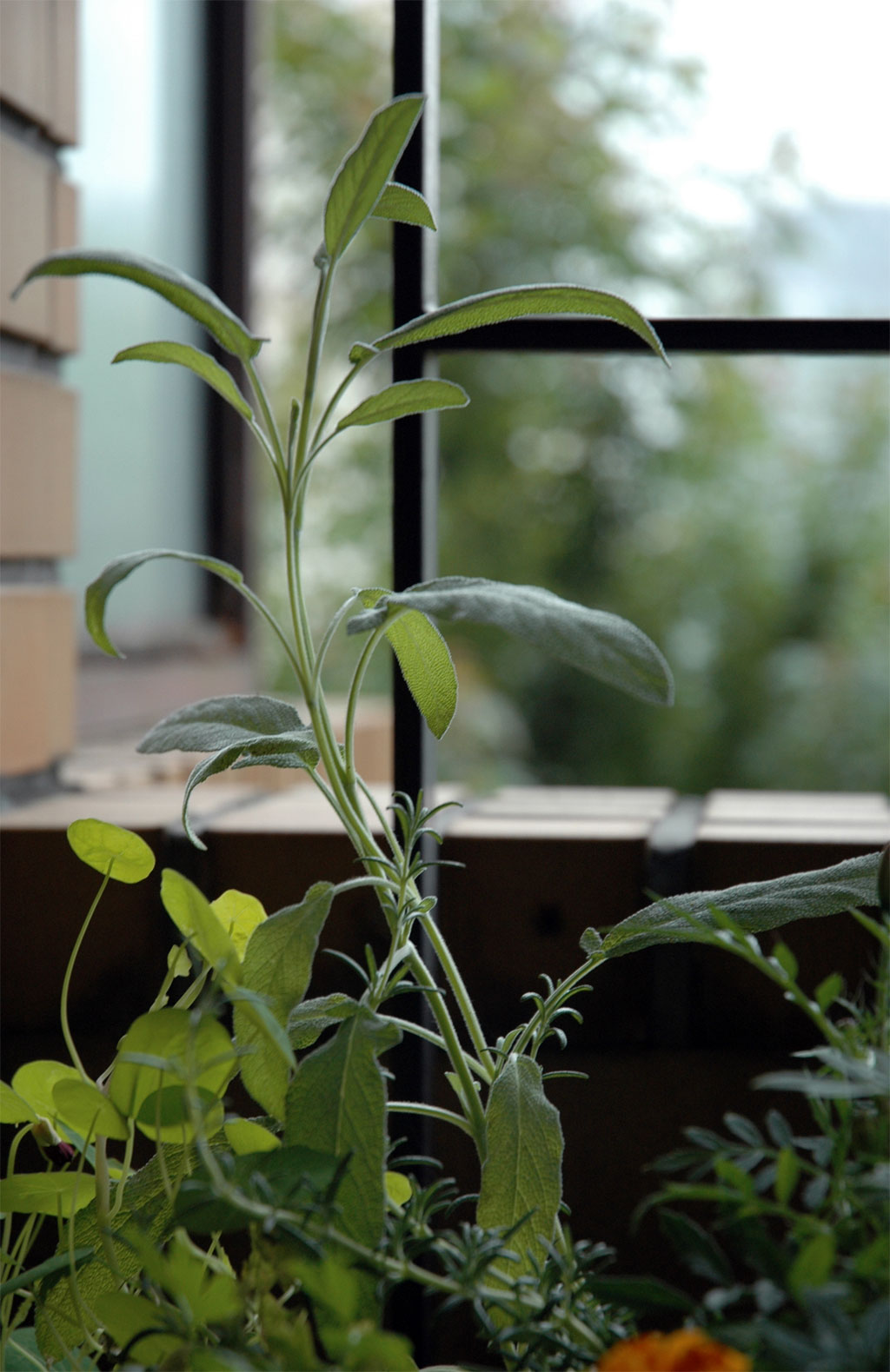
Sage's sinuous stems seek the sun
Happy solstice.

Iris in the genkan. Click for larger view.
The genkan is the Japanese entry hall where you remove your shoes and set your bags before stepping up into the house. In Matsudai, fresh flowers greeted us at every home.
I've added a dozen more photos of home interiors, people and gardens to the Matsudai set on Flickr.
This weekend I was back in Niigata taking photos. This time Tod came with me and we decided to take the train instead of the gallery's "staff bus" that leaves at an ungody hour from the gallery across town.
So I checked the very handy Jorudan Norikae site and typed in Tokyo to Matsudai in Japanese. I got our route, the time and cost and we set out with plans to arrive at 12:13 in time for my 1:00 shoot.
At 12:11, we realised something was amiss. "Next stop, Matsushiro. Matsushiro, next."
Huh?! MatsuSHIRO??
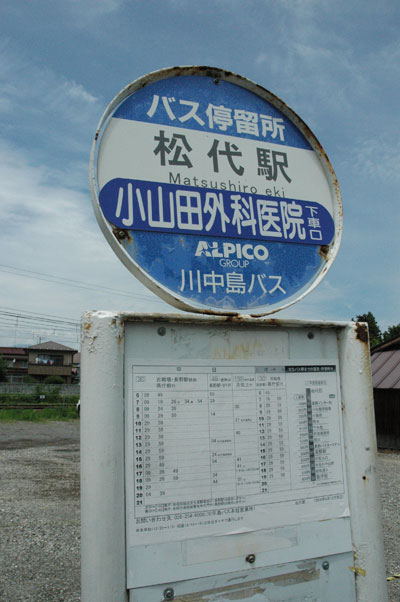
bus stop at Matsushiro station
Matsudai and Matsushiro have the exact same kanji - æ�¾ä»£. Since that can be confusing, my Matsudai uses hiragana for its station name. ã�¾ã�¤ã� ã�„. I didn't know this, since last trip I didn't go anywhere near the station.
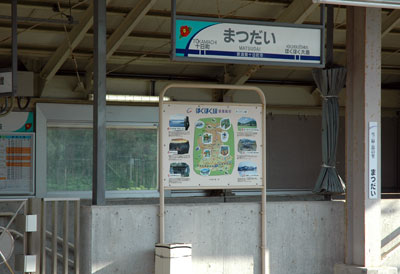
Accept no substitutes. This is Matsudai
I know in a vague way that Matsudai is not too far from the Nagano-Niigata border, so it seemed reasonable that we'd go up towards Nagano, then get a local train from there. But as it turns out, we should have been on a different Shinkansen line altogether, taking a different set of two local trains.
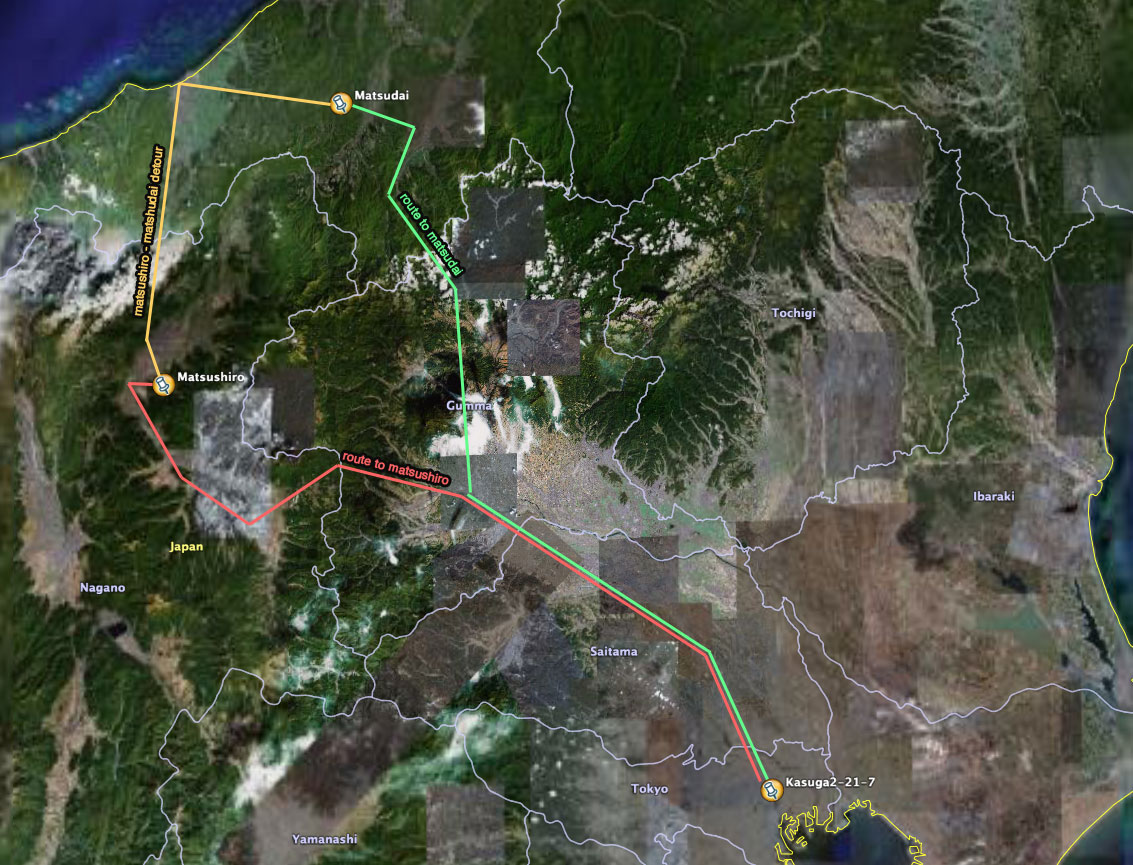
The long way around. Click for larger view.
Hanako assures me that I am the only person in Japan who could have made this mistake, but in my defense the towns have very similar details if you don't check the details or look at a map. If someone said to you "it's about 200 km, takes 2 1/2 hours and costs around 7,000 yen" you'd be hard pressed to know which was correct:
| Matsudai ã�¾ã�¤ã� ã�„ | Matsushiro æ�¾ä»£ | |
|---|---|---|
| Cost | 7,120 yen | 7,060 yen |
| Travel Time | 2:27 | 2:37 |
| Train 1 | Shinkansen (199 km) | Shinkansen (189 km) |
| Train 2 | Joetsu (17 km) | Shinano Tetsudo (20 km) |
| Train 3 | HokuHoku (30 km) | Nagano Dentetsu (9 km) |
It took almost 4 hours to get from Matsushiro to Matsudai by bus and local trains, so I missed the 1 o'clock shoot and showed up amidst the 3 pm appointment. But I made up for it by taking 380 pictures on Sunday, so it turned out OK.
Signs are pointing towards a North Korean missile test in the near future, perhaps as soon as today according to some reports. Dear Leader lobbed the previous one (in 1998) over Japan and into the ocean, so be prepared to duck and cover just in case it goes awry.
Morinaga Time Cookie
These petite yogurt flavored cookies are filled with blackcurrant cream. They are tasty, but I cannot figure out why they are called Time Cookie. The copy on the package doesn't say much. But TIME is a registered trademark...
I've eaten half the packet so far and no effect. Time's not slowing down or speeding up. I haven't seen any flashing clocks or countdowns in my peripheral vision. Well, I can only hope that the TARDIS will appear at the end of the week.
The weekend in Matsudai was primarily spent taking photos - I shot 530 in two days - and two of the photo sessions were with local obaachan & ojiichan (grandmas & grandpas). They dressed up in old-timey clothes and let us come take pictures in their gardens and alleys. And then they invited us in.
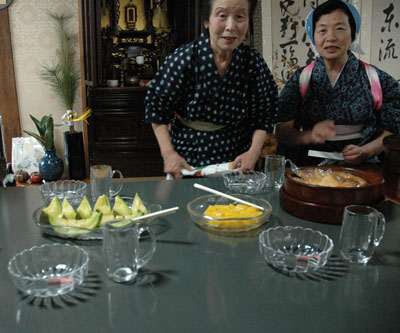
Sekiya-san and Kadoeya-san spread an elegant table of cool glass dishes and colorful fruits.
Kadoeya-san's house is beautiful. It's full of traditional Japanese colors and textures, seasonal decorations, multi-generational calligraphy. She is an elegant woman and her home reflects that. She also loves to sing and dance. While we nibbled fruit, she and Sekiya-san danced for us. I don't think anyone has ever performed a dance for my entertainment before. I was truly touched by their grace and generosity.
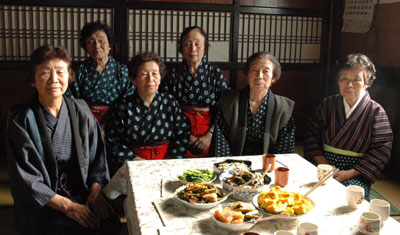
The Six Beauties of Chitose served up a meal of home cooked vegetable dishes from their gardens
Kodoeya-san's son drove us to the next village, Chitose, for our other shoot. Six women were waiting for us - I hadn't expected such a crowd - and invited us inside the old farmhouse while they finished getting ready. What an amazing building. Built 76 years ago, the rooms are two stories high with timbered ceilings. Thatch peeked through in places, though the roof had been tinned over years ago. And the walls crumbled in patches. Old, well-used and beautiful.
After the shoot, they surprised us with a feast of their specialties. I'll write more about those soon. In the meantime, you can have a look at home photos I've added to my Matsudai Flickr set.
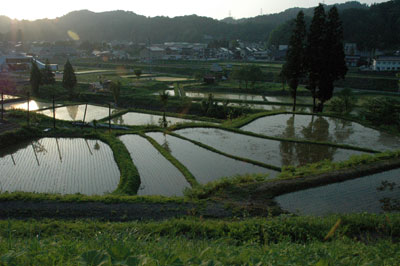
I went to Matsudai, Niigata this weekend as part of ã‚ンシーズ (Kinshees), an art project in the Echigo-Tsumari Art Triennial beginning July 22 and running through September 10.
What a beautiful place. I had my camera with me and took a lot of photos. Some scenes from the town are up on Flickr and I'll add more through the week.
Afternoon light on the potted flowers
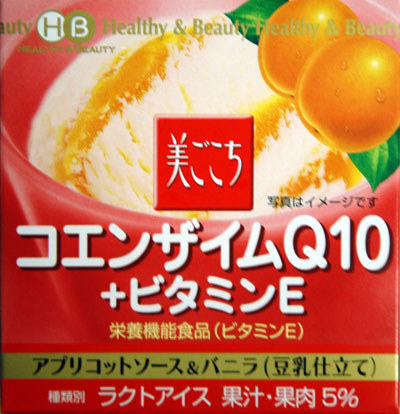
Healthy! Beauty! Dessert!
Apricot Sauce and Vanilla Soymilk Ice Cream with Co-enzyme Q10 and vitamin E. Only in Japan. From the Healthy & Beauty line by Lotte-Snow.
Tomorrow is the "official" day to start wearing summer uniforms and summery clothing like white dresses and linen suits. So keep your eyes open today, and note that the people in uniform in your neighborhood (schoolkids, policemen, railway & subway folks, construction workers) may all be dressed differently tomorrow.
June 1 kicks off the period for CoolBiz 2006, so businessmen are dressing for the summer, too. To conserve energy, the Ministry of the Environment is asking companies to keep their offices at 28°C (82°F), and workers are requested to dress appropriately - short sleeves, no ties, lightweight suits. CoolBiz style.
The department stores love this, setting up displays of ways to look corporate without a necktie, and the government sponsored a fashion event in Omotesando Hills today. But it's a hard sell. In Wakayama-ken, where the weather is warmer, the prefectural government started CoolBiz last week. According to a newspaper report only 80 of 2300 employees turned up without ties.
So get out your white shoes, press up all that lovely linen and get ready for summer dressing. It's supposed to be sunny and 28° in Tokyo tomorrow.
Moriokia Shoten. Inoue Bldg 2 #305, Nihonbashi-Kayabacho 2-17-13, Chuo-ku.
This evening I attended an opening party. It wasn't at a gallery or a museum. It was the opening of an exclusive word-of-mouth bookstore on the third floor of a delightfully vintage building overlooking Kamajima-gawa in Kayabacho.
Morioka Shoten specialises in early 20th century design, photography, art & photography books - mainly from Europe. Morioka-san, a young man who learned the trade at one of the venerable Jimbocho booksellers, has a small but impressive collection of books by Czech designer Josef ÄŒapek & his brother Karl as well as a wide variety of other interesting books.
I'm looking forward to going back on an evening when it isn't so crowded and hot to spend more time perusing the books.
My urban rainforest. Click for larger version.
I can see I'm going to keep happy during tsuyu by watching the rain on my bamboo grass. The surface tensions between the rain and the leaves form these beautiful rounded drops that sit still on the leaves.
Can you see the dust?
I've had the doors and windows open for the last couple of days to admit fresh breezes. Now everything in the house is coated with a fine, gritty layer of crud. This is how it will be for the rest of the season.
I've learned to protect my equipment with dust cloths, but no matter how frequently I wipe things down, every surface will recoat the moment I open the doors and windows. Filthy city!
Neighborhood dog
On Saturday, I made a pinhole for the digital camera. It was easy. I drilled a 1 cm hole in the center of a plastic Nikon body cap and attached a pinhole with some black tape. Then a took a lot of photos. The best of the bunch are in a Flickr set.
Herb garden
On Sunday, Tod & I went for a walk, hoping to take more pictures, and ended up buying 30 plants, two big pots and some dirt. Then we took a taxi home and got all dirty planting an herb garden in the containers. I hope these do better than my previous gardening attempts.
The Japanese government passed a law today that will affect me, most of my friends, and over 6 million other gaijin.
Foreigners visiting Japan will be photographed and fingerprinted on entry, including those living here, who will be photographed and fingerprinted upon any re-entry to Japan.
Of course, it's done in the name of anti-terrorism, safety and national security. Since the US has been doing this same thing to its foreign visitors since 2004, Japan was bound to follow. Wasn't it?
No date has been set to begin this procedure. Perhaps some of the groups that have protested can create a diversion before the government can pass the budget and schedule portions of the legislation. But that seems doubtful. This snippet from the Asahi Shimbun does not promise much good:
Meanwhile, Gayle S. Nix, a senior official at the U.S. firm Accenture, said little information is available on known terrorists and that border-control data ought to be shared among nations in the future.She said resistance to governments holding personal data such as fingerprints will likely ease over time.
Accenture also developed the fingerprint data-management system that the U.S. government adopted in 2004 to track all foreign nationals entering the United States.
Accenture won a bid from Japan last fall to develop an experimental immigration tracking system that includes integrated-circuit chip embedded cards capable of storing the fingerprint data of the holder.
The IC-card system will be used once the fingerprinting requirement legislation is passed.
Won't be long before we're all so comfy with governments "holding personal data", that we'll eagerly line up for our free, legislated RFID tags so our every move can processed to prove we're Good Citizens.
Stop this world! Let me off. What to do? What to do? Get off the grid. Start my own nation. Stop moving about in the world... I don't know how.
Hiratsuka, Kanagawa. May 5th. photo by JJ
The ocean was frigid and the waves were fierce but for some of us, swimming was an irresistable temptation.
On January 16th, I wrote about an upcoming trial of anti-terrorism facial recognition at Kasumigaseki station in central Tokyo.
The testing begins on Monday, May 1 and runs for nearly three weeks, until Friday May 19. According to an article off the Japan Economic Newswire:
The Institution for Transport Policy Studies will conduct the experiment for one hour from 2 p.m. every weekday from May 1-19 at a designated ticket gate at Kasumigaseki Station, noting that the test will involve only selected staff and no private passengers.The system is designed to issue an alert if the video monitor detects a person with facial features matching those of a person on a specified list, such as a list of criminal suspects compiled by the police or of condominium residents for checking building entrants, according to NTT Communications.
The system analyses the position of the nose and eyes as well as features of the skin from a video capture of the face, according to NTT Communications.
Technically, it can check one person against a list of 10,000 people per second, the Tokyo-based company said, adding that there is still room for enhancing the system's accuracy before the company releases it onto the market possibly next year.
I doubt they're going to get 3,600 (1 person/sec * 60 sec/min * 60 min/hour) employees together for an hour every day during the test, so they will run a limited test on a powerful system. What's the point? Couldn't they have done that in the lab?
This system offers a false sense of security and not much more. Terrorists are not going to be stopped by a facial recognition system, they'll simply avoid it or work around it by using unsuspected terrorists, plastic surgery, or taxis. If I can think of that, how hard can it be for someone determined to be bad to come up with a better plan?
I also believe that plain old security cameras are a bad way to secure something in the moment, even though they provide handy evidence after the fact. Did all the cameras in London stop the terrorist bombings last July? No. They caught the action on the day and even filmed a dry run of the event more than a week in advance, but nobody noticed and it didn't stop the bombings from happening.
Anti-terrorist measures need a little more thought.
Scott de Vacherie in Japan exhibition card
A friend's art exhibit opens tomorrow and I spent my day helping put things together at the gallery in Diakanyama. My knees are bruised from crawling around on the floor for hours and when I left at 10:30 pm, some of the exhibits still needed attention, but I'm sure everything will be prepared for the opening party in the evening.
You can find out more about the exhibition here: Scott de Vacherie in Japan or the Art Front Gallery website.
The exhibit has gotten a fair amount of press, with mentions in the Sankei Shimbun, Brutus, StudioVoice, Nippon Vogue and a few English outlets, so there should be a good turnout.
My Turning Point exam wasn't nearly as dreadful as I feared.
When I arrived at 9, there were already 22 people before me, mainly women from their mid-forties to mid-fifties I'd guess, judging from wrinkles and greyness. I saw one much older lady, but I think she was a doctor. Shortly after I arrived, a tall and swarthy man came in, so I wasn't the only foreigner there.
I didn't wait long before the first test - the barium x-ray. I'm glad it was first because I was nervous. MJ projectile vomited when she had to do it. Tod had one last year and said it was difficult and nasty. But I didn't have any trouble with the fizzy stuff or the thick barium shake they made me drink. It went right down and stayed where it belonged. I didn't even feel like burping.
The man running the machine had a patter that never stopped and alternated, rapid fire, between descriptions of what he was doing, "I'm turning the table a little to the side now", and orders for me, "I want you to turn a little to the side now." Unfortunately the distinction was sometimes lost on me and I moved when I shouldn't or turned the wrong way. He was frustrated but we flew through it only a little more slowly than other subjects.
The rest of the examination was a breeze: height & weight, urine sample, medical history, consultation with the doctor - who did nothing but wield a stethoscope - then off for an electrogardiogram, blood draw, retinal photography and a chest xray.
I was out of there in 70 minutes.
Now for the important part...what did I wear and who did I meet during my roujin debut? I chose an ensemble that expressed my casual attitude about the whole affair (yes, yes, roll your eyes): a faded rusty plaid home-made skirt, an embroidered purple t-shirt, a brown hooded sweatshirt, and brown clogs. Despite my sartorial elegance, I didn't really meet anyone. The staff were friendly and pleasant but busy. Okada-san was always before me in line. We exchanged some small smiles of encouragement, but didn't speak a word. Neither did anyone else.
I guess I'll have to find my old-lady social circle elsewhere.
Looming on my desk...
Tomorrow is my roujin debut - the Turning Point Physical Examination I wrote about last month. This could be as important for my social life in old age as it is for young mothers taking their babies to the playground for the first time. I wonder what I should wear?
The ku sent me a big manila envelope stuffed things to read, fill out, and bring with me. A medical history. A permission slip for the barium x-ray. A questionnaire about my Hepatitis C risk factors. And the "ben no torikata" - a do-it-yourself stool sampling kit.
I figured out how to use it from the pictures and simple instructions in the accompanying pamphlet. The joys of functional semi-illiteracy.
The medical history is another matter. I know that one question asks "Do you have any of the following conditions?" but except for high blood pressure I have no idea what the conditions are. One of the kanji looks like kushiage (skewered foods) over heart. What the hell is that??
I'll just answer "no" on that one and hope for the best.
Maybe as the only gaijin in the room (I can pretty safely assume), I will meet all sorts of wonderful old ladies like me. On the other hand, we're all likely to be nervous, stressed and disinclined to chitchat.
I'll report in tomorrow. For now I must fill in forms and plan my outfit.
Intensely fresh against a wet and dreary twighlight
In a surprising but unanimous blind taste test, Meiji Super Cup vanilla ice cream was voted superior to Haagen Dazs vanilla.
| Super Cup | Haagen Dazs | |
| Color | Yellow | Beige |
| Flavor | Mild vanilla start to finish | Strong alcohol aftertaste |
| Texture | Airy with soft lumps | Dense and creamy |
| Price | 100 yen/200ml | 250 yen/120ml |
| Web | スーパカップ | �ーゲンダッツ |
Maybe our three person sampling wasn't statistically significant, but we were amazed by how much we disliked the Haagen Dazs and enjoyed the domestic brand. And at quadruple the cost, how can we ever buy Haagen Dazs again?
Tod & I joined our neighbor Shinji on an outing to Satte, Saitama-ken, to view Japan's "other" spring flower, nanohana. It's called "rape" in English, which might contribute to why I never knew it in the US. When we eat it, we call it rapini.
I put a selection of our photos on Flickr if you want to see the carpet of brilliant yellow we experienced. I tried a watercolor sketch, but am not satified with it. I might use it for the basis of sone other drawing instead.
P.S. In case you wonder, it's na-no-hana, vegetable flower, not nano-hana, teeny-tiny flower.
It's the beginning of the new school year in Japan.
Walking past the local university today, I saw all of the freshmen out on campus looking dazed, carrying orientation packets, and chatting in small groups. The were busy trying to figure it all out before classes begin and signing themselves up for interesting campus organizations to meet people and fill their newly free hours after years of cram schools and entrance exam pressures.
It looked like they were new hires at a conservative company. They were all wearing suits. Everyone had fresh haircuts or carefully applied cosmetics. They were quite a contrast to the upperclassmen who were wearing jeans and artfully rumpled t-shirts, tossled hairstyles and a lot of attitude.
Some of the frosh had their parents in tow. It was cute. They looked so young-- soft-featured, unsullied, eager. Their parents seemed to be my age, which struck me as odd. Then I realised that I entered university 22 years ago.
Yeah, OK. I walked on past a little faster.
Tara chatted me this morning, "I'm going east today. You want to come along?" She's been taking advantage of her unexpectedly extended trip and trying to visit out-of-the way hanami spots around Tokyo. Today we went out to Higashi Oojima on the Toei Shinjuku line, and walked along the ����本桜 (Komatsu River 1000 Cherry Trees).
That part of town is so unlike the Tokyo we are familiar with. It is completely flat. There are wide open areas on either side of the river - playgrounds, sports fields and grassy picnic areas where you can see a lot of sky - surrounded by blocky concrete high rises in pastel colors. It looks more like Singapore or parts of China than Tokyo.
It felt like we were a thousand miles away when it was only a 20 minute subway ride from home.
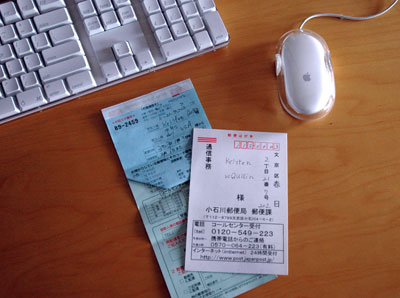
Japan's post office is very efficient. If you're not home when they deliver a parcel, they leave a slip with several options to get the package to you: stop by the post office in person, return a postcard telling them when and were to bring your box, make a phone call (in Japanese or English), or fill in a form online.
Today I figured out how to navigate the online system in Japanese. Here are instructions in English, so that you can do it, too. [nb: You must be able to type in Japanese with your computer]
URL
Go directly to the Redelivery Request Page or navigate from the Japan Post Home Page to �����申�込��付
What
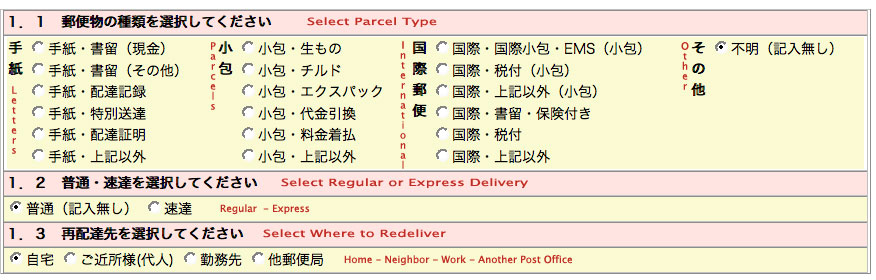 Step 1 (click for larger version)
STEP 1: Indicate what kind of parcel it is (as marked on the slip they left), whether is is regular or express mail, and where you want it redelivered. Then click the button marked 次�進む to go to the next step.
Where
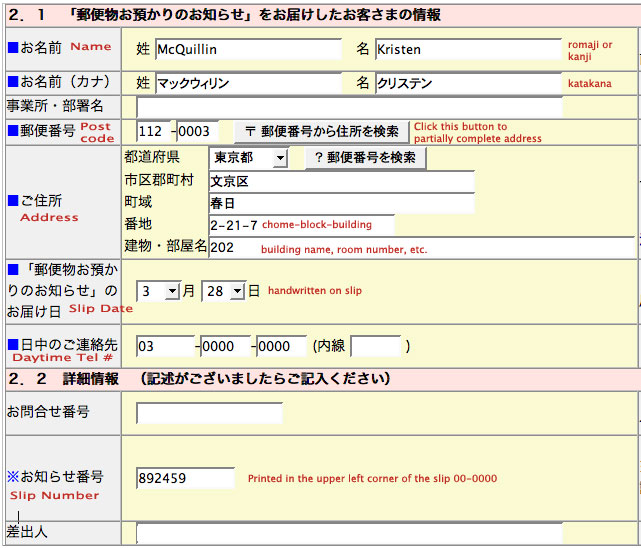 Step 2 (click for larger version)
STEP 2: On this screen, you must fill in your name and address where you want the package delivered. If you fill in the postal code and click the button next to it, the address is partially completed for you. Next comes the date the package was first delivered, folloowed by your phone number. Section 2.1 asks for the slip number. Click the button marked 次�進むto go to the next step.
When
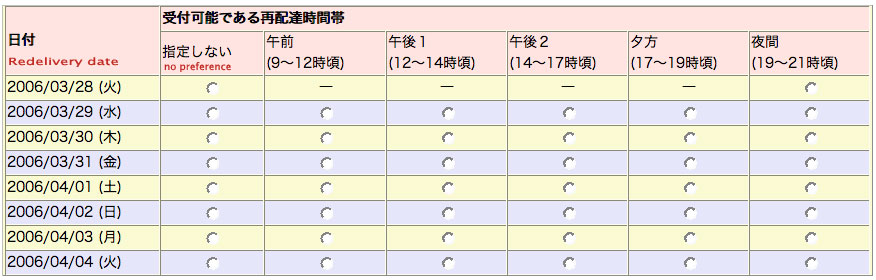 Step 3 (click for larger version)
STEP 3: Choose a date and time for redelivery. Click the button marked 次�進む to go to the next step.
Confirm
 Step 4 (click for larger version)
STEP 4: Check your work. If there's a mistake, click the button marked ��戻る to go back a page at a time and make corrections. If everything is OK, click 登録�る. On the final screen, you will see �付を完了���� (completed) and will be given a confirmation number to use if there are any problems with the redelivery.
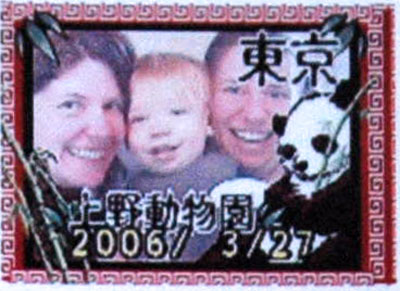
Me, Sean & Tara at the zoo
I took advantage of the lovely spring weather to go to the zoo with Tara & Sean. I love the zoo enough on my own, but watching an 18 month old enjoying the elephants, prairie dogs and penguins is a kick.
Sean toddled from place to place, signing "more, more" a lot. He figured out how to climb up onto the curbs and low railings for a better view over the handrails. And he waved goodbye to the animals before running off, hands in the air, to see something new.
He was equally fascinated with the trash cans, water fountains, and rocks. It's good to be little.
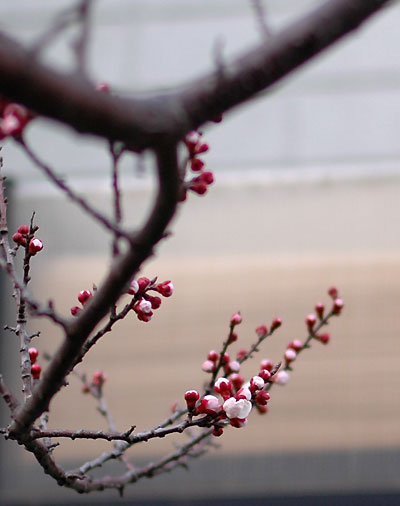
Opening
We're in the season between plum and cherry blossoms. Some of the late ume are still blooming and a few hardy sakura are just beginning to open. I caught this one in the act yesterday afternoon in my neighborhood. Official blooming is predicted for March 25th in Tokyo.
Today in the mail, I received a set of form letters from the ward office. As if shortly turning 40 weren't bad enough, now my government classes me as old.
Turning Point Physical Examination DetailsThe Kowishikawa Insurance Service Center would like to inform you that as a roujin (old person), you're entitled to a free physical examination every five years as part of your old age social insurance plan. This includes a general exam with x-ray and bloodwork, hepatitis test, and cancer screening with barium x-ray. The next scheduled date for exams is 4/19. Our records show your qualifying birthday is within the next two months. Please schedule early.
About Hepatits Virus Screening
Bunkyo-ku offers free hepatitis virus screenings every five years for its citizens starting at age 40.
Roujin Dental Exam Information
All of Bunkyo-ku "aged persons" 40 years old and over are invited to a free yearly dental examination.
At least I know where my tax yen are going. I think I'd rather have had that 988,000 yen refund, though.
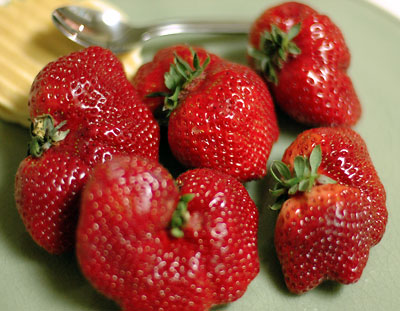
Gigantic strawberries
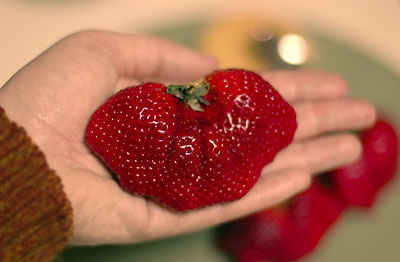
Freakishly large
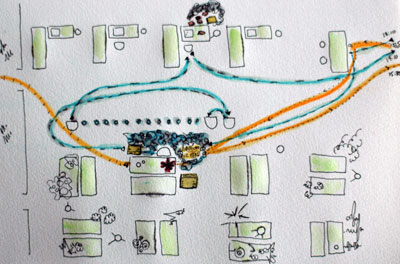
My path(s) through the tax office
Tax day in Japan is March 15th. As I had a question about my return, I bundled up all my bits of paper and walked down to the tax office after lunch today.
It's a busy place this time of year. There are forty seats at desks kittted out with pens, calculators, staplers, carbon paper and extra forms. 70% of the tables were full of harried housewives and small business owners. Another section of the large room is for consultations. I was directed there with about a half dozen other folks.
My question was answered ten minutes after I arrived, and to my surprise, I was told to get in line to use the touch panel system to fill in and print out my forms.
Fortunately there was a nice young man there to help me, because the kanji for tax-related items are quite over my head. He told me which buttons to press and where to fill in various numbers. There was some confusion about my income slips, as two clients didn't send me any, but two did. He told me what to do, and I did it.
I was out of there with a completed and signed return 59 minutes after I walked in to ask my question. Hooray. Then I got home and actually looked at the numbers on the form. Uh-oh. It showed that I should be getting a 988,000 yen refund. That's way too much. A quick calculation returned a more reasonable amount.
I turned right around and returned to the tax office. 25 minutes later, after my mistakes had been taken into the mysterious back room and corrected without my confused meddling, I was on my way with a corrected filing and still anticipating a refund.
Today I joined in with Sachiko and Yuka and sold a lot of stuff at the Shinagawa Intercity flea market.
At 8 am I loaded a suitcase, a backpack, four large paper shopping bags, a carpet, and a giant plastic crate into the van. At 5 pm I unloaded a practically empty suitcase. Almost everything sold. When I emptied my pockets and counted my wadded up notes and wonking fistful of coins, I had over 15,000 yen in profit.
It was hard won, too. Man, some of those thrifty flea market folks were relentless bargainers.
Fat Lady: How much is the skirt?
Me: 200 yen.
Fat Lady: 100 yen.
Me. Uh, no. 200 yen.
Fat Lady: How much is the dress?
Me: 200 yen.
Fat Lady: 100 yen.
Me. Uh, no. 200 yen. 400 yen for both. That's cheap!
Fat Lady: Gee, foreigners are strict.
Ojiisan: How much for the tripod?
Me: 500 yen.
Ojiisan: But it's so big. I'm really looking for a shorter one. 300 yen.
Me. Uh, no. If you want a smaller one, go buy a smaller one.
(he came back later and I sold it to him for 400 yen)
Shopper: How much for this book?
Yuka: 100 yen.
Shopper: I'm checking the original price on my keitai. Just a second.
Yuka: *rolls eyes*
Shopper: And this DVD?
Yuka: 500 yen.
Shopper: I'm checking the original price on my keitai. Just a second.
Yuka: *rolls eyes* It was 4,000 yen new.
So we worked to get rid of our treasures, even at very cheap prices. At the end we had a "tada" pile --free for the taking odds & ends--that made a few people very happy. I'm happy now that there's a bit more space in my house. Which is especially good, because Jeremy picked up a case of Coopers Pale Ale at Costco for me.
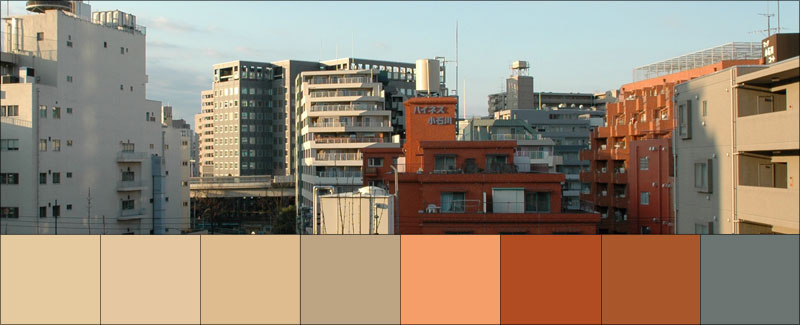
Orange light across the way
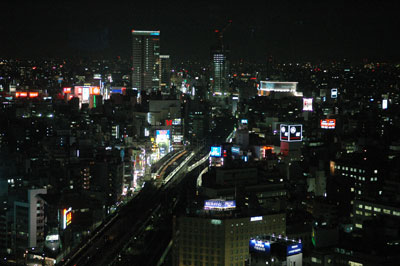
Akihabara from Otemachi
By request, a larger version (1024x768) and a bonus image from the same vantage point.
Is it possible that earthquakes happen more often when it rains? I know that's sort of like saying "every time I wear my blue underpants, the bus is late" but hey, I'm just throwing out a hypothesis.
Today was cold and soggy. This evening at 8:30, we had a nice shake, a magnitude 5.1 centered in Chiba-ken, just a couple dozen kilometers away.
The previous earthquake felt in Tokyo was on Saturday, January 14th. K and I were having a drink at Face Cafe, watching the trash float down the river near Ochanomizu Station. The tremblor at 3:30 was a 4.5 in Ibaraki-ken.
I mentioned the rain connection, and we talked about it a while. Maybe the wet ground transmits the shaking more. Maybe we're usually inside when it rains, and it's easier to feel earthquakes indoors. Maybe it rains because there is an earthquake coming. We didn't come up with a solid answer but I've learned I'm not the only person to wonder about this. There's a Q&A from the US Dept of Energy, though they pretty much dispel the idea.
I think it would be fun to get data on earthquakes and the weather then correlate it to see if I'm experiencing cognitive bias or if there might be something to this idea.
Or maybe I simply should stop wearing the blue underpants.

Snow, early Saturday morning.
It snowed, beginning at 4:01 am on Saturday morning (I know because my dear friend called me to say so) and ending on Saturday night sometime after pitch black set in.
Between those hours, we saw about 10 cm of snow fall on the city. I built a snowman in the park and watched the guard smile at it as he shut the gate for the night. I threw a snowball at Tod and watched him frown. I made cocoa from a bar of Cote d'Or Noir et Noir and enough milk to turn it milk chocolate-y. I opened the curtains in the living room and watched the snow fall.
Today the city was bedraggled white and grey. Shop owners took to the sidewalks with brooms, construction shovels, and hammers to break up the ice on the sidewalks. I slid down the hill, until I realised that the sunnier side of the street was melted clear.
More snow, please.
To attempt to combat terrorism, Tokyo will install a facial recognition system at Kasumigaseki station, the subway stop nearest the seat of government.
The software, developed by NTT Communications was the hit of last week's Ministerial Conference on International Transport Security. The system can scan faces in just a few seconds and compare them to a database of known suspects. If someone matches, an alarm goes off. Starting in March, every passenger at Kasumigaseki will be photographed, scanned and compared.
This is a stupid waste of time and an invasion of privacy for citizens and visitors.
With half a second's thought if I were a terrorist, I'd use people not suspected - single-serving terrorists - or I'd go blow up locations other than stations. Of course, I suppose just getting around Tokyo without the trains and subways would be an inconvenience, but there are always taxis, rental cars and Shank's pony.
Face recognition is an interesting technology. At My Heritage is a slightly less rude use; you can upload your picture (or anyone's) and during their beta trial see which celebrities you look like. The idea is to develop a database for geneology but it's really rather lame. If you wear glasses, it finds other people wearing similar glasses. If your head is tilted or turned, most of the matches also have tilted or turned heads.
The results from my tests with this photo and this one, indicate I look like Anna Kournikova, Helen Clark, Scarlett Johansson, and Dustin Hoffman. Hmmmm.
I hope the Tokyo trials of the terrorist facial recognition system are more precise.
Tod & I met for lunch today at an interesting French cafe in Marunouchi. Brasserie Aux Amis looks French--from the red leather seating accented with brass fittings to the drawings and writing penned on the walls. The Japanese waiters speak French. They play French radio quietly in the background. On fair days, there is sidewalk seating.
And ooo-la-la, the menu! Aux Amis offers two lunch specials (1050 yen each) that include a choice of entree and a main of fish or meat. Today's meat dish was roasted Ezo deer served with bacon-simmered potatoes and carrots. It was delicious. I had the pork rilettes for my entree. Meat, meat, meat! Tod had the fish (herb infused steamed suzuki over a creamy cabbage risotto) and started with a tiny slice of quiche lorraine. We finished off our meal with an espresso (210 yen) but were so satiated that we passed on the mocha eclair (also 210 yen).
Next time you find yourself in Marunouchi or around Yurakucho at lunchtime, I suggest you stop in. They have other restaurants and wine bars scattered through Marunouchi and Ginza, and run a small chain of flower shops.
Brasserie Aux Amis
Shin Tokyo Building, Marunouchi 3-3-1 [map]
Tel: 03-6212-1566
Monday - Friday 11:00 - 24:00 (LO)
Weekends/Holidays 11:00 - 23:00 (LO)
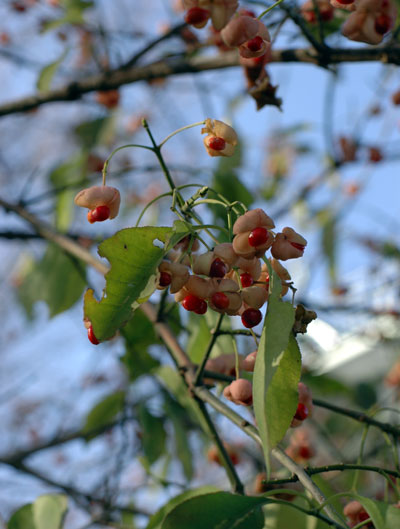
Delicate winter fruit on Mt. Futago
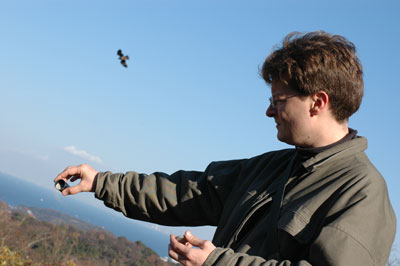
Sayonara
Taking advantage of the beautiful clear day, Tod & I hiked up to the top of Mt. Futago to scatter some of his Uncle Bernie's ashes. We visited it once before* about five and a half years ago to scatter his Aunt Sally. I feel good knowing that now they are together enjoying the view of Yokohama and Tokyo.
Mother Nature has been at work since our last visit, making it difficult to follow the course outlined in Gary D'A . Walters' Day Walks Near Tokyo. A typhoon blew through last year, downing massive trees all along the trail. We navigated over and under them to make our way through but some side trails seem to have vanished and signage is missing. The remaining signs have been helpfully annotated in marker by other hikers, though, so it's not as bad as it might have been.
At the advice of a local man we met near the trailhead, we did not take the route from the top of the mountain to Taura, as the book suggests, because the man said it was badly degraded from the storm. We walked through to Higashi-Zushi instead, which turned out to be shorter and easier than I remember the other way being. At least this time, we didn't get lost.
*I made a video that day--May 4, 2000--including the part where we got lost. You can view it here: 31 (98 MB Quicktime) duration 6'03"
In this month's issue of Health magazine, there are articles on stretches for different body types, a guide to aromatherapy, how to keep your hands and feet warm during winter, and a pull-out section on the benefits of whiskey.
Yes, you read that right. "Relaxing with Whiskey's Fragrance" is the name of the 8-page booklet. It has lovely photos of whiskey in crystal glasses, and many pretty charts proving the benefits of having a good belt after dinner. Did you know that whiskey scent is more relaxing than the smell of the forest? It's a good blood thinner, too, improving circulation (and keeping your hands and feet warmer as a consequence).
There's even a procedure for making the perfect whiskey mizu-wari to draw out the healthful aroma:
- Fill a glass halfway with ice
- Pour in a measure of whiskey
- Add mineral water in equal measure (or up to 1:2)
I guess I know what I'm going to have after dinner tonight. My feet are freezing!
Did you know that you can walk out of a station and within five minutes walk from Shinjuku-ku through one ku and into a third?
I'm not going to tell you which station or which ku. Can you figure it out?

Looking southwest at 16:41.

With Venus at 16:53.
When we go to Australia next month, we'll be throwing a little summer matsuri in the seaside village of Elliston (population about 200). We want to share the fun of a Japanese summer festival, but what are the key elements and where can you get them?
- Games: fishing, lucky draw, prizes
- Decorations: lanterns, bunting, happi coats
- Music: the traditional odori songs
- Food: Takoyaki, yakisoba, cotton candy, shaved ice, beer
Knowing where to get all this stuff--boxes of cheap plastic toys, lottery tickets, bingo cards, party costumes--makes me feel very settled in Japan. I'm not sure why.
Since our budget is very small, we won't be doing all of the above, but we'll fill in as many of the blanks as possible. It will be fun for us and I hope for the Ellistonians, too. If you happen to be in Elliston on December 20th, I don't think you'll have any trouble finding us.
Walking along the neighborhood shopping street near T's new place yesterday, we stopped to pet a huge shaggy grey cat perched on a makeshift plywood table. At the other end of the table was an older woman, long grey hair pulled back from her face, wearing clothes that looked like they'd been worn a long time. She was drawing pictures in colored pencil.
I have a feeling she is the local character who is a touch crazy but harmless. It's hard to tell in broken Japanese. She seemed happy to chat with us foreigners.
Turns out she's writing and illustrating a children's book. She gave us a plot summary and rummaged through her packrat collection of boxes and art supplies to locate a picture she wanted to show us. She sketched us a rose. I showed her my sketchbook from Paris and we traded compliments.
Despite our 15 minute conversation, we never exchanged names. But I know where to find her, as she seemed to be parked outside her own home--wedged between the fish market and the futon shop. I'll have to go back in a few weeks and find out how her meeting with the publisher went.
As reported by Kyodo News (via Japan Today), Japanese men will be buying their partners better gifts this year. They expect to spend, on average, 23,353 yen (about $195) which is 5,596 yen more than last year's present budget.
Women are also planning to spend more. Though that article indicated women were cheaper, becasue they had only added 3,959 yen to their Christmas budget for a total of 17,008 yen ($142), the ratio is just about the same--a 23% increase to the men's 24% increase.
Armed with the information from this report, I'll bet that the department stores have set their pricing accordingly. Sure enough, the first item on Takashimaya's gift list is a 23,000 yen stew pot, followed up by a 263,000 yen crystal chess set, so there may be some wishful thinking over there at the high end of the department store world.
 One of my LibriVox assignments needs some help.
James Joyce's Ulysses is being parcelled out to readers. Unlike most LibriVox readings, which are done in a quiet place and edited to remove any mistakes, this one is going to be better if done at a bar, drinking Guinness, with lots of voices chiming in.
Here's a snippet from Wikipedia about the book:
Ulysses chronicles the passage through Dublin by its main character, Leopold Bloom, during an unremarkable day, June 16, 1904.Ulysses is [...] celebrated for its groundbreaking stream-of-consciousness technique, highly experimental prose—full of puns, parodies, allusions—as well as for its rich characterizations and broad humor.
It's very funny and I have the best part--breakfast!!!
Who wants to help me read my 20 page chunk? We can either take characters (you be Leopold's voice, I'll read his thoughts, etc. I already have a friend lined up to do the meowing!), or you can have a whole page to yourself.
I'm thinking about a reading in early December on a weekday evening. At a bar (preferably Irish). I'll buy the first round. Everyone is welcome, even if you think you read terribly or are not sure you'd be good.
Sign up in the comments below and let me know what day's best for you.
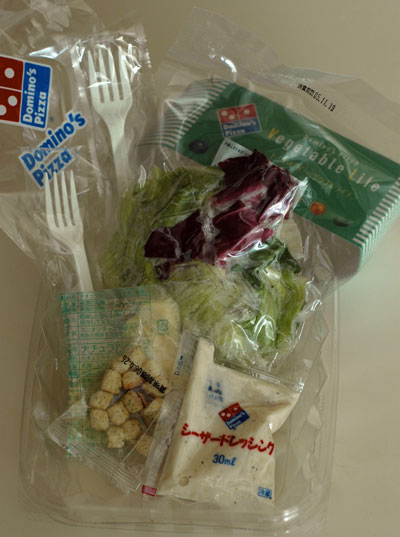
Edible parts inside.
See also Vegetable Life? on Flickr
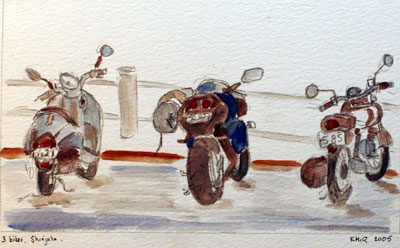
3 Bikes, Shinjuku. 12:05 - 12:50 pm
I had fun on the sketchcrawl, though it was only me and a patient non-drawing Tod (who slipped into Kinokuniya and bought me books as a surprise when I finished my drawing!)
I hope a few more people turn up next time...
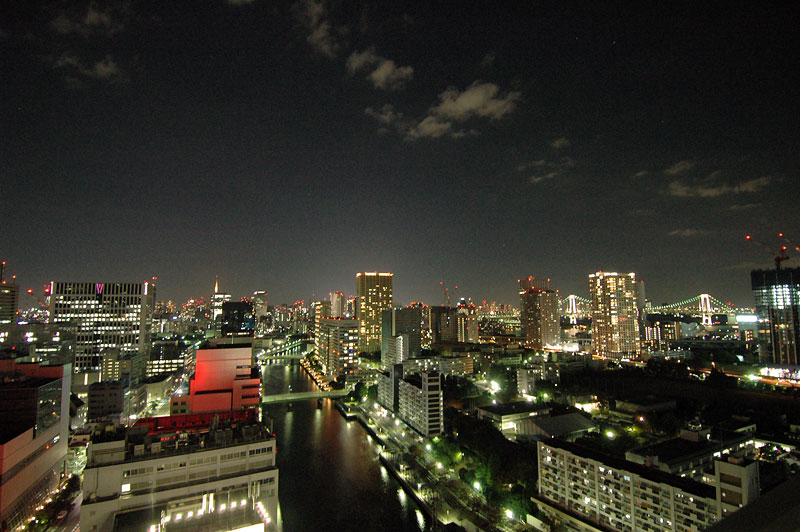
View of Tokyo from a 24th floor Shinagawa apartment. (Click for larger view)
Congratulations to Egon & Naoko on securing one of the best views in the city.
All of the neighborhood cats, usually stretched out in sunny alleys or hunkered under parked cars watching one another, have disappeared.
In their place are signs neatly laser printed and tucked into protective plastic folders explaining that recently there have been a number of incidents where cats have been killed. The causes were not stated, but the signmaker implores people to "Please be careful of your pets and children."
It's very sad. I miss the cats.

My only winning horse.
Today was the Melbourne Cup luncheon. I was sure that with the spread of horses I'd managed to collect in the various sweeps, bets and the calcutta that I'd win something--I had 11 different horses in the field of 24. But not a single one of them came in.
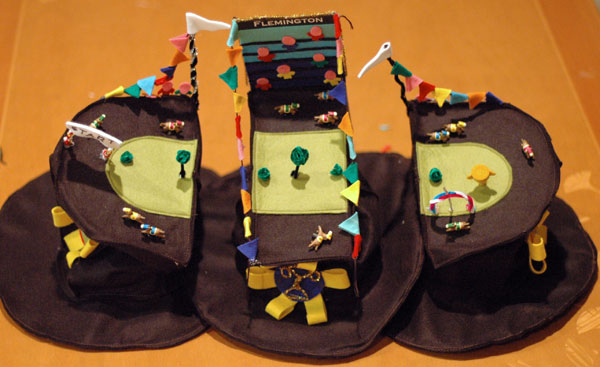
Flemington in felt.
But no matter, there was still the "fashions on the field" contest to come.
Tracey, Ashley and I laboured over the weekend on our hats, constructing a three-part racetrack from felt. I designed and sewed the hats together and the three of us decorated them with little horses, flags, a grandstand, start and finish lines. We even included sponsor logos.
Alas, we were trumped by a wide-brimmed feather-covered hat with marshmallows dangling from it like the corks people used to hang from their hats to keep away flies.
Better luck next year.
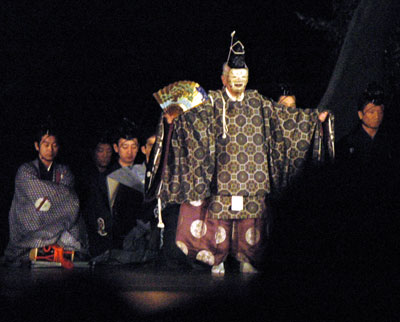
Noh performer in mask during Okina, a ritualised Okinawan form of Noh. (photo by Tod, the steady-handed)
Tonight we attended a performance of Noh plays in Shinjuku Gyoen. It was my first Noh experience and although it was a beautiful specta, even the comedic play was way over my head.
Here are two recordings from Okina, the first play. Neither is of the performer pictured above.
Okina Noh 2'13" MP3 (2 MB)
Okina Noh (2) 0'56" MP3 (884 KB)
By the intermission, we were chilled to the bone so we left the crowd of 4000 people for the warmth of dinner indoors. A shame, because the only play I knew the plot of was the one after intermission.
After dinner, we stopped to have some Pumpkin Milk. It seemed an appropriate beverage for the day. More importantly, it claims to erase irritableness and I needed it. Not sure if it worked.

Does the Flying Spaghetti Monster live in my neighborhood? (Click for larger view)
This broadsheet appeared in my mailbox for a nearby highrise. I couldn't help thinking that Verdure Residence "Foliage" might be a good place for the Flying Spaghetti Monster to live.
The Flying Spaghetti Monster, for those yet uninitiated, is a satire on the "Intelligent Design" theory of creation. His followers, who believe the FSM created the Earth and continues to influence it with His Noodly Appendage, have sent letters to all the boards of education who are advocating teaching intelligent design and have received some responses.
You can read all about FSM and his followers (the Pastafarians) at Church of the Flying Spaghetti Monster.
I can see this building from my window, so will keep an eye open for His Noodliness to come around with the moving van. If you want more information about the FSM Apartments, check out the website (in Japanese) at Joint Corporation
Good news for commuters with laptops. NTT offers wireless access points in stations all around Tokyo. Already there are over a hundred JR and commuter stations online and by mid-2006, they should have over 250 subway stations plugged into the 'Net.
Bad news is that it isn't free. Monthly access is 1575 yen, or you can buy a "time ticket" for 300 yen that's good for 12 hours. Another poor selling point is that the range is limited. For example, at Tokyo station, you can connect on platforms 14 through 19 but not 1-13.
You can find out more (in Japanese) at NTT BP.
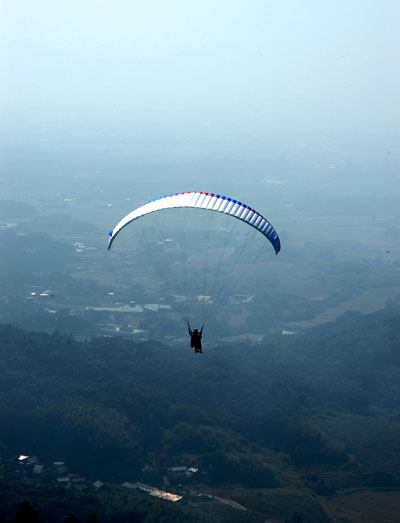
I'm flying!
This weekend we went to Ibaraki to try paragliding with the Tokyo Gaijins, a group that organizes outdoor activities like skiing and camping.
We did tandem jumping with skilled paragliders, and got to jump off a 300 meter mountain and glide through the air to land in a field at the base of the hill. It was wonderful to be in the sky. I was a bird. I stretched out my arms and felt the wind sliding past me like a current. I yearned to play with the controls.
Tod captured the moment of my stumble and the result.
My takeoff was not so smooth, though. As we ran towards the cliff, I tripped and fell, dragging Kanamoto-sensei and the wing with me. No damage done and we managed to get off the ground on the second try.
One of our party took short videos of everyone flying and she will send them to me for posting. I'll let you know when they're online.

Victory or agony? It's hard to tell.
I've been to the controversial Yasukuni Shrine a few times. This is where Koizumi gets in trouble for paying official visits because it enshrines the war dead--heros and Class A criminals alike.
Walking through it on Sunday evening, my eye fell on the large stone lanterns that flank the entrance. On each side of the hexagonal base is a bronze scultpure with a war scene from land or sea.
You can see all six of the brozes and the lantern they are attached to, in my Yasukuni Flickr set
Oyasumi Wine
It's not a nightcap. It's a packet of bath salts.
Oyasumi Wine gives your skin three rewards:1. Bright and glossy skin from wine polyphenols;
2. Healthy skin thanks to co-enzyme Q10;
3. Evening primrose oil to moisturise your skinEspecially on the nights when you're tired, the mellow beauty of red wine in the water gives you an intoxicating feeling of dreamy comfort.
It gives you comfortable sleep on the nights when your heart is tired.
Well, I could use a good tipsy sleep. I think I'll go try it out now.
Price: 158 yen
Manufacturer: Kiyo Jochugiku KK
Sales point: Shop In
Suspense Manju
This is a spin-off product from a popular Nippon Television series, Kasasu, (Tuesday Suspense Theater) that airs scary movies.
There are six cakes in the box. One of them is filled with spicy hot bean jam, instead of the usual sweet bean jam. We tried them with friends last night after Rie, Yumiko, & Yuka hummed the show's theme song.
Who got the spicy one?
Price: 630 yen
Manufacturer: Daitou AYSS
Sales point: RanKing/RanQueen
Neteru Ma-ni
This is far and away the freakiest product yet. Last night at bedtime, Tod & I taped six porous packets of odd-smelling sand-like stuff to my feet and by the morning, they'd turned into hard, goo-oozing lumps.
So what's in them and what are they doing?
The packets contain Triple Power: eucalyptus, tourmaline and agarics mushrooms. Eucalyptus is known as a remedy for a lot of things including coughs and minor scrapes. Though the tourmaline fad in Japan seems to have passed its peak, the stone still brings benefits of negative ions and far infrared rays. The mushrooms provide vitamins and minerals and are thought to prevent cancer and ward off Alzheimers. It also makes the stuff smell like a cross between a fire sale and a Russian restaurant.
According to the instructions, taping these packets to your feet detoxes you while you sleep. The main activity is in the sap from the eucalyptus.
A liberal and rough translation of the vague copy on the package:
As tree sap carries the energy from the roots to the tips of the leaves, so will this sap-infused packet carry the healing energy all through your body via the tsubo (energy points for accupuncture/shiatsu) located in your feet.
What definitely happens is that while you sleep, the eucalyptus extract heats up and melts all over your feet, making them sticky and congealing the rest of the packet. The oils in the eucalyptus also make your feet tingle a little bit. Several hours after taking off the packets, my feet still felt cool and happy, like they'd had a good massage.
Do I feel detoxed? I don't know. I will say that I'm in a better mood and more energetic today than I have been in a few days. But that could just be the amusement of leaving a trail of sticky footprints from the bed to the bath.
Price: 1,050 yen
Manufacturer: BMK
Sales Point: RanKing/RanQueen
Kan no Suke (Liver Assistant)
Here's another patent medicine with miracle curative powers. Turmeric is well-known in Japan for helping your liver to process alcohol--it's the curcumin that does the trick.
Inside the box are two sachets of granulated powder--one for before drinking and one for after. The powder is turmeric mixed with zedoary and some dried turtle bits. Zedoary is an Indian plant in the ginger family used as a medicinal stimulant.
Turmeric helps you drink more, zedoary fixes up the hangover, and the turtle stuff adds vigor to your body. Or as the company website says: Solve it, Erase it, Straighten it.
I enlisted Tod to test this out last night at Oktoberfest in Hibiya Park, though he downed the first packet with a swig of beer so I'm not sure how effective that one was.
When I asked him this morning, he said his liver felt fine and he didn't seem to have a hangover. Was it the Kan no Suke at work? Hard to tell.
Price: 315 yen
Manufacturer: Hosendo
Sales Point: RanKing/RanQueen
Yaki Katsuo (from the Ciao Cat Snack Series)
This is not the only type of cat food sold in Japan, but it is certainly the most interesting. Encased in this vacuum-packed plastic is a strip of katsuo fish (bonito) imbued with green tea essence to reduce the fishy smell. This one is regular katsuo flavor, but it also comes in scallop, sardine and even dashi (Japanese soup stock).
The packaging tells the rest of the story:
"Direct from Tosashimizu Harbour"
"Gently juicy, with lots of taste appeal. Delicious fresh ingredients to please your cat."
"Cats like salty foods. Your cat will like it even better if you heat it to body temperature before serving."
"The katsuo that come in on the Japan Current from Souda are cooked to fragrant perfection and soft juiciness to please your beloved cat."
"Soften by squeezing gently before opening."
"No artificial colors. Made in Japan."
Price: 88 yen
Manufacturer: Inaba Foods (pet food division)
Sales point: Seifu supermarket
Kome-touban
Most Japanese homes (if not all) store their rice in a big, boxy container that holds five or ten kilograms of rice. It gets used up quickly, but bugs love rice as much as people. So what to do? Put this insect repellent in it.
The 10 cm tall plastic pepper goes into your rice bin and repels weevils and other pests for up to six months. As the pepper samurai on the package insists, "Rice is delicious!" Togarashi Power!
Kome-touban is made from togarashi, cayene chili pepper, in a gel base. A list of points on the back:
- Togarashi extract and fermented alcohol protects the rice from bugs.
- When the product runs low, it's easy tell when to exchange it
- The alcohol in the product keeps your rice appetising and keeps mildew and bacteria at bay.
- You can use it in a rice bag or in your rice box
But it says that if you store eggs in your rice, you might get bugs anyway. (Who puts eggs in their rice??)
It also warns not to eat the contents and if you do, to call the ambulance for aid. The gel is highly flammable. Dangerous stuff...
Price: 398 yen
Manufacturer: ST Chemical Corporation
Sales point: Seifu supermarket
It's Freaky Japanese Products Week at mediatinker. All week long, I'm going to buy some of the strange and wacky things in Japanese shops. I'm looking for fads, trends and short-lived phenomenon that rake in the yen for manufacturers.
Collagen Marshmallows
Collagen is what makes skin elastic and taking supplements is good for aging skin, they say. There are tons of collagen-rich facial treatments, pills and creams on the market but I've never seen collagen marshmallows before today.
For only 122 yen, I purchased a 50 gram packet of lightly grapefruit flavored marshmallows at the local drugstore.
Normal marshmallows contain about 300 mg of collagen (it's processed from cow and pig marrow into the gelatine that makes marshmallows gummy) but these balls of chewy sweetness contain 3000 mg through added collagen peptides. That's quite a bit and the instructions say you should eat half a packet a day.
Price: 122 yen
Manufacturer: Eiwa Confectionary Company
Sales Point: local drugstore
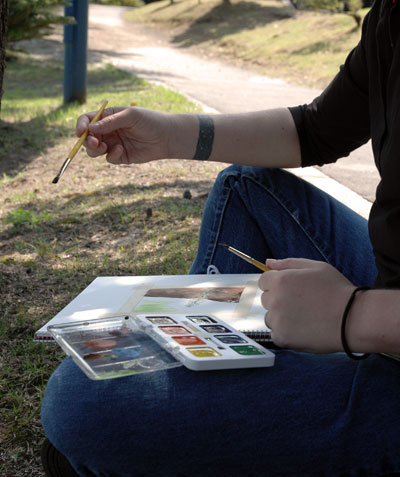
Two-fisted painting
Having quickly tired of the bath and hotel, I spent the second morning drawing a little bit of tree trunk after having another walk around the grounds. I made a recording of birds sounds with a stream burbling in the background (and a bit of a breeze, too).
Karuizawa Birdsong 1'59" MP3 (1.8 MB)
(Click to see the photo Tod snapped while I was recording--if you listen carefully, you can hear his camera's shutter.)
After lunch, Tod rented a bicycle and scouted out the rest of the complex while I sat on a moss covered rise to execute a a bunch of 60 second sketches as a drawing exercise.
We were to take up the tour again at 14:20, but the bus was two hours late--stuck in traffic on the way from Tokyo. By the time we left the hotel theday was fading. Our apple picking and grape picking were reduced to short hops off the bus at roadside stands in the pitch dark to be handed some fruit and shuffled back onto the bus. Terribly disappointing, as I'd looked forward to standing in the orchard and smelling the fruit and the earth.
We arrived at home 4 hours late. We'll never do a bus tour on a weekend (particularly a holiday weekend) again.
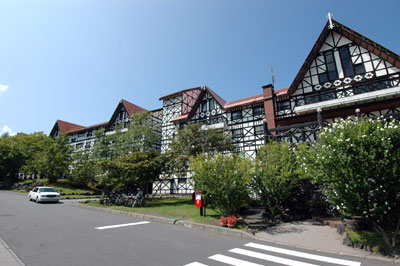
Hotel Green Plaza, Karuizawa
One thing Tod & I had never done until this weekend was to take a Japanese bus tour. They seem the province of older Japanses folks, but this is "Respect for the Aged" weekend, so it was the right way to celebrate.
We showed up on time at the appointed departure place, but screwed up right away by failing to notice the seating assignments posted on the door of the luxury bus. We really bollocksed up the works by sitting two rows ahead of where we were assigned. Because we couldn't fight our way back down to the front of the bus, a fellow passenger had to check the chart and shout our assignment to us. Embarrassing, but it was our only obvious error of the day.
The bus started off with two rounds of applause (for the guide and the driver) and a lot of explanations. We were offered the choice of reserving a popular lunch option for our meal stop, and a bento for the return trip the next day. We opted for both, as it seemed simplest.
Lunch was kamameshi, a steamed rice and chicken dish, at a roadside restaurant that's been serving it for 120 years. I guess that makes is popular, as advertised. They certainly had the bus tour business down pat. A man with a flag bearing the restaurant's logo greeted our bus as we pulled into the parking lot He waved teh flag high as he lead the lunching crowd through the gift shop and upstairs to our long table in the restaurant.
Back on the bus, we continued north to Karuizawa, a famous mountain resort area where many well-off families have summer homes. We'd spend the night at a hotel and on the way back, we'd stop along the way to pick apples and grapes.
"Karuizawa is a little bit interesting," my friend Elizabeth warned me. "It's where the upper middle class go for the summer, and it's a mix of Western styles and Japanese tastes."
She was more spot-on than I imagined. Many of the buildings, including the hotel, are half-timbered Swiss look-alikes. The summer homes span a wide range of styles, none of them particularly Japanese. Our hotel room was split in two: half the room was carpeted, papered in a floral design and sported twin beds. The other half was tatami with a low table, zabuton cushions and the ubiquitous complimentary green tea.
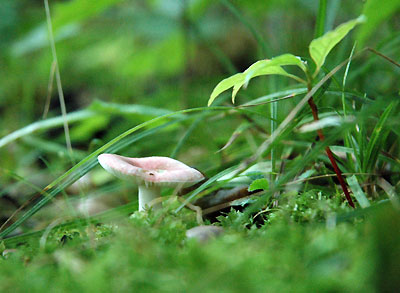
Beautiful flora
Shaking our heads in wonder, we headed outside to walk around the complex. The air smelled clean and woodsy and it wasn't long before we were off the beaten path and hunting for interesting flora and fauna. I spotted a pink mushroom; we marvelled at moss and discovered a well-contained stream meandering through the property.
Of course, we enjoyed an onsen bath and the hotel's extensive buffet dinner before heading off to bed. We had more fun in store for us the next day...
I had the honor of paging through the only printed copy of my friend Elizabeth's new book this week. It's gorgeous, though she worries it is too heavy. I disagree; the book has a good heft.
But better than weight, it has recipes! From fish to desserts, there are fabulous Japanese dishes to cook, a richly illustrated "pantry" section, and lots of tips and kitchen techniques. It really is a marvel. I've eaten with Elizabeth many times and she is a master chef, even when we're just having a casual lunch while computer troubleshooting.
Washoku, Recipes from the Japanese Home Kitchen is due in bookstores next month and available for preorder from Tenspeed Press, and at Amazon.
Elizabeth talked with me about the book, along with one of my favorite topics, Japanese pickles, in my recent Hanashi Station show, Japanese Kitchen. (12.1 MB MP3)
Have a listen and order the book (unless you're on my Christmas list, in which case...surprise! You're getting a cookbook this year!). Elizabeth has a US book tour lined up, so check her calendar at Taste of Culture and see if she's going to be in your area soon.
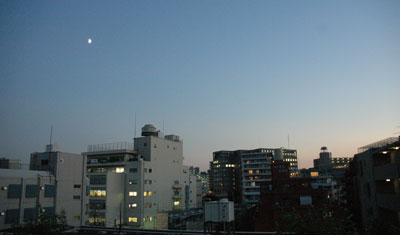
The evening sky at 6 pm
I woke to the sound of crickets this morning--a promise of cool weather to come. I recorded their quiet chirping outside my office this evening complete with kids playing and a train rushing past at the end:
Early Autumn Evening 0'56" MP3 (864 KB)
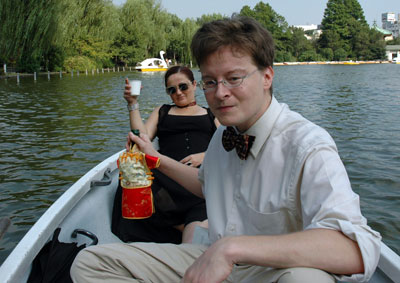
Audrey Hepburn (Tracey) and Jimmy Stewart (Tod) enjoy the drinks.
Some days are performance art, honestly. How else could I leave the house dressed as a water sprite?
The boating party was tiny--Tod, Tracey and me--but lots of fun anyway. Tod rowed us out to the middle of the pond and set us to drift. We popped the cork on a bottle of sprkling wine and noshed on cheese, crackers, fruit and cookies.
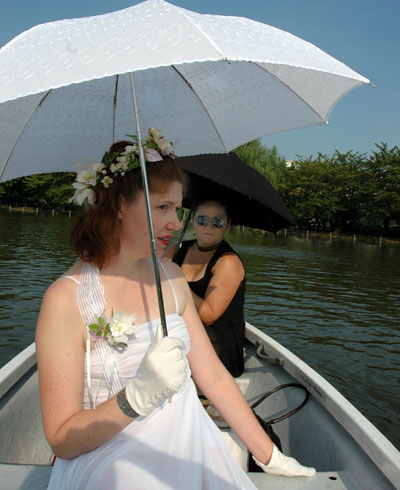
Me and Tracey, a study in contrasts.
The best part of the afternoon was watching people on shore and the other boaters watch us. Some waved, some looked away, a few called out to us. Most just smiled. We really did resemble like the painting on the invitation with our parasols and dress up clothes.
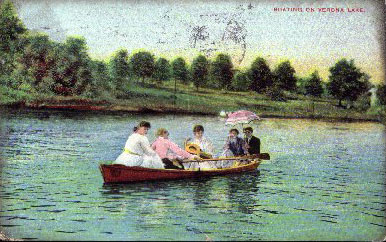
Boating Party
Saturday, September 10
14:30 - 16:30
Shinobazu pond boathouse, Ueno Park
Cost: boat rental, 600 - 700 yen/hour
Please come to our second dress-up party. Wear your favorite summer frock, hat, gloves & parasol--or don your tux or suit--for an elegant row around the pond at Ueno. If you'd like, bring some light snacks and drinks for a mid-pond picnic. I'm planning a bottle of champagne and some nibbles.
Everyone is welcome; no RSVP necessary, though you may leave a comment if you want to signal your attendance or have a question.
After enjoying a private bath together after dinner, Jim, Tod & I retreated to the 8th floor to sit outside on plastic deck chairs. Yuka went off for a massage and facial. I needed a Scotch.
So Tod & I went up to the observation lounge bar (open at long last) where a passel of yukata-clad salarymen were wailing karaoke. We scooted around them and bellied up to the bar.
Tod asked the barman if we could get some drinks to take downstairs. Sure, no problem. Could we charge them to our room? Yes, absoutely. He called over a girl dressed in a blue plaid uniform and asked her to pour our drinks while he wrote up the check.
"Um, straight, please," Tod reminded her. "No ice."
"And no water?"
"Right. No water."
This confusion lead her to pour our liquor like it was oolong cha. She finished off a bottle and her manager handed her a new one to top up the third drink. We received three juice glasses with five fingers of scotch each. Total bill: 1500 yen.
We laughed all the way to our deck chairs and the unfinished portion of our Scotch came home in my thermos bottle.
We spent today recovering from the excitement of the Expo by sitting around our seaside onsen hotel in Nishiura.
After 9:30 am, we were the only guests in the entire building. I don't know where everyone else went, but we encountered no other guests. Everything in the hotel was closed. Lights were off in the hallways. Staff walked by like zombies in a videogame. It was spooky, and Jim captured it all on film.
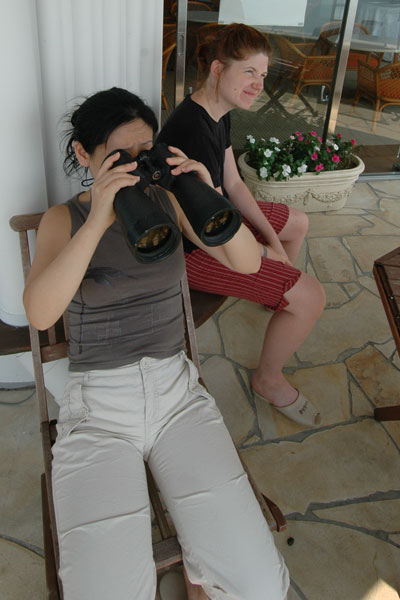
Looking at the sea
So we took advantage of the situation and chilled out on the abandoned 10th floor observation lounge. There were hawks to watch and conversations to enjoy. Tod sussed out the CD player for the lounge and we listened to music and danced. It was a good day.
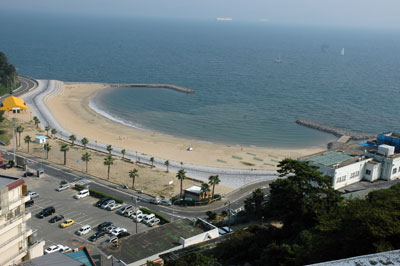
Nishiura beach
In the late afternoon, when the unforgiving heat had eased a little bit, we went down to the beach.
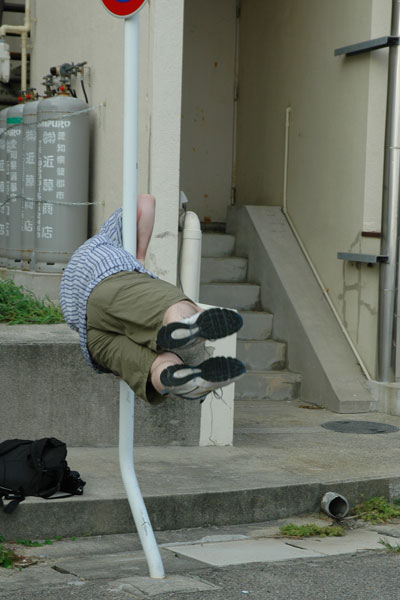
Jim does tricks
Jim amused us and the doormen at beach hotel with his pole trick. I think this is something that only men can do. Despite our efforts, Yuka and I failed to levitate.
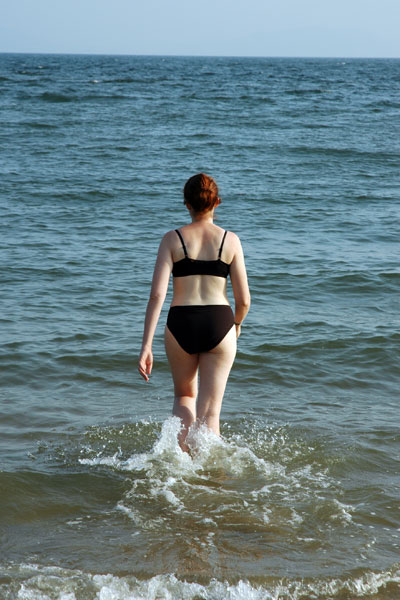
Walking into the ocean
But we did get to swim in the sea. Yuka had the foresight to wear her bathing suit. I swam in my underwear again. Tod & Jim weren't so brave; they stayed on shore.
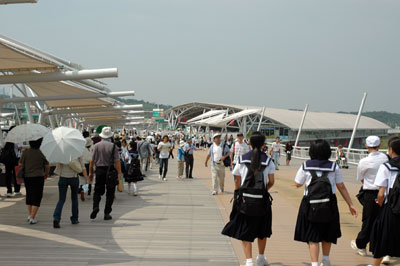
The main walkway at the Expo
Wow, it was hot. For an environment-and-forest themed Expo, there was an amazing lack of shade. But we sweated it out and thanks to the Belgian-Luxembourg Chamber of Commerce in Japan, we had special access to seven of the national pavilions, so we didn't have to wait in line.
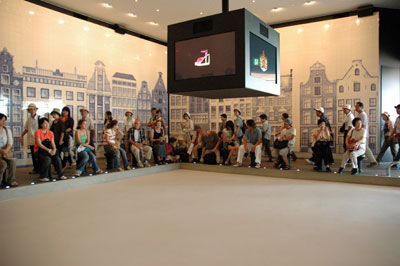
Visitors file into the Holland pavilion theatre
The one I liked best was Holland's. I cried tears of awe as I watched the film they created. It was a magical piece of editing that used four high definition projectors aimed at the floor and four vertical screens arranged in a cube. Water and kanji dripped from the screen to the floor, then swirled into a series of maps showing Holland's spice explorations followed by montages of modern Holland and its people. Metropolisfilm in Utrecht did this video. I want to go work with them.
For lunch we stood in line, but it was worth it to have proper Polish pierogies. Mmmmmmmm.
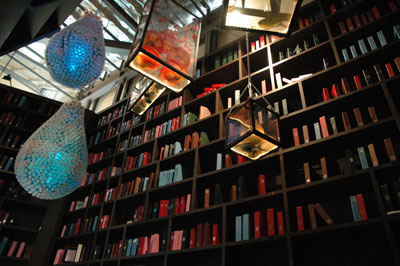
The library at the Singapore pavilion
Other highlights: the awesome science in the German pavillion, the library in the Singapore pavillion, and the experiences in Austria--waltzing and sledding.
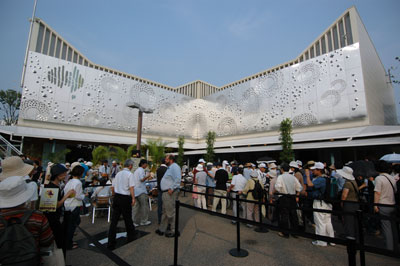
The Australia pavilion's beautiful facade
We did not visit the mammoth or encounter the robots and saw only a small fracton of what was on offer. But it was a full day from which we retreated, exhausted and a little cranky, to a satellite venue organized by the local village.
The evening wasn't what we expected at all--just a few visitors and a lot of staff trying to be very kind to us. They seemed lonely and a little bit desperate. As one woman explained, the Expo has only taken money away from the town. Everyone visiting the area is going to the Expo, and not to the village attractons (though I have no idea what those are).
But despite the pathos, we got to try on replica Japanese armour and that was fun. My posse and I are not going to win any wars, I think...
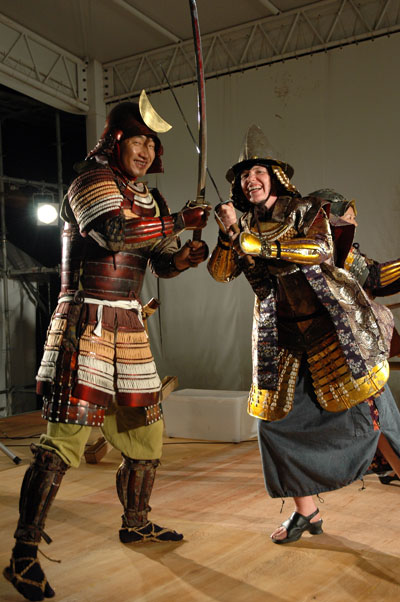
Kristen, the giggling samurai
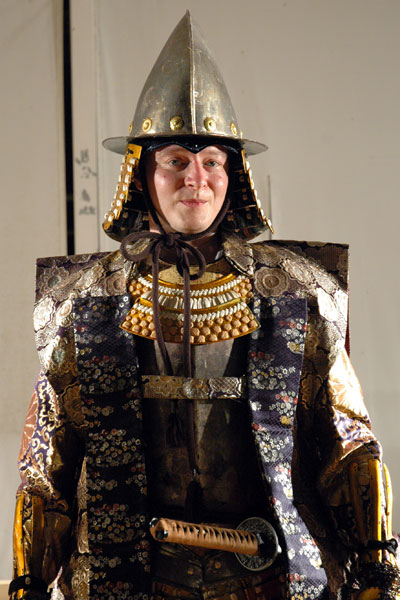
Tod, the elf-warrior
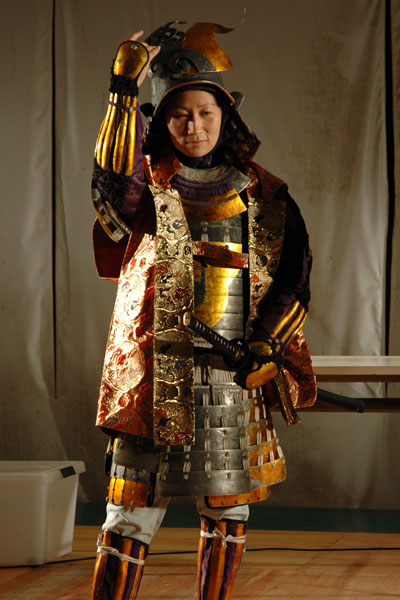
Yuka, the graceful soldier
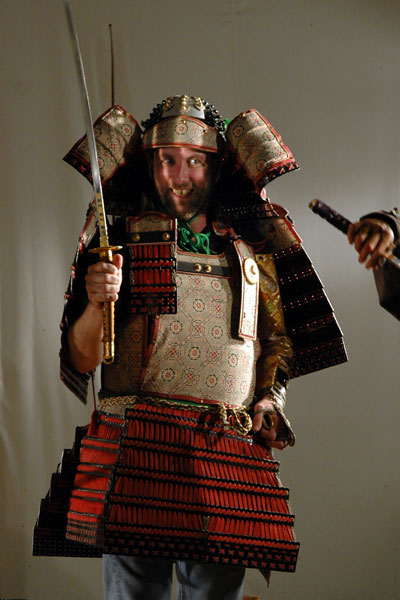
Jim, the shining samurai
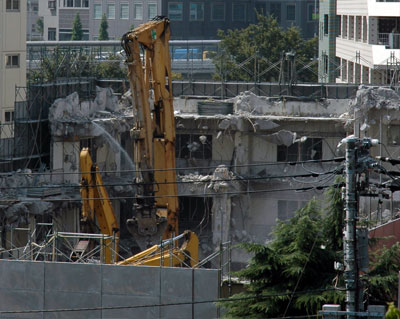
Blue truck on Expressway #5
"Oh, red flashing lights over on the highway," I noted to Tod last night, as a police traffic stop caught my eye.
What I didn't twig to was that I haven't seen the highway from our veranda since they finished building the ugly green striped apartment building last year.
The destruction of the building across the way is moving along quickly. The workmen remove the metal sheathing as they pull down each floor, so now we can see all the way across to the highway. I wonder what they are going to build here?
Tod & I and a large bunch of friends spent the day at a park bigger than a breadbox. We had to take the train out to Tachikawa to do it, but it was worth the 45 minute trip.
Showa Kinen Koen (Showa Memorial Park) used to be a military base. Now it's a giant playground. There's a series of shallow swimming pools and four waterslides; a mini-golf course, croquet lawn, frisbee golf course, boat rental, a bike trail, gardens & forests, a huge cargo net for climbing, and a series of bouncy trampoline hills.
If you want to splash in the wave pool or waterslide, hurry out to Tachikawa--the pool closes on September 4th. The rest of the park is open year round.
Miyakoya knife
Although it's said that giving a knife as a gift severs a friendship, that didn't stop Jim from presenting me with this one last night. (If I give him a coin as "payment" for the knife, that should hold off the bad luck and we can remain friends.)
I've often admired his collection of beautiful, antique Japanese steel knives and I love to help make dinner in his kitchen just so I get to use them. My knife is new, flat tipped, double bevelled along its 7 inch blade, and ever-so-slightly curved for chopping vegetables. It has a good weight and balance. I'm looking forward to wearing in the handle and gently reshaping the blade to my stroke as I use it.
Thank you, Jim.
Boating Party
Saturday, September 10 (rain date: Sept 11)
14:30 - 16:30
Shinobazu pond boathouse, Ueno Park
Cost: boat rental, 600 - 700 yen/hour
Please come to our second dress-up party. Wear your favorite summer frock, hat, gloves & parasol--or don your tux or suit--for an elegant row around the pond at Ueno. If you'd like, bring some light snacks and drinks for a mid-pond picnic.
Everyone is welcome; no RSVP necessary, though you may leave a comment if you want to signal your attendance or have a question.
Today we went to a Korean wedding. Tod's colleague, Sukki, was getting married formally, after having been married officially for four years. It was unlike any wedding I've ever attended.
The first hour was a Korean ceremony. The mothers entered and lit candles. Then to a fanfare of immense proportions, Sukki and Chang appeared in the spotlight. They wore wore bright traditional costumes--purple and fuchsia with lots of embroidery--and elaborate headdresses. Their resumes were read aloud and they recited some stuff in Korean, then signed a certificate and exchanged gifts. Sukki has a wedding ring now; Chang got a watch. They displayed them proudly for photos and then disappeared a while to change.
In the meantime, we indulged in a feast of Chinese food. We were seated with some of Tod's coworkers who are all fun to be around and the conversation was a mix of Japanese and English. The meal was fabulous and we were drinking some sort of strange carmel colored shochu that tasted like rancid soy sauce. Sounds nasty, but was actually pleasant over ice.
After three or four courses, Sukki and Chang reappeared in less elaborate, but still Korean, outfits. Chang wore an ivory colored suit with a long coat; Sukki wore a pale purple hoop-skirted Korean dress and had flowers woven into her hair. They sat together at the head table while people made speeches to them. During the speeches, friends and family lined up at the table to pour them beer after beer. I don't think they ate anything, so I imagine they were quite tipsy.
And then the dancing began. It was graceful but energetic--arms outstretched and waving with feet stepping side to side just a little. It is the perfect dance for the vivid Korean bell-skirted gowns. The women looked like flowers in a breeze.
I was dragged into the dancing early on by one of the men I thought of as "the crazy uncles" and immediately found myself holding hands with the groom. I danced with Chang twice as I was passed around the circle of dancers. It was only later, after many people commented on my dancing (which is nothing to comment on) that I figured out that I was the only white woman at the wedding. I forget what a curiousity Tod & I are among our circle. Most of our other foreign friends have Japanese partners.
After the dancing, there were speeches by Sukki and Chang to their parents and they presented flowers to their mothers. It was very touching. Chang's father made a very funny speech in Korean and Japanese. Then it was time to go, four hours after we began.
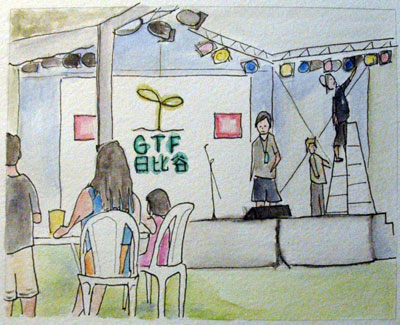
Hibiya Park, 7:05 pm
To celebrate my last day as FCCJ's webmaster, I walked to the park after work to sketch for a while before meeting up with MJ. Imagine my surprise when I discovered the Greater Tokyo Festival in full swing. I sketched for a bit near my favorite pond, then followed my ears to the music. I drew this as I waited for the next set to begin. It's annoyingly cartoonish and flat. I need to develop quicker realism. Anyone have pointers or cheats I can try?
MJ met me at the park, then Tod joined us and we had an alfresco dinner of good Aussie red (Tod brought it with him) and falafels from an Israeli falafel truck. The Japnese couples sitting near us must have thought we were crazy when we began to dance to "Can't Take My Eyes Off of You," but we had fun.
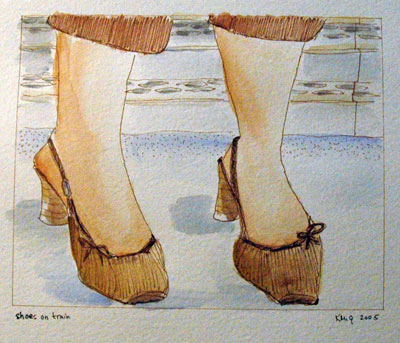
Fashionable commuter feet.
Yesterday afternoon, I whipped out my sketchbook on the train and drew some shoes. But the feet in them kept moving around and they got off a few stops after I started sketching, so the drawing is really loose and wonky. But I like it anyway and colored it in this evening (loosely and wonkily)
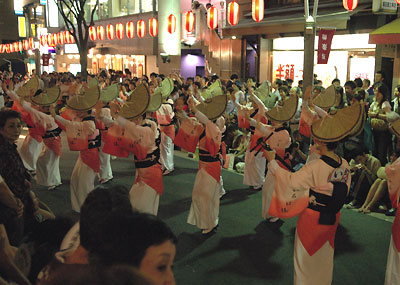
Last night Kagurazaka's main street filled with traditional dancers
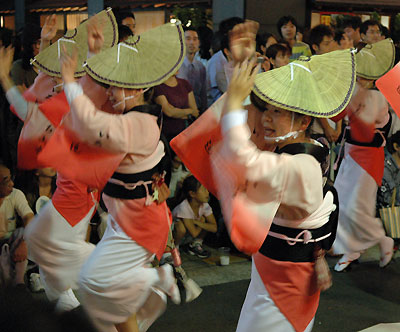
Dancers waved their hands gracefully while stepping on tiptoe and chanting in high-pitched voices
Musicians played gongs, drums, and wooden flutes as live accompaniment
The music was very loud and vibrated through our bones. I recorded some of it to share with you:
Awa Odori music 1'00" MP3 (950 KB)
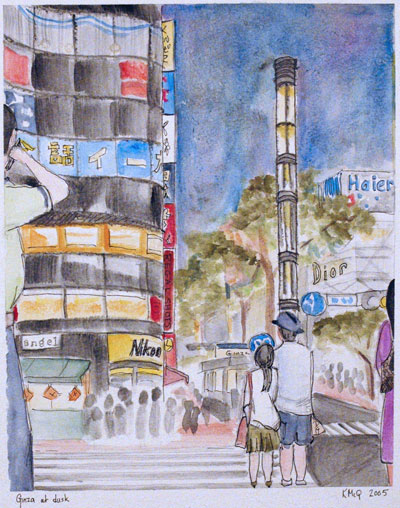
The neon glow isn't as obvious when I draw it
After work today, I walked over to Ginza and plopped myself on a low stone wall to draw. I wanted to try to capture the glow of neon against the early evening sky. It was as challenging as I expected and I learned a lot that I will put to good use next time I am out drawing at that time of day.
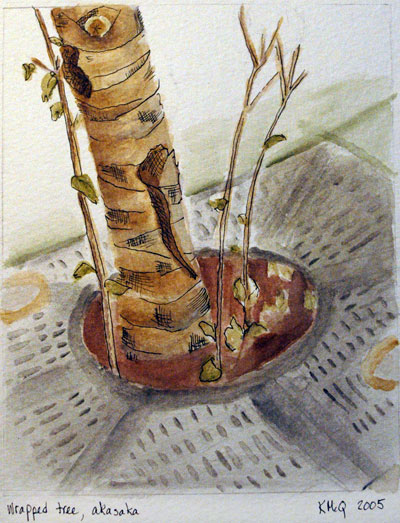
Nature tamed but still weedy in Tokyo
I passed a pleasant hour in Akasaka this afternoon. I had the presence of mind to set my keitai alarm before I started drawing so that I wouldn't be late for my lunch date. Time slips away very quickly when I'm playing with my pencils.
Bubbles on a temple basin. Koishikawa Enma.
Tall glass of water
Beads of liquid crystal form
How quickly ice melts
Stilton, white sangria, and candles
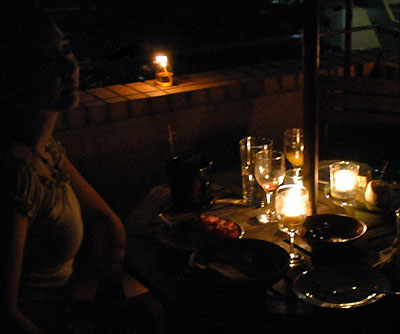
Sachiko by candlelight on the verandah.
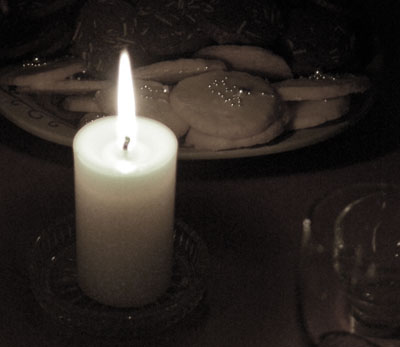
Tomorrow at 06:46 UTC (15:46 in Tokyo) is the summer solstice, marking another quarter turn of the Earth around the sun and longest daylight period of the year. I'm going to take part in a quiet event called Candle Night.
From 8 to 10 pm, I'll turn off the electric lights and enjoy a house lit by candles. Maybe I'll enjoy a glass of wine on the veranda, or a quiet chat with friends over a candlelit dinner I've cooked from scratch. Maybe we'll make some music. Whatever we do, I imagine a slow and mellow evening to match the lighting.
There are 330 Candle Night events in Japan, including live music around town and GeshiFest in Yoyogi Koen tomorrow evening. Tokyo Tower was unlit on Saturday as part of the project. Will you take part, too, to mark the quarter year?
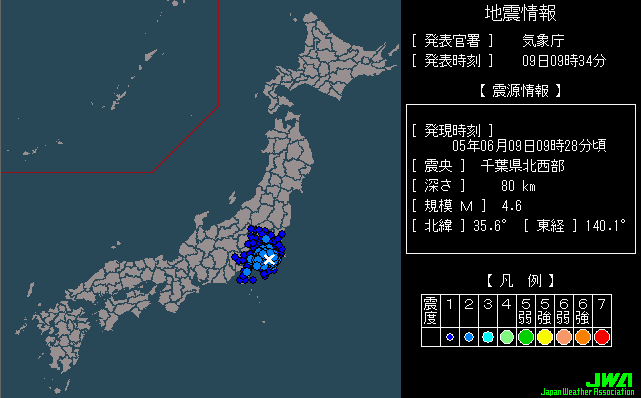
For the first time in a long while, my heart leaped and I exclaimed as I felt the jolt of an earthquake. This morning's tremor was abrupt and sent the G5 rocking back and forth on the rack.
It was only a magnitude 4.6, only a 2 on teh Japanese scale, and centered in nearby Chiba. I'm not sure why this one shocked me more than other recent ones, but I'm glad to know that I've generally gotten used to earthquakes.
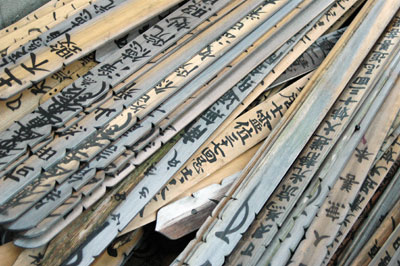
Prayer sticks, Aoyama Cemetery Photo by Tod.
A few minutes walk from Shinjuku's East exit you will find a two-hour getaway--quite a few of them, in fact--in the form of love hotels. I don't know if love hotels exist outside Japan but they certainly don't rear their heads in America, so for the benefit of foreign readers, here's a brief description of the neighborhood and the hotel I visited this evening.
Shinjuku's Kabukicho 2-chome is adjacent to one of Tokyo's seedier neighborhoods: Kabukicho 1-chome is all sex shops and massage parlors lining the neon-lit streets; young toughs in suits and over-coiffed hair stand outside to entice customers into their establishments. Not quite as blatant and a bit of a step up, Kabukicho 2-chome is known for well-appointed short-term hotels.
Hotel Tiffard is one of these places, about halfway down the main avenue of hotels. It doesn't stand out among the rest but it seems as good as any of the others. On a weeknight 6800 yen gets you two hours in room 508--equipped with a Jacuzzi, a steam sauna, karaoke service, a vending machine full of toys, and dimmable lighting.
Two points worth noting:
1) Get out before the clock rolls over 2 hours or you will pay for an extra half hour even if you are only 2 minutes past the checkout. If you want a leisurely pace, it's better to pay for the "stay" than the briefer "rest."
2) Be sure to visit Shinanoya at the corner before you head up the street. I swear this place has the best selection of Scotch and bourbon in Tokyo. And not a shabby wine list, either. There were several Margaret River wines I haven't seen before and a good selection of the usual favorites. (Plus some with screw tops, which are handy if you've forgotten your wine pull.)
It feels naughty to return home on the last train of the evening and realise that 20 minutes earlier you were enjoying the best amenities of a hotel room. Piqued your interest? Here's a coupon
Laurent in tux and umbrella.
It showered during yesterday evening's concert, but that didn't stop our crowd of 17 sartorially elegant socialisers from enjoying ourselves at the first dress-up event.
Jim & I danced in the rain. (courtesy of Tracey)
Yuka and I smile for Jonathan.
Jonathan and Tod took hundreds of photos; a select gallery of 27 images is online.
Our private classical concert
After the jazz concert at the park, we enjoyed dinner at Kaneko in Komagome. The other group in the restaurant with us were classical musicians. They played for about 15 minutes and finished off our evening on a wonderful note. Tracey captured a few seconds of video on her keitai during this private concert.
Violin solo (150K .mov)
Bolero video (250K .mov)
A swarm of chartreuse gnats hovers in the sunlight. The air vibrates with life until the sun goes behind a cloud, then they disappear.
Technology has revealed two classes of taxi drivers: the old school drivers who have memorised every road, turning and landmark in the city and can optimize a route from any point A to any point B taking into consideration the typical traffic conditions; and the younger generation who rely on car navi systems to tell them where to go.
Tod encountered this yesterday when he took a taxi from his office to meet me at a museum in Ueno, a distance of about 3 km. "Ueno park, please, but not via Chuo-dori because there is a festival going on," he instructed the driver.
The youthful driver punched the coordinates into his navigation system and then consulted it at every pause in the drive. Red light: switch view to a wider area. Stalled traffic: scroll along the route. Waiting to turn: flip on the "street level" viewer to see the intersection.
That driver is never going to learn how to get from Otemachi to Ueno on the back streets, even though he did it yesterday.
This morning, Tod & I finally got ourselves to the police station to report the three robberies we've suffered since March. I was a little bit nervous--would they get all "I sorry, no speak Engrish" when we spoke to them in Japanese? Would they dismiss our robberies as trivial? Would we get into trouble somehow?
I shouldn't have worried. After arousing an initial curiosity from all and sundry at the Reception counter, the staff quieted down and a man in a fishing vest took our report in hand and told us to sit and wait.
Tod passed the time reading all the posters in the lobby--aloud. Did you know that over 50% of burglars enter by breaking a window? Or that robberies trend upwards in the autumn? Neither did I. By the time Tod was done with the posters, Mr. Vest emerged from a side door with his colleague, Mr. Briefcase. "Let's go," Mr. Vest said enthusiastically, brandishing a digital camera.
And we were off to study the scene of the crime. Mr. Briefcase opened up his kit and examined the genkan with a strong light (so much dirt!) and dusted for fingerprints with a soft rabbit hair brush and some grey powder. Mr. Vest went downstairs to talk to the management guys and to test the door. He showed Tod how most "auto-lock" lobby doors can be fooled into opening by sliding a paper through the door from the outer lobby and waving it around. So much for security.
But that's not how our robber got in. Mr. Vest spotted a footprint and some dirt on the sill of the window in the lobby that overlooks a small garden. The window had been left unlocked for air circulation, as it sometimes is. The robber scaled the wall, dropped into the garden and slipped in through the window, bypassing the auto-lock door.
After nearly an hour of investigations, a brief visit from the police chief, and a few minutes fingerprinting us for comparison with prints gathered, our two detectives went back to the station.
Mr. Vest told us that they catch about 70% of the burglars they seek; I hope we're on the side of success.
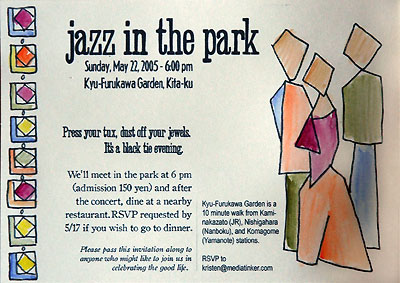
Press your tux, dust off your jewels. It's a black tie evening.
Sunday May 22, 2005
6:00 pm - 7:00 pm (dinner to follow)
Kyu-Furukawa Garden, Kita-ku (Map & info: English - Japanese
This is a free jazz concert featuring vocalist Miyuki Komatsu held at one of Tokyo's most beautiful parks.
Let's dress up and make it a special event (and a spectacle for the other people attending). Dinner is optional afterwards--I'm thinking of Isou Ryouri Kaneko, a fish restaurant in Komagome. If you'd like to eat with the party, please e-mail me before the 17th so I can reserve sufficient tables.
Why dress up for a concert and dinner? A while back, my friends and I were distressed that we have lovely frocks that we rarely use. Well, that's easily corrected. Jazz in the Park launches series of formal dress events, though the events themselves may not always be formal. Anyone is welcome to attend, just put on your best ballgown, cocktail dress, tuxedo, dinner jacket, or suit.
Coming soon: Dress-up Dim Sum, Ballgowns at the Ball Park, and Fireworks in Frocks.
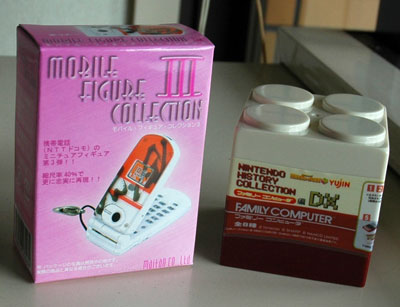
The boxes caught my eye at 7-11.
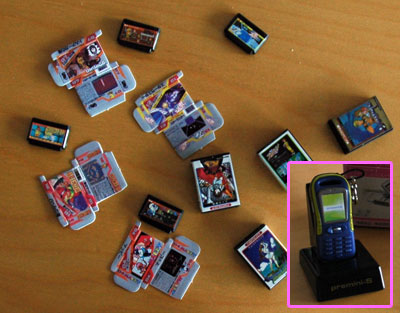
And inside...toys!
More conbini toys. This time not traditional gods, but the modern ones--gadgets. Mobile Figure Collection III is a set of 20 different minature DoCoMo mobile phones with display stands. Some of them fold, some come with the same accessories as the real-life versions.
And I could not resist the Nintendo History Collection. Aside from the cool plasic box, there are 8 different minatures--the Family Computer, the AV Famicom, the Family Basic & Data Recorder. I was hoping for the Family Computer Disk System, but my container held the Namco Soft Set--8 little games in their boxes (some assembly required). I assume they will fit into the computer toys.
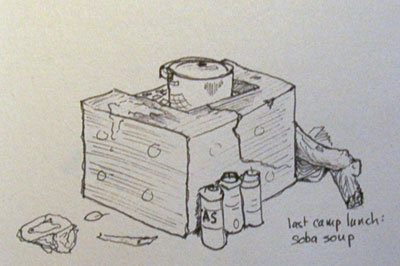
One final sketch before packing up to leave
I am certain we had the most elaborate kitchen of any other campers at the Niijima Camp-jo. We fed between 7 and 12 people per meal every day for a week. When the full compliment of our group was present, we had 4 camp stoves, two fires, and enough pots and pans to require a crew of four dish washers.
Our meals were spectacular--no instant noodles for us. From fruited pancakes to thai curry to daikon cakes to saffron chicken, we cooked up a storm (and in one, too). We ate three meals a day and there was still time for countless trips into town for shopping adventures. We know all the Niijima grocery stores.
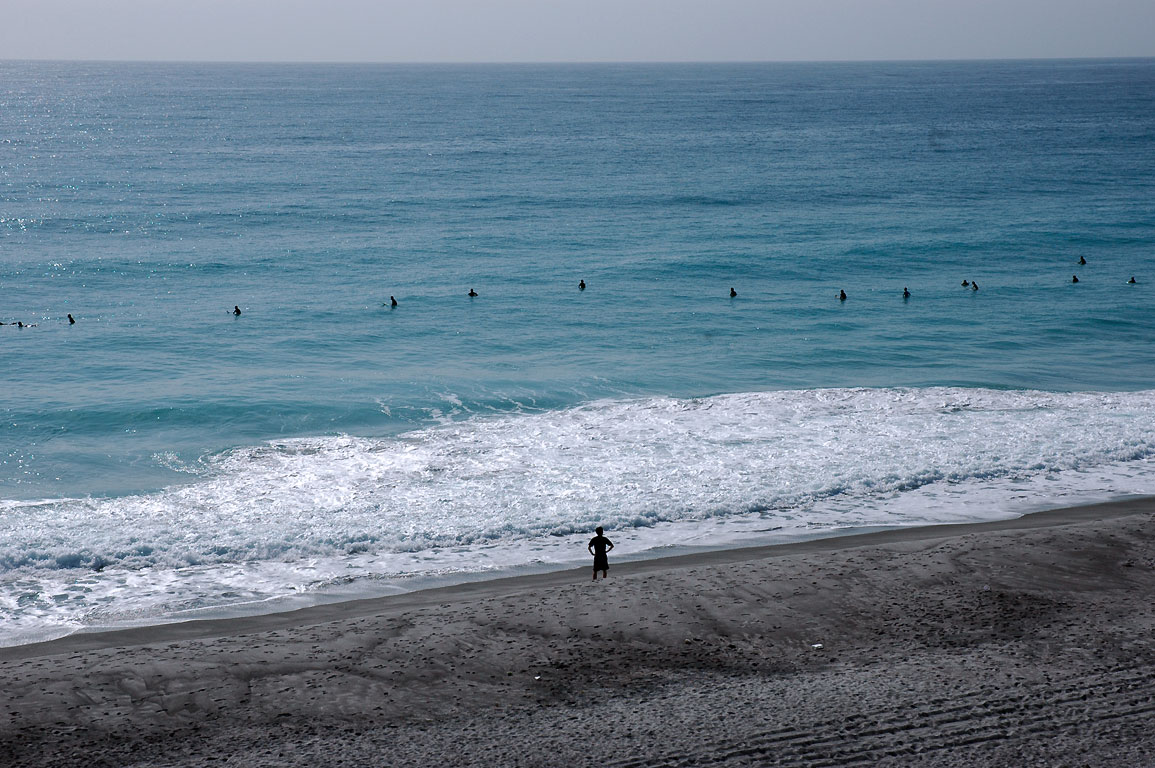
Click for screensaver sized version
Niijima is well-known (in Japan, at least) for its surf. But on the morning I took this photo, the surfers were more hopeful than active. They did eventually catch a few waves, but there were better days for hanging ten.
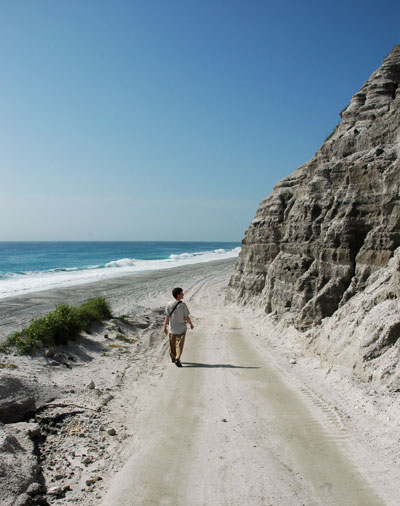
Tod admires the cliffs near Secret Point
Happy birthday, darling.
Tod's sneakers dry out on the fireplace
Everything was soaked--mats, sleeping bags, us. What a night of wind and rain.
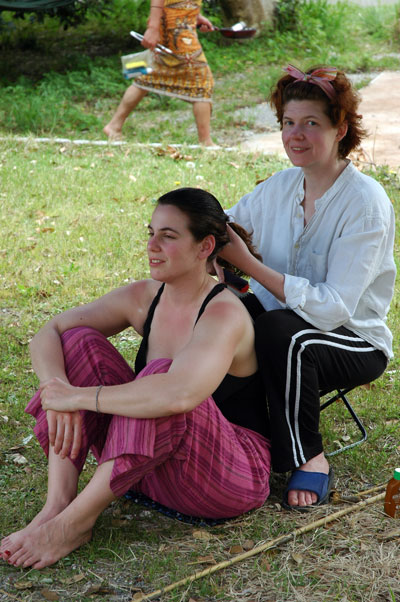
Smoothing coconut oil through Rachel's hair
Bring a bunch of girls camping and you get to do fun, girly things. I had the corner on the hairdressing market--brushing and braiding tresses all week. It was fun.
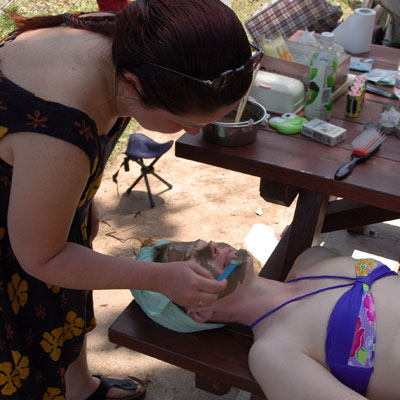
Trying not to giggle as Tracey applies a mud pack
I also received. Tracey brought along a bunch of facials to soothe our sun and wind burned skin. As I ambled from our site to the communal sinks, I thought "Yikes! I'm walking through camp in a bikini!" Then I remembered I had smears of mud all over my face and a green towel wrapped around my head.
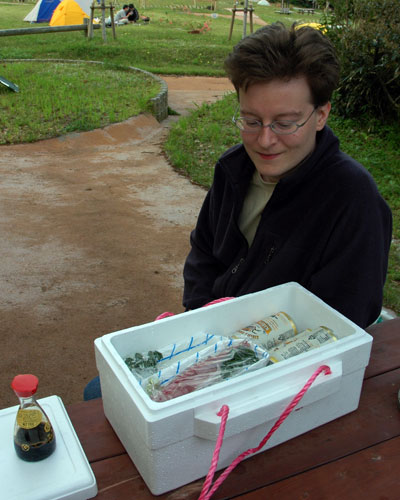
Tod with unexpected blessing.
5:00 on Saturday evening, a white-clad kitchen worker arrives at camp. After calling out a name loudly and wandering up the path, he stops not far from our campsite. Tracey speaks to him for a few minutes, then goes off to look for "three girls in a tent" who ordered the food.
They were not to be found, so Maeda-san, the delivery man, left the cooler with us. Inside: ika and kampachi sashimi, three beers and some soy sauce. A feast for which the man would not take payment.
Maeda-san, our benefactor
He returned that evening with some beer and settled in for a snack and a chat. He wanted to apologise for inconveniencing us (by giving us free sashimi?!). We invited him to stay for dinner, he had to return to his kitchen to tidy up. He took a shine to Tod who has the best Japanese of any of the gaijin in our group.

Vegetables from Maeda-san's garden
The next morning, he brought us a wooden box full of daikon, onions, parsley, and lettuce. He even came back on Wednesday with fruits...we have no idea why, but are grateful nonetheless.
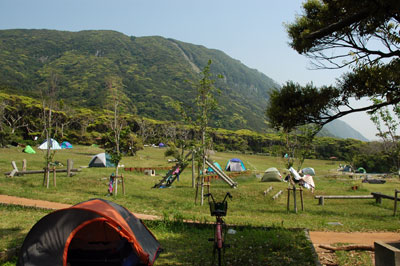
Across the site
Niijima has a well-designed campground. The toilets are clean; there is a large communal area with sinks and barbecues; and each site is neatly flattened out for tents and delineated with wood fences.
And as a bonus--there is no cell phone reception. You cannot help but relax here.
Not to mention that the air is clean, you can hear crashing waves, and there are lots of stars in the night sky. It's a heavenly place to chill out and enjoy nature.
Although it took us 20 hours to get there (our boat was canceled and we had to wait all day for the next one), it was worth the wait.
Tod related these two little tidbits today. He learned them from his colleague, Yoshioka-san.
Sushi has a special counter word for individual pieces: -kan. Most people just use -ko, but really you should ask for i-kan, ni-kan, san-kan pieces of sushi. The kanji for -kan is the same as suranuku, a verb meaning "to pass through." So why's that?
Well, 180 years ago, when sushi was new, people carried their money (coins will holes in them) threaded onto a cord. A set of fifty coins was called a "kan" and since sushi was about the same size...
Another sushi tale is why sushi always comes in pairs. Again back in the old days, raw fish for sushi was scarce. So the sushi chefs mounded up the rice really high, put a morsel of fish on top and then sliced the whole thing in two. When food became more abundant, they still prepared two pieces.
Home moxibustion is an entertainment and a medicine.
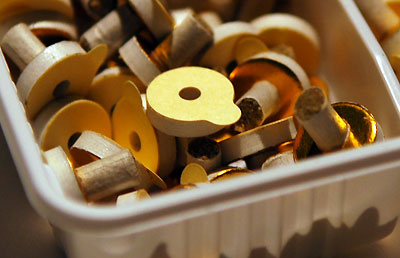
We bought the Sennen-kyu Off 80 moxibustion kit at some random drugstore in our neighborhood. This kit contains 80 tiny incense cigars on sticky holders. "Popular among young people" it said on the box; how could we resist?
Moxibustion uses the same theory as acupuncture and shiatsu--the meridians of the body--but works by burning mugwort (moxa) over them. You locate the right moxibustion points, light the moxa, and stick the holders to yourself. The herb burns down and heats your body with pinpoint precision.
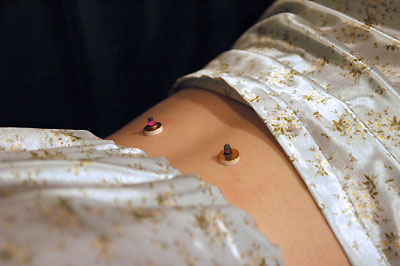
It gets really hot even though the coal doesn't touch your skin and I had to pull one off my back before it was probably done, but after walking all day, I tried the "legs feel weak" points and I felt pretty good afterwards.
Last week's prize goes to filmtunes because everyone needs blog fodder from time to time and for teaching me a new word-lagniappe. (Send me your address and I'll have the magnet in the mail to you right away.)
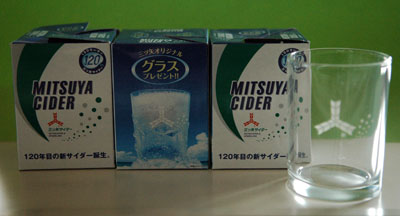
This week I am giving away a set of three Mitsuya cider glasses to whomever makes me laugh best before noon JST next Wednesday. This contest is not limited to comments, so you're welcome to e-mail me something original (I really despise forwarded jokes) or even make me laugh in person.
For a prize this monumental, I'm expecting some good belly laughs. Bonus points if you make me snort loudly in public or spit coffee on my monitor.
These glasses are the classic, tiny Japanese water/beer glasses; they hold about 150 ml. Tod collected them over the winter when they were given away as a promotion for Mitsuya Cider's 120th anniversary.
Pizza-la is giving away refrigerator magnets featuring Bae Yong Joon, the wildly popular Korean star of "Winter Sonata." He is adored by middle aged women who swoon over the romantic storyline of the show.
I'm willing to part with the magnet I received with last night's pizza.
I'll mail it anywhere in the world to whomever gives me the best reason for wanting it. To play, post your reasons in the comments by noon JST on April 20.
Download this flyer to distribute (1.9 MB PDF)
Please join the Foreign Section Trust for a relaxing day of eating and drinking under the cherry blossoms at Aoyama Cemetery. FST members will be on hand to discuss the city's plans for the area and how you can get involved.
Free to all! Bring your favorite food and drink. Meet under the cherry tree at the south end of Aoyama Cemetery's foreign section. Map
FST Hanami Party
Saturday, April 2
11 am - 7 pm
Aoyama Cemetery Foreign Section
(rain dates April 3 & 9)
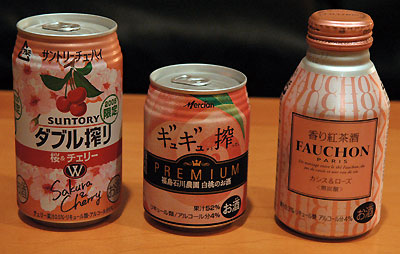
Ready for a a taste test
Suntory Double Shibori, Sakura & Cherry
Poured out a fizzy pale pink. The bouquet is nice. Not too sweet, but has a slightly medicinal aftertaste. Just the thing to cut the salt of senbei at hanami. 0.5% cherry juice; 5% alcohol.
Mercian GyuGyu Shibo Premium, White Peach
Translucent clouds of palest yellow. Fresh peach scent and juicy flavor. Slight carbonation cuts the cloying sweetness. A good starter drink for toddlers. 52% juice, 4% alcohol.
Fauchon Scented Tea Sake, Cassis & Rose
Pinkish brown tea, non-carbonated. Smells like roses. Tastes like tea brewed too strong then sweetened with cassis. Tod says it's "too girly." 0.3% juice, 4% alcohol.
 The foreigner's section of Aoyama Cemetery in Tokyo is under threat of being bulldozed. Why? The old dead foreigners aren't paying their cemetery fees. Bad gaijin!
According to the cemetery's rules, if a plot's 590 yen/sq meter annual fee isn't paid for five years, a notice goes up and the plot will be razed at the end of a year. 78 plots in Aoyama Reien were flagged in October and many of them are in the foreign section.
These are the graves of expatriates from the Meiji era, men and women who promoted Western ideas and practices in Japan--doctors, educators, missionaries, and artists. Although many of their contributions live on, it seems a pity to remove their memorials.
There is some hope; according to an article in the Daily Yomiuri on Friday the city government is reconsidering for some of the "important" graves--those foreigners the city employed way back when. They will make a final decision in April.
Not everyone is convinced the government will do the right thing. From the Yomiuri article:
Yuzo Takahashi, a Tokyo University of Agriculture and Technology professor specializing in the history of science and technology, is calling for the preservation of foreigners' graves."It's unthinkable that those who contributed to the modernization of the country are being forgotten. I'd like to see their graves preserved. In the case of foreign nationals, it can't be helped that fees aren't paid, but I hope the government will preserve as many graves as possible," he said.
Which still leaves the problem of the "unimportant" foreign graves.
The Foreign Section Trust is forming now to take action. We hope to first pay off the debt on the delinquent tombs and then build a trust fund to take care of them in the future. And just imagine the fun and good feelings at the FST hanami party (currently slated for April 2).
If you're interested in joining the society--whether to donate money, sponsor a plot, or offer your help with administration--visit the fledgling FST site and send an e-mail.
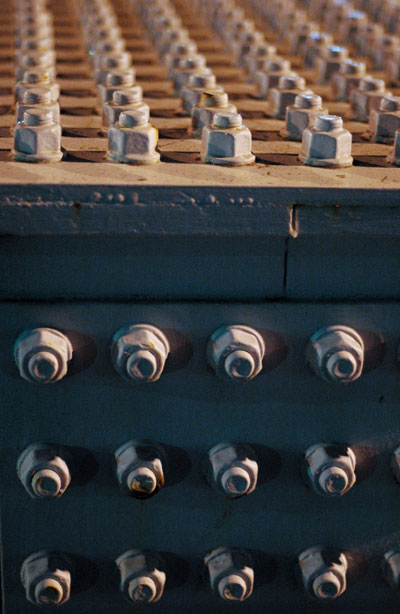
Even after seven years here, there are new things to learn. Yesterday I sent cash in the mail using the post office's registered cash envelope.
A genkin futo is a double envelope made of kraft paper; it costs 20 yen at the postal counter. You slip your cash into the inner envelope, which is attached to the outer envelope so robbers can't exchange it for another one. For additional security, you seal the outer envelope and stamp your hanko (or sign your initials) along the seam of the seal.
The front of the envelope has a carbon form on it. You fill in the recipient's address at the top, your address at the bottom and the middle part is used to note how much money is inside. The postal worker calculates the registration fee, stamps it up, gives you a section of the carbon form and your money is safely on its way.
As I went through the process, I saw three other people using genkin futo. As always, things become evident all around you once you know about them.
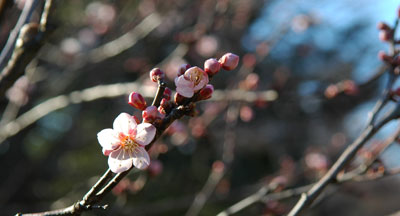
Plum blossoms herald the start of spring. They usually appear at the beginning of February. January 10th is too early.
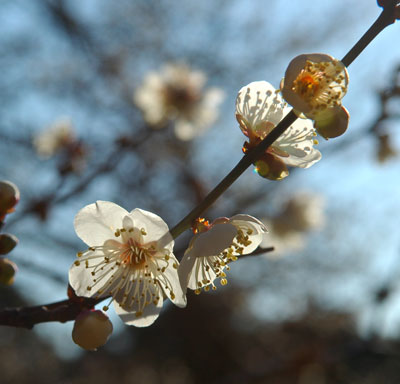
The scent of ume flowers is intoxicating and each variety is different--fruity, spicy, heavily floral.
The colors of these buds charmed me with their old-fashioned combination of brown toned colors
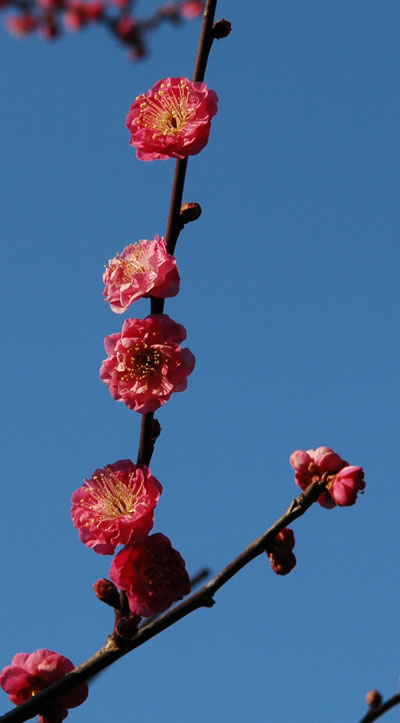
Vivid plum blossoms against a blue sky lift our spirits out of the winter doldrums.
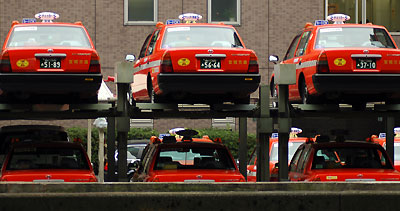
Taxis safely parked. (photo by Tod)
On the way home this evening we hopped in a taxi that was promptly rear-ended. It was a classic low-speed collision--we were stopped at a traffic light and the car behind us didn't brake soon enough. It made a loud bang.
The cars pulled over and the taxi driver checked to make sure we were OK. No bumps or bruises noted. The driver of the other car, a 20-something woman in an orange scarf, ran over to check on us, too. Her eyes got a little bigger when she saw we weren't Japanese, but she trotted out her best English for us and said she was very sorry.
The taxi driver handed the phone number of the taxi company on it so we can call if we discover any injuries later on. The next taxi driver, who was conveniently at the ready for us, said that if we're going to get whiplash, we'll feel it in the next three days.
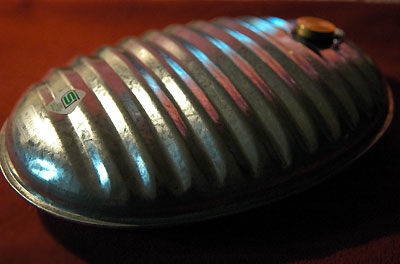
This is my new friend, the hot water bottle that Tod gave me for Christmas. It's called yutampo (湯湯婆) in Japanese. The three kanji mean hot water, hot water, and old woman. So fitting.
I love the old-fashioned design rendered in pressed tin. It looks like a cicada exoskeleton or a metal pastry.
Every night, Tod fills it with boiling water, zips it into a terrycloth case and slides it into the bed to warm me up. Although it seems like a sweet and loving gesture, I think he uses it to protect himself from my icy feet.
Today's the last day of the new year festivities. To be honest, I'm sick of it already. I've eaten too many chocolates, indulged in too much triple-fat French cheese, moved too little. I'm getting fat and bored.
I want to get back to work, to dig into the list of unfinished things and get a few of them crossed off. I want my pool to open so that I can swim every day. I want a regular bedtime that's not interrupted by late-night merrymaking.
明日から、ね。Ashita kara, ne.
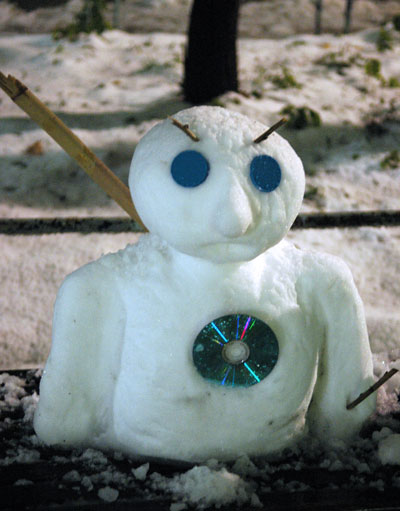
Snow samurai robot. Korakuen station, 31 December 2004
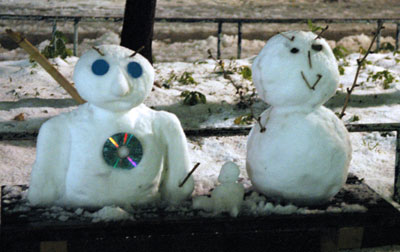
Snowfolks in the park.
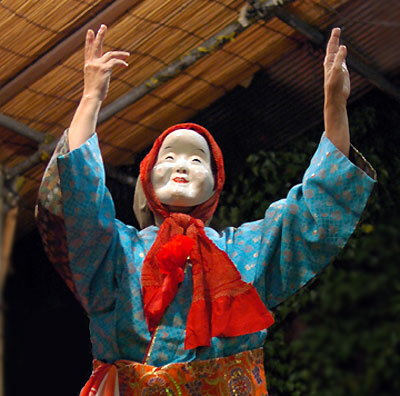
Edo bayashi entertainer. Genjinmeigu shrine, Minato-ku.
Pretty flakes all morning long. It's such a rare event that I ran around filming it and set it to music. The snow is still falling--if it keeps this up we may see a centimeter or two on the ground by nighttime. I'll have to go out to shoot snow at night.
Tokyo Snow - small 711 K 0'49" MP4
Tokyo Snow - medium 1.7 MB 0'49" MP4
Tokyo Snow - large 4.8 MB 0'49" MP4
Every year around this time, neighborhood volunteers are out on the streets at night, clacking wooden sticks together and calling out to people about fire safety. It's taken us six years to figure out what they are chanting.
The other night, as we were walking home late from work, the patrol was out. It was a group of three younger men and they were doing their job with gusto.
"Are they yelling Ii yo, ii yo ji? Maybe Iroiro ii?" I wondered after listening to them.
"Um....yoyogi?" Tod suggested doubtfully. He listened again. "I think maybe it ends in shin"
"Or jin? I can't tell. Let's ask them," I suggested as we converged on their path. Of course that meant Tod was going to ask; his Japanese is much better than mine.
The patrol volunteers were happy to tell us, carefully and loudly, that they are saying hi no youjin which means "fire caution."
Have a listen for yourself. I made this recording of a different, somewhat less enthusiastic patrol this evening: Hi no youjin (0:18 mp3 429K)
Our friends, Jim and Yuka, bought an apartment near us--a 22 minute walk away, to be exact. They moved in yesterday and we went over today to help them unpack. We celebrated Boxing Day by un-boxing things.
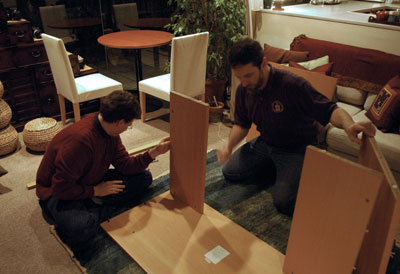
Tod & Jim put the desk together.
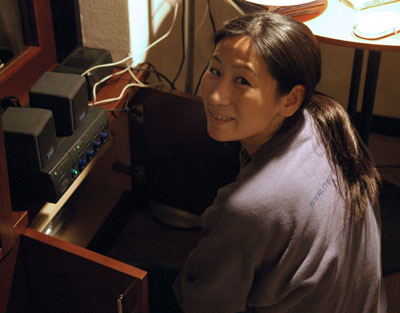
Yuka put away all the CDs into the built-in cabinets in the living room.
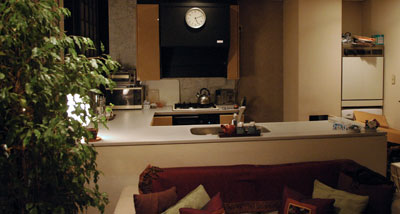
I spent my afternoon in the kitchen with good results.
Eight and a half years ago, when Tod & I first visited Japan, we saw a building in Ginza with an unusual round upper story. "Is that thing revolving?" we wondered.
Fast forward to this evening. Answer: yes, it is revolving.
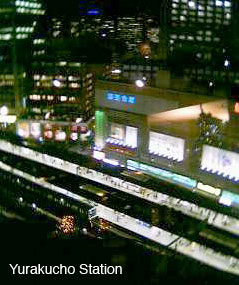 The Tokyo Kotsu Kaikan is home to one of Tokyo's three revolving restaurants, the Ginza Sky Lounge. (The others are at the New Otani in Akasaka and the Hotel New Tsukamoto in Makuhari, which is really in Chiba but close enough to count.)
The Sky Lounge serves French food and a 360 degree view every 40 minutes or so. We didn't take good timings, though we went around about 4 times while we were eating. We were having entirely too much fun pointing out the sights to remember to note the time and relative position.
"Oh, there's the Rainbow Bridge, peeking out between the skyscrapers."
"Look at how the tracks into Tokyo Station make a sinuous path."
"Are those red and blue elevator lights on the Dentsu Building?"
"I've never see the yellow flashing lights on the highway before."
Perhaps it was silly to be so delighted, but I was smiling all through dinner. It's highly agreeable to sit still and watch the scenery change.
I especially liked the gorgeous reflections on the Mullion building of the passing trains and people waiting on the Yurakucho platform.
Let's go there for lunch someday.
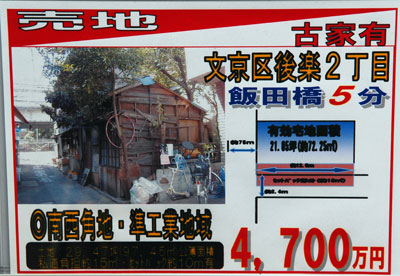
At a realty office. Photo by Tod
Land for sale - includes old house!
Bunkyo-ku, Koraku 2-chome
5 minute walk from Iidabashi station
72.25 sq meters
South facing lot - zoned for industry
47,000,000 yen (that's $450,000 US)
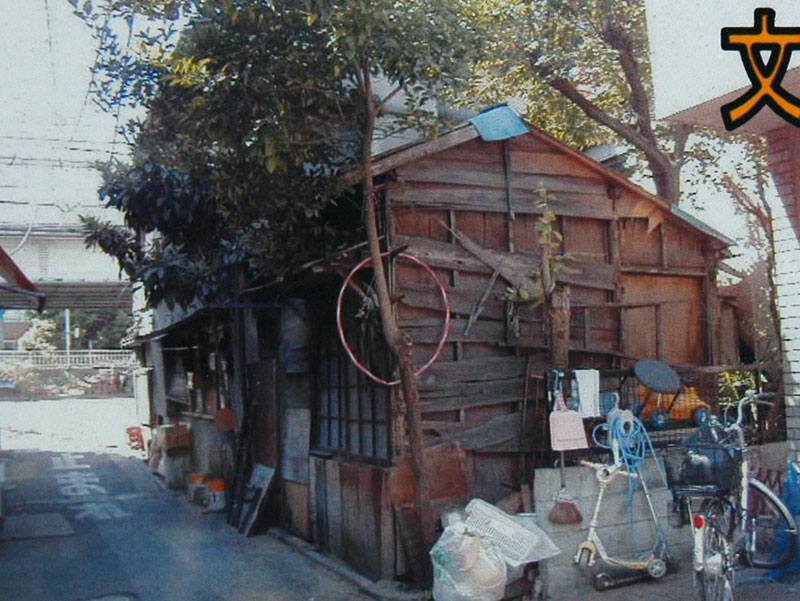
A closer view of the "old house." (click to enlarge)
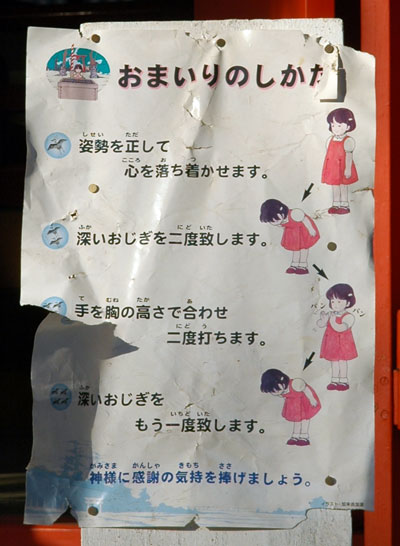
At a shrine next to a nursery school. Shinjuku-ku, Tokyo.
How to Visit the Shrine
- Straighten your posture and calm your heart.
- Give two deep bows.
- Arrange your hands at chest-height and clap twice.
- Make one more deep bow.
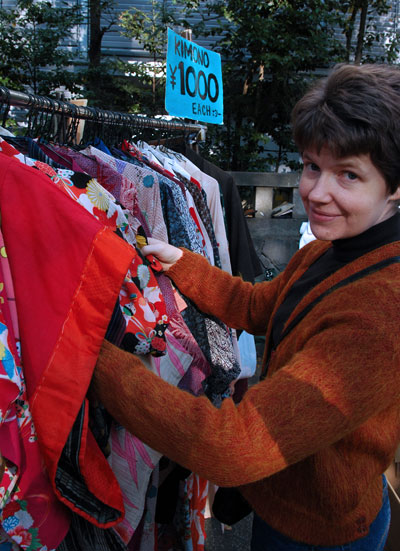
Looking for old fabrics in Harajuku.
Icon on a bottle of Spanish wine
What an odd diagram to put on a bottle of wine. We had all sorts of ideas about what it represents, not all of them fit for the dinner table. Then we tasted the wine (spoiled by improper storage) and decided that it indicated "pour directly down drain."
What do you think it means? Is this a standard symbol in Spain or the EU?
Unexpected beauty in Kohinata, Tokyo
 Tod spied this in the liquor shop the other day. "It's rosehip liquor," he said as I perused the wines. Sounded interesting so we picked up a bottle along with a bottle of more traditional chilean Pinot.
Macadia is tangy and sweet with a hint of spice. It drinks more like plum wine than a strong liquor. As it turns out, it's not just rosehips. It also contains maca, aka Peruvian ginseng. What an odd combination. I did some poking around and found Suntory's press release:
Suntory is to release healthy liqueur “Macadia” --Wine for “beauty” and “high spirit” with soaked maca and rose hip from Andes --...Recently, customers’ health consciousness has been on rise. In such a trend, Suntory has pursued the development of liqueur that uses healthy ingredients, by utilizing both product development on alcoholic beverage business and research development of healthy product business. Suntory then, has focused on “maca” and “rose hip” that contain vitamin, mineral, and amino acid and newly released healthy liqueur “Macadia” as a drink that can be enjoyed by women. It is particularly targeted to women who are highly interested in beauty and health, enabling them to enjoy alcohol and satisfy their health consciousness at the same time....
On the Japanese site there is a Macadia column with beauty advice from a color analyst, an esthetician, and a nail artist. There are recipes for foods that pair with Macadia (watch for goya chijimi in this week's Recipe Thursday). And of course, the CM Library. There's only one, The Story of Maca and Rosehip. They're cats...
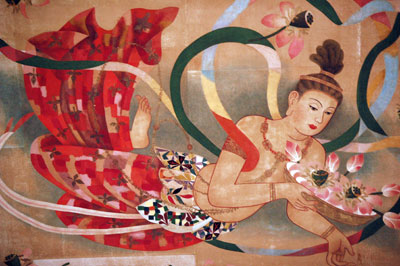
Devotional candles. Asakusa, Tokyo
Dalle de verre glass in the Symphonic Scultpure, Hakone Open Air Museum
Oh, no. Please, no. There are better mentors, Mr Koizumi.
Koizumi wants to learn from Bush how to cope with world criticismTOKYO — Prime Minister Junichiro Koizumi said Thursday he wants to learn from U.S. President George W Bush about how to endure global criticism in exerting leadership, fueling views that he is resolved to go along with Bush's policies on Iraq no matter what.
"He is exerting leadership despite being criticized so much by the world and enduring massive criticism from the domestic media. That's something. I have to learn by watching it," Koizumi told reporters when asked for his view on Bush's leadership following his reelection. (Kyodo News via Japan Today)
At the southwest corner of the Ginza Nine shopping arcade is a open plaza under a roof. On weekends and holidays there are often long lines of people waiting to get freebies given away by various companies and promotion boards. Over the years, I've snagged mysterious juices, teas, and the occasional sweet.
Today, for the effort of standing in line for about three minutes, I received some literature about Japan's oranges and a trio of mikan stacked in a clear plastic container. A smiling Mikan Girl dressed in a Chanel-style orange suit with a matching hat and a white ribbon pageant banner handed them to all comers--so Mom, Tracey, and her parents got them, too. It wasn't quite as rewarding as mikangari, but the mikan are nearly as tasty.
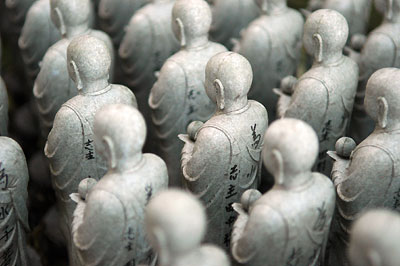
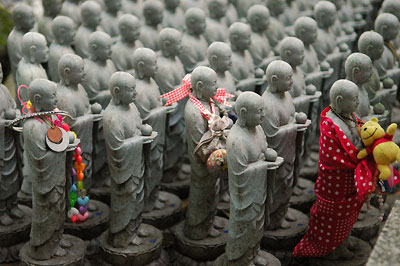
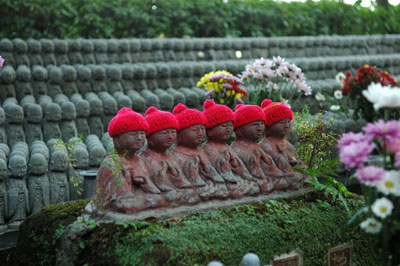
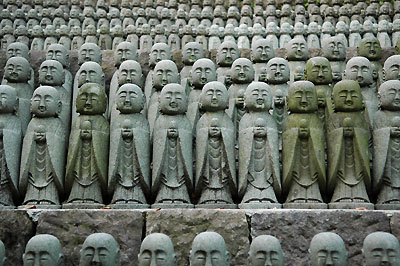
Jizo statues at Hasedera. 5 November 2004
Japan's currency is probably the most valuable in the region and as a consequence, counterfeiting has gone up in recent years. The National Police Agency reported a 25-times increase in forgeries over the past five years. They expect to recover 30,000 fake bills this year.
So the Bank of Japan launched an anti-counterfeiting measure and released new banknotes on November 1st. I spotted one "in the wild" yesterday.
The 5,000 yen note features a new face, 19th century novelist Ichiyo Higuchi. She was a pioneer feminist writer. I haven't ever read her work, but I guess I ought to.
There are, of course, all sorts of new measures to foil counterfeiters and you can read about them on the Bank of Japan's About Money pages.
And so I don't forget in a few months when most of the old bills are gone, the old 5000 yen notes look like this:
Suddenly the evening light seems richer. Shadows appear where none were a month ago. It's intriguing; my eyes are opened to the play of dark on light. I've been trying to capture the essence of them.
Still life with keitai
With a nod to the sensibilities of my mothers, we went in search of decaf coffee and sulfite-free wines today.
People drink a lot of coffee here, but decaf is not part of the food culture. There was none to be found at the Santoku supermarket. Doutor does not sell decaf. Starbucks doesn't brew it, either. But we found some at Seijo Ishii, the fancy grocery store at LaQua. Now the Moms will be safe from getting too hyped up.
Jean's request for sulfite-free wine required Tod to do some Japanese study. We now know that the word for organic is yuuki and sulfites are aryuusanen. Sankaboushizai means antioxidant.
First we tried the local liquor shop, Kashiwaya, and talked to Imamura-san. They have organic wine in stock, but it has sulfites. Chuckling at the thought of our mothers visiting togehter, Imamura-san promised to call her wine supplier on Monday and see if she can get some sulfite-free wine.
Seijo Ishii was plus on coffee but a minus on wine. Although the stock boy called over the sake manager, he had no idea. "Wines are made differently in some places. Maybe an Australian wine, or one from New Zealand," he hoped as he read the labels of various bottles. He was speaking ex-rectum, of course. Grapes naturally have sulfites and nearly all wines add more as an anti-oxidizing preservative. Sulfite-free wines are not a regional phenomenon.
Santoku Liquor World has a large selection of French wines that don't impress me, and little else. However, they had a range of Japanese sulfite-free wines, the Wine Story (wain no monogatari) line. We picked up a bottle of white and one of red. But at 500 yen a bottle, I'm not sure I want to drink them.
We'll see how they are when we toast the Moms' arrival tomorrow afternoon.
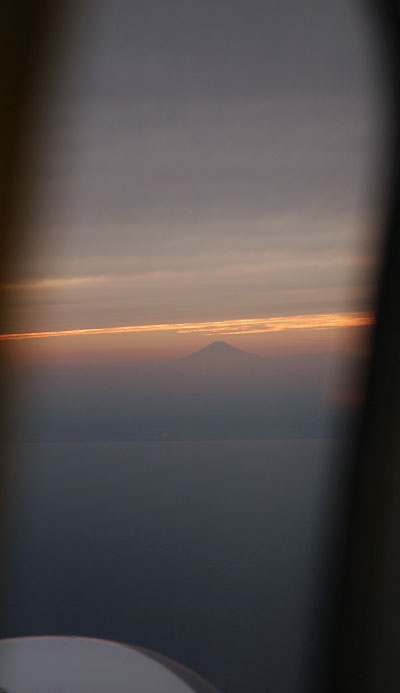
Fuji-san as viewed on approach to Narita this evening
I bought a soap the other day that smells so good, I keep walking into the bathroom to sniff it.
It bills itself as a lavender soap but the fragrance is really the scent of the middle drawer in my desk when I was 9. Pencil shavings, postage stamp glue, rubber bands, library paste. Neglected homework.
Who makes soap that smells so academic? It's Lush's Ohh La La. Reading through the ingredient list, I see no pencil shavings, but I do find thyme (my favorite herb), rosemary and lots of lavender. Plus the grape juice that makes it run vivid fuschia when wet.
Once again, I modelled for the CEATEC convention posters. On last year's poster, I wasn't easily identified--you could see my tattoo in one shot and I was a tiny black spec at the bottom of an escalator in another.
Last night, I faced my photographed self in Shinjuku station. On this year's poster I found my smile, my profile and my full body.
It was disconcerting, delightful, and slightly uncomfortable to see myself in such a well-travelled public place--sort of like having my name published on an article. Thankfully, the photos are small; I hope this doesn't count much towards the elusive 15 minutes.
CEATEC begins tomorrow and runs only a few days, so if you want to scope out the poster, you'd better hurry. Walk down the Metro Promenade on B2F in Shinjuku station towards the Marunouchi line. The poster is on a bulletin board not far past the row of shops in the promenade.
Take a pen and draw in a mustache and devil horns. You know you want to...
Fireworks festivals are not normally held in October but this one in Tsuchiura, Ibaraki prefecture, is an exception. It's a competition and showcase of nearly 100 "grand finales" and new models of colorful explosions.
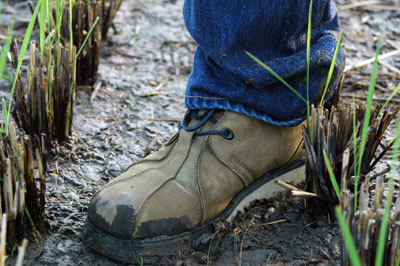
Seating was in a muddy rice paddy, freshly harvested.
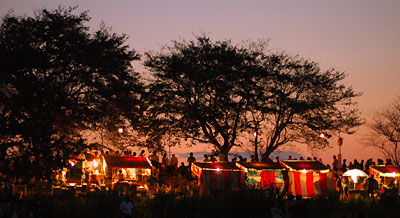
As the sun set the food stalls lit up but our group of twelve didn't indulge. We brought a picnic feast of homemade pizza, lamb chops, lasagne, oden, Taiwanese eggs, side dishes galore, cakes and lots of drinks.
The finales were bright as day.

The combination of colors and shapes delighted me. I grinned for the entire two hour show.
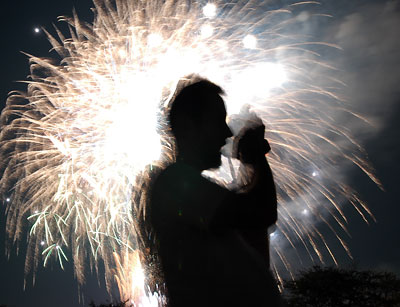
Jim, eschewing the usual (as usual), took black and white photos.
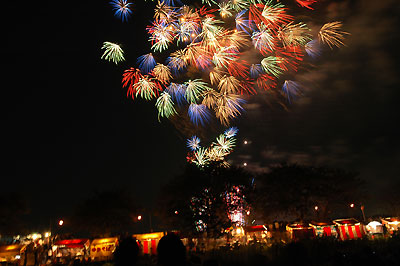
This patchwork of small explosions quilted the sky.
RFID (radio frequency identification) tags are used by warehousing and large retailers to track their stock; the tags are programmed with all kinds of information and identify themselves automatically to any tag reader in the vicinity.
RFID is also used for livestock tagging and in corporate ID badges. In Mexico, the attorney general's lawyers have had RFID tags implanted so they can be tracked in case of kidnappings.
And now Rikkyo Primary School in Tokyo has jumped on the RFID bandwagon in the interest of school security. From April next year, students will have RFID tags pinned to them to monitor their entry and exit from the building. Although it seems benign on one level, don't you think it's a little bit too Big Brother? And will it extend from the doorway to a more thorough monitoring?
"Where's little Ko-chan?" teacher asks.
"In the toilet. Stall three. Been there for....2 minutes 46 seconds," replies the school monitor.
Will these children, along with the countless adults who have RFID implanted or tucked into their wallet, get so used to being tracked that they won't consider it an invasion of privacy?
Sorry, but I'm not going there. no RFID for me, thank you very much.
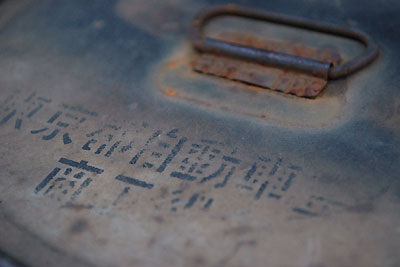
This abandoned oil drum sits amidst a pile of junk under Expressway No. 5 in Toshima-ku. I'm attracted to the rust and decay of Tokyo; there are plenty of pictures of dirt and oxidation in my collection. This is a recent one and a favorite.
Inspired by Antipixel (again) and his generosity in sharing a beautiful calligraphic screen photo sized as a desktop background, I've done the same.
1024 x 768 112 KB JPG.
1280 x 1024 196 KB JPG.
1280 x 854 (15" Powerbook) 156 KB JPG.
2560 x 1600 (30" Cinema Display) 660 KB JPG.
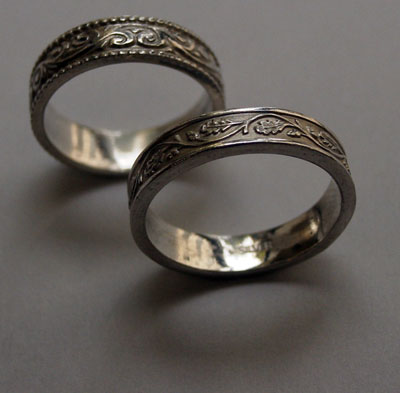 Interested in working with metal and making jewelry? On Thursday mornings from 10 - 12, I attend a jewelry making class at RBR The New Center for Creative Arts in Azabu Juban. It's great fun, but unless I can drum up a few more students to join me, the class will be cancelled.
It's an ongoing class, so you can jump in anywhere. I've learned the basic techniques of soldering, hammering, and filing. Lots of filing. Now I'm working on a lost wax casting. The next project focuses on piercing and sawing. It's like high school woodshop, only prettier.
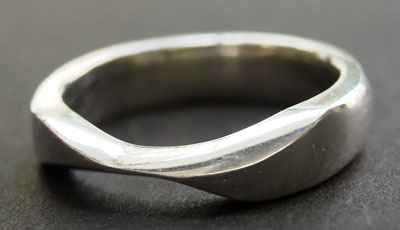
I made this ring by hammering and filing silver. Tod wears it every day.
Above left: simple rings made in the first class session
Here's the course description from RBR's website:
JEWELRY MAKING - Instructor: Mami KatsukiThis class will teach, in detail, the whole process of creating a piece of jewelry. Learning the basic skills is a hard and time-consuming process but this class has been carefully paced so that every individual will make progress! Learn how to use sandpaper, electric tools, files, and how to metal fold, weld, pierce, polish and finish up. After mastering the filing, students will learn Wax Carving techniques, using several different types of wax to create rings, pendants or earrings. Transform your sketch into a 3D model. After understanding and mastering the basic process, students will work on their design and bring it to life. In the first three months, most students will be able to complete two pieces of jewelry. The goal - fashion an original creation you can show off with pride!
If you're interested, contact RBR or better yet, talk to the instructor directly. She's great (and bilingual): Mami Katsuki mamikatsuki@hotmail.com 03-3710-8889.
UPDATE: Mami-sensei says the last class will be October 7th unless we enroll 3 or 4 more students. If you're interested, don't delay.
Today is "Respect for the Aged Day," a national holiday in Japan.
But "the aged" is never us despite our half-truth jests about becoming grey and feeble; it's always someone elder. Who do Japan's 23,000 centenarians respect today? Maybe themselves. Today all new centenarians are presented with a silver cup and a certificate.
The number of centenarians in Japan will total a record 23,038 by the end of this month, surpassing last year's previous high by more than 2,000, the Ministry of Health, Labor and Welfare said Tuesday.The centenarian population has posted a 150-fold rise since the government began compiling the statistics in 1963, when the number of centenarians stood at only 153, the ministry said. Women continue to make up the vast majority of the cohort, accounting for 84.7%. (Kyodo News)
Where there more babies than usual in 1904? Maybe so; Japan was winning the Russo-Japanese War. Or did these 2000+ new centenarians lead especially charmed lives? Regardless, I guess the government had to prepare a lot of gifts this year.
Bike shadows. Korakuen station, September 11.




Tod tried on new frames yesterday at Zoff. We used the camera as a mirror because he can't see without his lenses.
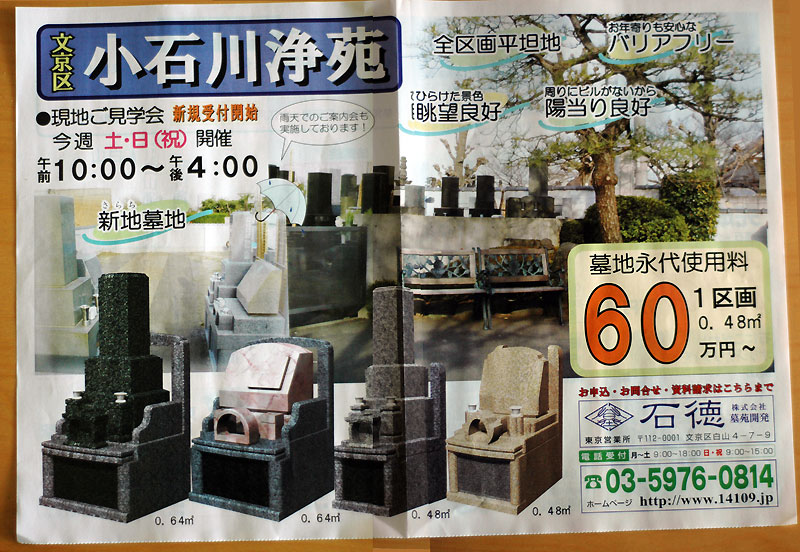
Usually our mailbox is stuffed with pizza menus, real estate ads and lists of porn videos, but the other day this appeared--a flyer for a nearby cemetery.
"Come tour Koishikawa Jo-En every weekend from 10 - 4. New plots available! Good views, good sunlight, no surrounding buildings, barrier free!"
A 0.48 sq meter plot with a permanent lease (I think that's what the kanji mean, please correct me if I'm wrong) is 600,000 yen at a minimum. To convert for my American readers, that's about 5 square feet for $5,000. Pricey real estate. Fortunately, they offer a 10-year payment plan.
If you want a monument like the ones shown, add at least a 1.18 million yen (about $11,000) to the price. Tax included.

I picked up a couple of clothing catalogs yesterday to see what everyone will be wearing from this month through January. Here are the trends I noted:
Colors: black, charcoal grey, white (pure white and winter white), camel, chocolate brown, pumpkin orange, emerald green, dusty rose, burgundy, slate blue.
Fabrics: corduroy, wool, leather, chunky knits, fur accents
Patterns: mainly solids and heathery tweeds, but some flowery prints, large checks, houndstooth
Hemlines: just below the knee; mid-calf
Styles: 1960s retro styling; V-neck sweaters over lacy camisoles; frilled shirts & ruched tops over A-line skirts, sleeveless dresses with belt accents, necklines of all sorts. Not so much "skirt over pants" this year--thank goodness.
One oddity of both the catalogs--all the lingerie models are blonde foreigners.
Tokyo's governor is planning to ban some legal drugs starting next April.
The metropolitan government asked a panel Monday to map out the ordinance to ban the sale, production, import and advertisement of drugs such as those that induce hallucinations or improve sexual pleasure, which will be called "governor's assigned drugs."
I wonder if drugstores specialising in these newly illicit drugs will spring up along the borders of neighboring prefectures, providing easy access to the banned products?
It happens in the States. Along the Pennsylvania-Ohio border there were always fireworks for sale at makeshift stalls just inside the Ohio state line, and back in the day when the drinking age was state-mandated (18 in Ohio, 21 in PA), plenty of liquor stores.
And speaking of liquor, isn't that the #1 legal, addictive drug? I bet Ishihara won't ban that.
The edge of typhoon Chaba (#16) blew across Kanto last night. At 1 am, I woke to hear rain pouring down. 14 mm fell that hour--about 10% of the month's quota all at once. The air was silvery grey with raindrops when I looked out the window.
This morning, the clouds play a time-lapse nature film. The atmosphere is blood temperature and gravid with humidity. Wind gusts 40 m/s from every direction and anything with makeshift aerodynamics--the watering cans, plants, tins of mosquito coils--now floats in the small pond on our veranda that formed in the rain.
The sky is lightening even as I type this and the weather forecast predicts a hot sunny day by noon. Don't bother with an umbrella today.
Shinjuku is well known for its exclusive little clubs and bars that are invitation only. The Golden Gai neighborhood, really just a handful of crisscrossing alleys, is stuffed full of itty bitty spaces for drinking and carousing. Imagine a hallway with doors on both sides and a few signs glowing above the doors and you're seeing Golden Gai.
Last night was the annual Golden Gai matsuri. About half the bars opened their doors to all comers and dispensed drinks at 2 for 500 yen until midnight--a good bargain for any Tokyo drinking establishment.
We tried out a few places with our friends Tracey, Ashley and Jamie. At Kura Kura we watched rhythmic gymnastics on a screen that took up an entire wall (it was a very small room); Kenzo's Bar, including Kenzo himself, was decorated in leopard prints; and Evi, one of Tracey's hangouts, was standing room only and kicked everyone out just before midnight--the bartender was getting cranky. We ended up at a karaoke bar called Champion where we sang until about 3 this morning.
Tracey, Ashley and I love to sing. Jamie fills in the chorus, but won't take the microphone. Tod shoots photos of us enjoying the evening. We singers took turns with the other patrons, but I think the three of us might have sung more than everyone else. It was a lot of singing.
Now I'm nursing a raspy voice (but no hangover) and it's back to work today. Ah, weekends.
The Japan Photographers Mailing List folks organized an afternoon workshop on developing black and white film. It may have been one of the best documented workshops ever, as everyone was snapping away as James Luckett, consumptive.org, our fearless guide spoke. He made the process crystal clear and unintimidating.
The process goes like this:
- Beer
- Load the film into the reel (in the dark, of course)
- Pre-soak: clear water and a little agitation
- Developer: check the chart on your film or developer for timing. Agitate 10 seconds every minute--or whatever you think is good. Use a timer so you don't lose track of when to stop developing.
- Stop bath or water wash: to remove the developer.
- Fixer: for twice the "clear time" --the length of time it takes for a snippet of film to come clear in the fixer. Don't forget to agitate.
- Wash, wash, wash
- Wash with "photo flo" and hang to dry.
- Beer
I think film developing is much like cooking. You can carefully follow a recipe or you can wing it a bit. Either way you end up with a palatable finished product. Whether or not you can reproduce it depends on how many variables you introduced.
Do you know how the little numbers appear on the edge of the negatives? I assumed they were done somehow during processing but they're actually on the film as a latent image from the factory. You can use them to tell if you correctly developed your film. They should be black. Grey indicates underdevelopment. If they're black and fuzzy, you developed too much.
I put some of our photos from the workshop in our gallery, if you want to take a peek.
A few pictures from Jo's camera to wind up the travelogue. Thanks, Jo!
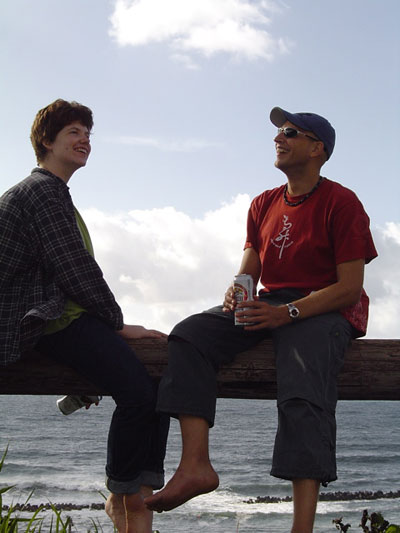
Me and Ashley sharing a laugh at the campsite. I look like I'm posing for a political poster.
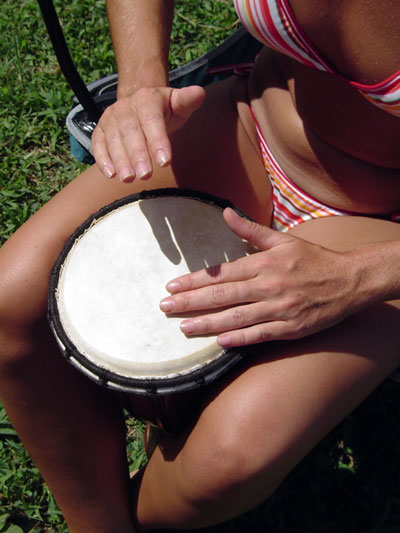
Sarah drums after breakfast. This is what the weekend was really all about.
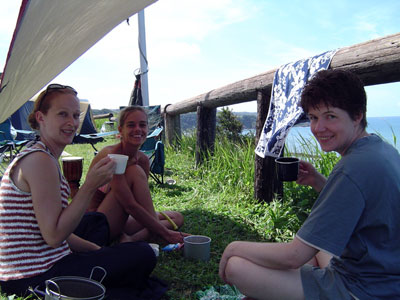
Enjoying a spot of tea.
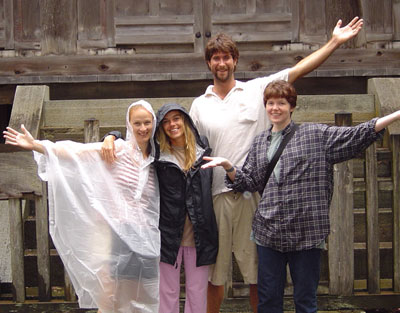
Jo, Sarah, Jonathan and me in the rain at Rengebuji Temple.
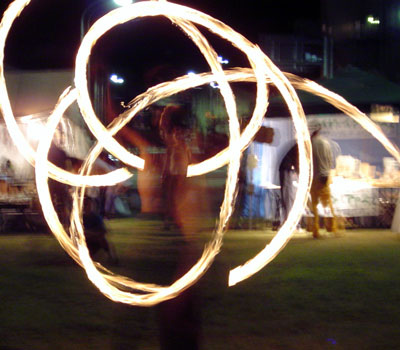
A fire dancer spins at the drumming circle after the evening concert.
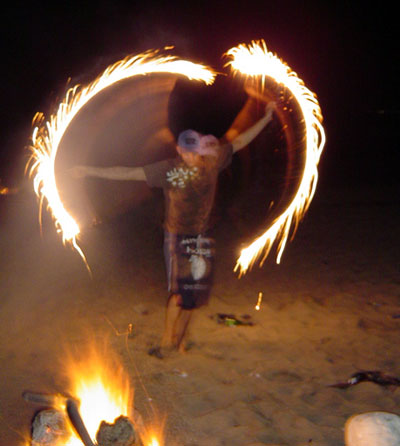
A tipsy Ashley interprets fire dancing with fireworks on the beach.
I've just returned from Sado Island, Niigata prefecture, where I attended the Kodo Earth Celebration. It was a weekend of camping, music and ocean.
If you have a chance to see Kodo play live (they tour all over the world), I recommend that you go. They are great drummers, versatile musicians and all-around superb performers. On stage they look like they are having the time of their life and the audience reflects their enthusiasm. They're coming to Tokyo in December and playing at the Bunkyo Civic Hall just down the road from me, so I'll get to hear them again soon.
The whole vacation was fun and relaxing. I'll try to backfill the details in the missing blog entries. But for now I'm off to bed, clean, dry and happy to be home.
I might be the only person who swims laps in the ocean. I woke early and went for a swim before everyone got up. Being a cautious soul, I didn't want to swim alone far from the shore so I swam out to the far side of the breakwater and did laps along its length for a while. The water had calmed down and cooled. It was a good energetic swim.
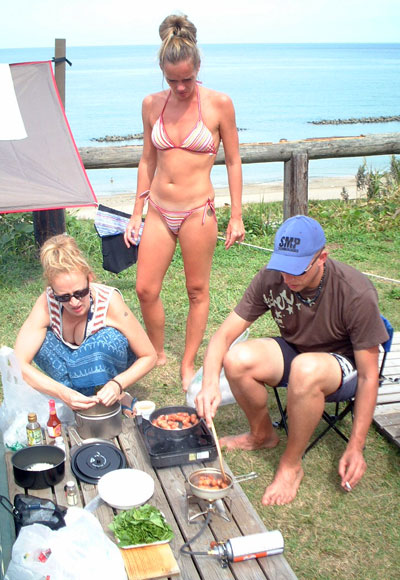
Jo and Ashley cook brunch while Sarah looks on
After brunch, we headed into town and walked over to Ogi no Yu, a local sento. We bathed for an hour, enjoying the ocean view from the bath, then relaxed in the massage chairs for a while. It was lovely to be clean.
Jo took our groceries back to the campsite while the rest of us lounged in town and had a snack, then we were off to the final concert--Fanfare Ciocarlia and Kodo playing together. There were 2500 people crowded into the hilltop park.
Who'd've thunk that you could combine taiko drumming with gypsy music? But they did it, proving that Kodo are extremely versatile musicians. One number nearly brought me to tears -- a duet/battle between trumpet and bamboo flute. Such different tones echoing and repeating the same notes and phrases. Breathtaking.
I think my favorite bit was two of Kodo's drummers, carrying one drum between them arguing whether rice or noodles were better food. It was a rhythmic comedy sketch.
Kitsune-DON, Curry-DON, Niku-DON
Kitsune-uDON, Curry-uDON, Niku-uDON
Jo and Sarah wade out to chat with Ashley on the breakwater. Sobama beach
We spent most of the day in the water or on the sand. The waves were still pretty big from the typhoon and there was lots of seaweed floating around, so we body surfed in the morning and bobbed around without actually doing much swimming. Still, it was very nice to be in water.
The evening's concert with Romanian gypsy brass band Fanfare Ciocarlia was an energetic dance fest. Despite announcements that dancers were to move to the side of the seating area, when the band leader said "Everybody dance!" 1500 people did for over an hour. I left with more energy than I came with, and a pulled stomach muscle in the bargain.
We arrived on Sado several hours later than planned, delayed by a typhoon blowing over. The train was late, the ferry cancelled. But it made no difference--everyone else was delayed, too--and we snagged the perfect campsite at Sobama beach overlooking the ocean.
I've never owned a tent before; I don't camp too often. But this one is my very own. It's just the right size for me (they say 1-2 people, but you'd have to be two skinny people or very friendly). It has the best "genkan" I've ever seen--it's almost as big as the sleeping space.
With camp set up (5 tents, 7 people), we caught the bus into Ogi to check out the festival fringe events and food stalls before walking over to the Kodo concert. The storm blew the roof off the outdoor stage, so the concert was relocated in the municipal gymnasium. 1500 people sat on the floor--it's a large gym.
After the concert, I looked up. Ah! The stars are thick in the sky on Sado. The Milky Way is prominent in the sky. I spied all 7 of the Pleiades, the teapot, Cassiopeia, and the familiar constellations from my childhood. I could have gazed at the stars all night, but sleep got the best of me too soon.
On jtrains, a geeky train mailing list I read, someone asked how many stations are within Tokyo's 23 wards. Thanks to desktoptestu we now know the answer.
566 stations.
15 rail companies.
566 is a little bit misleading. Some stations are used by multiple rail companies and are counted once for each company. For example, Iidabashi station has trains from JR East, Tokyo Metro and Toei. So even though it's one station as far as travelers are concerned, it's counted thrice.
And here's the breakdown by rail company in order of number of stations:
Tokyo Metro: 132
Toei: 130
JR East: 75
Tokyu: 62
Tobu: 29
Seibu: 28
Keio: 25
Keisei: 19
Odakyu: 15
Keikyu: 19
Yurikamome: 12
Tokyo Monorail: 9
Tokyo Rinkai Kosoku: 8
JR Tokai: 2
Saitama Kosoku Tetsudo: 1
We often eat out, sampling Tokyo's vibrant restaurants scene. We travel all over the city in search of good food, so it's a nice surprise to discover a treasure in our neighborhood.
Indoshina specialises in Vietnamese cuisine with a smattering of other SE Asian flavours on the menu. I've walked past it dozens of times but it looks like a dive and we've been so disappointed in the Japanified Vietnamese restaurants we've tried that we've always given Indoshina a miss. But it turns out that it's quite good. A Vietnamese man runs the kitchen.
And boy does he know how to cook. We tried a spicy tofu and pork sautee, vinegar-dressed celery salad with peanuts, fried noodles and eggplant soup. The fried noodles were uninspired, but the other dishes were excellent. The soup, a coconut and onion broth with chunks of eggplant and pork flavored with lemongrass and shiso, was outstanding. The prices were reasonable, with each dish running about 800 yen.
Indoshina is on Kasuga Dori, just a few blocks from Myogadani station (towards Korakuen). The red, white and blue striped sign is in kanji that sound out in-do-shi-na but don't mean anything. There are pictures of the food outside, so you probably won't miss it. Open 5 pm til midnight on weekdays and til 11 pm on weekends.
Who spends the afternoon in a park? A variety of people and I spied on them all. You can have a peek in the Yoyogi Park People gallery.
People weren't the only ones enjoying themselves; light was playing in the fountain. Pretty.
My wallet's become extra thick with various stores' point cards, so I pulled them all out and had a look at what I've collected. Most of them are useless but they offer a voyeur an interesting look into my shopping habits.
Santoku & Queen's Isetan (grocery stores) cards get me a 500 yen coupon after I've purchased 50,000 in groceries). I just redeemed a Santoku coupon yesterday. It will be about 6 weeks before I get another one. At QI, you have to check your total in a little kiosk that prints you a coupon if you have enough points.
Bic Camera gives me 10% of the purchase price in points to be spent as yen on future purchases. I think Tod's card has about 16,000 points. Mine's got 5,000. We shop there too often but it feels good to buy things just in points.
Jingu Skate Rink has a really good deal. Get 5 stamps and earn one free entrance. Ten stamps gets you in for free three times. I have 2 stamps so far. Must skate more!
Oshman's sporting goods store gives you a 1,000 yen discount after you spend 20,000 yen. I bought one bathing suit and I'm already 70% of the way there. It was a double points sale week; I didn't spend 14,000 on a bathing suit.
Shop In gives 500 yen for 10,000 yen in purchases. This is probably the most generous of the programs, but they sell cosmetics and jewelry and stuff like that, so I don't shop there very often...why have I kept this card?
Karako sells "ethnic" housewares at La Qua. I've got 520 points on the card, but no idea what they are good for. I should toss this one.
Club ON is Seibu's member club. I accumulate 1 point for every 1000 yen I spend, but I've no idea what I do with the points. I do a lot of framing at Loft, part of the Seibu group, so I probably have a fair number of points.
Junoesque Bagel Buy 4000 yen's worth of bagels and get three bagels free. They have a kiosk in the station where I transfer on a Friday night coming home late, so we often have bagels for breakfast on Saturday mornings. I'm sure I'll fill this one up in no time at all.
Coffee History is my newest card. It's a coffee bean shop in Ginza with roasted and green beans from all over, but a paltry reward program: after 2.5 kg of coffee purchased, you get a 500 yen discount. Good coffee isn't cheap.
Despite dim prospects in for medals in Athens in the next few weeks, Japan's doing great in other record breaking areas. Mother Nature is having her own field day here in Tokyo.
This is the 40th straight day of manatsu-bi, midsummer days that reach 30 degrees or more.
It's the longest unbroken stretch of hot days since Tokyo meteorologists started taking notes in 1923. The previous record was 37 days in 1995.
Tokyo's new record doesn't touch the one set in Kobe in 1994: 76 miserable dog days. Kobe can keep that gold medal; that is one record I hope we don't break.
I was down to 1236 yen in my wallet this morning, so I went to the post office ATM to get some money. As usual, I withdrew 50,000 yen--about a week's worth of groceries, train fares, restaurant meals, and small purchases. It doesn't seem like a lot of yen to carry around, but if I convert it to US dollars, it's more than I would ever consider carrying in that country. $450? No way. $20 and some plastic...
I used to pay for just about everything with a debit card that deducted the amount directly from my bank account. Groceries, gas for the car, lunches, clothes, snacks at the convenience store. Every shop in America has a credit card machine next to the cash register. And everyone uses them almost to the exclusion of paper money.
In Japan I carry cash. I like it better.
Cash is discreet. Nobody needs to know what I do with my money. If you examined my ATM card use, you could tell when and where I withdrew money, but not what I spent it on. With a debit card there's a detailed record of your spending habits. Creepy.
Cash is concrete. Money in my wallet waxes and wanes as I withdraw and spend. It's easy to keep track of what I have left for the week. It gives me pause when I spend. A small pause, anyway. It's shocking to take out 50,000 on Wednesday and spend it all by Thursday night. But with a debit card, it's easy to forget exactly what you've spent.
Cash is neat. It's so pretty--all the colors and patterns (the guilloches are particularly lovely). The microprinting and fibrous paper, the holograms, watermarks and slivers of shiny ribbon running through it offer hours of fodder for daydreaming and fine observation. No credit card has ever capture my attention for so long as a 1000 yen bill has.
I've never been a big fan of putting drops into my eyes, but I've been overindulging in computers and books for the last couple of days and my eyes were feeling kinda crusty this morning, so I grabbed Tod's bottle of Sante FX Neo.
"Whooooo, refreshing!!" he exclaims every time he drops them in. I should have taken that as a warning. But I tried them anyway.
I didn't read the ingredients before I used them. If I had, I might have stopped myself. The contain neostigmine menthylsulfate (minty!), aminoethylsulfonic acid (aka taurine), potassium L-asparate, tetrahydrozoline hydrochloride (vasoconstrictor) , chlorpheniramine maleate (antihistamine), and e-aminocaproic acid (used to stop bleeding during surgery).
Ouch! Refreshing! Ooooooh! Refreshing!
Sante FX Neo are sold only in Japan, so overseas readers won't be able to try them. But follow along with the instructions to get the idea:
- Drop a Frisk or an Altoid into your eye.
- Repeat with the other eye before you chicken out.
- Blink. Tear up.
- Jump around a bit trying to get the mints out.
- Note the mentholated tear tracks burning your skin.
- Feel refreshed when the pain finally stops.
That's the effect of these eyedrops. Will I use them again? Maybe...
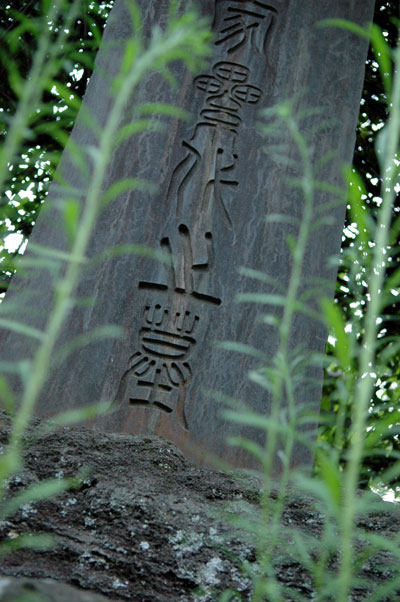
Tomb with weeds. Zoushigaya Bochi, Toshima-ku.
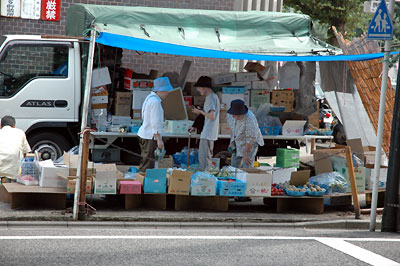
This vegetable truck parks on the corner across from Denzuin temple, creating a convenient market for the local ladies.
The owner chats up the aunties as though he were hoping to marry them all. But the first time I asked him a question, he answered in the rudest possible way and made me feel really stupid. I guess I'm not the marrying type. So I don't go very often. Really, who wants to be insulted while buying lettuce?
But I like the idea of the portable vegetable market. There's a fish truck man, too, who parks around the other corner. He's much nicer and once gave me a free grilled-squid-on-a-stick. I'll bet he thought I wouldn't eat it. Ha! I fooled him, it was delicious.
A typhoon blew through last week. The sunlit raindrops looked like a downpour of diamonds. So luxurious.
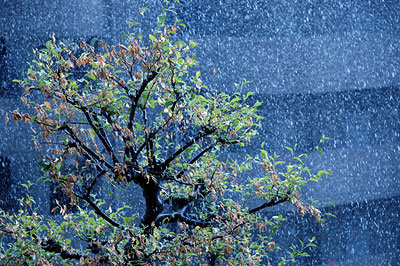
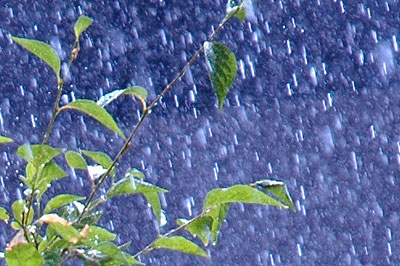
"I'm here all the time, love," replied the foreign swimmer in the next lane when I said hello this morning and noted that I hadn't seen him before.
Well, he was exaggerating. He isn't there all the time--usually on Sundays and sometimes during the week. Seems nice enough and he swims 2 km on Sundays. Not sure how far he went today, but he's planning to swim around a small island in September, so I guess he's preparing for that 8 km trek.
I don't usually talk to people when I swim, so it was a treat to meet an English speaking neighbor who likes the water. Hope to see you again soon, Sean. But not on Sunday; the pool is too crowded.
 Marshmallow Spike played in Yotsuya last night--their first show inside the Yamanote. Tod took lots of photos.
They get better and better every time I see them. MJ even smiled last night while she played and her MC patter had the audience cracking up. Sweaty men on trains, indeed...
And they know who the fans are: Yoshi dedicated "Stolen Umbrella" (download the MP3) to me last night with a quick "for Kristen" before playing the first chords, and he gave me his backstage pass after the show. (Am I almost famous now?) MJ's pass went to Tracey, who also got her CD signed. We're such groupies.
The next show is in Yokohama on August 11th. See you there?
 Here's a product you're not likely to find in American grocery stores. These potato chips are yuzu-shichimi flavoured.
I'm a bit of a traditionalist when it comes to fried potato snacks--salt is sufficient seasoning--but these are pretty good for doctored chips. The yuzu is subtle; the shichimi is barely there. If you want a blast of overpoweringly spicy citrus flavour, these are not the snack for you. But if you are looking for something gently different, then I recommend them.
Yamayoshi also makes the popular WasaBeef (wasabi beef) chips and a host of others. They have a website with dancing bobble-headed cows in their TV commercials and online shopping, but they don't ship outside Japan.
 Kagurazaka is one of Tokyo's well known "traditional" neighborhoods. Despite encroaching fast food chains and convenience stores, it's still an authentic working neighborhood, not at all staged or quaint. Kagurazaka charms by its utter lack of pretense.
The sloping street leading from the station to the temple is lined with family owned shops and restaurants. The side streets teem with tiny bars displaying red lanterns for signs. Shop owners come out in the afternoon wet down the street and cool things off. Cats roam the alleys.
Many lively precincts like Kagurazaka are fading memories. There was a similar neighborhood feel in Koishikawa, on the other side of the river in Bunkyo-ku, but it has been wiped out by developers who snatched up the old 2-story storefronts and constructed towering luxury condo highrises. Where there used to be three streets of shotengai, now there are 7 or 8 giant apartment blocks. Ironically, they use the neighborhood's former charm as a selling point.
But Kagurazaka holds out for now. Walking through yesterday, we stumbled upon the annual matsuri and watched the awaodori dancers milling around before their performances and all of the spectators dressed in yukata. Although most of the people wearing yukata were women (young or old, but not too many in the middle years), a few men dressed for the occasion, too. A double dose of tradition to tide us over for a while.
It's bloody hot here. Yesterday the weather service recorded Tokyo's highest temperature since they began measurements in 1923--it was 39.5 (just over 103 F) in Otemachi. 210 people were treated for heatstroke, but I don't think anyone died.
Being outside was like walking through blood.
Today was slightly cooler at 37.2 (99 F) but I had to dress up for the CEATEC poster photo shoot, so I was wearing cosmetics, pantyhose, and a suit. Atsuiiiiii!
The average temperature in Tokyo for 7/21 is 25.8 but today's average is 33.3. I can only hope that this ends very soon or I am going to melt.
Originally published in Epicure Exchange in 1997; photos taken on July 17, 2004
Unlike the dying breed of classic American coffee shops of the 1950s, the traditional coffee shop in Tokyo still thrives. These family owned coffeehouses, called kissaten (kee-sah-ten), have been around since WWII. Although most of them seem to have undergone a redecoration phase in the late sixties or early seventies, they haven't changed much since the forties.
Walk into a kissaten on a hot summer day and you are greeted with a cheery "Irasshaimase!" from the owner's wife, who tends the cash register and serves the coffee. Her liveliness is in contrast with her surroundings, which are dark and dank. An almost overpowering smell of mildew-- the residue from years of rainy season and hot, humid summers--wafts through the room as the door closes.
The interior is dimly lit and while each shop owner decorates to his (or his wife's) taste, dark wood and earth tones seem to predominate at most places. In this kissaten, the tables have grey marble tops, the heavy, wooden chairs have been upholstered in red velvet and the yellowing walls are strewn with clocks and landscape paintings of Europe. Lamps with hand blown globes hang at regular intervals down the corridor of tables that leads to the coffee bar.
This is not Starbucks. The coffee bar is made of wood, not laminate. It is standing height and the man who stands behind it tending the pots and grinders could never be called a barista. There is not an espresso machine in sight.
The tools of the trade look like equipment in an antique science laboratory. Arranged along the bar are a handful of gas outlets. Over each one sits a giant test tube holder with a glass bowl half full of coffee in its grip. A gas burner that would look at home in a kitchen keeps a kettle of water boiling. On a shelf behind the bar sits a group of brewing pots--a combination of glass receptacles and plastic filter baskets.
When an order is placed, the coffee man goes into action. He is fluid and artistic as he measures out and grinds an individual serving of coffee, simultaneously reaching for the brewing pot. Gently depositing the grounds into the filter basket, he carefully pours hot water into the apparatus, swirling the pot a bit to encourage the brewing, adding more water, watching until the coffee is just right. Then, selecting a cup and saucer from the mismatched collection that time has created, he removes the filter basket and pours the coffee into the cup.
His wife delivers the coffee along with a wood-topped glass container of sugar and a tiny pitcher of cream. For the price of 500 yen (about $5 US) you receive a cup of kohi (coffee), countless glasses of mizu (water) and a place to sit for as long as you like.
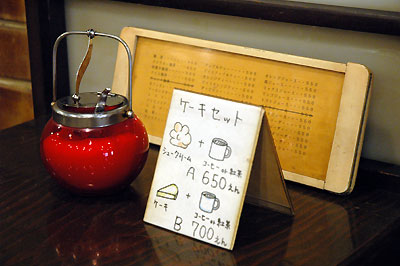
The emphasis in these coffeehouses is on "house" and not on coffee. The high price of coffee is as much a rental fee as it is beverage. Citizens of this crowded metropolis live in cramped quarters so alternate places to relax or work are essential. To find a kissaten that fits your mood and style is to find a second home; most kissaten boast a bevy of regular customers. Neighborhood wives take a break from daily chores and meet their friends for cafe au lait and gossip. Businessmen take refuge from the stresses of the office with a newspaper and coffee or come to vent midday frustrations with their coworkers.
The atmosphere of cool, damp, darkness keeps conversations quiet. Thoughts do not have to compete with blaring rock music and chattering schoolgirls, making the kissaten a good place to plan and work. For those in a solitary but uncontemplative mood, a shared library of used magazines and comics entertains.
When the coffee in the cup is gone, work complete, conversations finished, it is time to leave the cavern of coffee. Walking out into the hot sunshine is a pleasant shock. Across the street is an outlet of one of the coffeehouse chains. The coffee there is cheap and consistent, but the atmosphere is sterile and full of giggling girls and frantic commuters looking for a quick caffeine fix. How unenlightened.
Cemetery wall, Bunkyo-ku
Does the barbed wire keep the ghosts in or the graverobbers out?
In the last two weeks, cockroaches seem to have taken up residence in our bathroom. On alternate evenings, I spy a reddish-brown monster the size of my thumb hanging out near the sink or in the shower.
Gokiburi are not my my list of Things I Can Kill, so we chase them around the room, trap them in a glass and fling them over the veranda into the garden below.
I'm sure the neighbors love us.
 Jingu Skate Rink is an oasis in summer.
If you overlook the slightly choppy ice surface, unsharpened rental skates, and a few crazies on the ice, this is the best place to spend a 34 degree afternoon that I can think of. It's cool. It's athletic. And it's not too crowded on a Saturday.
We went yesterday. Tod hadn't skated in about ten years, but within minutes he was skating backwards and zipping around the rink. I can only skate forwards, a little shakily, but I loosened up after a couple of laps. Even with a wobble, I love to skate.
I turned around the rink with Lionel Belasco tunes running through my head, and the first few lines from Neal Stephenson's The Diamond Age
"The bells of St. Mark's were ringing changes up on the mountain when Bud skated over to the mod parlor to upgrade his skull gun. Bud had a nice new pair of blades with a top speed of anywhere from a hundred to a hundred and fifty kilometers, depending on how fat you were and whether or not you wore aero."
Later on, Stephenson describes Bud as "a little hinky on those skates" which is exactly how I see myself. Only I don't have the skull gun.
Info on the skating ring (in Japanese): http://www.meijijingu.or.jp/gaien/05.htm
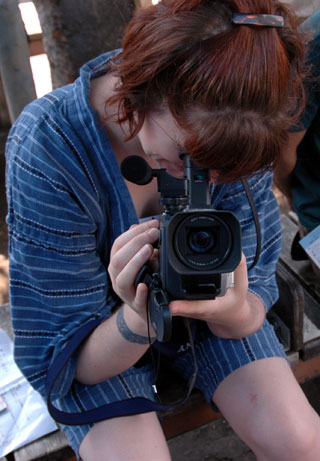
Yesterday we reprised last year's Tanabata matsuri festivities with MJ & Yoshi. I brought my DV camera; Tod carried his new D-70 digital camera. Dressed in men's indigo jinbei (traditional loose jackets with shorts), we captured the festival thoroughly and probably turned a few heads--henna gaijin (weird foreigners) wearing Japanese clothes.
I hoped to make a short film about Altair and Vega, the stars of the matsuri, but Tod declined to be my leading man. Still, I shot a lot of footage and you'll see a brief documentary, "Scenes from Shonan Hiratsuka Tanabata," on Wednesday the 7th, the actual date of Tanabata.
14 August 1999
I was apprehensively cheerful when I woke. My next sleep would be in my own bed and I was looking forward to my own pillows and blankets--the first sign that I was ready to go home. But before I got to go home, I knew I was in for a difficult, emotional day.
Tod & I had discussed visiting Hiroshima many times. It’s an important place to visit. But we knew that it would depress us. I dreaded it. The horror of what happened during the war--and not just that war, that bomb, but all bombs, all wars--would affect me. Human stupidity at it’s very worst.
But the trip had to be made and when I planned the visit to Shikoku, it seemed logical to conclude it by meeting Tod in Hiroshima on the weekend. Get this out of the way, like a dentist’s appointment or a family reunion picnic.
Breakfast was a treat. We dined sitting on the floor of a beautiful lacquered and gilt dining room and the salted fish, rice, miso soup and pickles were so good that I momentarily regretted missing dinner the night before.
As we checked out, the woman behind the desk handed up each a little gift wrapped in a cone of tissue paper. They were tiny little mobiles made of peanuts painted to look like babies in swaddling. Odd but endearing. If we return to Hiroshima, I’m sure the New Kikusui will get our business again. And this time we’ll be sure to take all our meals.
We decided to stash our stuff in the coin lockers in the station which meant a detour but it wasn’t long before we alighted the street car at Genbaku Domu, the A-Bomb Dome.
Before the bomb, the building had been the Industrial Promotion Hall. After the bomb it was one of few structures left standing. You’ve seen pictures of it, I’m sure. Its domed top is a framework of curved iron; brick and stone walls are partially erect; empty windows give clear views through the ruin to the park on the other side. Huge chunks of carved stone look as if they were artfully arranged on the ground where they fell. It’s a powerful symbol. An icon.
And as an icon, I thought it would be dismissable. But it wasn’t. It was big and solid and not a photograph. It was real. Tod & I walked slowly around it and talked about it--what it looked like now. What had happened to it. I took some photographs but neither of us wanted to be photographed next to it. This was not the sort of place where we wanted to capture our visit.
The Peace Memorial Museum was on the other side of the park so we left the dome behind us. We hadn’t walked very far before I was attracted by a small crowd of people near a monument and the sound of a recorded announcement. We went over to have a closer look.
This was the Memorial Tower to Mobilized Students, we learned, as we stood back and listened to the English announcement. During the war, Japanese children over the age of 12 we drafted to work for the war effort. They held factory jobs, or farmed or ripped down buildings to create firebreaks. And when the bomb dropped, many thousands of them in Hiroshima died. Difficult to imagine, isn’t it? But thinking about it made my eyes fill with tears. So unjust.
The Peace Park is filled with monuments, both major and minor, to memorialize war victims in groups or individually, to recognize the suffering of the bomb’s survivors, to promote peace, to serve as reminders of what happened. By the time we reached the museum at the other end of the park, we’d passed by dozens. There were too many to look at but we paused in front of the main ones: the flame of peace which will burn until all nuclear weapons are disarmed; the arched cenotaph through which you can see the flame and the dome; and the children’s peace memorial with its legion of origami cranes arranged in neat rows and huge piles at its base.
A legend that says if you fold a thousand paper cranes, your wish will come true. Ten years after the war, a girl named Sadako had contracted radiation-induced leukemia. She folded paper cranes in the hope that if she got to 1000 she would be cured but she did died before reaching her goal. Today the cranes symbolize peace and are seen all over Hiroshima. People fold them and send them from around the world to be placed near the monuments. They are brightly colored and add a strange air of festivity to the somber reminders of the past--like party decorations at a funeral.
Guidebooks recommended a half hour to an hour at the Peace Memorial Museum. Tod & I were there for four hours and could easily have been there for longer. After paying our 50 yen admission (about 40 cents), we were pointed toward the special exhibits in the basement.
A week previously, at Aono-san’s parents’ house I had watched the annual Hiroshima memorial ceremonies on TV as we ate breakfast. The mayor of Hiroshima gave a speech and two middle school children, dressed in their school uniforms mounted the steps of the podium in lockstep and delivered a speech in unison. The speeches, which I understood little of when broadcast on TV, were on display in the exhibit room. I read the translations and they were powerful cries for Peace on Earth.
The mayor had solicited letters from foreign ambassadors in Japan and they, too were on display. It was fascinating to read them and discover the range of views on atomic weaponry and world peace. Of particular interest were those from India and Pakistan, displayed at opposite ends of the room as if they would somehow cause damage if near one another. In these letters, each ambassador blamed his neighbor for starting the arms race that the countries are now in. I noted that the American ambassador had not replied to the mayor.
We were fortunate to be in town at the same time as a collection of printed materials on loan from the University of Maryland. It was a fascinating and disturbing illustration of censorship in Occupied Japan. I learned much about the power of media control and invisible censoring that morning. There were so many things the Japanese were not allowed to write about--the bomb, it’s aftereffects, food shortages, the Emperor, disparaging or even questionable comments about the occupying forces, the command structure of the occupational government and of course, censorship was not allowed to be mentioned whatsoever.
I wondered if all this was the right thing? The censoring department helped promote stability, I suppose. It absolutely shaped Japan into what it is today. I doubt the average American of my generation really understands what an influence America was on Japan in the early 1950s. From politics to fashion; Japan was inundated and never had a chance to escape it.
My brain was reeling and we weren’t even out of the basement yet. A gallery of paintings and drawings done by A-bomb survivors and one that talked about the impact of the war on children--from the bomb to the years of occupation and beyond--filled the rest of the halls downstairs. We learned about the how orphaned children survived; how schools were back in session by October, how rationing during and immediately after the war stunted children’s growth.
The museum, on alternate Wednesdays (which our visit was not), mixed up a batch of the powdered milk which was the entirety of children’s school lunches in the time immediately following the bomb. “Come and try the nostalgic taste of powdered milk so many children drank at school” a sign read.
Two hours in the basement and it was time for a break. In the tiny cafeteria on the first floor, I had a bar of red bean ice cream and Tod had a cheeseburger from a vending machine that conveyed the refrigerated burger through a microwave and dispensed it steaming hot for your eating pleasure. Tod said it wasn’t bad. I mused over the irony that the technology which made Tod’s hot snack possible in the peace museum had probably originally been developed for the military.
Finally we were ready to tour the permanent exhibits. It was crowded and dimly illuminated on the first floor. Two large dioramas took center stage. One showed Hiroshima before and one after the bomb. An old man talked over his wartime experiences with a green-jacketed docent and some teenage visitors. He pointed to places in the diorama and talked in a croaky voice while people gathered around him and nodded solemnly.
The museum had a message to convey--No more Hiroshimas--and it did its job well though was sometimes a bit heavy handed with descriptives.
They told the story of Hiroshima before the war, during the instant of the bomb and for the years after the war with photographs, maps, simple explanations of the technology of nuclear weaponry, political aspects to nuclear disarmament. Why Hiroshima was the target and why drop a bomb at all were briefly explained.
What I found most disturbing were the “material witnesses.” Scraps of clothing, watches stopped at 8:15, charred lunch boxes, half melted belt buckles and other personal belongings were accompanied by short biographies of their owners and the date and time of their death along with, in some cases, how far from the hypocenter the item was found. Some of the stories were tragic.
In too many cases, people survived the initial blast but were grievously wounded and died within a day or two after making heroic treks home from the city. One teenage boy who had been working in the city was burned over a huge portion of his body but managed to walk kilometers to reach home. His skin was peeling in strips from this wounds and his fingernails fell off. When he died later that day, his mother kept the nails and bits of flesh to show his father who was in the army and not at home. Now we all get to see the gruesome reminders.
It was difficult to read all these, but at one point, after seeing the twentieth or thirtieth uniform blouse of a teenage girl or charred work pants of an old man, I thought I was getting numbed to it. The individual stories were blurring together and I was relieved to see that I was nearing the end of the exhibit. Then I came to the tricycle.
The battered red tricycle was owned by a three year old boy who rode it every day and loved it the way little kids love their favorite toys. When the bomb went off, he was riding outside. He was killed instantly and the tricycle was mangled. His father buried them together in the back yard so that his son would have his best friend nearby and would not be lonely. That got me. Tears slipped down my cheeks and I hurried away to find Tod who had gotten ahead of me.
Fortunately there wasn’t much more of the museum to cover and we dispatched the melted bottles and roof tiles quickly and with a minimum of emotion. The shadow of someone sitting on the granite stairs of a bank wasn’t nearly as powerful as I thought it would be. It looked like a blotch of dirt and not a human shadow.
Regardless, it was a draining experience and we both felt limp and exhausted when we left. It was 2:30 and we were hungry. We had three hours before the train was scheduled to leave so we wandered around the town. We could have visited the castle or one of the art museums or any number of non-atomic sights but lunch and a fruitless search for English books occupied us instead.
I’d like to return to Hiroshima. Despite the parts I’ve described, it’s not a solemn place overall. It’s a typical Japanese city with big, ugly ferro-concrete buildings, museums bursting with artworks, a baseball team called the Carp, a zoo, many gardens and even a manga library. Now that I’ve toured the grim but important part of Hiroshima, I would like to experience the rest of it.
Maybe someday. But for now I need a rest.
13 August 1999
Tod was scheduled to arrive at Hiroshima at about quarter to one in the afternoon and I had no intention of running around to see things without him, so my morning was relaxed. I caught the 11:00 train to Hiroshima and arrived with plenty of time to scope out the coin lockers, load up on brochures at the tourist information desk and even to have a cup of coffee.
All my free time pointed out a delightful opportunity of good timing (finally!). While sipping my coffee and reading the tourist brochures, I discovered that Miyajima, a small island that was the destination for the next day, was holding its annual hanabi (fireworks) festival that night. So if we adjusted our itinerary we could see Miyajima’s today and visit the Hiroshima sights the next day. Which we did.
When Tod’s train came in, we went off for lunch. Hiroshima is known for two delicacies: oysters and okonomiyaki. Oysters are not my favorite food, so we opted for okonomiyaki for lunch.
Okonomiyaki is something like a pancake or a frittatta. We’d eaten them in Tokyo, but only at a fancy Ginza restaurant where the staff did the cooking. In the rest of Japan, okonomiyaki is a participatory experience.
We were seated at a table with a grill in the middle. Tod figured out the menu quickly and ordered two bowls of the basic “stuff” which included batter, eggs, cabbage and strips of pork, then added some extra toppings--garlic, rice paste balls, mushrooms. They arrived and I realized I had no idea what to do next! I looked at the waiter with a questioning look in my eyes and a little shrug, and mimed turning the bowl over onto the grill.
He was aghast. He kneeled at our table and explained the correct method for making okonomiyaki. Remove the pork strips and sit them on the smaller of the two paintscrapers that were out implements. Mix the remaining contents of the bowl and add the extra ingredients. After things were well mixed then the contents could be poured onto the grill. The larger spatula was used to shape the runny edges into a neat circle. When the pancake was golden brown on one side, the pork was laid on top and whole thing was flipped with the larger spatula to cook on side two.
He left us to cook but returned frequently to give us more water and watch our progress. He even corrected our mistakes. The result was delicious and the cooking was fun. Fully stuffed, we were ready to face our next challenge--an early check-in.
Our hotel was a traditional Japanese hotel with a good recommendation but a 4:00 check-in time. If we wanted to be on Miyajima in time to see the island and find a reasonably good place to sit among the crowd, we’d have to be there by late afternoon. So we headed across town to explain our predicament a few hours ahead of the check-in time.
They woman at the desk was understanding, took our bags, gave us advice on reaching Miyajima and even dug up some English language maps. But the price of our stay at the New Kikusui included a dinner we would not be able to eat and there was no refund. That was OK, though. We chalked it up to the price of changing plans at the last minute and went on our way to Miyajima.
The journey from the hotel involved a streetcar, a train and a ferry and took about 45 minutes. The ferry was filled with young women in yukata with their hair arranged in upsweeps and held in place with hair accessories ranging from traditional lacquer combs to Hello Kitty barrettes.
Two brightly blonde American girls, dressed in yukata and sitting with a group of Japanese girls similarly costumed and coifed, carried on a loud conversation about the immaturity of one of their American associates. I gathered that these two, and their absent companion, were exchange students or very young English teachers. Fortunately, they and their cortege vanished into the crowd as we disembarked and they scurried away towards the shops.
Because I had an agenda. It’s sort of a pain to have to see the sights when you visit somewhere. I planned to incorporate Miyajima into a story I would write for a magazine when I got back home, so I needed to check out and photograph as much as I could while I was there: the (inevitable?) ropeway to the top of Mt. Misen, the sacred forest and its wild monkeys; the view from the hill, the treasure house.
And of course, the most famous sight on Miyajima, Itsukushima Shrine is one of the Three Most Beautiful places in Japan. It sits on pilings at the water’s edge and at high tide it looks like it’s floating. The huge red torii gate sits further out in the sea and is an often photographed landmark--almost an icon of Japan.
Japan is full of “Three Most
Anyway, here we were at one of the Three Most Beautiful places in Japan and it was not living up to our expectations. First of all, the tide was out, so the shrine and its gate were not floating on water, but mired in mud. Then there were the deer. Very tame, miniature deer roam at will charmingly chewing on trash and tourists snap their photos. They are adorable, but the island at low tide has a distinct scent of deer urine.
But we were going to brave it all. Tod was feeling tired and had a headache from his trip. But there was a bus outside the ferry pier that Tod said would take us to the ropeway station halfway up the mountain. It would save us the fifteen minute uphill walk. We hopped on and a few minutes later found ourselves halfway around the island at a beach. Not the ropeway station. I tried to make the best of it and snapped a couple of photos to commemorate our error and we hopped on the return bus.
Tod’s headache was getting worse and the sun was just beginning to go down--we wouldn’t have enough time to reach the summit of the mountain, shoot photos and get back down in time to get a good vantage for the fireworks. So we abandoned everything but the fireworks and walked off in the direction of the shrine. The hanabi would be launched from barges in the water on the other side of the torii.
We walked through the makeshift festival arcade and scoped out the food options. Although still full from our late lunch, we knew that our stomachs would eventually start to grumble. When that time came, we passed up the traditional Japanese grilled whole skewered squid, the bits of octopus tucked inside a ball of batter and fried, the fried noodles. We went straight for the “familiar” foods--french fries and American Dog which you will recognize when it’s described as Corn Dog on a Stick. So much for going native...
Finding a suitable place to watch the fireworks was a challenge. The photographers’ tripods had the best views of all. The clustered between the shore and the torii facing the barges where the fireworks were waiting for dark. These photographers would get great shots of the gate silhouetted against the fire flowers in the sky.
Other photographers preferred a flanking view. No matter where we tried to stand or sit there was a photographer in front of us. I was wishing I had a tripod of my own. But I didn’t and the dozen or so photos I attempted that night look like fireworks in an earthquake!
The fireworks were incredibly beautiful. Japan knows how to do hanabi. All summer long you can see fireworks on the weekends and not the 20 minute Independence Day show at the park, but sixty to seventy five minute extravaganzas. Beautiful, huge loud displays. The Miyajima hanabi were especially beautiful and designed for those photographers. High circles of white and pale colored exploded above water level fountains of sparks. After a few minutes of action, the show paused for the smoke to clear and then began anew. Each set was more spectacular than the last.
Eventually it ended and we threaded our way back to the ferry. I bought a candy mekan--like a candy apple but a mandarin orange instead of an apple. A deer was stuck in the middle of the surging crowd. Confused and frightened, he was trying to back his way out of the crush of people but instead, backed into Tod! We reached the plaza outside the pier and stood in line with the thousands of other people who wanted to get back to Hiroshima. It took more than an hour to get on the ferry for our five minute ride across to the mainland.
Exhausted by the time we reached our hotel, we asked for our key and got into a conversation with the man at the desk who had lived in Tokyo for a number of years and knew our neighborhood. That was nice, but really I wanted to go shower (I hadn’t had one since 9 that morning!) and collapse into bed.
I was so tired that I couldn’t’ find the towels or the yukatas or the bars of soap that were neatly laid out on a lacquer tray and tucked into our closet (I found them in the morning). I showered with leftover soap I’d carried with me, used a washcloth to dry myself and fell into my futon. Tomorrow would be the last day on the road and I was looking forward to being finished with traveling.
12 August 1999
Traveling is sometimes a game of chance. Having rolled snake eyes on the previous day’s activities, I woke up with a desire to leave Innoshima with all due haste. Maybe I could improve my game back on the mainland.
And so I did. I was bathed, breakfasted and checked out of the Hotel from Hell in time to catch the 7:40 bus to Onomichi. I had no intention of following through with my original plan of cycling the 20 km across the final two bridges. Air conditioned comfort and views of Setouchi from the fast lane were what I wanted and exactly what I got. I arrived at Onomichi Station at 8:30 am.
But I hadn’t planned to spend much time in Onomichi--it was more of a bed and breakfast stop than a day’s sightseeing destination. I had no idea what I’d find there to occupy my day. My entire Onomichi research consisted of the mimeographed map given to me by the travel agency which showed where I was staying for the night.
The station map indicated that there was a nearby castle park, so I walked down the street in the direction of the ropeway that would carry me to the top. Maybe I could stretch the park to fill my morning; I’d figure out what to do with the afternoon when it came.
The ropeway at Onomichi was much quainter than that at Tokushima. People crammed into the car until it felt like a Tokyo train at rush hour. at precisely 9:15, the car, stuffed with two dozen sweaty riders trying to fan themselves without whacking their neighbors, began it’s slow ascent. We traversed a shrine, glided past a pagoda and were deposited at the top of the mountain in a few minutes.
I had picked up a bilingual area map at the ropeway station but the crowded compartment had prevented me from unfolding it. Now I sat on a rock wall and spread it in front of me. I sipped on some warm tea and nibbled leftover Oreo cookies from the previous night’s orgy while I studied my options.
Onomichi is nestled in a curve of shore between the mountain I now sat on and the inland sea I had just crossed. Its nearest island neighbor is a two minute ferry ride across a narrow stretch of sea that looks like a river. It is a port town so ferry terminals and docks with huge cranes dot the water’s edge. I could see all of this from my vantage point atop the wall on the mountain. In the distance, I could see hazy mountains of farther islands poking out from a shiny glaze of water.
But returning my gaze to my map, I discovered that I was not the only one to be taken with the beauty of the scene. I was sitting at one of the “Vantage Points of Famous Painters” that were marked by stars on the map. Looking around, I saw a little plaque about a half a meter away that said the same thing, only without the star and the English. I don’t know who he painter was, but I could appreciate his taste in viewing points. Another dozen stars were scattered around the map. I decided to try to take in as many as I could.
Also marked on the map were two walking routes--the Road Way of Literature and the Round of Old Temple. According to the map, the Road Way to Literature began almost where I was sitting. I looked up and turned my back to the view to see what was around me.
I had missed noticing the two-story circular observation platform when I alighted from the ropeway, but there it was, squatly topping the height of the mountain. Signs pointed the way to cobblestone paved paths leading to the town’s art museum and an amusement park. In the opposite direction was the Road Way to Literature and a temple. I opted to begin with the Road Way to Literature.
The Road Way is a hiking course that starts down the hill away from the ropeway then snakes behind the pagoda I’d passed on the way up and winds its way back up to the top of the mountain. The Literature part takes the form of 25 stones inscribed with poems. Many of the poems seemed to have an outdoor theme and some were specifically about the mountain and Onomichi. I surprised myself by being able to read a few of them from start to finish. The calligraphy of the inscriptions was supplemented by a nearby sign neatly printed and including furigana, the spelled out readings of kanji often seen in children’s books.
Along the trail were several more of the Viewpoints of Famous Artists. They must have painted lovely pictures of the mountains and sea, though I suspect that they completed their works before the hulking orange and white cranes in the harbor got in the way.
Heading downward along the Road Way, I visited the vermilion pagoda. It was lovely and shady and I stopped for a few minutes to admire yet another view over Onomichi.
To worship at a temple, you must summon the attention of the deities that are housed there. Normally this is done in one of two ways. A Buddhist temple, you clap loudly in front of the shrine before bowing. At Shinto shrines, you ring a bell fastened above the offering box. But at this shrine was a novel noisemaker.
Instead of a bellpull over the offering box there was a long rosary of grapefruit-sized wooden beads on a pulley. The beads filled all but the last meter or so of rope that strung them together. I was attracted to the sound and watched from a safe distance to see how it was done before trying it myself. Pulling on the loop caused the beads to fall from the top of the pulley to land on their mates below. They made a lovely clacking sound. One bead was painted red to mark the end of a full circuit. People who had done this before were able to keep the flow of beads evenly tapping the whole way around. My attempt was a bit uneven but pleasurable nonetheless.
After the pagoda, the Road Way angled back up to the top of the mountain and ended near the art museum. Unfortunately, the art museum was closed in preparation for a showing of “Water Painting in connection with Onomichi” scheduled to open the next day. Once again, I was a victim of bad timing.
But it didn’t really matter. I wandered over to the edge of the mountain where the keep of the old castle was perched. It was a classic white walled, winged roofed castle of the style which figures prominently in samurai movies but that was destroyed throughout Japan when the feudal period ended and the Meiji era began. There are still plenty of castle remnants around, though. I can only imagine what the countryside looked like before the end of the 19th century. So many castle towns!
A bamboo forest shaded the path leading off the mountain away from the castle. I followed it and end up not far from the station. It wasn’t quite lunch time yet, so I opened my map and decided to follow the Round of Old Temple for a little while. It would lead me in the direction of the shopping arcade near the ferry terminal which promised to have a good noodle shop or two.
The Round of Old Temple was a long winding route up and down grey, shell patterned stone paths and myriad steps. It wound its way from one end of town to the other and took the diligent walker to almost two dozen beautiful old temples which had survived the war, earthquakes and centuries of time. Unlike many of the famous temples in Tokyo and other big cities, these had not been firebombed and reconstructed.
The street, a narrow pedestrian lane bounded on both sides by the garden walls of the housed that faced it, radiated heat that the local cats napped in. The cats in Onomichi are friendly, like the people, and whether perched on a garden wall or curled up in the shade of a garden gate, they purred appreciatively when rubbed behind the ears. I walked along, collecting an overdue quota of cat-petting as I made my way from on the Round.
At one of the temples I visited, I found yet another opportunity to incorporate pottery into my travels. I sat on a bench in the shade of an eaves and watch people walking past me on their way to the cemetery. The neatly swept dirt courtyard in front of me ended in an old-style temple hall. But outside the hall a middle aged couple were sitting on zabuton cushions at a low table and they seemed to be making something from clay. I watched for a little while, but couldn’t figure it out. I wasn’t even sure if they were associated with the temple, or just visiting like me.
As I smoothed a bit more sunscreen over my arms and nose, the gentleman and his wife stood to leave, bowed to a woman in the door way and headed towards me. The wife turned and went to pray at the temple; the man sat at the other end of my bench. He smiled at me, we exchanged pleasantries in Japanese and then, in broken English, he said “Hand Buddha. You can make it.”
So that’s what they were doing. making Buddhas. It didn’t take me too long to debate whether to try it myself and I was sitting on a zabuton a few minutes later. A woman in an indigo blue work kimono greeted me and smiled when I said I wanted to make a Buddha.
She apologized for not speaking English and proceeded to instruct me in the proper way to hold the cylinder of clay and squeeze it to form the Buddha’s head and fingerprinted body. I pulled ears and a distinctly Western-looking nose from the clay and with a bamboo skewer incised the remaining details.
When two junior high school girls came to sit at the table opposite me; the woman looked relieved. Did one of them speak English? They giggled, as teenagers around the globe do, and said they did not. However, when we got to a sticking place in the instructions, they knew the right English word to enlighten me.
Buoyed by this exchange and activity, I walked on to the next temples. On the way up a long flight of stairs, I saw a sign pointing the way to the Mansion of Literature Onomichi. That seemed like a fitting extension to my earlier Road Way of Literature walk, so I turned and went up the side path to a little house.
I could see people inside reading, I almost didn’t go in since my Japanese reading skills are on a par with my spoken Japanese. I was sure that this place might hold more embarrassment than joy for me. But as I stood there deliberating, someone came out and that sealed my fate. It was air conditioned in there!
The man who took my admission fee apologized for not speaking English (maybe this should be an unofficial Onomichi slogan) but then proceeded to explain to me, in English, what the museum was all about, and that there was a second part of it up the hill and around the corner. This part of the Mansion of Literature had been home to one of Onomichi’s celebrated writers. I perused the manuscripts in the glass cases, looked at the giant painted gourds on display and gawked at the beautiful view from the window of this writer’s study room.
But the house was only three rooms, so after a few minutes, I was back on the path upwards to find the other half of the Mansion of Literature. I took a momentary wrong turn and considered giving up and going back down into town for lunch. But I knew if I was this close and I didn’t find it, I probably wouldn’t bother to try again after lunch. I persevered and after turning myself in the right direction, found the other half.
A chorus of “I’m very sorry but I don’t speak any English” greeted me at the door as the counter man exchanged my ticket for a bookmark with the museum’s logo. I wandered through several rooms of displays looking at the momentos of writers, playwrights, poets and songwriters. A shamisen. Fountain pens. A pair of wire rimmed glasses. A tea service. And on the walls were photographs of the writers and their brief biographies.
I was puzzling through some of these when an old man approached me and asked (in English) if I was interested in Japanese literature.
When I expressed an novice’s interest, he was delighted and gave me a personal tour of the museum, explaining who the authors were and what they wrote. His particular favorite, and I gather the most famous of the Onomichi writers, was a woman named Fumiko Hayashi. I had seen a statue of her in the town square earlier that day.
Takagaki-san, my self-appointed escort, told me all sorts of stories about her as he lead me through the rooms devoted to her writing and her momentos. He told me about the years she lived in Onomichi and how she eventually moved to Tokyo. Her house there is now a museum. I told him I would be sure to find it and visit.
“Do you read Japanese?” he asked. I said I could read a little bit, and he asked me to see if I could read the read the postcard she had written to her six year old son while he went off to look for something for me.
He came back with a photocopy of the Tokyo museum’s brochure which included the address. We talked for a while longer and he said he would send me a copy of Shitamachi, one of her short stories that had been translated into English. Profoundly grateful for this incredible kindness, I wrote down my address.
Takagaki-san confided in me that he has translated 720 Japanese songs into English. “Just for a hobby,” he said. I suggested that they would make a very interesting book with facing pages of the Japanese and English lyrics along with the musical notation. He demurred, saying that he didn’t think there would be anybody to buy it. But I’m not so sure. You don’t see bilingual books like that very often and they can provide good insight into the natural use of both languages.
Eventually, I took my leave and started down the hill to have lunch in the shopping arcade. But before I’d gone two hundred meters, I stumbled across a cafe terrace with an unparalleled view of the water and the mountains. It wasn’t marked as a Viewpoint of Famous Artists, but it should have been.
The proprietress was a liaison for AFS (American Field Service), an international exchange program, and had spent lots of time outside Japan. Although she understood and spoke English perfectly, she knew the value of speaking to me in Japanese. So I stumbled along and got further beyond the four question conversation than I ever had previously. She coached me when I erred and my half hour sitting in the shade of her trees listening to the cicadas and chatting was very pleasant.
Lunch ended up being really late and by the time I’d finished it was time to check into the hotel and have a shower--my favorite time of day!
Onomichi held more delights in store for me. Marked on my map was something labeled Tile Street near one of the temples on the Round of Old Temple. I wanted to see what this could be. It turned out to be a tiny alley which someone had paved with cement and colored tiles laid in patterns. The walls of the alley were covered with wooden frames holding bathroom tiles onto which visitors had penned their wishes and thoughts. Tile Street didn’t hold the allure of Bangkok’s flashy tiled buildings, but it drew a fair crowd of people regardless.
I wandered around on the Round and saw a few more temples, even going so far as to climb up an overgrown staircase to get a view of the pinkening sunset sky with a pagoda in the foreground. But eventually it turned dark and after a promenade up the shopping arcades, I settled in for dinner at a pizza restaurant with a wood fired pizza oven and two independent women entrepreneurs.
After dinner, I holed up in my room with the television. Since we don’t have one at home, I was enjoying the opportunity to watch some of the silly Japanese shows. Variety shows with guest stars taking on silly challenges while dressed in bizarre costumes filled my evening. Tomorrow, I would catch a train to Hiroshima to meet Tod and begin the final leg of my trip.
11 August 1999
To say I was a bit high strung when I woke up is an understatement. This was the big day...biking 40 km from Imabari to the island of Innoshima in the middle of Setouchi—the Seto Inland Sea. It would be a test of my endurance, my biking ability, my will power.
I had another round of bathing at the hotel and my first Western breakfast of the trip. Sausages, scrambled eggs, toast, fruit, yogurt and coffee. Plus a salad with a shrimp and a raw scallop (even Western food has a Japanese flair).
I went to the station and caught the first train to Imabari. It was a “one-man,” a local diesel train with only one car and the eponymous one man at the controls. Although I had never encountered a one-man in Tokyo, where all trains are six to fifteen cars long and have conductors plus drivers, they are the norm for local trains in Shikoku.
But they are slow. The trip which took 30 minutes on the express train the day before was stretched to 75 minutes on the one-man. Giving me more time to fuel my morbid fears about failing at my task and being driven off the bridge by a passing truck or falling off my bike and breaking a limb and having to explain in Japanese to the hospital staff what’s happened to me. So by the time I got to Imabari I was even worse than I was when I woke up.
But dammit, I was going to do this. I was determined (or maybe just stubborn) and I knew that riding a bike over some bridges really wasn’t outside my capabilities. No matter how morbid my imagination was painting the scene, I could do this.
Shimanami Kaido is a series of seven bridges that span ten islands from Shikoku to Honshu, Japan’s “mainland.” This bridge route has been under construction for ten years and the final bridge was finished this April. So this summer there are a number of events taking place on and around the bridges-—walks, bike rides, marathons, special island-based events.
I was armed with the locations of the cycle rental terminals, the name and length of each bridge and I had planned my course to take me as far as Innoshima where I had a reservation at a hotel that night. Now all I needed was a bicycle. Crossing over from the Imabari train station, I checked in at the bus terminal.
“I’d like to go to Itoyama Events Site.” I explained to the ticket woman.
“Ah, I see. Are you going to rent a bicycle?” she asked.
“Yes, I am riding to Innoshima today.”
“Oh! That’s a long way. You must be very athletic. But I’m afraid the next bus doesn’t leave until 1:20 this afternoon.”
“Really? That’s a very long wait, isn’t it? Well, I’ll buy a ticket now, thank you.”
I was going to have to wait almost three hours for the bus. This did not bode well, as I’d planned to be on the bridges by noon at the latest. I was getting used to a slower pace than back home in Tokyo, but this was too slow!
I walked away from the terminal and back towards the train station. Although I wasn’t hungry, maybe I could fill some time with a coffee or a snack. As I passed through the driveway , my eye was caught by a sign at the taxi queue that listed the fares to nearby tourist destinations. Although the cycle terminal wasn’t listed, I ventured to ask the taxi driver how much it would cost to go to the cycle terminal. The 1600 yen fare he quoted was definitely worth saving three hours! I got in and we were at the rental shop in 20 minutes.
I filled in the rental forms and paid for my bike. I could rent it one way as far as Omishima, about 25 km away. Then I would have to turn it in and rent another one-way cycle to the next renal shop. To make it all the way across the bridges from Shikoku to Onomichi on the mainland would take four or five rentals.
However, when I was told that the only bikes left today were three-speed shopping bikes with bell and basket, I was glad that I would have to change bikes. I picked up a map of the bridges that included not only details of the distances, but schematics of the cleverly designed bike and pedestrian interchanges that minimized the slope to each bridge by creating curlicues and vortices of roads leading upwards.
I hopped on my bike, tested the brakes, and was off. The first thing I did wrong was to go up the motorbike ramp. I didn’t know the kanji on the signs so I couldn’t tell which way was for bicycles and which for motorbikes. But I wasn’t the only bike up there, so I only felt slightly foolish. And I managed to ride up the steeper incline without too much fuss.
The first bridge was a long triple span suspension bridge. In fact, it’s one of Japan’s superlatives—”the longest suspension bridge in Japan.” It is just over 4 kilometers from end to end. Once I was at the top, it was a lovely ride. There was a breeze and the view of the tiny islands of the Inland Sea was breathtaking.
The Inland Sea was a place for pirates I had read and now riding over it I could understand why. Countless pinpricks of islands dotted the calm sea. Perfect places to hide treasure or more importantly, escape from the authorities. I didn’t see any jolly rogers as I cruised over the bridge, though.
At the end of the bridge, I was already feeling the heat of the day. It was noon and the sun was beating down. My sunscreen has perspired off and I was happy for the shade provided by the hat I’d pinned to my head. My sunglasses slid down my slippery nose as I rode.
The next phase of the ride was a long 11 km trek across the island of Oshima. Oshima is very hilly and I thought that between the heat, dehydration and exertion I was going to collapse. This is when I discovered that I lie to myself.
“Kristen, why did you want to do this? This is terrible!” the intellectual part of me complained.
“You can do it. This is good exercise,” the other half encouraged.
“Sure. Until it kills me.”
“Now, now. You’re stronger than you think. Look ahead...see that little shadow there? If you get there you can stop and have a rest,” I encouraged myself aloud.
“OK,” I capitulated. I knew I really didn’t have a choice. I had to get the bike to Omishima to turn it in.
I pedaled as fast as I could uphill on the shopping bike (which wasn’t very fast!) and reached the shady spot. But that nasty, masochistic part of me was already looking ahead.
“Hey, if you go just a little farther, I’ll bet you’ll find a drink machine,” she said as we passed by the shady spot without stopping. I pedaled on.
Sure enough, there was a drink machine. But did I let myself stop? No. A place for lunch must be just up ahead. A bowl of noodles would be very good. So ever onward I pedaled.
I sweat. I drank. I stopped to rest. I walked my bike when the hill was too steep to ride. I did eventually find a place to have lunch. I chatted with two other bridge crossers while we ate. Then it was back on the bike for a short downhill stretch.
The downhill ride was a tease. Ahead of me was the longest hill I’ve ever had to ascend on a bike. Lying Kristen was with me the whole way encouraging me to keep going. I nearly passed out but I did eventually reach the top of the hill. There was a viewing point with a view of the sea and more pirate islands, but I was too beat to appreciate it.
I was now 15 km into my 40 km ride. It was 1:30 in the afternoon. I was averaging 7.5 km an hour after factoring out lunch. I had better ride a little harder if I was going to make it to my hotel before dark.
The next bridge was beautiful and I appreciated it despite my heat exhaustion. I stopped to take a picture of it at the same time as someone heading in the opposite direction. We traded cameras and captured souvenir photos with the bridge in the background. This turned out to be the only proof I have of being on a bicycle over the bridges so it was a lucky encounter.
Another stretch of island. By this time I was walking my shopping bike up hills I should have been able to ride. Drink machines were few and far between.
I must have looked quite a sight. People stopped to ask me if I was OK. I’d smacked my healing wound (from the last bicycle expedition) with the pedal of the bike and opened it up again so a small torrent of blood leaked out. My fair skin which flushes at the least provocation was beet colored with exertion. My arms and legs were getting sunburned. I just kept answering “Yes, I’m fine, thanks.”
I was too weak to make this ride. I should have trained. Or gone on a day that wasn’t 35 degrees. In cooler weather I might have sustained a better pace. I walked my bike up hills on Hakata Island that I ought to have been able to ride up easily. Thankfully this island was not quite so hilly as the first one, and soon enough I was flying over the Omishima bridge and cruising along a nice flat coastal road on my way to turn in my bicycle.
“After I turn this bike in I’m not pedaling another meter,” I told myself firmly.
“Maybe that’s a good idea. I guess we’ll see what happens,” the vicious Kristen answered. I knew she had no good planned.
I returned in the bike at 2:45 (four hours after I’d rented it) and was surprised to receive a gift to commemorate my struggle—a t-shirt! That was probably the high spot of my afternoon since it meant I would not have to do laundry that night.
After resting in the air conditioned bike rental lounge, I checked on the availability of buses to Innoshima. The staff at the information desk were very helpful—they even called my hotel to figure out which bus would get me closest. But I had just missed a bus and would have to wait until 5:30 for the next one.
“That’s OK,” I told myself. “I don’t want to ride any farther. I can’t do it. 25 km is enough.”
“But you failed to meet your goal. You could ride to Innoshima in 2 1/2 hours and beat the bus there.”
“No, I could not. Now shut up and let me go buy some ice cream.”
My two halves don’t get along very well in the face of adversity, you see. But the tired one won this time and I had an ice cream, bought some post cards which I wrote to everyone whose address I have memorized (only three or four!) and watched kids playing along the shore. The bus to Innoshima dropped me off a block from the hotel.
I was so happy to reach a place where I could have a bath! The road grime and sweat from my travels had cooled and crusted and all I wanted was a hot shower. But the hotel didn’t have my reservation.
This was the only hotel on my trip that I hadn’t been able to prepay at the JTB travel agency. Not many people come to Innoshima. So even though JTB had called, made a reservation in my name and gotten a map faxed over for me, the hotel didn’t know I was coming. I showed them the map they faxed. I wrote my name in Roman letters and in katakana. To no avail, There was no reservation. And no room.
I have to admit with some embarrassment that I was not the most gracious of Americans at this point. I didn’t raise my voice or scream but I was very snippy. I implored them to look again. I explained that JTB had made the reservation for me. I gave the date the reservation was made. I was insistent in a way that Japanese are generally not.
Eventually, they found a room for me. It was a Western style room that was dirtier than I was. But I was so exhausted and distraught that I was happy to have it. There would be no dinner for me, as I didn’t have a reservation, but I could have breakfast in the morning. OK, fine. Whatever. Just let me go upstairs and have a shower, please!
In my room, it took me all of 30 seconds to strip off my clothes and start the shower. But in that 30 second interval, there was a knock on the door. I threw on the yukata and answered. The maid was bringing water for the electric teapot.
Dispatching her, I stepped into the steaming shower. I tried to ignore the mold on the shower curtain and the creepy black stuff in the corners where the tub met the tiled walls. The crud that covered my body melted off and I shampooed and soaped my way back to feeling human.
I thought I heard the phone ringing but I wasn’t sure. But when the knocking on the door began, I knew someone was trying to get my attention. I threw a towel around myself and, dripping, opened the door a crack.
It was the desk clerk. “We have your reservation, Kristen-san.”
“Great. I’m showering right now. Thank you.” I rudely closed the door before he could go on. After I was dressed the phone rang again. It was my new friend the desk clerk. “Dinner is OK for tonight. Come to the front and I’ll show you which room it is.”
At the desk, the clerk told me that they could move me to the Japanese room I had reserved and that dinner was in the Seto Room down the hall. This all just seemed too much, but I was glad I didn’t have to find dinner on my own. I went off to dinner, anticipating my post-dinner room change.
I walked to the room where dinner was being served, but the door was closed. I wasn’t sure if I should open it--it had been standing open when I passed by it earlier. I waited for a staffperson to come by and I asked which room dinner was in.
“Oh, you have to have a reservation,” she said.
“I have one,” I said.
“I don’t think so. Are you sure? Let me check. Just a minute,” she said as she disappeared down the hall.
I slumped against the wall and my eyes filled with tears. Surely this wasn’t really happening to me. By the time the waitress had returned with the “all clear” from the front desk, I had pulled myself together.
Dinner was not stellar and I wasn’t really very hungry. A bit of lukewarm steak that had been sitting out too long, miso soup, rice and pickles. I ate the rice, soup and pickles, then went upstairs to repack and switch rooms.
With my backpack slung over my shoulder, I presented myself to the desk clerk.
“I can change rooms now,” I suggested.
“Oh? I thought you said you weren’t going to change rooms. We gave the other room to someone else.”
“Oh.” What else could I say? “My mistake.”
“I’m sorry. I hope that’s OK. Is it OK?”
My answer was a pretty unconvincing “Yes, it’s fine. It can’t be helped, can it?” as I turned my back on the desk and went back upstairs where I proceeded to call Tod and unload my terrible day to him.
I took a walk around the quiet harbor neighborhood, checked the morning bus schedule to Onomichi (I was definitely not going to bike the remaining 20 km!) and bought myself some consolation ice cream and cookies to nibble on while I watched TV in bed. And that was the end of my very long biking day.
10 August 1999
Over the course of the previous week, I had stopped marking time by meals and begun paying attention to check-in times and bath times. Eating had become less important than washing away the day’s grime and soaking in hot water.
The New Tokushima Hotel had two baths. From 3 p.m. - midnight, women bathed on the first floor. From 6 a.m. until 9, they bathed upstairs on the fifth floor. The men’s schedule was opposite--upstairs at night and downstairs in the morning. I’ve learned that when baths are switched like this, there’s usually something special about one of the bath rooms. So before breakfast, I decided to have a bath upstairs.
And I was right. The fifth floor bath had a rotenburo, an open air bath, with a little garden. It was nice to sit in the warm water with my wash towel piled on my head and listen to the traffic below me on the street and the calls of early morning workers unloading trucks of produce. Although maybe these aren’t the poetic sounds of nature, I enjoyed them. No matter where you are, there’s a world around you that you never imagine. And vice versa--how many of those produce workers gave a second thought (or even a first) to a foreigner’s bath that morning?
I finished my bath and back in my room I packed up my things. Breakfast turned out to be much less dreadful that the previous morning’s. No natto and raw fish today--it was ham and cabbage with my egg broken into the miniature cast iron skillet atop my brazier. Plus rice, miso soup and all the little pickle dishes. Japanese breakfasts are really quite a feast!
Today I was going to be spending some time on a train heading west to Matsuyama and Dogo Onsen. When I had made my reservations the day before I decided that I wanted another morning in Tokushima to see some craftsman. But my enthusiasm for crafts waned a bit after the trip to Ko and now I had several hours to wait before the train left. I decided to walk around the castle museum and park.
The next day marked the start of the annual Awa Odori festival. For three days & nights the town would dance. There’s a saying written all over posters and all the promotions for Awa Odori “Fools are dancing and fools are watching. Why not dance?”
Dance parades fill the streets, contests and impromptu lessons are held anywhere there is space. Brilliantly costumed women wearing cotton kimono and straw hats tied to their heads like folded paper plates dance for hours balanced on the toes of their wooden geta sandals. Arms point into the air as wrists rotate and legs fold then step forward. Men bounce along standing tall then suddenly doubling in half as they writhe to the beat of the drums they carry. It’s quite a spectacle.
But I was witness only to the preparations. Young men in light green uniforms and white gloves spliced electrical wires to create endless streams of red and yellow lanterns that would be hung along city streets and waterfront parks. Metal pipes clanked as burly workers, skin shining and brown from the heat of the day, constructed the bleachers flanking the parade routes. Traffic was disrupted by slow moving trucks bearing port-a-potties.
In the park near the castle museum, in the shadow of the ancient castle gate, a handful of bleached blond boys inspected the sound equipment going up for the concert scheduled for the evening. Their roadies, dressed in baggy t-shirts, long shorts and flat bottomed skateboarding shoes, could have been college students from any US university. But the ubiquitous Japanese towels tied around their heads gave away their national identity as they worked busily adjusting cabling, moving monitors and lugging carts around while two well-wrought women with clipboards discussed the progress off to one side of the event stage.
Eventually, I boarded my train to Matsuyama. The trip took four hours and the only thing to break up my studying was the view of the Shimanami Kaido bridge at Imabari. This bridge was the beginning of the next two days’ travels--I was planning to cover the 60 km span on a bicycle. The approach to the bridge, all curves and circles, looked so much steeper and intimidating from my low vantage point than from the aerial photographs in the brochures. I wondered if perhaps I was getting myself into something I couldn’t handle.
I tried to put that thought aside and concentrate on what I was going to do for the rest of the day. I would arrive in Matsuyama in the late afternoon and make my way by tram to the outlying area where I was spending the night--Dogo Onsen.
Dogo Onsen was the pinnacle of my bathing experience. The public bath there is the oldest in Japan. It is mentioned in Japan’s first written records which are about 3,000 years old. The legend of the bath says that an injured white heron dipped its leg into the hot spring here and was cured. Since then, people have flocked to Dogo for its curing powers.
There is the main public bath house and myriad hotels surrounding it each with its own baths for guests. Which was excellent, because my inner clock told me it was bathtime!
In my hotel room was a pink cotton yukata robe with a pattern of blue toys printed on it. The “Big Book of Hotel,” my generic name for the folder in every hotel room which lists the hotels amenities and rules, didn’t give my any information in English. Should I take my room towels to the bath? Was it OK to wear the yukata in the halls? Some hotels don’t like that...
I needn’t have worried. Not only in the halls of the hotel but also on the streets of Dogo Onsen, visitors wear the yukata provided by their hotels as they go bath hopping. They carry their toiletries in wicker baskets or plastic bags and shuffle along in geta or slippers.
But I discovered this later. I decided that my first bath should be at the town’s feature attraction, the main public bath, so I went out in my street clothes without any towel or toiletries. The bath, about 10 meters from the door of my hotel, had a long queue waiting for tickets.
The onsen has three floors. On the first floor is the general bath. If you have your own yukata and towel with you, the Water of the Gods bath is the one to go to. If, like me, you don’t have a towel or a yukata you use the second floor where you get both and a cup of green tea and a cookie after your bath included in the price of your visit. On the third floor is the family bath area with private rooms.
The building dates from 1894 and it is quite lovely, though its small, interlocking tatami rooms are a bit confusing for the first time visitor. I padded barefoot through the first floor hall and up some stairs to a larger room with zabuton cushions scattered on the floor. I was handed a drawer for my valuables along with a yukata and a towel and was pointed in the general direction of the women’s bath which was several rooms away and down a short flight of stairs.
The bath was very small and crammed full of bathers. I had a quick, chilly scrub at the cold faucet tap because there wasn’t a hot tap available. The heat of the bath water took the chill off, though I didn’t stay in for very long. Too many people. And bathing alone in a crowded room isn’t really very fun.
I donned my yukata and went back up to my zabuton for tea and cookies. A family group came in and sat at the other cushions around me. The youngest child was about three and hadn’t had a lot of interaction with gaijin-san. Her eyes widened when she saw my blue, round ones looking at her. Her grandmother, a spindly woman hobbled off to the bath with her daughters and granddaughters in tow.
Across the room, two men were waiting for their wives to appear from the bath. As they waited, one of them completed a deft dressing maneuver--sliding on underwear and pants while wrapped in his yukata and then quickly exchanging yukata for shirt. He dressed unselfconsciously and quickly. Well practiced in the art of public bathing. It will take me years before I can do that. And as a woman, I think maybe it would be inappropriate.
I have a lot of leeway as a foreigner so I could probably get away with dressing under my yukata in public. I live outside the rules, even though I try to follow them as best I can. Since I don’t really understand them I can’t follow them too closely--I don’t know when to laugh or not laugh. How deeply to bow. Or whether to shake hands instead. But I’ve stopped worrying about it too much. I just live my life and see what happens. I learn as I go.
It’s interesting to see what stereotypes the Japanese expect me to fit. Eat huge amounts of food (Not very often). Talk at the top of my lungs (I’ve learned not to). Be violent (OK, I fit that one). Be Christian and proselytizing (I am not). Go to sleep without bathing first (Only in a Western bed). These are just the few assumptions that people have hinted at. I sometimes wonder what other stereotypes are unspoken.
Before leaving the bath house, I visited a special room on the third floor--Botchan’s room. Botchan is a fictional character created by Soseki Natsume, the Meiji-era writer pictured on the 1000 yen note. Soseki’s novel is a funny account of the misdeeds of a young, opinionated teacher from Tokyo who was assigned to teach at a boy’s school in Shikoku (which was the hinterlands of Japan as far as a Meiji-era Tokyo-ite was concerned). It takes place in Matsuyama and Dogo Onsen, though neither town is mentioned by name.
On my way back to my hotel, I watched a sequined band of amateur samba dancers piling out of a van like clowns at a circus. They were drumming up (literally) spectators for the evening’s Samba Parade at the main shopping arcade in Matsuyama. I was heading there for dinner, so I made sure not to miss _this_ dance parade!
It was great fun. For two hours, dancers flowed past. Scantily clad but heavily bejeweled and feathered girls pranced along to the beat, executing footwork which would have had me flat on my face. They were followed by what seemed like the entire population of Matsuyama’s preschools. These toddlers could samba! A band of fools came along, then more kids. A troupe of professional dancers danced to an Aladdin theme. On and on they came.
But when it was over, most of the restaurants were closed! So I ended up eating Chinese food in a restaurant called London. Incongruous but filling. I went back to the hotel and had a bath in their lovely bath area. There were three places to soak and I tried them all: a fragrant cedar bath, a very hot indoor bath and a tepid rotenburo.
It was an early night for me., I wanted to be well rested for the next day’s biking trip across the bridges of Shimanami Kaido. But no amount of rest could have prepared me for what was coming...
9 August 1999
The reason I went to Tokushima was not to chase Tod’s phone or even to do my laundry. I wanted to see some of the prefecture’s traditional crafts. Tokushima boasts indigo dying, traditional weaving, puppet making, pottery, paper making and a special local dance called Awa Odori.
The day dawned and I was full of excited anticipation. I had a list of places I wanted to go and things I wanted to see. Bur first, I’d fortify myself with breakfast.
I had asked for an early breakfast because I wanted to get a jump on things and leave enough time to figure out which busses to take and generally manage my illiteracy. So I was the only person in the dining room when I came in. At my place at the low table was the usual array of tiny dishes filled with pickled things. To one side was a brazier with a grate. As I puzzled a bit over this, the room attendant from the previous afternoon appeared bearing a bowl of rice, some miso soup and a fish which she placed on the brazier.
So I had to cook my own breakfast and it stared at me the whole time. As long as I concentrated on the rice I was OK. The attendant came over and flipped the fish over when it started to burn on the first side.
She also noticed I hadn’t cracked open my raw egg and she asked me if she could help. Well, I really had no way of resisting her help, so I just sat there while she cracked the egg into my miso soup. Which partly cooked the egg and made me lose my taste for the miso.
At least the pickles were all vegetables and they looked good. There were some light brown colored beans in a bowl to one side. I dug in and came away with two beans and some silky stringy stuff like you see on okra. Weird but I eat okra so no problem. Except this wasn’t beans with okra goo. It was natto. Fermented, rotting soybeans.
They actually tasted fine. But the texture was impossible and they upset my stomach for two hours afterwards. So breakfast was not a big hit with me that day.
No worries though, I hadn’t lost my enthusiasm for the day, just my appetite. I beat as hasty a retreat as I could politely manage and walked to what was becoming my Tokushima Point of Reference--the bus terminal.
Where I discovered that I wasn’t in Tokyo anymore. Not that I hadn’t been aware of this all along, but it really hit home when I looked at the schedule and saw that the bus that heads to Tokushima’s main tourist center, ASTY Tokushima, only runs once every 90 minutes. Either A) everyone has cars or B) nobody goes to ASTY or C) they are all on package tours.
Option C turned out to be the correct one. I caught the bus and got there at about 10:00--three hours after breakfast. So much for an early start!
ASTY promised me the chance to see the main points of the prefecture--some of the far-flung sights I wasn’t going to have time to travel to see in person--and give me the chance to try some of the crafts and learn the Awa Odori dance, too!
But the promises weren’t kept very well. Since I was traveling alone instead of with a busload of companions, the center’s staff weren’t sure what to do with me. They hurried me into the 360 degree film theater where the film had just begun. It was a nice film and the 360 view was interesting. The film showed the natural highlights of the region--gorges, seascapes and mountains, and also portrayed the Awa Odori dance festival.
In real life, the dance festival started the day after I was left Tokushima. Bad timing! But I did watch a lot of festival preparations and that was fun, too.
Once the film was over, I wanted to learn to do the dance. But a bus tour was being ushered past the dance corner and away from the place where you could try the gong and drums that accompany the dancing. I tried to resist the flow of traffic, but it was over the “vine bridge” and into the puppet theater for me.
The puppet show was Bunraku, a traditional Japanese art form with puppets that are half life size and handled by three to four puppeteers. But this particular show was a computer controlled mechanized version. It was interesting, but I’d rather have seen the real thing. After the show, I dawdled at the exhibits of puppet making and handling until one of the docents came up to me and handed me a puppet head to try to manipulate. It was more difficult than I expected to keep the neck from flopping around while opening and closing the eyes with a little pull chain inside the neck.
The docent, having discharged her duty, sat me in front of a three dimensional film box and started a puppet film for me. Then, as I was getting interested in some puppet heads, she decided I needed a change of scenery and led me off to a room lined with wavy wooden benches representing mountains and a TV playing videotaped seascapes. Lovely but not very exciting.
I made my way through ASTY in about 30 minutes and missed much of what I’d hoped to see. But there was also a Handicraft Hall where I would be able to try some aizome (indigo dying), papermaking and other crafts. The handicraft hall held the key to a good time.
Except the handicraft hall was more of a shopping arcade. At the back of each specialized craft shop--one for indigo, one for bamboo craft, one for puppets and dolls and so on--most of the shops had an area where you could either watch an artisan at work or try the craft yourself.
However, none of the Craft Corners were manned. The bus tour that had sped ahead of me after the puppet theater was long gone so I suspect the shopkeepers and craftspeople were having a rest before another busload arrived. To the credit of the single shop that was in action, two women who were folding handkerchiefs for the dyepot did nod at me as I walked past and gesture for me to come try which, being completely disgusted by this time, I did not. So it was back to the bus stop to wait for the bus back into town.
But my afternoon was still free. I could do what I ought to have done in the first place. Go see real artisans in their actual workshops. Not sanitized films and the ten minute tour at ASTY. I fortified my finally calm stomach with some tonkatsu, breaded fried pork cutlet, and went in search of indigo dying and shijira, a local weaving that produces cloth similar to seersucker. I would get to try dying after all.
The tourist information center had lots of brochures on places that promoted these fibercrafts and I decided to hop on the train and go three stops down the line to a village named Ko. Ko had six or seven places to observe and participate in dying and weaving.
The station at Ko was once a train car. Not big. Neither was the town. With my cartoon map in hand, I tried to find the nearest aizome place.
“OK, exit the station and just about a block ahead there should be a big road,” I coached myself as I walked along. Good. I was on track. There was the big road.
“Now, turn left and go past two traffic signals...” I was still consulting my cartoon map when I saw a big painted map on a billboard across the street. So I crossed and compared it to my map. Which was a mistake, because the big painted map was oriented backwards. I ended up all turned around and heading the other way which I didn’t realize was wrong at the time.
So I walked past two signals but saw nothing that looked like weaving or dying. But as I walked along I discovered the Ko is home to four of the 88 Temples of Shikoku.
The 88 Temples of Shikoku form a famous pilgrimage that was first undertaken by a Buddhist priest in the late 8th century as he founded temples and brought his brand of Buddhism to Shikoku. To walk the entire pilgrimage can take up to two months. Most people now do it as a bus tour or by private car. But there are still those who walk the entire route. Pilgrims, whether in a bus or on foot, can be identified by their white clothing and hats.
Since I was having no luck finding my craft places and I was less than two kilometers away from temple number 16, I decided to walk there. It was hard to miss. Village street signs pointed the way. Stone obelisks erected at key intersections showed the direction and distance to the nearest temples. Hand lettered signs tacked to lampposts gave maps. If only there had been this much publicity for the indigo and shijira places!
Oh, have I mentioned that it was raining? By the time I left the temple, I was soaked, but the rain had stopped. I walked back to the main road with renewed hope that I would find what I was looking for.
At a crossroads near a Shinto shrine, an older man stopped me and asked if he could take my picture. Ever the ambassador for my country, I assented and stood near a Mickey Mouse statue in the shrine’s precincts for an all-American photo. The man asked for my address and said he would send me a copy of the photo. For all I know, we’ll see him on our doorstep soon, but he seemed harmless and sincere so perhaps I’ll have a souvenir of my damp walk.
Do you think it’s possible that certain types of people gravitate into your life? This man who took my picture was another in the “palm reading” series. I will have a good life and two children according to what he says. And I should stand up straighter, he recommended.
After that brief exchange which was mostly Japanese with a smattering of English, he launched into a long comparison of Buddhism, Shintoism and Christianity. Of course it was lost on me, though I did comprehend that he was Shinto and he didn’t understand the idea of the crucifixion.
To extricate myself from having to try to explain a theology I don’t understand myself, I explained I was in a bit of a rush and asked him if he knew where I could find the shijira places. He pointed me in the direction I started out when I left the station and I left.
And promptly got lost again. Ko is a one street town. How I could get lost was beyond me, but I was not where I expected to be. However, the community center was on the corner and I went in for directions.
The women behind the counter pulled out maps, consulted with coworkers and ended up deciding which of the (honestly) many options would be best. They gave me another map and told me some landmarks near where I needed to turn.
Thus armed, I headed back outside and followed their directions. Three kilometers later, I was at the corner of a three rice fields and a house with a minvan parked outside. Wrong turn? I don’t know...I turned at the Elegance Fair shop like they told me to!
Once again, I retreated to the main road. I continued on until I reached the river at which point all my maps told me I had gone too far. But I did find a German pretzel shop (a wonderful surprise) so I had a soft pretzel and a box of juice before walking back to the train station. About a kilometer from the station, a trendy, bleached hair boy in a car with friends called out and asked me where I was going, but before my brain could parse the Japanese, the traffic signal turned green and they pulled away.
I reached the hotel in time for a rest before dinner. I decided I required a dose of English so I consulted with the ladies at the front desk and went off to see Eyes Wide Shut at the local theater. What a treat. Cool air conditioning and my own language for more than two hours! After the movie, I went back to the hotel and had a bath and fell asleep hoping for a better breakfast in the morning.
8 August 1999
Working under the first rule of travel, allow extra time to figure things out, I woke Tod very early so that we could get to our destination in a timely way. We had dined, checked out and walked to the station before 8 am. The next train to Naruto left at 8:23.
It took about 90 minutes to reach Naruto, and operating under the second rule, sort out your return trip as soon as you arrive, we figured out what train Tod needed to be on to get back to Takamatsu in time for his 15:29 train back to Tokyo. If he missed the train in Takamatsu, he’d miss his connection and forfeit his seat on the Shinkansen which would mean standing on the next train. A three hour trip seems much longer when you can’t sit down.
So at 10:00 we were in Naruto, our bags were living in the coin lockers, and Tod had a ticket for the 12:46 Naruto to Takamatsu train. The next step was to get to the park where we could (maybe) see the whirlpools. Over to the bus stop we went.
The 9:56 had left only a few minutes before. The next bus was at 10:56. Ouch...that didn’t leave us much time at all for whirlpool-viewing, though by this time we’d resigned ourselves to not actually seeing any whirlpools. Maybe there was another way to get to the park.
Aha! A taxi stand with a taxi waiting for us! We hopped in and 20 minutes later we cruised past the bus stop we’d need for the return trip. The taxi driver pointed it out to us as he gave us the bad news that were no taxi stands at the park. Two minutes later he dropped us off at the viewing area.
As we pulled up, we saw two dozen costumed festival dancers boarding a tour bus to leave. We had just missed their annual dance show on the beach! The morning’s timing really wasn’t very good. Our 10:20 arrival fell 10 minutes after the tide, too.
We did get to see some whirlpools and the cruise ships that ride people out to see them. It wasn’t as dramatic as I’d hoped. In fact, since we didn’t know whether the sea at the straights was ever calm, we didn’t know if the churning waters were a tidal effect or just normal. We concluded “normal” until I saw a tide table later on that day.
So it’s 10:30. We know Tod has to be back at Naruto Station for his 12:46 train. And we also know that the bus is on an hourly schedule. But we don't know the schedule or how long the bus takes to get to the station. How long can we stay at the park before we lose our chance to get back to the station in time? I was living an algebra word problem!
The kind shopkeeper at one of the souvenir stands had the answer for us--a bus schedule! We had enough time to buy some omiyage (souvenir gifts), have an ice cream and take some photos. Then we walked to the bus stop and boarded the 11:16 bus to the station.
Tod is not a master of time and I’ve never seen him more tense about a schedule. Losing the Shinkansen seat would be a bad way to end the day. He tried to be relaxed about the disappointing showing of the whirlpools, but he checked the time frequently and was pretty high strung about getting back to the station. Fortunately, we caught the bus and got back to town with no problems.
Until Tod went to check the time again...his clock which is actually the display of his cell phone was gone. “Oh my god, my keitai denwa is gone!” he exclaimed. “It must have fallen out of my pocket on the bus.” This was bad. He had managed to hang on to that phone for more than a year while his colleagues kept losing theirs. He used it all the time as a phone and even more frequently as a watch. Its loss devastated him. A slightly bad day had turned into a disaster.
My watch, still firmly attached to my wrist in the conventional manner, told me we had 45 minutes before the train. So we headed to a restaurant nearby the station to discuss the day’s disasters. As we reviewed the plastic food in the display case, the waitress (who didn’t know I could see her) looked at us, turned to her colleague and made the arms crossed sign that usually means “Sorry, we’re out of that” or “no.” She meant, I think, that she wasn’t looking forward to having to deal with foreigners during the lunch rush.
But we went in anyway and spoken entirely in Japanese to her. She had nothing to worry about. Our level of personal distress required some calming foods so even though it was only noon we ordered two mugs of beer and a plate of edomame, salty steamed soybeans in their pods.
Two beers later, we had a plan. Although Tod was returning to Tokyo, I was about to begin the next leg of my journey at Tokushima. Amazingly enough, Tod’s phone was headed there, too. I would check in at the wasuremono (lost items) office and see if Tod’s phone had been found.
Which was easier said than done. I arrived in Tokushima at 1:45 and the first place I went was the bus office. I explained that I had lost my portable phone and told them which bus I was on. The woman who I explained this to picked up her intercom and broadcast to all the buses in the lot, as well as to all the passengers in the queues, to see if the Naruto Koen bus was there.
But the bus hadn’t arrived yet--it was due in at 3:00. At 3:00 on the dot, I returned to the bus office. As I walked through the bus lot, I saw a bus bound for Naruto Park pulling out.
“Excellent,” I thought. “They’ll have the phone.”
But they did not. The woman at the bus office were very nice, but I didn’t understand everything she said. Eventually, we got around to drawing a map of the bus to pinpoint where I had been sitting. I described the phone’s color and manufacturer. The woman said the bus driver would search the bus again when he got to Naruto and she would call me at 3:45 at my hotel.
This gave me enough time to check into my hotel and get settled in. Packing lightly as I do, I was anxious to get some laundry done. I had rehearsed in my head on the train how to say so in Japanese.
“Sentaku o shitai desu ne,” I carefully enunciated to the kimono clad woman who was showing my room.
“Eh..?” she answered and showed me where the bathrobe was.
“Sentaku o shitai desu,” I ventured again. Maybe if I said it enough, she’d understand. It was a simple declarative,’ I would like to do laundry,’ that I hoped would elicit a response of “Oh yes of course. We can do your laundry for you and add it to your bill.”
However, on my repetition, the room attendant led me to the bathroom sink and showed me that I could put the stopper in and use the little bar of soap to wash my clothes. So much for an easy afternoon of sightseeing!
So I did my laundry by hand. I kept my fingers crossed that it would dry in time to wear it the next day. In the middle of the third t-shirt, the phone rang. It was the bus office.
“Keitai denwa o arimasu,” the nice woman said. We have the phone.
“Hai, wakarimashita. Domo arigato!” I answered.
Then she went on at length about something I didn’t entirely understand. I asked her to repeat and then to repeat again. I feel sorry for, but very grateful to, the kind people who struggle patiently along with my language problems. Not everyone does, but she repeated more slowly and simply until she was sure I understood that the bus would arrive with the phone at 6:00 and I could pick it up then.
I dispatched the remaining laundry in few minutes and went out to explore the city. Most of the day had been spent in the vicinity of the bus terminal, so I opted to head in the other direction--towards the Mt. Bizen Ropeway.
As ropeways go, it was perfectly fine. The view from the top was panoramic and the mountains on the far side of the city faded into the late day haze like a classical painting. I took some photos and then headed back down to recover Tod’s phone.
We had agreed that I would mail the phone back to Tod if I found it. In my numerous walks around the station, I found the main post office and noted it had an after hours section. So with the phone in hand, I went in.
“Hello, I’d like to send this phone to Tokyo, please,” I explained in Japanese as I held up the phone.
“Um...you can’t send that phone like that,” the young, pudgy postal worker answered me in rapid fire Japanese. He called over a colleague to confirm. “Yes, I think you need an envelope.”
“Just a second,” I said as I made room for the next transaction. I was not prepared to deal with a post office that didn’t sell envelopes. I needed to bolster my vocabulary. I checked my dictionary and got back into line.
Back at the front of the line, I inquired about where to buy an envelope. The post boy lectured me that I needed a box. But he spoke very quickly and I didn’t understand exactly what he said. I asked him to repeat, more slowly, please.
At this point, I wish I’d had my camera ready. The man cupped his hands around his mouth and spoke very loudly. But not more slowly. So classic and really funny. But at the time, I was frustrated and insulted.
“Yes, yes, I see,” I countered. “But where can I buy one?” The post boy was speechless. I thanked him for his help and left the post office shaking my head.
Fortunately my walks had also taken me past a convenience store. I bought a ten pack of manila envelopes and a pair of socks. The phone was a neat package shortly thereafter. When I returned with the sock-padded, wrapped phone and asked the post boy to have it sent special delivery to Tokyo, the transaction was complete in 30 seconds!
And it was time for dinner. I’d joked with Tod that now that I’d be traveling alone I would end up eating exclusively in fast food chains where I wouldn’t have to talk to anyone. But I did not. I walked around another area of town and found a little restaurant that had food I had never tried before, zousui, which turned out to be a delicious rice porridge.
I was the only customer and the mama-san talked to me. We had the four questions conversation and she was patient with my fumbling attempts to conjugate verbs fast enough to continue the conversation. I was pretty stupid and I was glad to finish my dinner and get back to my hotel for a well deserved period of oblivion before another day.
8 August 1999
Kotohira-gu enshrines Kompira, the sailors’ god who has expanded his business to include all travelers. On this long trip, it seemed foolish not to go invoke his good favor. So we woke early to catch the train that would take us about an hour west of Takamatsu.
Morning is not Tod’s best time of day but he normally manages to make it through with the help of a few cups of coffee but Japanese breakfasts don’t include coffee, just green tea. And while green tea has enough caffeine to get me going, Tod would have to drink several pots before he was awake. So I led the way that morning. After our breakfast we walked to the tram station at the other end of the street and were on our way,
When we arrived in Kotohira, we walked along a river to the main street. The main street turns into a staircase leading up to the shrine. A staircase that has 785 stairs! We knew because the guidebooks said so. And to confirm their accuracy Tod counted every one of them as we went up.
As we started out, the stairs were lined on either side by shops selling t-shirts, wooden statues, things to offer to Kompira, drinks, masks, all manner of souvenirs. Green and blue tarps strung over the stairs from the tops of the low buildings furnished some shade to walk in.
As we reached stair 50 or so, Tod realized this was going to be a very hot climb and he bought himself a red paper fan. This 100 yen investment turned out to be very useful on the next 735 steps and beyond.
About a third of the way up, the shops ended and the steps were lined with tall stone pillars inscribed with dates and the names of patrons of the shrine. Then came stone lanterns. When we reached a broad plaza with shady trees, and a giant golden ship’s screw near the first gate to the shrine, we were perplexed by a dog statue wearing a yellow cloth bib. People stopped to have their photos taken near it. Never did figure it out, but we had a good rest while we tried.
Even more perplexing was the nearby stable of horses. Real horse in a real stable eating real hay and making real horse noises. Halfway up a 785 step staircase! It wasn’t until later that I remembered that horses are often depicted as messengers to the gods. So here were some real live messengers. Japan’s a quirky place!
Rested a little bit, but not enough for Tod, we continued upwards. Overachieving eight year olds ran circles around us, calling back to their struggling parents “Hayaku! Hayaku!” which means ‘quickly’ or in more vernacular terms “Hurry up!”
We finally reached the main shrine. Exactly 785 steps from the start--though there was some confusion over whether to count the occasional step down in the flatter areas as a negative step, a positive step or nothing at all. I don’t remember how we tallied it, but in the end we had 785 steps to the top so we must have counted the same way as everyone else.
The first business at hand was to pay respects to Kompira-san. I tossed my small denomination change into the wooden offering box and clapped, asked a favor for a safe trip and came away to make room for the next pilgrim. Tod just stood by too tired to make the three step ascent to the altar.
There was a little tent off to one side of the shrine where two urns of water and an urn of green tea were available. Freshly rinsed plastic tea bowls were stacked up at one end of the table and at the other end, the used tea bowls were stacked almost as neatly waiting for one of the shrine’s acolytes to takes them to be washed.
We had our ration of water, admired the view and explored the precincts of the shrine. Beyond the water tent were two open galleries of offerings to Kompira. Many of them were photographs or paintings of ships. Some were quite old and weathered. Others were new. All had been carried up the steps by people wishing to get Kompira’s blessing. Several of the ships depicted in large, ornately framed oil paintings were commercial cargo vessels. On the other end of the scale were snapshots of people’s rowboats and pleasure craft.
Not all of the offerings were two dimensional. There was a 5 meter long, solar powered, one-man craft that looked like it had been either an experiment or in a race--the entire thing was there. Maybe it was a post-event offering
Someone else brought up a beautiful wooden model of his three mast sailing ship. One ship model was made of lucky 5 yen coins (which have a hole in them) strung together with copper wire in the most ingenious way.
Although ships dominated the galleries, they weren’t the only things there. There was a large bronze statue of an elephant signifying Mt. Zousa, “Elephant Mountain,” which we’d just climbed. Japan’s first astronaut was captured in a painting. Monkeys seemed to be a minor theme, too. And the bib-wearing dog appeared a few more times in various media.
Fascinating as the galleries were, they only held our attention long enough for us to move on to the next discovery---more stairs! A map showed a 1.2 km route to another shrine further up the mountain. I was game and Tod came along. It was a lot more stairs. I think by the time we reached the summit we had climbed at least a million steps. Maybe as many as a million and a half.
But the view from the top was spectacular. And we saw a number of interesting fauna on the way including a butterfly that glided rather than flapping its wings like regular butterflies. It doesn’t sound like much now, but when you’re climbing a million stairs on a very hot day, anything that captures your attention is good.
We were also distracted by the electrical lines running up the mountain along with the stairs. In Japan where there is electricity there is a machine vending drinks. We buoyed ourselves on the hope that at the top we could find a shady spot and have a rest and a drink.
But Kotohira is the only place in Japan where electricity does not equal vending machine. Poor Tod. His legs, now well conditioned from biking to work, are not happy when climbing or descending stairs. By the time we reached the bottom he was dehydrated and very achy. We had more water at the main shrine, but even three bowls of it didn’t slake Tod’s thirst.
It wasn’t until he’d had a bowl of handmade udon noodles that he started to feel better. The Kompira udon was topped with vegetables, fish cake, meat and mushrooms. It was delicious.
Thus revived we wandered out into the town and came across a surprise. A giant bottle attracted my attention. After a moment of puzzling over what it was, we figured out that we’d found a sake museum. Inside was the history of Kinryo Sake company and very detailed descriptions of the process of sake brewing. Side by side photos compared the ancient techniques and today’s modern methods. Dioramas and films described each step.
At the end of the self-paced tour, three vending machines doled out samples of different types of sake. We took our tiny cups of sake out into the courtyard and sat in the shade of an 800 year old camphor tree and contemplated the art of sake.
The sake kicked my brain into gear and I remembered that there was one more thing I wanted to see in Kotohira. Kanamaru-za is Japan’s oldest extant theater. I had only a vague idea of where it was, so after we wandered around without finding it, we asked someone who not only pointed us in the right direction, but drew our attention by clapping briskly when we almost missed the turn we needed.
Live kabuki is performed at Kanamaru-za only once a year and the shows are sold out well in advance. For those of us attending on non-performance days, there is a great videotape that reveals on-stage and off-stage action. The theater was built in 1835 and underwent a number of changes (including being used as a movie theater) until its restoration 25 years ago.
Of course the theater obliged our day’s theme of “uphill” and was at the top of another set of stairs but it was worth the climb. It was the most beautiful theater I’ve ever been in. It wasn’t angels-on-the-ceiling-ornate like beautiful theaters in America. This theater had white painted walls with exposed beams and tatami mats on the floor for seating in front of the stage. The wood and the rice straw made the theater smell so sweet. From the ceiling hung ranks of paper lanterns painted with the red circled-shaped bird crest of the theater. The stage was lighted with footlights and with daylight that filtered through screens in the wings.
Backstage, narrow ladders led to second story, communal dressing rooms for the cast. The stars were assigned private dressing rooms at stage level. The technical crew had rooms on the second story wings with bamboo blinded windows that commanded a view of the stage and audience.
Best of all was the area under the stage. The stage revolves under the power of four young men who are strapped into thick harnesses and strain against stone footholds embedded in the floor like the marks on a compass. Two trap doors allow the actors and scenery to be lifted to and lowered from the stage. Those strong young men power the lifting as well as the rotating. Actors can run along a narrow corridor to the back of the audience where another trap door lets them pop out for a grand entrance as they walk along a stage-level walkway to the front.
We made our exit along this walkway and headed back to Takamatsu for a quiet evening before another fun-filled day.
7 August 1999
I left the Aonos with my new karuta cards and pottery souvenirs filling my bag. After thanking Aono-san for all the trouble he’d gone to to make my vacation so special, I bid the family goodbye at the station and was on my way east to Takamatsu and Tod.
Takamatsu is not a very exciting city. It’s kind of flat and although far smaller than Tokyo, it’s made of ferro concrete and asphalt just like its larger cousin. But it is a great jumping off point for other destinations and there are a number of nearby sights to see.
Tod took the Shinkansen from Tokyo early on Saturday morning and after chaging to a local express train, arrived in Takamatsu at about 12:30. I scheduled my arrival from Nyugawa to give me enough time to visit the tourist information centre for maps and to scope out the coin lockers. But I left plenty of time for a good blunder, too.
I walked up to the information desk and asked
“Sumimasen, Matsuyama no chizu ga arimasu ka?”
Excuse me, do you have a map of Matsuyama?
“Matsuyama no chizu ga arimasen,”
I don’t have a map of Matsuyama, the man at the counter answered.
“Ah, so desu ka. Sumimasen.”
Oh, ok. Thanks.
And I walked away but I was confused--why didn’t the information centre have a map? Then it dawned on me...I went back to the window.
“Sumimasen. Watashi wa ‘Matsuyama’ wo iimashita ka? Machigaimasu! Takamatsu no chizu ga arimasu ka?”
Excuse me. Did I say ‘Matsuyama?’ That was a mistake. Do you have a map of Takamatsu?
The man happily handed me a map of the town I was in, Takamatsu. Matsuyama is on the other side of Shikoku and I wasn’t due there for four more days!
Tod arrived sometime shortly after I stopped blushing my embarrassment. We locked our bags into coin lockers at the station--the first of many times my bag was to be shed from my shoulders and locked into temporary storage--and headed toward the only attraction in town we wanted to see.
Ritsurin Koen is a strolling garden designed by a lord of Sanuki (the ancient name for Kagawa prefecture) about 370 years ago. As we walked along the paths, each turn brought a new vista:
A 300 year old pine tree with a weathered rock placed in front of it dominated the landscape. But we turned down the path to the right and in five steps were standing on a bridge over a lotus pond in full flower.
A carefully cultivated hedge of pine trees with limbs painstakingly twisted so that the branches face the gravel path opened out to the shore of a different pond with a tiny islet in the centre.
Following the path around the water’s edge we came to a teahouse which we couldn’t see when we started our walk at the pond.
The teahouse served two sorts of green tea--sencha, the brewed leaf, and matcha, powdered tea which is frothed into boiling foam with a whisk--along with a traditional sweet-potato filled cookie. But better than the refreshments was the view. The teahouse was placed on the shore of a pond and no matter which of the openings we gazed out, we saw water and greenery. The sound of late summer cicadas was very soothing.
The teahouse was larger than it appeared from the outside when we approached it. Used by the feudal lords for large and small receptions (some of the rooms are barely big enough for two), it can be divided into many rooms by opening or closing the sliding panels. After our tea, we wandered through the teahouse to see the views, admire the simplicity of the architecture--and even accidentially stumbled upon a young couple seeking privacy in the farther reaches of the interior.
Slipping back into our shoes at the door and continuing the stroll, we saw the foundation of the park which looked to me like a bunch of rocks on a hill but to the experts in ancient park design, the style in which the rocks are placed tells the history of the park. I dunno; looked like rocks on a hill to my Philistine eyes.
To reach the park, we had walked two kilometres down Japan’s longest covered shopping arcade (every town in Japan claims some superlative thing--tallest, prettiest, longest, oldest), but we opted to take the train back to the station to pick up our bags and settle into the hotel with no further ado. Dinner and breakfast were included in the price of the room and we wanted to make sure we didn’t miss dinner.
The hotel was conveniently near the station but it wasn’t much to write home about really. We had a Japanese style room with tatami flooring and futons to sleep on. I have become a fan of real Japanese futons on the floor. They are most comfortable! This was a business hotel so there was no shared bath--we had to bathe in our own room. Dinner was a standard Japanese meal with lots of little dishes of pickles, some sashimi which was very good, and other local delicacies.
After dinner, which was over by 7, we decided to wander around outside again. A cold beer was what we craved. So we tooled around the back alleys looking for someplace interesting. Eventually, having seen nothing that jumped out at us, we stopped on a corner and said “Ok, this place (Snack Love) or that place (Pub Patohiru). Patohiru won out--I just couldn’t go to a place with Love in the name.
It turned out to be a good choice. We opened the door to a tiny bar with maybe a dozen seat. All of them were empty! The barkeep and his assistant were sitting chatting and they looked more than startled to see two foreigners coming in. Takamatsu has a pretty small foreign population and I suspect none of them ever make it to Pub Patohiru.
Tod put them at ease by asking them in Japanese if they were open. Tod carried the conversation mostly. I answered my four common questions--where are you from, are you on holiday, how long have you been here, where have you visited--and that was the end for me. But Tod carried on a more normal conversation. He even made a joke.
Pointing at the umbrella stand full of forgotten umbrellas, he said,
“Kyaku-san ga imasen, keredemo kasa ga takusan arimasu.”
There are not too many customers, but there are a lot of umbrellas.
OK, it wasn’t very funny, but it was in Japanese! The bartender laughed.
He also warmed up to us and started giving us some of the local sake and even dug into his collection of postage stamps and gave us a first day of issue Ritsuren Koen stamp set and some other very pretty scenic Japan stamps.
So even though it was a little scary going into an unknown bar where we knew we’d have to speak Japanese exclusively and even though Tod carried the conversation for us pretty much entirely on his own, it was a good experience.
But after our beer and sake, we were tired so it was off to bed before another full day of adventures.
6 August 1999
I woke to the sound of the local announcements at 6:45. Why the community centre needs to broadcast information about the evening’s events so early in the day is beyond me, but there was a man reading slowly and solemnly from a sheet of paper about a party and some classes. When he reached the end, there was a pause and then the dreaded “mo ichi dou” (one more time) that I know so well from class and the announcements began again!
A bit later in the morning, after breakfast, laundry and a tour of the vegetable garden, there was a bit of an argument between Ko & Yuka. Ko didn’t want to come on the day’s excursions; he wanted to play go with his grandfather. Yuka wanted to stay with her brother who she adores and imitates. But Yuka’s destiny was to be in the car with us as we toured some of Ehime prefecture’s highlights. Eventually, she gave in and we were all in the car and on our way.
Aono-san took such great pains to make sure I got to see all the things that interest me. We started at the Iyo Sakurai Lacquer Hall a small factory that had an area where you could watch the craftsmen working at carving the lacquer, filling it with gold leaf, painting details and polishing the finished items. It was fascinating to watch the process in action. I was so entranced that it was startling when they all got up and left the room for a smoke break.
The hall also had an exhibit of antique lacquerware and new products for sale. Some of the large bowls and boxes with gold and mother of pearl inlays were as much as 500,000 yen (about $5,000). On the lower end of the scale, chopsticks were only 300 yen.
Our next stop was in the middle of nowhere. I have no idea how Aono managed to find this place in the middle of a rice field, off the side road, off the main road, over a bridge, past a tumbling down village. The drive took us on one lane roads with hairpin curves and two way traffic--exactly the sort of driving Tod loves! It’s a shame he wasn’t with us.
Anyway, we arrived at an old schoolhouse where an artist named Atsushi Tanaka has set up his studio. The halls of the school are filled with fragrant camphorwood, called kusunoki. Tanaka-san was a salaryman in Tokyo until about 10 years ago when he moved to Shikoku and took up the artistic life full-time. His handcarved dolls and puzzle pictures are now sold in one of the major department stores in Tokyo. He welcomes visitors (if they can find the school!) and has set up one of the former classrooms with a low key display of his works and a wall of photos and flyers from his exhibits around Japan. My favorite carving was of “Momotoro, the Peach Boy” who is the Japanese equivalent of Thumbelina.
When you think of Japanese pottery, do you think of white and blue glaze? Tobe, a town not too far from Nyugawa, produces some of Japan’s best known blue and white pottery. We went there to try our hand at painting some of our own.
The Creative Ceramic Art Center holds classes in pottery making from the ground up but for those like us with limited time, there is a painting-only room. Shelves full of greenware, the unglazed pottery, in the form of tea bowls, sushi plates, platters, rice bowls, sake sets and every other imaginable size and shape of dish, are available. I selected two small tea bowls. Ayoko painted a nameplate and Yuka decorated a small oval dish. Painting on the porous surfaces was more challenging than I expected, but after making a lot of mistakes on the first teacup, I did better on the second one.
Yuka’s dish was quite a masterpiece. She didn’t want her mother’s help with writing her name or making an outline around the dish--she did the whole thing herself. I’m sure she will treasure it forever. :-)
Nearby is the Tobe Pottery Museum. I was feeling a little bit “potteried-out” when we entered, but I’m very glad we went. The first thing you see is a giant pottery globe. It’s easily 2 meters in diameter. The seas are blue; the continents are raised out of the water and glazed in brown. And dotting the globe are little round stickers placed by all the international visitors.
I got to put my sticker on Pittsburgh, though it might have been closer to Erie in reality as a two meter globe really doesn’t give much margin for error. For my troubles, I was given a present from the Ehime Prefectural Tourist Association--a lovely straight-sided pottery tea cup. That was a really nice surprise.
The museum helped me to put into context all the pottery things I’d seen during the trip--the potteries I’d visited and learned about were all given in a timeline and on a map that pointed out why each was important. And of course, there were beautiful examples of Tobe style pottery. My tea bowls are shabby in comparison.
When we arrived back home, Aono-san’s mother met us outside. “Ko and Grandfather have gone to Hontani onsen for a bath before dinner,” she said. We ran inside, grabbed our bath things and were back in the car and on our way to join them.
“I’m afraid I won’t be able to guide you in the onsen,” Aono-san said to me, meaning that the baths are segregated by gender. He paused a beat then added, “Does that count as harassment?” I laughed and shook my head.
Hontani onsen is a hot spring bath about 10 minutes from the Aono’s house. It’s been visited by ancient emperors and is as beautiful as it is popular. A curved red bridge spans the gorge below the bath house and in the spring, cherry blossoms tint the hills pink.
The bath was very busy! There were more women than taps to bathe at but as the honored guest (a role I was getting more than a little embarrassed and uncomfortable with), I got to bathe first when a tap opened up. I washed quickly and settled myself in the cedar-lined bath which was warm but not too hot.
Some friendly women--everyone in Ehime is friendly--tried to talk to me. But I am still not confident about my Japanese ability. I answered their questions as best I could, but I’m sure I introduced some non-sequiturs. The standard conversation that I had--almost every time someone talked to me they asked the same questions--went like this:
“Where are you from?”
“I come from America.”
“Are you on holiday?”
“Yes, I am. But I work in Tokyo.”
“Oh, really? How long have you been in Japan?”
“One year.”
“You are very skillful at Japanese.”
“I only speak a little bit.”
“Where have you visited in Japan?”
“I like Japan very much. Tomorrow I am going to Takamatsu and then to Kotohira-gu.”
And then they would invariably ask something I didn’t understand at all and the conversation would end with me putting my head in my hands and mumbling, “Gomen nasai. Wakarimasen.” Please forgive me, I don’t understand.
But this particular conversation ended in an unusual way. As I sat there talking to the nice bathing women, the water was getting hotter. Soon steam was no longer gently rising from the surface of the bath, but billowing up in great clouds!
“Atsui desu yo!” I said, meaning Wow it’s really hot!
The women smiled and giggled as I got up to leave the bath in search of cooler water at a tap. Where I’d been submerged, I looked like a boiled lobster! I cooled off and washed my hair, then Ayoko suggested I try the steam bath.
Man that was hot! The bath was really a tiny, cedar lined closet with a bench running around the wall and a big rock formation in one corner. There was a thermometer and an egg-timer sized hourglass on one wall. The thermometer read 92 centigrade (that’s 198 F) and the egg timer was to make sure you didn’t stay in too long. Five minutes at a time is the maximum. I lasted for three minutes before I had to escape to the icy water in the basin outside. Ayoko was right behind me but the other women who were in there stayed in the full five minutes. They were tough old women!
But at least I wasn’t the only pink one anymore. I still held the title of most pink, though. We left the bath and went home fir a delicious Japanese curry dinner and to admire the tanabata decorations that Ko had made while we were driving around.
Tanabata is a summer folk holiday that celebrates the legend of the stars Altair and Vega who are known as the Shepherd and the Weaver. Doomed lovers, they were banished to opposite sides of the sky for some slight they made against one of the gods. But they are allowed to come together once a year on Tanabata. People decorate poles of bamboo with colored strips of paper bearing wishes (usually romantic). In Tokyo, Tanabata is celebrated on the 7th of July, but outside Tokyo, most people celebrate it in early August.
After dinner, we played games again. Aono’s father played ceaseless games of go and elementary shogi (Japanese chess) with Ko while I was there. But in the evening, it was my turn to entertain. I showed Ko how to shuffle cards and though his hands were a little too small to do it right, he did really well. After a few rounds of babanuki, Aono-san’s father brought out another card game to show me.
Karuta is a poetry card game. There are one hundred famous tanka poems which are short sometimes humorous verse in two parts. The original selection of hundred poems was made by a famous poet in the 13th century. Some newer poems have been substituted since then and in the Edo era, someone came up with a game to play with them.
There are three players and two sets of cards. The reader has a set of 100 cards with the full poem written on them. The other two players share from a set of cards that has only the second half of the poem. Each player lays out 25 cards face up in front of them. The other 50 “second half” cards are out of play.
The reader reads the first half of one of his cards. The two players have to match the second half of the poem from among their cards. The first one to do so, removes the card from play. You can take the card from your own or your opponent’s layout but since the goal is to clear all 25 cards from in front of you, if you take one of your opponents cards, you get to give him one of yours.
Among good players, the pace is fast and furious. Aono-san’s father is the prefectural Karuta champion and he teaches people how to play at the community center. He gave me not only an overview of the game and hints on how to win but also a full set of 200 cards and a book on the history and gameplay. So now I need to memorize all the poems and see if I can play!
I fell asleep that night trying to translate the cards and so ended the first phase of my travels--life with the Aonos. The next morning, I was on my way to meet Tod in Takamatsu.
5 August 1999
Sometimes you end up seeing the strangest places. On the trip from Kobe to Nyugawa, Aono’s hometown on Shikoku, we stopped for a few minutes at Nihon no Heso, the Bellybutton of Japan. At 35 N latitude, 135 E longitude, Nihon no Heso is the very center of the country.
There are a number of monuments competing to be the actual center--a sundial, two obelisks and a large stone monument share near proximity. I suspect that varying survey techniques produced slightly different results. But one of them must be correct, so I stood near all four of them...at some point I was standing dead center in Japan!
There’s a park surrounding the monuments and a small art museum. There’s even a special train that comes out to the park. The station platform is decorated with kids’ paintings and a ceramic tile map of Japan done complete with a crosshair showing the center.
But we didn’t stay too long at Nihon no Hesa. The drive to Nyugawa on the northern coast of Shikoku was long and we had other places to visit along the way.
We passed from Honshu, the largest island, to Shikoku when we crossed over Seto Ohashi a huge span of bridge near Takamatsu. We stopped for lunch and photos and tried to catch donbo (dragonflies) by holding our fingers up in the air near a swarm of them. None of them took our fingertip bait though and soon we were back in the car.
At Kawanoe we stopped to try our hand at papermaking. Kawanoe is known for its papermills and the whole town smells like sour paper pulp. The paper museum exhibited washi techniques and raw materials as well as the myriad things done with Kawanoe paper. The kids were impressed with the long, uncut rolls of toilet paper. I liked the beautiful and elaborate knotted paper strings. They’re used on gift envelopes and these examples were some of the fanciest I’ve ever seen.
Behind the exhibits on the second floor is a huge workroom where you can make your own paper postcards. While you are not making the traditional Japanese rice paper, which takes years to master, papermaking is fun and even Yuka had a successful postcard making experience.
The man who ran the workroom has been making paper since he was 14 and has volunteered at the museum since he retired from his job 11 years ago. When the Empress came to visit the museum, he helped her make paper--hers was especially beautiful. He helped us commoners, too. Yuka had his assistance in dipping the frame into the slurry of pulp and water. Ko shyly helped him decorate a sample postcard for us.
How do you make paper? It’s really not too difficult.:
1. Create a soupy mixture of paper pulp and water. You can do this in a blender by ripping up old paper or cartons, adding water and pureeing.
2. Carefully and evenly pour the pulp into a special hinged frame with a screen on one side. Or put your paper pulp in a basin and dip the screen in. In either case, the water seeps out through the screen.
3. While the paper pulp is wet, you can add bits of flowers, shreds of colored paper and tissue, or pour colored pulp in patterns on top.
4. Start the drying process. The workroom had a special vacuum dryer that sucked out most of the water. But without the dryer, you use towels and blotting paper to soak up the water.
5. Turn the pages out of the frame and onto a table to dry. The workroom was fitted out with a steam heated table to shorten the drying time.
6. After the paper has dried most of the way and is curled up on the edges, you iron it flat which simultaneously completes the drying process.
All this education came at the price of only 10 yen per postcard!
Back in the car it was only a little further to Aono’s parent’s home in Nyugawa. “It’s a very old house,” Aono-san warned me. He sounded apologetic. But I don’t understand why. It is a beautiful, pre-war Japanese style house. It has a tile roof with ornate caps and a carved turtle tile on the peak over the door. There’s a pond of ornamental koi in front.
“That pond seemed so big when I was a kid,” Aono confided. “But now...it is pretty small, isn’t it?”
Inside, the main room has a tatami floor and on three sides of the room, sliding panels of wood and frosted glass to shut it off from the hall which surrounds it. Two sides of the hall are floor to ceiling exterior windows. The third hall opens into another room which has been renovated in a western style. The fourth wall of the main room is the alcove where the family shrine sits, complete with candles and a can of mandarin oranges for the hungry gods.
We ate dinner in the main room the first night. We ate well--do it yourself temaki (handrolled sushi), with shrimp, egg custard, crab sticks, daikon sprouts, a flatish shrimp thing called shako that was very difficult to shell, and a variety of sauces.
I noted a conspicuous absence of raw foods--certainly done for my benefit. There was a lot of care taken to ensure my comfort and food was one of the foremost issues. Aono-san noted that I did not eat like an American--meaning I didn’t eat as much as people apparently expected me to eat. Was I on a diet?
Because I didn’t eat enough, I think, I was treated to a special bowl of one of Aono-san’s fathers favorite foods, chazuke. It is rice mixed with green tea like a porridge. It’s salty and delicious.
After dinner, while the Ayoko did the dishes (I was never allowed to help in the kitchen), Aono-san and I looked through his photo albums. His father even fetched out the baby pictures. It was so much fun to see my friend as a child and then as a young man on his exchange trip to America and later being crazy in college with a former girlfriend (one that Ayoko doesn’t know about!). You never really can know another person--just parts of them. But paging through the photos helped me to see Aono in a different light.
Aono-san’s mother had taken Yuka and gone off to a min-yo (folk-singing) rehearsal at the community center down the street. I wanted to listen in, so Aono and I walked down the block and into the center. It was eerily quiet until we got to the second floor rehearsal room.
We gingerly slid the door open to reveal two neatly arranged rows of tables with six middle aged women and one man sitting at them. Sheet music in hand, slippered feet tapping and tape recorders running to capture the session, they sang to the accompaniment of their sensei as he played the shamisen.
We entered the back of the room, making as little noise as possible, but a foreigner and a stranger coming into a rural folk singing class is a bit of a spectacle. Class came to a brief standstill and we accepted the proffered chairs while an embarrassed yet proud Aono’s mother explained who we were. Yuka was sitting next to her grandmother being only minorly fidgety, but as the singing resumed, she came to sit on her father’s lap.
This folk music is ancient. These are the songs the working people sang as they farmed, picked rice, sailed boats. It’s high pitched, slightly syncopated and tuned to a scale I couldn’t recognize. It’s beautiful and very foreign. The three string shamisen has a tone that is distinctive but difficult to describe. In any case, it was played with a large triangular pick or sometimes plucked to provide the simple accompaniment to the singing.
Sensei played and everyone sang. But a look of displeasure crossed his face and he stopped to deliver a lecture about starting on the downbeat. He demonstrated, tapping out the rhythm on the table and speaking the lyrics in time with the taps. Recorders clicked on to capture the wisdom and instruction. He started from the top and six slightly wobbly voices sang. Some of them hit the downbeat.
Aono and Yuka made their escape on the pretext of Yuka’s bedtime, but I was fascinated and stayed an hour until the rehearsal was over. There were a number of lectures on the finer points of changing notes on the correct beat. The accompaniment doesn’t give the singers the notes so they need to know exactly when to change one long drawn out syllable for the next. I certainly couldn’t have sung that music correctly even with the lectures.
At the end of class, as the participants put away their tables and chairs and tidied the room, Sensei showed me the shamisen. The tuning was in half steps for part of the major scale, but some notes were missing and there seemed to be others thrown into places where they shouldn’t be. This is absolutely not a Western instrument! He played a major scale for me, to prove it could be done. Then he launched into a very fast, finger-numbing solo. At first I thought he was mimicking a rock riff, but later I encountered a similar shamisen tune and I realized that this was part of the traditional style used in the interludes of plays. Really impressive in either case.
That night, I slept in the Western-style room. Unlike the other rooms in the house which were sparsely furnished (tatami flooring is not made for furniture), this one was crammed with a sofa, two easy chairs, a coffee table, a karaoke machine and bookshelves. A mantle over an empty fireplace spanned one end of the room and the other end of the room was wall to wall bookcases. Orange carpeting complemented the golden colored drapes and rusty-brown flocked upholstery. The furniture had been moved aside to make room for my futon which seemed completely incongruous in this bastion of Western tastes.
If you have read “36 Views of Mount Fuji” by Cathy Davidson, you’ll recognize this room as the Practice Room. If you haven’t read the book, I highly recommend it.
The next few entries (not including Recipe Thursday and Creative Perspectives on Friday) are another set of essays I wrote years ago describing my trip to Shikoku. I'm publishing them as they were written (sloppily) and presented to the group of readers who came before my weblog. This first one is from 4 August 1999.
It’s been a pretty amazing two weeks. I just arrived home from the long trip I mentioned last time I wrote to you. What an adventure. Or rather a long series of adventures. There’s far too much to tell all in one go, so I’ll dole out the highlights in a series.
The first part of my trip was spent with the Aono family. I met Aono-san when I worked at the bank. When I mentioned one day that I wanted to visit Shikoku, the smallest of the four major islands of Japan, he invited me to come along with him and his family on their summer vacation.
Over 25 million people live in the Tokyo metropolitan area and suburbs but most of them aren’t native to Tokyo. They’ve come to seek their fortunes in the big city. Once a year, at O-Bon in the middle of August, they head back to their hometowns to visit family and in the ancient tradition make peace with their ancestors. The Aonos were traveling to Aono-san’s hometown on Shikoku for O-Bon this year.
This was an invitation not to be passed up. To see Shikoku with a native and to get to meet Aono’s family was a major big deal.
Japanese are pretty reserved about showing their private feelings and sharing their private lives. There is even a special word for the external mask used at work and with people who aren’t relatives or close, trusted friends. This is the “face” you hear about so much in Western press--as in saving face, you know. But there is another side of the Japanese--playful, loving, silly. I was being given an opportunity to see that private, family side of Aono-san.
And it was such fun.
I traveled by Shinkansen to Kobe where Aono-san, his wife, two kids and brother-in-law met me. The kids, Ko and Yuka, were in the backseat of the car asleep with their mom, Ayoko. When I nudged Ko, Aono’s 6 year old son, he looked at me rather dubiously. A big, pink gaijin was invading his space! But he climbed onto his mother’s lap, squashing his little sister in the process, and soon we were on our way to a local pottery.
Pottery has an 800 hundred year history in the town of Tachikui. There are over 5 dozen family-run pottery businesses in the tiny village and a pottery museum complex that includes a workshop where you can try your hand at making a pot with the local clay. Mine turned out very lopsided!
The museum and pottery workshop whetted my appetite for more information about the pottery of the area, so the fearless Takashi went into the museum’s offices and interrupted the board of directors meeting to find out if I could interview someone! This was a very bold move, but Takashi is a man who does not fear stepping outside his social rank and talking to people. The president of the museum complex, who kindly took a few minutes out of his meeting to talk to us, encouraged us to visit any of the local potters who would be happy to show us around.
So we piled into the car and Takashi picked a place at random. Through Aono and Takashi’s patient translating, I learned about the local wood-fired nobori-gama (inclined kilns) and saw works of art created by a third-generation potter named Ichino-san. He was happy to give us a tour and to answer my questions. He showed us all his kilns, going so far as to jump in his truck and drive down the road to show us his ana-gama (hole kiln) where he fires artistic, old-styled pottery. This was great country hospitality.
I think that Takashi and Aono enjoyed it as much as I did. I gave them an excuse to go outside the bounds of what they normally might restrain themselves from doing--dropping in unannounced on an artist at work and asking questions. They grinned ear to ear that afternoon.
After the pottery, we headed to Takashi and Nanako’s house. They live in an abandoned vacation resort! much like the one where I grew up. The house is on a small lake and surrounded by hills and trees. It’s very beautiful. Nanako who is Aono’s older sister had prepared a picnic feast for us--dish after dish of food arrived on the table as presided over the grill with a blowtorch and a fan. We gorged ourselves on yakiniku, yakitori, pickles, salads, fresh fruit.
Eventually, dinner concluded and Yuka’s impatient insistence on fireworks was rewarded. The hanabi came out and we all played with dangerous explosives. I think I had as much fun playing with the hanabi as the kids did because it was quite novel; this is not something I can imagine doing in the US. In addition to handheld fireworks which we lit over candle flames, there were rockets and huge spark-spitting monsters that Takashi set off three feet from us.
Over dinner, Nanako told me that they have a pair of wild tanuki who come up to the house for dinner scraps. Tanuki are “raccoon dogs” which are neither raccoons nor dogs and there’s no equivalent beast in the States. They are the mythological pranksters and while you won’t see any real ones in Tokyo except at the zoo, statues of them posed with sake flasks and straw hats sit outside many bars. So I was anxious to see my first wild tanuki to compare.
And they did not disappoint. After the cacophony of the hanabi had died down and our after dinner hilarity had become a quiet conversation, a pair of eyes appeared in the bushes. A step forward brought a head into the light followed by quick dart to the patio door for some food and then back into the bushes. I went into the house to stand at the patio door and get a better view. The female of the pair was a little more skittish. She hung back, then came forward, but froze and looked around at every sound. She didn’t like me standing in the doorway, either. Her approach was slow and halting while her retreat was lightning quick.
The tanuki statues are round and jolly and show really huge testicles (part of the prankster image, I suppose). The wild tanuki in summer are lean and the male was too fast for me to check underneath for size. Takashi and Nanako say that their tanuki get fat but only in winter. They had the same mask-like eye markings and multicolored fur as the statues depict but no sake flasks and they weren’t wearing straw hats. Maybe that’s saved for winter, too.
Before bedtime, the kids taught me some new card games--”babanuki” and one whose name sounded like “shichi-nana-bai”--which were easy enough for me to understand and play. Ko is a game fiend and a good strategist. Yuka’s still sorting out the idea of rules (she’s only 4) but she plays enthusiastically nonetheless and doesn’t mind when people help her a little bit. We played a few hands and then it was time for sleep for all of us.
My arrival and guest status meant that the entire Aono family vacated the 8 mat tatami room where they had been sleeping for the past three nights and moved themselves to a tent outside while I occupied their former quarters. That was a little strange and I felt bad for having put them to so much trouble and inconvenience. I felt worse in the morning when I saw that it had rained in the night.
Not long ago, a 6th grade girl in Sasebo, Japan, killed her classmate in a rather gruesome way at school. Investigators discovered the girls had once been friends and things had gone sour. The victim had written some unkind things about the girl on a website. The murderess (so sad to think of an 11 year old that way, but she is...) also had a website where she posted poetry and other writing expressing her unhappiness and problems.
Today a survey company, Interactive Marketing Interface, announced that 69% of sixth- and seventh-grade female students have their own websites. Do you think that websites will be tied to school violence like video games were after Columbine?
(October 2000)
Tokyo, like many metropolitan areas around the globe, has not one trash day, but many. In fact, we have four--two for burnable trash, one for non-burnable and a final one for recyclable metals and glass.
Everyone in the neighborhood puts their trash at the same place. Tokyo’s streets are so narrow that event the miniature trash trucks—they are about the size of a pickup but shaped like a normal garbage truck—can’t squeeze through. So for their convenience, we all plop our bags at a place designated by a color-coded sign which also tells us what days belong to what type of garbage. Which is good, because I’ve always had some problems remembering what day which sort of trash was to be taken out to the collection point.
When we moved to a new neighborhood earlier this month, I ran into a problem.
Our house sits in the crook of two roads that intersect to form a Y. One branch of the Y goes uphill; the other goes down. The downslope side is bound by a wall where lots of people park their cars during the day and the street leads to the main street, Hakusan Dori. The upslope side leads into a residential neighborhood.
Across the street on the downslope side there is a printing company, very small, that churns out lots of A1 sized sheets that are cut and folded into A4 sized booklets. I enjoy hearing the ke-chunk of the presses all day and the triplet beep of their forklift backing up the hill with it’s palettes of paper. They seem to be the only industry in my neighborhood (zoning in Tokyo is nothing like zoning in American cities—homes and businesses, even manufacturing plants—sit side by side.
But back to the trash trouble.
The day we moved in, I looked for the place to put our trash. There was no sign designating a spot on the downslope side, so I walked uphill. Nothing up there either. I turned around and walked down the trunk of the Y. No sign anywhere!
There’s construction going on all over the neighborhood right now. Two brand new buildings are going up—one outside my bedroom and one outside my office. I guessed that the signs had been removed during the construction.
So I planned to keep watch and see where people put their trash and examine it to sort out match type of trash and days of the week.
Two days went by and I didn’t see any trash. I was starting to wonder if maybe our neighbors had some special high-tech Japanese gadget that vaporized their waste. But I was busy unpacking and really didn’t worry too much. We have a two car garage and no cars, so there’s plenty of room for a few trash bags if I didn’t find the collection point for a little while.
But as I was unpacking the books in my office one afternoon, I heard a knock on the door. I ran downstairs to answer it.
“Sumimasen,” began a woman in her 50s. She was wearing a casual housedress and wanted to chat. In Japanese of course.
“My name is Shimizu. I am a friend of Matsuno-san, who used to live here. I wanted to welcome you to the neighborhood,” she said. “How long have you been living in here?”
I wasn’t sure whether she meant this house or Japan. I fumbled my way through a sort of an answer.
“Ah, I see. I live over there,” she pointed up the hill. “If I can help you in any way, please ask.”
Aha! A neighbor. Surely, she would know where the trash goes. I asked her about the collection point.
“Hmmm,” she started. She didn’t really know where, since her house is distant enough to have a closer collection point. But she gamely looked around for the color-coded sign. Of course, it wasn’t there.
As we stood in the middle of the intersection, discussing the possibilities—maybe the trash was collected down there, around the corner, or perhaps it was at the apartment building up the hill—a woman on a bicycle in front of the print shop asked if she could help.
She and Shimizu-san completely ignored me as they discussed my predicament in rapid Japanese. I just stood there, trying to look grateful.
After a few moments of explanation, the bicycle woman suggested that trash was collected next to the utility pole just past my garage door. Wow, very convenient!
But Shimizu-san was not convinced. After all, there was no city sign there. How could it be a collection point with no sign? She decided that we would go ask at the apartment building.
So we walked up the hill and climbed the stairs to the entry. The reception window, where the caretaker or guard normally sits, was curtained off. He was gone for the day. But Shimizu-san was determined to find me an answer, and she rapped on the window.
A moment later, a man peeked out. Shimizu-san asked to speak to him and he waved us into the lobby, gesturing to us to come around the corner.
He greeted us at the door, his wife coming out of the kitchen wiping her hands on a towel. Shimizu-san, once again, took the lead and explained why we were there. I did interject with a polite introduction in Japanese.
“Do you speak Japanese?” the caretaker asked me. I explained that I speak a little bit and still study the language.
“Gambatte!” his wife said to him. She meant for him to try hard to speak English to me. Inwardly I sighed. I really do want my Japanese to improve and if people insist on speaking English to me, it never will. But, then maybe my neighbor-caretaker wanted to improve his English.
I don’t know whether Matsuno-san, the previous resident of my house, had put her trash at this apartment building, but Caretaker-san was happy to show me where the trash belonged, what days it was collected and even what time it was to be placed.
“Nama gomi on Monday and Thursday,” he explained in halting but comprehensible English before switching back to Japanese for the more details explanation. “But it must be at 8:30 exactly. I bring the building’s trash out here then and the truck comes right after that. Don’t be late, and please don’t come early.”
I parroted back to him what he had said to show that I understood. Eventually, after a few more careful iterations, it seemed that we truly did understand one another and all was well. I was welcome to put my trash in his building’s pile as long as I made sure to follow his rules.
No problem.
Shimizu-san and I stood at the edge of the sidewalk and thanked him, bowing over and over with every more humble and sincere thank yous. Once Caretaker-san had gone back inside. I did the same for Shimizu-san. She certainly pout herself out to help me and I was very grateful for her aid.
Ironically, we left town the next day for a two week holiday, so I didn’t get to put out the trash until we returned.
And even more ironically, it turns out that the utility pole next to the garage is a collection point. It has no sign, but every Monday, Thursday and Saturday, there are bags of garbage there. And no time restrictions…
(August 2000)
Kinichi Kitano wore a red and orange plaid shirt, tan shorts and black Birkenstock clogs.
“Today we’re going to tour Akihabara for Made-for-Linux items. Does anyone want to buy anything special?” he asked the group assembled in the Computing books section of Shosen Book Tower.
A short list of desired items was produced: a SCSI hard drive and two internal, 50-pin (narrow), terminated SCSI cables. And soon we were out of the bookstore and on the broiling hot streets of Akihabara.
Akihabara is Tokyo’s famous electronics district. It grew from a few small shops under the railroad tracks selling black-market radio components after World War II. The district was originally called Akiba-hara, after a shrine in the neighborhood, but when the train station opened in 1890, a misprint on the station sign turned it around to Akihabara. Akihabara is still called Akiba by those who like nicknames.
Tokyo neighborhoods are well known for their specialties—near Ueno station you’ll find many motorcycle shops; Otsuka has love hotels; Nezu offers up art supplies in abundance. So when the original radio stores became famous, many related shops opened up in Akiba.
Nowadays the electronics district spans many blocks and includes hundreds of stores ranging from the behemoth Llaox to tiny one-room shops on upper floors of narrow buildings. You can find everything from resistors and soldering equipment to the latest model of dishwasher or massage chair. If you know where to look, you can still find radio parts and antique radios.
Kitano-san was going to show us where to look for cheap computers and components. He’s a member of the Tokyo Linux User’s Group (TLUG) and had volunteered to lead an expedition around the bewildering maze of shops to show us the best places.
Our group comprised seven people. In addition to me and Tod, there were five men, all gaijin. Michael was youthful but very quiet; his clear eyes revealed depths that he otherwise kept to himself. Victor, from the Ukraine, had been a chemist until deciding that programming was more fun than research. He credits the ease of his career transition to the free availability of the Linux operating system.
One member of our group, a tall lanky man with a tangle of curly grey hair, never identified himself to me. Tod recognised him from previous TLUG gatherings, but didn’t learn his name.
Two Steves rounded out our group. One Steve was an impassioned man who pretty much disagreed with every topic discussed for the seven hours we were together. Except for zsh, I can’t think of a single thing he spoke positively about. He looked completely bemused when non-computing topics were introduced to the conversation. I found him to be slightly irritating; Tod was amused.
The other Steve was an engineering professor at a local university. He fit the mold of an academic to a tee—curious and opinionated. He’s co-authored a popular book on Japanese in Linux recently published by O’Reilly. At the post-tour nomikai (drinking party), several people brought out their copies for an impromptu signing, but conversation moved as swiftly as the beer flowed and Steve absentmindedly neglected to sign them.
Weekends are especially crowded with tourists and locals coming to shop so we battled our way through human traffic to reach our many stops along the tour.
Kitano-san valiantly attempted to keep us on track in and out of the dozen or so shops on our route “It’s difficult,” he confided to me. “We get into a store and some people are really excited about what’s there and others are bored.” He managed pretty well, though, pacing us through several kilometers of streets and up and down countless elevators and stairs.
“There are some Akihabara rules” Kitano-san intoned before we started out. “No smoking or drinking in the stores. And don’t mention Linux, you’ll just be wasting your time. Nobody knows what you’re talking about.”
Later on he added an explanation of ‘junk,’ the Akiba term for most used or out-of-date goods. “Junk has different meanings in different stores, but usually it means the staff won’t answer technical questions and there’s no guarantee it will work. Sometimes junk is tested by the staff, but sometimes it isn’t.”
The tour covered a lot of ground over the course of four hours. There were some overall favorites: everyone seemed to like the glass-topped computer rack-cum-desk,; we laughed over the mouse shaped like a nude female torso; but the best of all was the first store we visited--it had a mix of used computers and office equipment, including a pay phone.
Kitano-san imparted some of the local lore to me, giving me tips on good places to eat. And he paid me an indirect compliment by telling me about a female colleague who came to Akihabara with him but decided that every store was exactly alike. That is patently untrue, though I will admit that after a few hours searching fruitlessly for a particular item, the stores do start to blur together. I suggested that next time his friend comes along, he drop her off at Livina, an upscale furniture and household goods store on the fringes of Akihabara.
By the time we neared the end of the tour, everyone was weary and even the genki Kitano-san was getting tired. We all hoped it was “one more store and then to the nomikai for a beer.” Victor made the last purchase of the day, and then our tour group broke apart at the train station as quiet Michael headed home. The mysterious man abandoned the tour halfway through. The remaining six of us met up with five other TLUG members at the Ebisu Garden Place beer hall.
I sat between Victor and Simon, who spent some time discussing the merits of various Ukrainian and Polish vodkas. Simon, a 25 year old programmer originally from Montreal, taught me the differences in pronunciation of the Polish z. He’s learned Polish and English recently (French is his first language) and now is working on Japanese. This is a young man with a very big brain.
The general conversation was naturally centered on computing and there were some very spirited discussions of the best 1970’s era terminal, how to improve your programming by using a profiler, and whether or not Xemacs has stylish code. Richard Stallman, known to the Unix world as rms, was invoked as a hot potato topic—he owns the copyright to all of the freely distributed GNU programs; will rms ever choose to betray the foundation of his intellectual property and cash in on all that open source software?
Ah, being geeky is fun. Often I deny being a geek, but I followed every conversational thread with interest and with some familiarity, and although I didn’t feel the same passion for the topics as some people did, I found it quite entertaining. Particularly after several beers.
(September 2000)
I won them. Five little goldfish, kingyo in Japanese.
Our local end-of-summer festival blocked off the shopping street. Makeshift stalls in the street grilled corn on the cob, yakitori and takoyaki. Lines of children in yukata waited for their turn to get a cone of shaved ice. All along the street, games of skill awaited those who would try to toss a ring, shoot a cork-gun or catch a fish.
A little girl squatted at the side of a large, shallow tank of water filled with goldfish. She dipped a paper-covered frame into the water and scooped up a fish. It flopped off the frame and back into the water. She tried again.
This time her catch landed on the sidewalk. I squeaked, but she just reached over with little fingers and dropped the fish into her bowl of water. And she dipped again for another fish…this time she aimed carefully for one of the lovely orange and white ones. Fish number two was swimming in her bowl a few seconds later. Again and again she captured fish and deposited them into the bowl at her side.
I had stood there watching for so long and with such interest that I almost didn’t notice when an older man approached holding out a frame for me.
“Douzo,” he said, waving the frame at me as though I ought to take it from him.
“Ikura desu ka?” I asked, reaching for my wallet.
“Sebisu…” he answered. Service, for free.
I thanked him profusely and kneeled down to the fish basin. I studied the little girl’s technique. Pick a fish, slide the frame gently into the water and under the fish. Lift. Didn’t look so hard. After all, the little girl had more than a dozen before she finished.
I managed six. I decided that I’d rather have five, so I put the largest one back into the tank and handed the man my catch. Still unsure whether I should be paying for these fish, I asked again “Ikura?” but was waved away. Little did I know how much I’d be paying for these fish in the end.
I was smiling when I approached Tod with my catch in hand. “Look, Tod, I got fish!”
“We have no place to keep them,” he pointed out.
“Well, I know, but yesterday I saw some big ceramic bowls, like giant planters, on Hongo Dori. We could go get one of those because I want to make a water garden with these fish and some water lilies.”
Tod looked a little bit startled at this rather elaborate plan, but agreed to walk up Hongo Dori to the antique shop where I’d seen a dozen ornamental urns stacked up outside.
But when we arrived, the store was closed and the giant bowls were neatly covered with a tarp tied over them.
We settled on stopping for supplies, distilled water and fish food, at the BanBan Bazaar down the street. The shopkeeper grinned when she rang up our purchase and realised I was holding a baggie full of fish.
“Cute,” she crooned. “Are they from the festival?” she asked as the baggie mysteriously sprung a leak. Together we tucked the fish and their water into a second bag to stem the rush of water. Tod & I hurried home to install the fish into a bucket.
Tod named three of them. Pinky, Dinky, & Calico. I named the other two Fish-piki. Hiki is the counter for small animals…one fish is ippiki, two fish are nihiki, three fish are sambiki and so on. I decided that all of my fish taken as a group were fish-piki and the two without names were also fish-piki. It was easier that way.
We were aware of the brief mortality of festival fish and I worried about the fish-piki having sufficient oxygen, food and a happy environment. They made it through the night and lived all day Sunday. By Monday morning, they were still all alive, but their water was becoming cloudy. It was time to think about a more appropriate container and a filtering system.
So Tod did some research on the Internet and came up with RTW’s Goldfish Information Page (http://www.geocities.com/Tokyo/4468/). RTW is a real aficionado; he has a basement full of goldfish. He gave some good advice about feeding, tank cleaning and even how much space a healthy goldfish needs.
“For two fish a twenty gallon tank will be big enough for several years. You can start with a ten gallon tank, but you may need a bigger tank within a year!” he writes.
A quick calculation showed that we would need a 50 gallon tank for the fish-piki. The big ceramic bowls I had seen don’t come quite that big. Time to rethink.
A few cruel options discarded, we had a decision. We’d go on safari to Sudo Park and release the fish-piki into the wild.
After dusk, I gathered up the pink bucket containing the well-fed fish and handed it to Tod, who carried it through the back streets from our house to the park.
We reached the park, a generous block of trees, pathways and the pond. Looking around to make certain we weren’t seen I climbed over the railing of the bridge down to the edge of the pond. Tod handed me the bucket and I tipped the fish in.
The water was a little chillier than their bucket and they slowed down for a few minutes, but when they adjusted to their new environment, they swum around energetically.
We said goodbye walked back home.
A few days later, we returned in the daylight to see if we could find them. The pond teems with fish of all sizes. Tiny fish the size of baby carrots swam in schools in the shade of rocks and trees. Large, venerably aged goldfish (dinner for six?) cruised the pond or rested near where the turtles sunned themselves.
We looked and looked. It seemed like the fish-piki might have had a chance with so many fish sharing the pond. We saw one goldfish that looked like Pinky or maybe Dinky. But we saw no sign of Calico or the two unnamed fish-piki. I was sad, but Tod was hopeful that they were there, swimming around unseen.
As we climbed the hill out of the park, we turned around to look back at the pond. A boy with a bucket was climbing over the railing where I had released the fish-piki. He had a bucket in his hands. He dipped it into the water, scooping up an unseen treasure. Maybe it was Calico.
I hope the fish-piki are enjoying their new home.
This morning I attended a 9 am meeting at FCCJ. I was dressed and out the door at 8:30, just in time for rush hour on the Marunouchi line.
A hundred people in the train car with me multiplied the effects of today's sticky weather. By the time I reached my stop, 11 minutes after I'd boarded the train, my upper lip was beaded with perspiration, my hair was damp, and sweat dripped down the curve of my spine.
I'm lucky, though, because I got to come home and strip off my clammy clothes after the meeting. While everyone else suffers in their suits and ties, I'll spend the rest of the day in a t-shirt (and not much else).
Six months living in Singapore gave me a taste for Malaysian food--spicy, flavorful dishes of meat and vegetables. But spicy foods aren't really to the Japanese tastes, and we haven't seen much Malaysian food here. But wandering the streets of Ginza looking for a place to eat, we spotted a sign for Rasa. "Malaysia - Singapore cuisine" Oh, wow!
The menu is full of my old favorites--beef rendang, chicken rice, and a host of seafood dishes with peppery sauces and exotic names. Prices range from 700 - 1800 yen. There's also an extensive drinks menu including local beers and Singapore favorites like kopi, the-O and wheatgrass juice.
We splurged on the 4,000 yen set. It was eight courses, from steamed chicken salad through black pepper beef and finishing up with mango pudding. Each dish was better than the last and as authentic as you're likely to find in Tokyo. The chef spent 13 years in Malaysia and 11 in Singapore.
Malaysia Airlines is connected to Rasa (the store card features the airline's logo, and they play Malaysia Airlines travel videos in the dining room). I wonder if they get their blacan and other key ingredients flown in specially from the source.
Rasa is 1 minute from Ginza Station, exit A3. Go out the exit, and walk towards Citibank. Turn left at that corner and the building is two or three doors down on the left.
Rasa: Malaysia - Singapore cuisine
Ginza Five Star Building, 8F.
Ginza 5-8-13, Chuo-ku
03-3289-1668
Weekdays 11:00 - 14:30 & 17:00 - 23:00
Weekends/Holidays 12:00 - 23:00
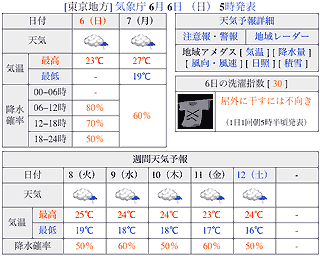
I listened to the first drops of rain fall this morning, breaking the Sunday morning silence with faint plop-pitters against our deck umbrella. This will be a familiar percussion for the next six weeks.
Although I don't think it will be officially declared for a few more days, I do believe tsuyu, the rainy season, has begun. UPDATE: The start of tsuyu was declared today.
Look at that forecast... For current tsuyu details, weathernews has a national tsuyu map and information about tsuyu on the Kanto plain where Tokyo sits.
Tsuyu begins in the southwest and moves northeastward. Last year Tokyo saw on June 10th and said goodbye to it on August 2nd, but on average it starts on June 8th and ends July 20th. I guess we'll have to wait to find out how this year's rainy season compares. Here's hoping for short and wet.
Maybe shopping would be easier if I paid attention to what's in fashion, but I don't, so I always seem to desire something that doesn't exist.
This time my goal is a black straw cloche. A cloche is the close-to-the-head hat, small brimmed style from the 1920s. But apparently it's not a style for 2004. I can find all sorts of floppy sun hats and narrow-brimmed fabric hats with square crowns, and some dreadful caps I remember from the 1970s. One lovely hat I tried on was the right shape--but it was the wrong color (burgundy) and definitely the wrong price (41,000 yen).
So I will have to look again because I don't have the millinery skills to make a straw hat.
I've found a place to swim and it's practically in my backyard. (If my backyard was as big as a 20 minute walk, anyway). The Bunkyo Sports Center near Myogadani station is where I'll be taking my exercise. They don't mind if I have a tattoo and it's pay as you go--450 yen/swim. I think there's a monthly pass as well.
Swimming is one of my favorite athletic endeavors. I learned when I was 11 or 12 and took to it like a fish to water. By the time I was 15, I was a lifeguard. My school didn't have a swim team, so I never became competitive. I just spent my summers swimming laps.
But that was twenty years ago and I haven't done too much swimming since. I have to get myself back into form. There's a lot to re-learn and my body has changed over the years.
I swam for a brief 20 minutes on Monday evening and wrenched my shoulder trying to breathe on the left instead of the right. But it feels OK today, so I'm going back this morning to try for a slower, longer workout. And I'll stick to breathing on the right today.
Let's Make Ume Shu 4'38" (28.7 MB MP4)
 ...starring Tracey Northcott as the barkeep...
As promised, here's a how to video with everything you need to know to make ume shu (Japanese plum wine). Learn how to choose plums, wash and dry them, sterilse the bottles, layer the fruit with sugar and fill. It's surprisingly easy.
For your shopping and kitchen convenience, here's a recipe to print out.
Ume Shu
1 kg green ume (Japanese plums)
1 kg rock sugar
1.8 liters white liquor (35% alcohol)
Sterilise a 4 liter glass jar by filling it with boiling water, rinsing and drying carefully. Wash the ume, culling any fruit with bruises or broken skins. Dry the ume and remove the waxy bit in the stem end. Dry the fruit again. Layer ume and sugar in the jar, pour in the liquor. Seal tightly. Upend theh jar once a month until the sugar is completely dissolved. The ume shu is drinkable after 6 months, and fully mature at the end of a year.
I bit the bullet, swallowed my guilt and shame, and quit my Japanese class. Last week's lesson had me near tears; I just wasn't getting the finer points of wake. Why put myself through that any longer?
So I wrote a note to Oyama sensei, explaining that I needed to take a break and maybe after a while I'd be able to to return to language study with a fresh enthusiasm (not bloody likely, really).
And this morning I got this reply (translated from her Japanese original, of course)
Dear Kristen. I received your mail. I'm very sad and it's such a shame but it can't be helped. Take a little break.
Thanks, Oyama sensei. For all your good instruction and for being so understanding.
"Synchronicity" at FUJIMAMAS
New works by the RBR artists
May 17 - June 16, 2004
I've just returned from hanging my prints at Fujimamas. There are dozens of pieces by 20 different artists. They represent quite a range of styles, media, and talent.
This morning restaurant was abuzz with people sharing hammers, explaining how to slide the hooks up and down, and waiting for Lauren, the curator, to decide what went where. I think Lauren had a challenge on her hands--so many sizes and styles--not quite enough walls.
My prints are hanging upstairs. Two are paired in a curving corner in the private party space and one is in the hall near the toilet.
In amongst the hammering and questions were lots of over-blown ohs and ahs. The effusive praise these artists give one another sometimes seems fake. "Oooooooooo, these are BEAUTUIFUL!!" "I really LOVE your WORK!!" "Look how CUTE with all these colors!!"
I offered up a few "I like this one a lot" and "Your painting looks great in this space" but I couldn't bring myself to coo or exclaim. Should you happen to go to Fujimamas this month and catch a glimpse of my engravings, no praise required.
When the rain is so fine that it's more a mist than drops, should you carry an umbrella?
I didn't. The walk home from the station was like being in a room with a vaporiser. My skin is moist and supple but my hair is frizzy beyond belief.
Yesterday as I sat on the stoop of a defunct shop, waiting to meet a friend, I heard a wild whoop coming from someone down the block.
A young man, slightly moon-faced and sporting a fringe of mustache, tottered along the street in a lime green t-shirt. He moved jerkily, the weight of his bent body pulling him along from step to step. His fist pumped the air and he brayed with joy. An attendant hovered close, arm extended for support or in case of a tumble.
I looked away, embarrassed by my curiosity and a little ashamed for being fully-functional. But as they passed by, I peeked again. His lopsided gait was explained by his braced shoes: feet in opposition and one ankle turned inward.
He was excited to be walking. I tracked forward with my eyes to see a wheelchair waiting for him 50 meters further on. As he approached it, his hoots became a happy wordless keening.
He dropped into the chair, grinning and accepting the congratulations and praise of his orderlies. I caught his eye and we exchanged broad smiles as he was turned and wheeled away.
Mother Nature reads my weblog, apparently. She cleared the skies and brought us the warmest day of the year so far. (If summer were always like today--28 degrees and only slightly humid--I'd be a happy girl.)
This afternoon, we lunched in Hibiya Park under a wisteria arbor near one of the ponds and watched salarymen and pensioners interacting with the turtles. I brought muffaletta (check for the recipe on Thursday) and plenty of fresh vegetables and fruit, and a few cookies that a crow snatched from our picnic as we stood to look out over the pond. Sneaky crow.
This evening, we met Jim & Yuka at Canal Cafe in Iidabashi. It's a lovely spot on the outer moat of the Imperial Palace with a view across to the Chuo and Sobu line trains. There's a rather expensive restaurant and a more reasonably priced dock-side bar. We quaffed some wine and then walked up Kagurazaka to Sofra, a Turkish restaurant. The food is good, but overpriced and the service is awful. Thankfully, we missed the belly dancing. Sadly, there aren't a lot of options for Turkish food in Tokyo, so we'll probably go back.
We've shifted from the alternating cool and warm days of April to the alternating blue and grey skies of May.
Tsuyu, the rainy season, has already begun in Okinawa (about 10 days earlier than average) and though it won't officially start here until June, it's obviously on its way. The past few days have offered a preview--grey skies, sprinkling-then-pouring rain and dull heavy air.
It's good for the plants but not for my spirits. Even though I love rain, endless days of grey get to be a bit much.
Still, tsuyu beats summer. I'm already thinking ahead to August with a certain amount of dread. I want to escape the city to somewhere less miserable. A summer rental in the mountains or at the seaside...
For the very first time since having my skin colored at the Meeting of the Marked convention in 1993, my tattoo has caused me trouble.
On Thursday, I decided to get off my lazy butt and join the Tokyo Dome Fitness Club. I took the tour and was filling in the application when an employee came over and waved some sheets of paper at the woman who was helping me. A conversation ensued--the rules, look at her arm, we can't!
And I was turned away. "I'm very sorry, but our rules say no tattoos. And it's the rule, so I'm sorry. There's really no excuse but it's the rule. It's Japan, you know. Very sorry."
So I seek a more tolerant gym. Maybe I will be working out and swimming with the four-fingered crowd. That's OK by me, I just have to find them.
Golden Week winds down today with Children's Day, the last in a string of spring holidays.
In our household we have no reason to fly carp streamers (it's traditional to hang out one for each boy in the family) but thanks to my friend Elizabeth Andoh's timely Taste of Culture newsletter, I did partake of another holiday ritual, shobu yu.
Shobu are the leaves and stems of Japanese iris. Shobu is also a homonym for victory and for warlike spirit, making a shobu bath just the thing on a day that celebrates boy children. A shobu bath is supposed to ward off illness, too. I soaked a nice long time, and expect the benefits to last until next year.
I made the bath even more relaxing by dotting the room with the lovely (waterproof!) electric candles that Jim & Yuka gave Tod for his birthday yesterday. Their reflections in the water with the floating reeds made me think I was sitting in a crystal clear pond. I tried standing the reeds upright and ducking my head under the water to pretend I was a fish, but there's not enough room to maneuver in the tub.
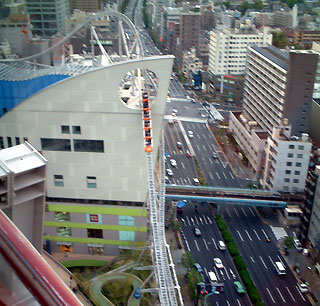
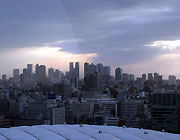 I love heights. Or rather, I should say, I get a kick out of seeing the familiar world from another perspective. I also like the fear in the pit of my stomach that sometimes accompanies the view. So when Tod suggested we ride the ferris wheel at LaQua the other day, I was excited. It's been there a year and we hadn't ridden it yet (though we've been on the roller coaster several times--I also like speed thrills)
From our slowly moving vantage point, we watched the roller coaster scream through the building and gazed out over our neighborhood across to the skyscraper district in west Shinjuku.
 Mt Fuji made an appearance, silhouetted by the setting sun just to the left of the Tokyo Metropolitan Government Building. I'm always a little shocked at how large the sacred mountain looms on the horizon. But at the same time, she's very small. Catching Fuji on film from Tokyo is a little bit like taking photos of the moon--it captures your whole attention, but in reality it doesn't take up too much of your field of view. Can you see her in the inset? It's just a few dark pixels smack dab in the middle. But such pretty pixels.
TOKYO (Kyodo News) -- The government decided Friday to sign a pact to link Asia by highway in a signing ceremony next Monday in Shanghai, government officials said Friday.
Signatories to the U.N. pact will be required to improve their highways to meet the criteria of the 140,000-kilometer Asian Highway network, which is to link 32 nations to one another and to Europe.
But Japan is an island nation, as we are often reminded. Maybe there's an Asian Highway ferry between S. Korea and here...or plans for a terribly long bridge.
I think the Japan highway must be akin to Hawaii's interstate highways.
 For those of you who missed last Friday's Marshmallow Spike gig (that would be everyone except me and J-ster), here's a first glimpse at MJ, Yoshi and their new drummer, Kei-san doing Stolen Umbrella, an original with lyrics by MJ, music by Yoshi.
The camerawork is crap, I know. I had forgotten I promised to film and wasn't prepared for anything other than basically static handheld. Next time, I'm taking a steadicam and doing it right.
Stolen Umbrella. Small, mono version. 3'25" (2.6 MB MP4)
Stolen Umbrella. Large, stereo version. 3'25" (22 MB MP4)
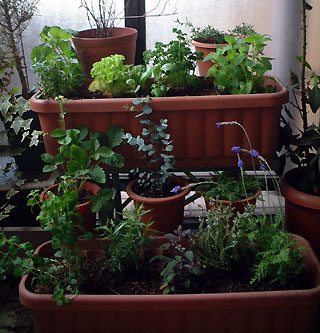
The results of today's planting. I've grouped the herbs based on how much water and sun they like. They look so fresh and green and healthy now. I will take care of them faithfully and hope they survive the summer.
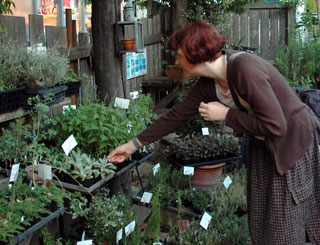
Lamb's Ear is the softest plant ever. I love stroking its leaves and was very happy to do so at the herb shop we visited today.
I didn't buy any, though. Instead I picked up parsely, sage, rosemary, thyme, margoram, basil, shiso, lemon balm, tarragon, wild strawberry, lettuce, yarrow, lavender, and eucalyptus. I would have purchased more, but I'm not sure I have enough pots or space to plant everything.
This little garden shop in tucked away in Harajuku--right next to the Yahoo Cafe and around the corner from Fujimamas but I never remember what it's called--is the city's best source for all sorts of medicinal and cooking herbs, ornamental grasses and quirky garden plants.
As soon as I have time tomorrow, I will be planting these in our little niwa off the living room. This summer's kitchen garden!
Once a week for the last five years and some, Tod & I've had a Japanese lesson together. Anyone who has heard us speak Japanese will marvel at our different abilities. Tod's approaching fluency. I flail with any conjugation more complex than negative past tense.
So this evening, when we rounded the corner on the current grammar review, I indicated that I would be quite happy to be done when we reach the end of these handouts.
Oyama-sensei looked less than surprised, though she encouraged me to continue. "The next thing is a new book and it's not so much grammar, mostly conversations. You're really good at those," she said in Japanese. Ha, right!
Tod was horrified. He loves learning Japanese so much that he can't fathom that I might not share his enthusiasm. Or maybe he enjoys watching me struggle. Either way, he looked disappointed.
I told them I'd think about it. But really, I don't want to take lessons anymore. I see light at the end of the tunnel and I'm hurrying towards it as fast as I can.
 This drypoint etching and two others of mine will be part of an RBR group exhibit at Fujimamas between May 17 and June 16.
If you find yourself in tony Omotesando, and let's face it, what Tokyoite isn't there at least once in a while?, make a date for a delicious lunch or dinner and mediocre art (I only mean my work, of course; I'm sure the other exhibitors will be brilliant).
There is an opening party scheduled for Sunday, May 23rd from 3 - 6 pm. Please come say hello--I'll be the redhead in the corner, smiling fiercely and avoiding eye contact.
Today's weather forecast--sunny and 25 degrees--inspired me to go for a hike. I left home shortly after 7 and by 9 am I was starting the easy climb up Mt. Takao at the western edge of Tokyo. The weather lived up to its promise--warm, sunny and perfect for a short jaunt into the mountains.
I went alone and I think it's the first time I've hiked by myself in the forest since I was a kid.
From 1975 until I left home for college, I lived in an undeveloped vacation resort in the low, rolling mountains of northeastern Pennsylvania. There were no neighbors, but there were hectares of land to explore. And I did. I had favorite trails that only the deer and I knew about. I understood the ridge-line of the nearby mountain like nobody else, except maybe our dog, Turkey, who liked to come along with me. I could make a beeline to interesting rocks and trees and to the head of the streams that fed the lake in the valley below.
Today's trip wasn't quite so intimate with the land. I stuck to the trails and I wasn't exactly alone. There were scores of senior citizens hiking, too. They were so beautifully prepared--thin white cotton towels around their necks, collapsable aluminum walking sticks, pants tucked into their socks. And every one of them had a backpack stuffed full with provisions. Really put me to shame. I had no fancy hiking gear--not even a backpack.
But it was such a freeing experience to walk mostly by myself in nature. I should make sure to do that more often. Only next time, I'm taking a towel.
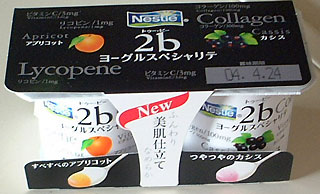
These tiny 45g (3 tablespoons) cups of yogurt contain collagen, vitamin C, and lycopene--all good for skin and beauty. The only information the package gives is a little marketing blurb: Making beautiful skin. The 2b website has a lot more detail, including the benefits of lycopene (an antioxidant) and collagen (a protein).
The name, 2b yogourt spécialité, is strange. The French makes is sound luxurious and elegant, of course. But 2b isn't said "deux beh" it's spelled out in katakana as "two bee." There are no B vitamins in this, so what's it mean? The website explains: "to be what I want to be, two benefits, and to be beautiful. Ha!
1969: a 29 year old man in the shipping department of a major Japanese nrewspaper dies of a stroke. This is the first case of karoshi or death by overwork, though it won't be called that until a 1982 book by the same name.
2002: 819 people apply for compensation after family members died from karoshi. Estimates range from 1,000 to 10,000 deaths per year are related to working too hard--stroke, heart attack, cerebral hemorrhaging, even suicides are attributed to too much slogging.
If you are working more than 80 hours in overtime every month, you're at a high risk for karoshi. So watch out for those 60 hour work weeks, friends, they are a killer.
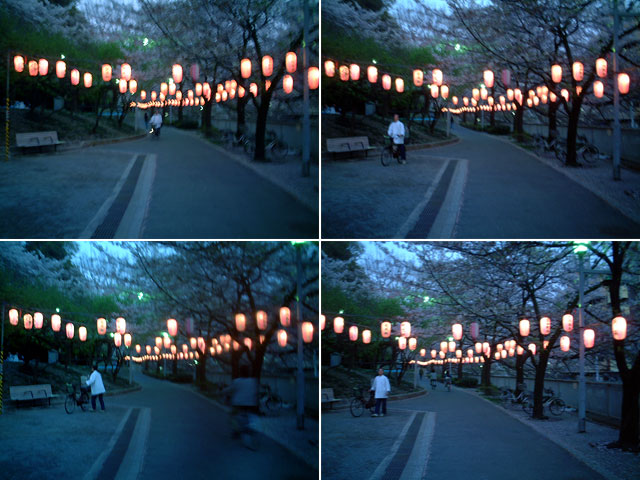
This noodle delivery man pedaled into Edogawa park last night at sunset, hopped off his bike, and looked around perplexed. Which of the dozens of parties in the sprawling park beyond were these noodles for, anyway?
Every Wednesday I spend a couple of hours at the Foreign Correspondents' Club. I'm the club webmaster and the go-to girl for Mac troubles. Mainly I just sit in a little room off the library and manage web content. From time to time someone will pop in with a question or just to say hello.
Way more than half of the Club's members are over 50--maybe half are over 60. They've been kicking around the bar since the early days and it's definitely an old boys club (with a few girls and a growing handful of youthful go-getters in the mix). When they fuss and squabble among themselves, I think of them as the Old Curmudgeons and reflect on my future temperament.
But I really don't know much about them at all. So I each month I read with great delight Write Up Your Alley, a column of reminisces in the No 1 Shimbun. This month, Max Desfor described a memorable trip to an onsen:
They apparently didn't speak English and, of course, I couldn't speak Japanese. One day, as I was luxuriating in my kimono after soaking in the hot tub, there was a loud knock on the door and the innkeeper was jabbering away at me. I understood only one word: denwa. I jabbered back that no one knew where I was and no one could be calling me. But he kept insisting, and I finally went downstairs with him to the phone.
It was Don Huth, our news editor and a very close friend, who told me that I had won the Pulitzer Prize for news photography. My reply was, "Look, if you want me back to work, say so. But don't give me that bullshit." With which I immediately slammed the phone down and went back up to my room.
A few minutes later, the innkeeper was knocking on my door and again jabbered about denwa. So back I went to the phone. This time it was Bob Eunson, our chief of bureau, who first ordered me not to hang up on him. Then he read several congratulatory messages from the big bosses in NY, also from my wife and brother.
I was somewhat shellshocked at that point and didn't slam the phone down. Shortly after that, the ryokan was filled with a mob of local newsmen who came to interview me. The innkeeper apparently knew he had something of a celebrity in his house, so he came up with a beautifully decorated, enormous platter of sushi as an honorific offering.
So I guess some of my Old Curmudgeons are eminent old curmudgeons. I should probably pay more attention to them.
Spring, she is fickle. After a warm and sunny yesterday, we've got a leaden grey sky and it's only 9 degrees. Brrrrr. There go the cherry blossoms. Ah, well, they will be back next year.
I contributed a short piece to Four Corners to commemorate this year's hanami and to celebrate the launch of this new online magazine.
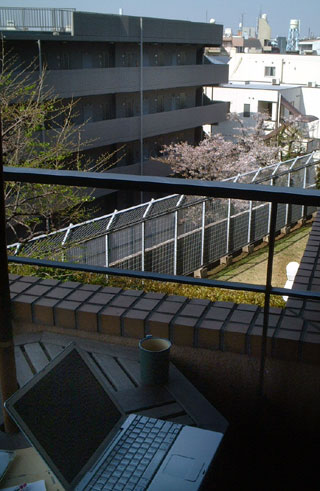
This morning I'm sitting out on the veranda working on an article for a design magazine. It's a gorgeous morning--the sun is burning off some early morning clouds and the day promises to be warm.
The sakura beyond the fence and across the tracks is just starting to give up its petals to the wind. Occasional gusts blow confetti upward or shower pink snow on the passing trains. The residents on the third and fourth floors of the building next to this lone tree have an eye-level view and have been capturing the spring glory in photos.
Around 8:30 a woman in a yellow t-shirt and unbrushed hair came out onto the 4th floor balcony to wave her keitai at the tree--an incantation for a friend.
Shortly after ten, a young man in a blue-tipped white t-shirt hauled out a professional-looking digital camera and snapped shots of the tree before catching me watching him. He carefully loaded the camera into a huge bag and ran down the stairs--on his way to party and take more pictures, I'm sure. A half dozen people have left the building with backpacks and duffles overflowing with picnic supplies.
Later today, when the article is done and Tod's awake, I think we'll take a walk under the sakura at the 33rd Annual Bunkyo-ku Sakura Matsuri near Myogadani.
Eliza Scidmore was late 19th century American travel writer and photographer (and contemporary of Nellie Bly) who often travelled to Japan. She suggested and organized the donation of over 2,000 cherry trees that line the avenues of Washington, DC.
She died in Geneva in 1928, but the Japanese government asked for her ashes to be interred at the Foreigners Cemetery in Yokohama. I visited her grave today. It's not a particularly interesting monument as far as they go, a polished granite sarcophagus with an inscription, but it forged an interesting connection to my life at the moment: the sakura are blooming and I've been spending lots of time in cemeteries surrounded by cherry blossoms.
 Our annual supply of Girl Scout cookies arrived yesterday. We order them from one of Tod's colleague's daughters in Chicago and she mails them to us.
This year, the package arrived sealed with Japan Post tape and with a note saying the box had been inspected at Customs. Both boxes of Thin Mints were open.
I wonder if the densely packed cylinders of Thin Mints--18 cookies per roll, two rolls to a box--trigger some sort of weapons alert? Maybe it looks like a pipe bomb.

Lose 399 calories/hour just by wearing these knee highs? Not exactly. You have to spend that hour walking, too. I hope this is an additional use of calories, because an hour's brisk walk should burn off about 400 calories no matter what you're wearing on your legs.
These "high socks" are designed to increase your metabolism and relax your legs. They're engineered with some kind of plant-based "slimming essence" as well. But no vitamins.
Buring calories by wearing socks sounds quite amazing, doesn't it? But, shhh, don't tell anyone...these are old-fashioned support hose marketed to the under-20 set. I guess the marketing works, these are flying off the shelves at Shop In.
They're actually pretty comfy and I've been searching for a pair of beige knee highs for months so I'm happy to have them in my sock drawer. But as I discovered yesterday, they don't stay up as well as they should. I walked for only 20 minutes before the left sock was down around my ankle. I guess that means I only got a 333 calorie benefit.
Toes curled in wool socks
Ache for balmier weather--
Frosty hanami.
Hands thrust in pockets,
Sake abandoned on lawn;
Fingers dream of Spring.
Rosy chilly cheeks
Compete with sakura pinks;
The finer blush wins.
Four Seeds and Pepsico/Frito Lay team up to bring us Pizza-la Garlic Meat Doritos.
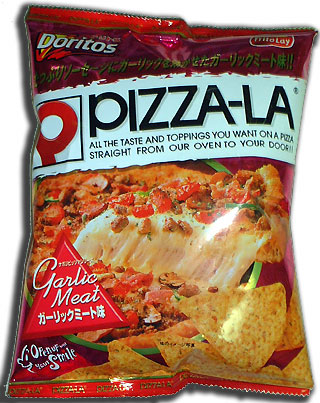
Also available in Italiana (tomato and cheese) and Get's (garlic, pepperoni and bacon) flavors.
Having been entirely too happy and carefree lately, I've compiled a list of things I could be worrying about in Tokyo:
Food safety, specifically avian flu
TAMBA, Japan (AP) - Men in white protective suits, masks and hoods moved along the hillside above a chicken farm, spraying disinfectant and throwing lime into a huge ditch filled with thousands of dead birds.
This mountain-ringed town in western Japan is the epicenter in the country's mounting struggle with avian flu, which has compounded worries about the food supply and provoked a scare over the possible spread of the disease to humans.
Those fears have expanded in recent days with the discovery of five wild crows infected with the virus - raising the threat that the freely roaming birds could trigger an uncontrollable spread of the disease.
"That's really worrying," Kaoru Iwamoto, a 55-year-old housewife, said just a few blocks away from a farm being disinfected. "You can control where the chickens go, but crows fly all over the place."
The avian flu hit Japan in January for the first time since the mid-1920s. It has infected chickens at three farms and led to the deaths or extermination of more than 300,000 birds.
So far, Japan has been lucky with no cases of human transmission. The disease has spread to people in Thailand and Vietnam, killing 22 and prompting the cull of about 100 million chickens across Asia.
Terror attacks in Tokyo by al Qaeda or Iraqi operatives
TOKYO (AP) -- Japan added police at railway stations in Tokyo and vowed to stand firm on Iraq after an Islamic militant group reportedly said Japan could be targeted by terrorists.
Japan's conservative government, a firm supporter of the U.S.-led invasion of Iraq, has insisted the deadly bombings that killed 202 people in Madrid last week would not change its backing for Washington.
A London-based Arabic newspaper on Thursday published a message attributed to the Brigade of Abu Hafs al-Masri warning that its next targets could be Japan, Italy, Britain or Australia. The group has claimed responsibility for the Madrid bombings.
Being anonymously reported as a suspicious foreigner
TOKYO — The Justice Ministry on Thursday decided to review its controversial online service that allows people to anonymously submit information via email about suspected illegal aliens to a web site run by the Immigration Bureau after drawing fire from groups supporting foreign nationals living in Japan.
The service, which began Feb 16, allows people to submit information on the identity, address or workplace of suspected illegal aliens. Critics say the service constitutes racial discrimination but the Justice Ministry says it has reminded users that it will not tolerate any attempts to slander foreigners. (Kyodo News)
That long-overdue, city-flattening earthquake
This threat hangs over all our heads, all the time. The city is 10 years overdue on its "70 year cycle" of major quakes. And as far as I've noticed, we haven't even had a moderate one in months.
I tried to come up with a list of ten things to worry about, but I could only think of four. I think that's cause to celebrate...
Researchers at Osaka Prefectural University have developed a way to speed up the growth of moss. By adjusting the light, temperate and nourishment, the researchers can grow Racomitrium japonicum in two months, rather than the usual two years.
They say that this can help to alleviate the urban heat-island effect.
Imagine that. I envision green, moss-covered buildings, dripping into silent streets--a post-apocalypse, anti-urban landscape.
But when I snap back to reality, I see a different picture: withered moss covering rooftops, where gardening is mandated to combat the city's heat. Noone can see the moss, which is fine because the enthusiastic experiment has dried up from too little of that careful adjustment of light, temperature and nourishment.
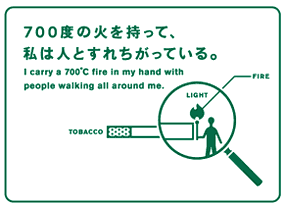 Japan Tobacco launched a new campaign to remind smokers to mind their manners. This ad is one of four designs that evoke misleading newspaper diagrams. The messages are good--I cringe every time Tod lights a cigarette on a crowded street--but the delivery is weird.
Although Tokyo's nowhere near as anti-smoking as the US, the past few years have seen more public spaces become "no smoking zones." Japan Tobacco makes an effort to teach their customers better manners while promoting smoking. Will better manners prevent anti-smoking laws? Maybe. If smoking ceases to be a daily nuisance for non-smokers, then why bother with laws? But I don't think than an ad campaign is enough to make a difference.
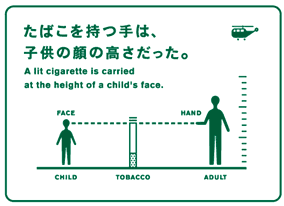 And neither does Japan Tobacco. "Smokers' style" is their ongoing smoking campaign title. It has a cute stylised leaf logo--so natural, just like smoking.
Smokers' style is more than just ads. They maintain a large indoor smoking space in Akihabara and two mobile trailers (SmoCars) in no-smoking zones to give people a place to feed their addiction. JT also sponsors clean-up teams that sweep the streets free of cigarette butts and hand out portable ashtrays.
You can find out more about the Smokers' style manners plan, including photos of the SmoCars and all of the new ads at JT Delight World.
A DIY (do it yourself) store, Town DOit, opened near Kourakuen station a week or two ago.
Tools, art supplies, and stationery are the things that I love shopping for. These are places where I can buy creative toys! I will browse for hours as my mind races to think of new projects. What can I do with a half-dozen pink screws and a piece of yellow plastic? What about this flooring? Can I use this plumbing fitting somehow?
So it was a treat to spend 90 minutes perusing the aisles of the Town DOit this evening. From imported power drills to shoji screen repair kits (for the holes kids inevitably make in the paper door screens), the shop carries a little bit of everything. And if they don't have it in stock, there's a shelf or two of catalogs that you can order from.
I'm already awash in plans to renovate my garden and maybe to build a 35mm adapter and a jib arm for my video camera...
On Thursday, I did as announced and took a long walk. I strode for 4 hours and took a 60 minute break for lunch. I ended up at Niiza, Saitama, 20.7 km from home.
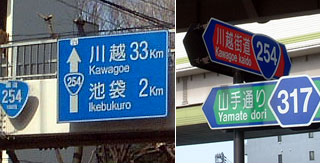
My route was straight up national road 254. It's called Kasuga Dori where I live, but past Ikebukuro it turns into Kawagoe Kaido. This route from Tokyo to Kawagoe has been travelled for hundreds of years. These days, it's a four-lane highway all the way. Well designated, too. Even at the most complex intersections, I was never disoriented for more than the moment it took to find the right signpost.
I plodded through the familiar territory of my neighborhood, then into a section of the city I hadn't seen before, though it was the same in tone and tenor as my neighborhood. After 45 minutes, I reached Ikebukuro, where I crossed over the Yamanote Line.
Outside the loop, the neighborhoods seemed more parochial than the skyscraping commercial zone I'd just left. Buildings were lower and businesses focussed on daily living. But soon enough the quaint shops in run down buildings gave way to suburban sprawl. Bicyclists outnumbered pedestrians. Ramen shops gave way to family restaurants. I watched bicycle shops turn into motorcycle shops and eventually car dealerships.
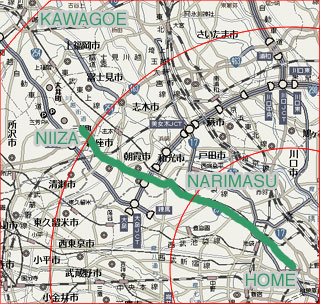
My goal was to reach Kawagoe, 34 km from home. But as I walked, my sense of time and distance got looser. By lunchtime, I'd reached Narimasu, 10 km from my starting point. I'd walked for about 2.5 hours according to my notes. I tried to do the math but it seemed wrong. After that much time, shouldn't I be farther? I remeasured the map and came up with a different distance. I noted both then focussed my attention on eating.
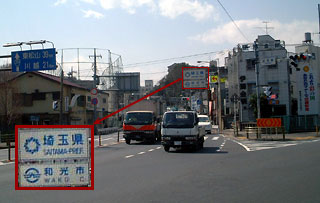
Reaching the prefectural border just after lunch cheered me up. How many people in central Tokyo have walked to Saitama? Probably not too many. And there's a reason for that. Over the border, Kawagoe Kaido turned industrial and extremely car-centric.
But this was intended as an endurance test, not a sightseeing trip. How far can I walk? What is the experience of going that far? I spent time thinking about how I should be thinking about the trip. I wondered back in time--50 years, 100 years, 400 years.
The reality was that four lanes of traffic accompanied me. A strong wind blew dust into my face. I walked for minutes with my head down and my eyes half shut. It was boring most of the time. There wasn't much nature around. I stopped walking and came home because the blisters on my feet broke open. It hurt and I'm a wuss.
But I'm encouraged. I've made a target map of the places I can reach within a 10, 20 and 30 km radius of home. I'll be going walking again as soon as my feet heal. I'll buy a pedometer and maybe next time, I'll try a more scenic route...
For the last little while I've been considering long walks. Having walked from home to Yotsuya a few weeks ago, only a 40 minute trip on foot, I imagined some of the long journeys by foot throughout history. To be honest, hobbits kept coming to mind...
Walking is the most natural mode of transportation. After all, we only recently invented motorised transportation, and even hooved transport wasn't always available. But we've always had feet. Well, for a long, long time, anyway.
MJ mentioned a TV show she saw quoted 10,000 steps a day as the optimum amount of walking. Figuring about 80 cm per stride, that's 8 km, or just short of 5 miles every day. Apparently the average Japanese dweller walks about half that.
The average walking pace is about 4 km/hour. So 8 km is a two hour walk and that seems not so difficult, really.
What if I started out in the morning and walked for 8 hours? Where would I be? I have no idea...but I plan to find out.
If the weather is fair on Thursday, (tenki yoho says it will be) I will take a long hike, starting from Korakuen station at 9 am and walking until about 6, allowing time for lunch and short breaks along the way. Return via train to a long, cold beer.
If anyone would like to join me, send me a mail. Company is most welcome.
"Kuri, can I ask a favor?" MJ asked this morning. "Bring me a chicken pie..."
So I took the last of our stash of Vili's pies from the freezer and hopped a train for Kanagawa. 90 minutes later, I handed MJ her chicken pie. And here I am , enjoying an evening away from home in cosmopolitan Hiratsuka.
No more pies left. Deliveries are currently suspended until the supply is replenished.
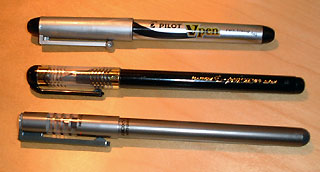
Disposable fountain pens make me feel connected to great writers of the past but without the inconvenience of spilling bottles of ink everywhere or feeling guilty for not cleaning my nibs. Sekaido in Shinjuku has a good selection if you're in the market for a new pen.
Mitsubishi Boxy has an unusual name, but it's nothing special as far as writing goes. It's shaped like a slightly thick Bic ballpoint--a long straight line with a cap. It writes well, but without the balanced grace of a fountain pen.
Platinum E-pen is similar in shape to the Boxy, but it has an ever-so-slightly thinner nib and its ink seems a touch more translucent. The ink doesn't wick very much at all and it lays down a consistent line.
Pilot V-pen is slightly stubby, similar to a proper fountain pen. It feels good in the hand and its classic shaped, slightly rounded nib that deposits the ink in a pleasantly uneven line--or maybe that's just my handwriting. I like this one the best of the three.
The V-pen is available in six ink colors: black, blue, red, green, cyan, and pink. I have a black one and nearly bought a pink one tonight. But then I'd have four disposable fountain pens and doesn't that seem excessive?
Tokyo's population has reached a new peak. By the current accounting it is 12,378,974 people strong, with nearly 90,000 more inhabitants than 2002. (That's just the 23 wards; a census of the "greater Tokyo area" adds another 20 - 25 million people.)
The increased population is a good thing, because there are more and more places for people to live. As I've written before, there are a lot of new apartment buildings going up around the city. Here are some floor plans from the latest brochure to appear in my mailbox:
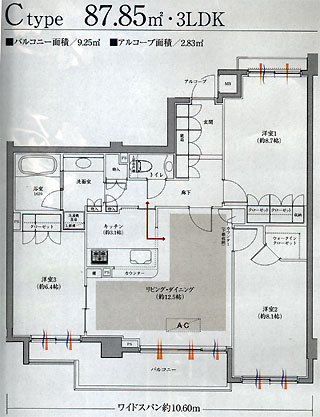
This is an 87.85 square meter (945 sq ft) 3 bedroom apartment (aka mansion) for 72,000,000 yen (about $720,000) And in the same building, there's a 130 sq meter, two-storey mansionette (no price given) and this 102 sq meter (1,097 sq ft) apartment for 80,800,000 yen ($808,000):
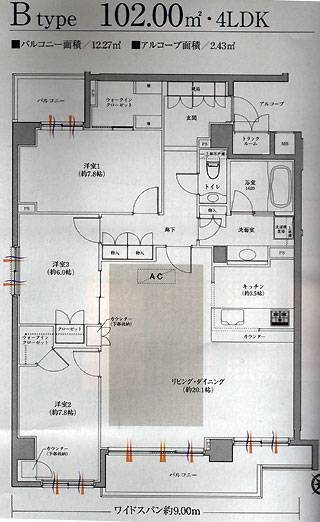
Luxury buildings like this one are springing up all over the inner city as lower cost housing is torn down to make way. I sure hope the 90,000 Tokyo newcomers are rich.
Japanese taxes are due on March 15th, so this afternoon I got friendly with my pile of receipts and bank details. My head is now full of numbers and doubts, but my Heisei 15 tax forms are completed. Every filing I've submitted has been returned for corrections. I'm sure this year will be no different.
The Japanese tax system is a black box but I assume it follows the same basic pattern as the US. If you add up your earnings, subtract out any deductions, then multiply by your tax percentage, you'll know how much tax you owe. But the details are a little hazy, so I don't really try to understand. I simply follow along with the translated English instructions and do the math.
But even my indifferent attitude was pierced when I reached this calculation:
Total earnings from employment / 4 * 2.8 - 180,000 = employment income (please fill in line 6)
Huh?? Why? I guess it doesn't matter. I have to say, I'm glad I have a calculator.
9 am
10 am
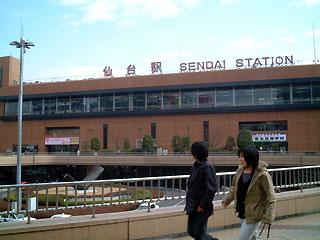
11 am
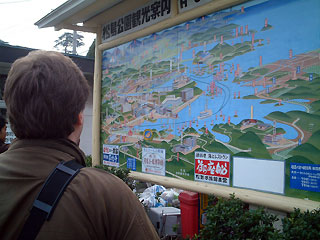
noon
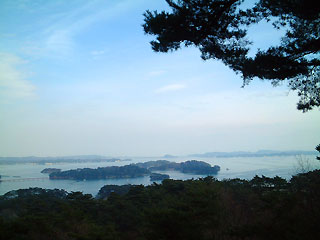
1 pm
2 pm
3 pm
4 pm
5 pm
6 pm
7 pm
8 pm
9 pm
10 pm
 The city subways are rebranding. Actually, they are privatising. From April 1st, Teito Rapid Transit Authority will become Tokyo Metro.
The new logo is a ribbony M in cyan blue. They call it the Heart M. It's cute but not as distinctive as the pointy red S we all know and love.
It's fun to try to find the things they are doing in advance. You might see some changes in your local station--ticket machines are being refaced in blue, for example. Dark blue uniforms are replacing the grass green jackets on drivers and conductors. And on some rolling stock, you'll see the familiar S logo is now on a sticker covering up a subtle indentation of the new M logo underneath.
I haven't seen any changes to exterior station signs, but I know they are coming...
On the way to work today, I walked by this impromptu flower and plant market set up on the corner. It reminded me of the farmers market in Chicago--every Thursday after lunch, women returned to their offices with armfuls of gladiolas. It was very cheery and colorful.
Some expats bemoan the loss of friends when their compatriots move back home. I don't mind at all when friends come and go from my life; it seems quite natural. I think I'm well suited to being a long-term expatriate.
Despite that, it's comforting to have a few friends who I know will stick around. I don't see them all that often, but I know they're there.
I had dinner tonight with Greg, who is actually a newish friend, but has been in Japan for more than a decade. He's applied for his permanent residency, so I think he'll be sticking around for a while. We talk about creativity and organizing our lives. We swap movies. Greg introduced me to Queer Eye for the Straight Guy and loaned me the Edward Tufte book that I hadn't read. He came to Design Festa in November. We made nengajo together. I taught him about CSS and Movable Type templates.
Also among my long-term resident friends is Elizabeth Andoh, who has lived in Japan for more than 30 years, teaches Japanese food culture and writes for the New York Times and Gourmet. Various colleagues from Tod's office and MJ, of course, are here for the duration because they've married Japanese nationals.
Which is something that I wish I could do, too. Not that I want to give up darling Tod (never!), but couldn't I have a Japanese husband, too? Sure would make the visa issues easier...
Yesterday the first warm gale of spring, haru ichiban, blew through Japan. Although it didn't reach Tokyo, it was pretty windy here and today's weather feels like spring has arrived for sure. The warmth is a welcome change from days we've been shivering through lately.
This morning I opened all the windows to air out the apartment and then gave the veranda a good washing. Afterwards, I burned some incense and enjoyed a cup of coffee to celebrate the sun.
It's too early to replant the little garden off the living room, but I'm itching to do it. I'll settle for planning instead. This year I will make it a true kitchen garden--lots of herbs, as usual, but some vegetables, too: lettuces, peppers, beans. Maybe some berries. I don't believe I have enough room for melons, eggplants or cucumbers, but I can probably squeeze in some tomatoes. I wonder if there's a Japan equivalent to Seeds of Change?
Today is Kenkoku Kinnenbi, known in English as National Foundation Day. It's the historical (possibly legendary) date that the first Emperor of Japan, Jinmu, ascended to the throne a really, really long time ago--660 BC.
Before WWII, today was called Kigensetsu. But it was removed from the calendar, along with all the Buddhist holidays, and wasn't reinstated 1966.
Not much pomp or circumstance marks this day--there's a parade of mikoshi at some of the key temples. Like most holidays in Japan, people will use today to catch up on sleep, go shopping, or enjoy a meal at a restaurant. Maybe girls will stock up on chocolates for the boys on Valentine's Day.
I will spend my day trying to get Tod away from the computer and outdoors for some fresh air activities. Or maybe some shopping or eating out.
These are Margaret Josefin Breath Palette, a series of boutique toothpastes.
Toothpaste is something that I don't spend a lot of time thinking about. There are a couple of brands I prefer and I buy what's on sale. Now Breath Palette ups the ante with 31 different flavors:
- Sweet salt
- Tropical Pineapple
- Peppermint
- Fresh Yogurt
- First Crop Green Tea
- Rose
- Monkey Banana
- Honey
- Kiwifruit
- Cafe au Lait
- Plum
- Tsugaru Apple
- Vanilla
- Indian Curry
- Strawberry
- California Orange
- Kyoto Green Tea
- White Peach
- Kisshu Ume
- Lavender
- Darjeeling Tea
- Cinnamon
- Budou (grape)
- Lemon Tea
- Bitter Chocolate
- Blueberry
- Caramel
- Espresso
- Grapefruit
- Pumpkin Pudding
- Cola
Rose, lavender and honey bring to mind hygiene of ancient cultures; maybe they should be applied with traditional twig-brushes. Fruit flavors seem refreshing enough to use. But cola? India curry? Chocolate? Those are things I brush to get rid of...
At 200 yen per 25 gram tube (about the same price as a 160 gram tube of regular toothpaste) Breath Palette is a luxury. This is a product for gift-giving or as a splurge when out shopping with your girlfriends.
If you want to see more (in Japanese) http://www.margaret-jj.co.jp/catalog.html. To buy some for yourself, visit Sony Plaza, Tokyu Hands, Loft, or Keio department stores. Unfortunately for my international readers, Breath Palette does not seem to be sold outside Japan; so pack your bags and come to visit.
A couple of weeks ago, I got a note from the phone company: "Please pay your past due amount or your keitai service will be terminated on 2/6."
Huh? I checked with Tod, who is in charge of family bill payment, and he said he'd paid them all. The current bill didn't show a past due amount, so I ignored the note.
My keitai was turned off on 2/6.
Of course it turns out there was an unpaid bill buried in Tod's pile of papers. Oops. He paid it at the convenience store on the way to work today and less than 30 minutes later my phone was back on.
I expected a hassle involving a special trip to the NTT office in Shinjuku, a mandatory letter of apology for being a deadbeat, and a fee to turn the service back on followed by a week's delay while they reactivated my account.
But this was as easy as it could be. Thank you, NTT DoCoMo. But next time, could you please put the past due amount on the future bills?
Place: Namboku line subway.
Time: 8:47 am, Monday morning
DOORS open and passengers spill out. A steady stream of men in suits heads towards the nearby ESCALATOR.
KRISTEN stands to one side, waiting to get on. She holds a large tote bag containing 7 Thunderbirds DVDs, a two-page To Do list, and a change of clothes.
K: So many people. What do they all do? Push paper and money around the country, I suppose.
The buzzer sounds and the flow of traffic changes directions. Everyone boards the train.
K: Oh, look a little bit of space over there. Can I squeeze through?
Pushed from behind, Kristen slides into the gap between two people with backpacks. Her tote bag catches between two businessmen's computer cases. She yanks it free.
K: Ugh, foetid breath on that guy...I hope I don't catch whatever he has. Can I breathe more shallowly? How do people manage this every morning? Is that woman putting on makeup? She has no room to move her arms...what a trick!
Train pulls into station after station. More passengers crowd the carriage, until one last one swings in puts his hand on the door frame and pushes back until there is room for his feet to clear the DOOR as it closes.
K: (wedged solidly in the middle of the car) My station's next. I am never going to get out of here.
The CONDUCTOR announces "Nagatacho, Nagatacho desu" and the doors open. All passengers moves as one toward the doors and head up the ESCALATOR to the EXIT.
[OK, now I have to go do this for real. Wish me luck.]
Thousands of finger-width glass tiles on the facade of a bank near Itabashi station. The overall effect is brick red and glossy. I suspect that not too many people even notice, but imagine the effort that went into creating this.
In the gourmand spirit of single malt whisky, varietal wine, and single bean coffee, Lotte launched a product called Single Beans Chocolate.
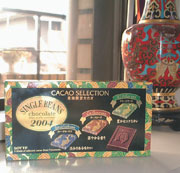 Of course I had to try them. Who knew chocolate beans tasted so different to one another? But sure enough, they are distinctive. La Flora is sweet and fruity; Sur del Lago is piquant; El Pilar tastes like piney mould.
The chocolates come in small bars for 150 yen each or a "cacao selection" variety pack for 300 yen. It's a bit more expensive than the average chocolate but you can buy it at the conbini, so it's not really too luxe.
Plenty of people got used to the high life in the economic bubbles of real estate and tech. Now we can't afford the extreme luxuries any more, but we still crave them. Lotte is cleverly profiting on the fact that our tastes and our pocketbooks don't quite match.
Or maybe gourmet foods in the convenience store indicate an upswing in the economy in general. I never did understand the Japanese economic slump--it seems like everyone is carrying on as usual with plenty of construction, designers doing good business, new restaurants and shops springing up all over. To say that this is a slump, well, the Bubble must have been heady times, indeed.
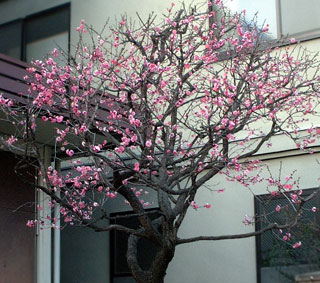
Ume in bloom. Itabashi, Tokyo. January 18.
The first sign of spring. The rest arrives on February 3rd, the lunar new year.
I'm very excited that there is a Japanese version of lastminute.com - http://www.lastminute.co.jp/.
Americans may be unfamiliar with this UK-based service, but it lists lots of great deals on travel and entertainment for those of us who find ourselves planning things a day or two before we want to do them.
Nearly everyone I know has a cell phone that displays the caller's name and number when the phone rings. Some can even pop up a photo of the caller. It's extremely handy. This isn't exactly new tech; even in the US, Caller ID was introduced in the 90s. These days, I don't answer the phone unless I know who is calling.
It got me thinking about how phone transactions have changed over time.
1894: Operator-assisted calls required long waits and sometimes multiple transactions before conversation commenced.
"Operator. How may I direct your call?"
"Albany, New York, please."
1954: Before conversing, you needed to have a brief exchange to determine who was on the other end of the line.
"Hello, Jones residence. Myra speaking. May I ask who's calling?"
"Hi, Myra, this is Jane."
2004: Technology allows preliminaries to be skipped. With a glance at the display, the person answering can just start talking.
"You're running late?"
"Sorry. At Shinjuku now. I'll be about 20 minutes..."
I've been reading an interesting classic text on Japanese psychology: Anatomy of Dependence by Dr. Takeo Doi. It was written in 1971 and Doi was hailed as the Freud of Japan.
In the book, he explains amae. It's odd but I can't even begin to explain amae even after reading nearly 100 pages of the book, instinctually understanding the concept, even having a few "Aha! That explains that thing I experienced" moments as I read along.
Amae isn't unknown to Western culture, but there's no word for it. It's part unconditional love, part dependency, part selfishness, part generosity, part obligation, part indulgence.
For example, amae is what Tod and I experience when I bring him coffee in bed in the morning--he is relying on me to indulge him and I am (usually) happy to do so. When he tucks me in at night, that's amae I get a warm loving feeling as he indulges my desire to be cuddled and made safe before I go to sleep. It makes me want to bring him coffee in the mornings. What goes around, comes around.
The book is good. I'm not all the way through it, but I expect I'll have quite a few more "aha!' moments as I see why Japanese people sometimes behave in ways that seem odd to me. If you are interested in why Japanese seem "different" to Westerners, this is a good place to start your explorations.
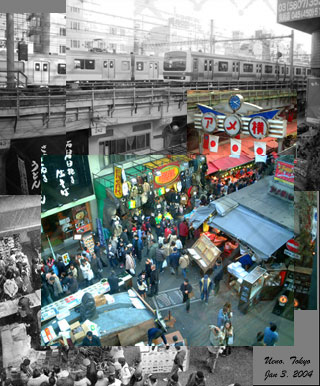
It's been so mild this winter that we've gone without heat until just lately. In fact, the heat's not on now, at ten minutes to midnight on December 29th. Amazing.
Tokyo winters are never terribly cold (compared to Chicago or Pittsburgh, that is) but this one seems warmer than average. Could be my imagination, but November into early December seemed warmer and wetter than usual. We're finally getting typical crisp, clear December days but it seems like they came a few weeks later than usual.
Weather's a little tricky to recall. I could be just misremembering past years. But according to this nifty page from the Japan Meteorological Agency I'm not off base. http://www.data.kishou.go.jp/normal-e/mrep_e.html
December's data's not in yet (of course) but I be it will be warmer and wetter than usual.
 Today at the combini, I spied this new drink: Nodojiman. I'm mystified by the name. Nodo is throat, but Jiman mean "boasting" so I have a feeling that I'm missing something here...there are musical notes on the label and the character on the label is a uvula, so maybe it's a pun I don't understand.
Anyway, Nodojiman is a slightly fizzy, sweet, quince flavoured drink. It tastes a lot like nodo ame, what we'd call cough drops, but nodo ame literally translates to "throat candy."
 I thought that the back of the Nodojiman label was really funny. For your dry throat, your dry heart, your dry life..."
Quince has magical properties to cure sore throats. Called karin in Japanese, it's a key ingredient in all of the Japanese cough drops and has long been used as an herbal remedy. But I don't know if it can cure your dry life.
A ripe fruit hangs like a Christmas ornament in my neighbor's garden.
"Look, a rice shop," I said to Tod as we walked up Sotobori Dori from Akihabara towards Ochanomizu.
"And they sell CDs...huh?"
"Hey, wait a second, that's Basmati rice!" I pulled the door open. Inside the modest store was a treasure trove of Iranian food: dried beans; tinned halal stews; saffron candy; nuts, pickles, and olives.
The owner offered us each a fresh date sprinkled with coconut to enjoy while we browsed. Heaven!
I left with a bottle of rosewater for making sweets, a jar of jam that is labeled in Arabic with the picture of a mysterious fruit, a box of dried herbs, and a bottle of pomegranate molasses--now I can make mohomara!
We returned after dinner to acquire some weightier purchases--a leg of lamb and a 5 kg bag of basmati rice. Guess what we're having for dinner on the Emperor's birthday this Tuesday?
If you'd like to visit Darya Shop, you'll find it at 2-1-4 Soto-kanda, Chiyoda-ku on Sotobori-dori, just down the hill from Marunouchi line Ochanomizu station (on the same side of the street as the river). The phone number is 03-3251-5387 and it's open from noon - 10 pm, except Mondays.
Yesterday afternoon as Tod was leaving for work, he found a white tube outside our door and handed it to me
"Dunno what it is, but everyone seems to have them," he said, scanning up and down the hallway.
I pulled off the packaging to reveal the 2004 Metro Network Map. It's a large, detailed map of the subway system with exits and underground passageways marked. We held it up to the wall in the genkan and followed streets and trains until my arm felt numb and Tod was definitely late for work.
But we're not sure why we received this. Maybe Eidan is giving them to all the people who live along the exposed portion of the Marunouchi line? They were doing some work out there recently; maybe this is a little "pardon our dust" present.
Because of all the construction in our neighborhood, the past year has seen the local sidewalks dug up and patched over three or four times. But it has finally drawn to a close.
For the past few weeks, the curb-layers were building new edging and yesterday the bricks were delivered. They worked hard this weekend and have already finished two blocks.
I love Bunkyo-ku's red brick sidewalks and I'm happy to see them again. I'm also pleased that I won't be tripping over uneven lumps of asphalt anymore.
I've never talked to a real princess before.
But tonight at the Australian Embassy's Ancient Future reception for Patricia Piccinini's "We Are Family" exhibit at Hara Museum of Contemporary Art in Shinagawa (how's that for an introduction?), I had a conversation with Princess Takamado, the sister-in-law of the Japanese Emperor.
She gave an eloquent toast in Japanese and English (delivered with a lovely Cambridge accent) talking about her late husband's definition of art--it must be beautiful, not merely freedom of expression as art was originally made as a gift to God.
It brought tears to my eyes. I had to say hello. But she was being monopolized by a guy wearing a backpack, and I have not learned the gentle art of butting in. So MJ's embassy contact, Katherine, helped us out and sidled over. The backpacker vanished and then a woman slipped in with a bouquet of pink and yellow tulips (in December ?!) and had her photo taken. And then we talked with the Princess.
It wasn't a very long conversation; perhaps six or seven minutes. First it was about the art exhibit, then we moved on to the Princess' involvement in judging speech contests and how men usually won, even though 75% or more of the contestants are women. Why? Because women don't deliver their speeches as well. She said that women trying to tell jokes made everyone slightly uncomfortable. (Interesting.)
Princess Takamado is gracious, graceful, and well-spoken. I'm very happy to have conversed briefly with her. Even though she'll never know who I am, I'll take her as a role model. I feel special for having spoken to a real, live princess.
Granted, this is all reflected glory...but...but...I talked to a princess! Not bad for a girl with hands perfectly shaped to use a plow.
Although there are plenty of international fast food chains in Japan, many of them are locally controlled. And sometimes that leads to ad copy you'd never see in their home country. Here's an example from a Subway sandwich wrapper.

"Subway the dominant sandwich shop in the US is now available in over 74 countries. Here in Japan, we serve Subway sandwiches as a new style of Native Diet. This simply means that Subway sandwiches are the Natural Ideal style of eating Vegetables. We hope to spread this form of Native Diet to create a healthy living for both humans and the environment."
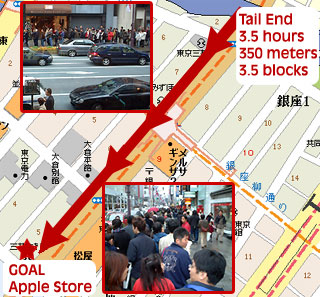
The Apple Store opened in Ginza today. The lines stretched for three and a half long blocks--a three and a half hour wait. I just gawked at the people standing in line.
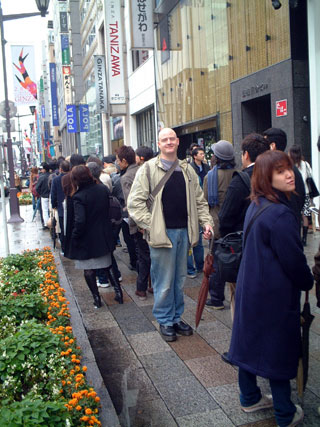
UltraBob came all the way from Zushi just to stand in line. He looks very happy here (near the end of the line) at 1:30 pm. I wonder what time he got into the store?
Leslie has the right idea--capture the crowds from outside the line.
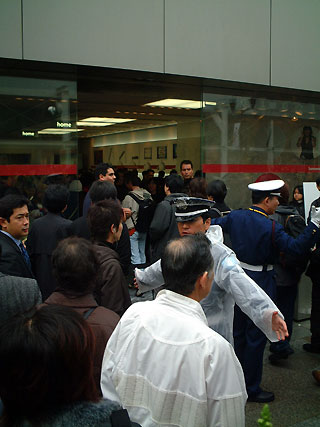
The crowds were extremely well behaved and the guards were mostly for directing traffic to the end of the line and allowing people into the store in batches. You can see a few burly American bouncers in the background. I've no idea why they might have been needed.
Japan is not immune to holiday shopping madness. In fact, it might be worse, as Christmas isn't for kids, but for couples.
Christmas Eve is a big date night and you are a certain loser if you don't have a date that involves presenting an expensive gift, eating roast chicken and going to a love hotel. Choose your own order but all of the above are required for a successful holiday.
So the shops go wild with luxury gifts. And to attract the right demographic, they sure do come up with some wacky campaign names. Here are some I've seen around Tokyo this week:
Hearty Xmas (at Metro M shopping mall)
Lovely Xmas (at Junior Station 109)
Happy Merry Xmas 2003 in LaQua (at LaQua, of course)
and my favorite...
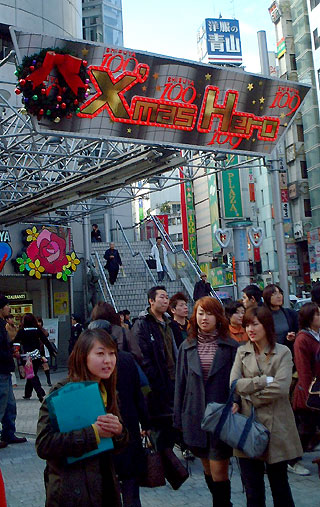
Xmas Hero at 109, a boutique mall for trendy Shibuya youth.
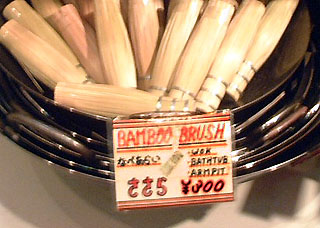
As seen in Yokohama Chinatown.
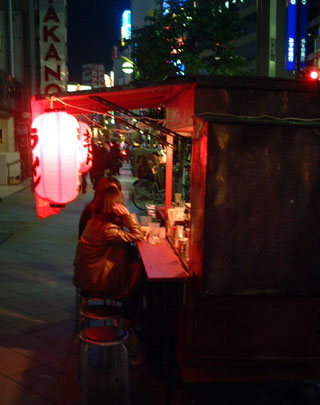
Late-night snacking in Shinjuku.
Where to dine when the trains stop running? Street-side stalls ply their trade into the wee hours. Ramen is Tokyo's favorite apres-bar sustenance.
Construction in our neighborhood has pedestrians routed into the street. The traffic cones are out in full force doing their duty.
Cones try to protect the construction workers from nosy, photo snapping onlookers, but not very well.
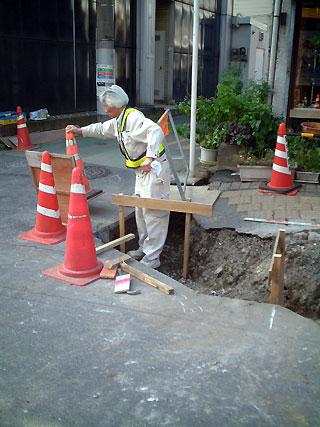
The cone supervisor realigns his charges.
Even cones need a break.
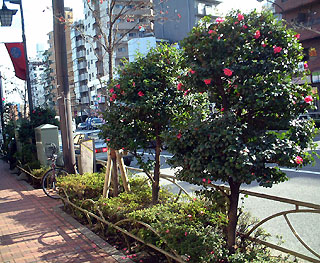
Between the black asphalt of Kasuga-dori and the wide brick pedestrian walkway, lies a verge planted with large flowering shrubs--Japanese camellias--that begin to bloom around this time of year. The vivid pink blossoms against dark green foliage herald the coming holidays more insistently than any Xmas illumination.
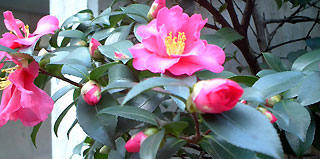
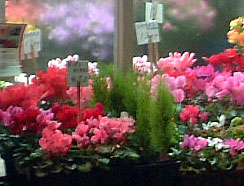 In the flower shops, cyclamens echo the camillias' palette while the floral newcomers, poinsettias, clash with their deep red leaves.
Every foreigner you find happily living in Japan is an exceptional person. Not everyone is likable, but they are definitely out of the ordinary.
Living abroad requires a sense of adventure, a willingness to learn, and either a flexible open mind, or a seriously strong sense of self. Most gaijin living here are also intelligent--dummies need not apply for international assignments. Anyone who comes to Japan without those attributes seems to find their way home as quickly as possible.
Because everyone is interesting, I find myself surrounded by a cast of characters ready-made to populate a comedy: the glamour queen; the frantic freelancer; the party animal; the downtrodden sensei; the struggling artist; an insane business owner; the boy next door; some privileged expats; and the Japanophile.
So when you read in the credits of my first feature, "the characters in this film are fictional and do not represent any person living or dead," please know that it's only partly truthful...
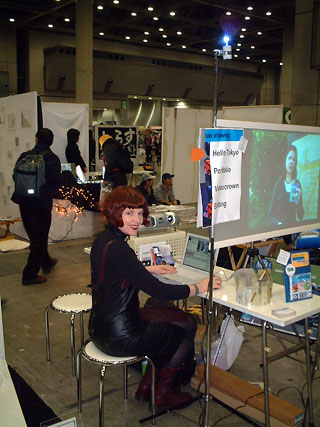
Here I am, sitting at the iBook, editing a video of the days events.
My booth is sandwiched between customised motorcycles and an art school project that both get a lot more attention than mine. I guess that might be because I'm sitting at a computer and although I do look up and smile from time to time, a woman at a computer is not all that compelling.
But when I put on the videocrown, passersby stopped to figure out where the video was coming from. Sometimes I told them, taking off the crown and showing them the camera. Sometimes I got them to guess. Lots of laughter and smiles and a few interesting conversations.
UltraBob burned 10 DVD-R of the video for me and brought them in the afternoon. Zoupi helped me sell them.
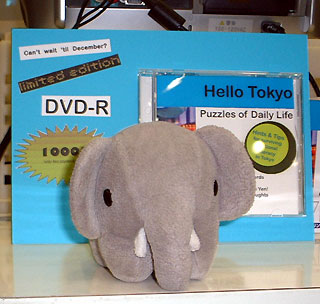
This morning, I happily filled in the other eye of my daruma--"finish video" is now an accomplished goal!
Just a quick note as I get ready to run off to Design Festa. I'll be at Booth C-429 today and tomorrow (11 am -7 pm). Please stop by and say hello.
I'll bring back some photos tonight...
I'm excited to be setting up my own booth at Design Festa vol 18 this weekend. Not only will I premiere Hello Tokyo and show some other videos, but I'll also unveil the videocrown, a multimedia artwork for people to interact with. And I will edit a new video based on footage I capture with the crown while I'm there.
I'll be reporting this week on how things are coming along as I countdown to Saturday. Completing the video, building my costume, preparing the laptop for editing, constructing signage--there's a lot left to do!

If you're planning to come to see Hello Tokyo, or just to revel in the creative overload of 2000 booths of artists, designers, and performers, you can to save 200 yen if you buy tickets in advance. Only 800 yen for a one-day pass via Ticket PIA (P-code 804-202) or Lawson Ticket (L-code 33337). Entrance is free for children aged 12 and under.
For more details, including directions for getting to Big Site (Ariake near Odaiba), check the Design Festa vol 18 website.
Inspired by a recent post on Wirefarm (and Kibo's amusing cones in action page), Tod & I counted traffic cones on our way from Iidabashi station to home.
It's about a 15 minute walk. I guessed we'd see 20-30; Tod estimated 100. We saw 95 cones. Next I counted the cones en route from our house to the coffee shop and grocery store at La Qua. A 10 minute walk--137 cones. They are everywhere...
They were hidden in bushes, tucked into dark alleys, defending bumpers of parked cars, saving parking places. Most of them are just sitting around, piled up next to buildings or guard rails, waiting to be useful.
I never really noticed them much, but now that I'm paying attention, I can't cast a glance anywhere without a bright orange witch's hat appearing.
It seems that two apartments in our neighborhood were robbed of about $1.5 million dollars of Edo-era gold coins, precious metals and cash. Was it in our building...?
Tod saw a film crew outside our mansion last night, one camera on a tripod pointing towards the front door and another panning across the building. This morning my friend Junko sent a mail asking after us, "I watched the news of a robbery in Bunkyo-ku last night and the apartment seemed to be where you live."
 And those two clues sent me off in search of news of the robbery. I found an article at Asahi.com in Japanese that seems to point in the right direction. You can click the image for a larger version or read on for a rough translation.
I printed the article and took it downstairs to the front desk to ask if this happened in our building. The blue-jacketed gentlemen who watch over the doors were very interested in the article, but they didn't say it took place here. So I guess the robbery happened to some unlucky neighbor and not to the guy down the hall.
Here's what the newspaper wrote (more or less):
"170 million yen in Edo-era gold coins and other valuables were stolen from an apartment in Kasuga 2-chome, Bunkyo-ku Tokyo. Police are investigating.
"The Tomizaka Investigative Department stated that the 2nd floor apartment is owned by the 53 year old president of a Meguro real estate agency. On 10/31, he discovered that 65 million yen in cash, one Tenpo coin worth 7 million yen, 10 watches with a total value of 50 million yen and 42 million yen in gold as well as some foreign gold coins had been taken from his closet. The apartment directly above on the 3rd floor was also robbed of approximately 2.5 million yen in cash and precious metals.
"Police believe that the thief gained access to the apartment by using the building next door for support as he scaled the space between them and broke the window of the apartments." Asahi Shimbun 11/05
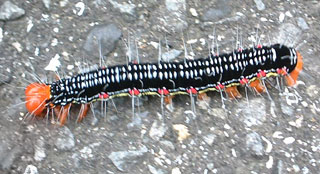
Can you identify this caterpillar? It was crawling along the sidewalk in a residential area of Beppu, Oita prefecture when I snapped its photo on October 13. It's quite pretty, but I've no idea what it is.
 The bulbous, bright orange head is unusual so it should be easy enough to ID, but I can't find anything that looks like it or any references on the Internet.
I checked my usual references: What is This Caterpillar?, the USGS Caterpillars of Eastern Forests and closest to home, Fukuoka Butterflies (in Japanese) but I'm stumped.
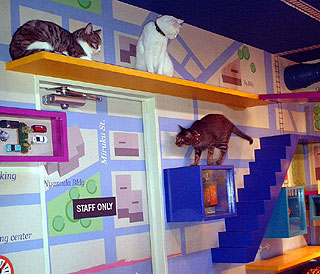
Nekobukuro is a mini theme park where 20 cats roam free so you can play with them. The walls are fitted out with shelves and boxes that the cats can jump to and walk around on. There's even an overhead plank that spans two rooms for quick escapes and pirate games.
When they are ready for catnaps, there's no shortage of places to conk out. In addition to shelves, there is all sorts of soft cat furniture. The cat-shaped TV plays videos of the Nekobukuro Idol Cats while Anpanman narrates with facts and jokes.
 There are cats in every size, shape and color you can imagine. Rare breeds, like the wrinkly, hairless Sphinx and giagantic Maine coon, live behind glass but are rotated through the mix. While we were there a yowly little Tonkinese was out of her room and playing with visitors.
Some cats were disdainful or wary, others playful and happy to have a pat. I tried to engage one cat with a feather toy, but it wanted to chase string. Next time, I'll sneak in the laser pointer and see what happens.
This is a clever idea in a country where a kitten costs 120,000 yen and not too many apartments allow pets. I enjoyed interacting with the cats for a little while and the dozen other people, some with cameras and some on dates, seemed to be having fun, too.
Although the rooms are well ventilated, there's a faint scent of litter box. After after 15 minutes, my eyes were itchy. We hadn't really handled the cats as much as observed them, so we didn't need to use the cat-hair lint removers at the door.
Nekobukuro
Location: Tokyu Hands Ikebukuro, 8th floor.
Hours: 10:00 -20:00
Admission: 600 yen (1,000 yen "pair ticket")
See also: Cats Livin', Cat Park, Dog Forest, Dog Town, Ferret Friends at the same website.
One of the Japanese members of the Foreign Correspondents Club asked me to explain "raincheck" to him today. He sometimes pops into my office while I'm working and asks me to help him understand idiomatic English. I'm glad that I usually know the meaning and also the origin of the phrases he asks about.
A raincheck is a promise to deliver a service after a postponement. You might get a raincheck if the supermarket runs out of the toilet paper that's on sale. They give you a voucher that allows you to buy the toilet paper at the reduced price when it's in stock again. Or you might say "Can I take a raincheck?" if someone invites you out to dinner on a night that you are busy. This means that you hope they will invite you again on another night.
The original raincheck was a special ticket issued when a baseball game was cancelled due to bad weather. The raincheck allowed you to come to another game instead. Rainchecks have been around since 1884.
Assisting friends and colleagues with language is par for the course* around here. Tod explained "that old chestnut" to Ota-san today and even UltraBob recently needed some help translating muchi to ame (literally whip and candy) into "carrot and stick."
* yet another idiom--this time relating to golf.
Boston University School of Medicine researchers tested 2,500 Beijing residents over 60 years old to discover that the repetitive motion of using chopsticks causes degeneration of the joints and causes arthritis.
I'll bet that they got a lot of money to do that study. And what's the point? Nobody's going to stop using chopsticks. We all know already that repetitive motion of many sorts causes damage to joints and ligaments.
Maybe they'll come study my typical repetitive motions: typing, mousing, and flipping the bird at stupid researchers.
While I was being winked at by this praying mantis, Jim & Yuka were documenting park outing more fully. Read all about our afternoon in the wilds of Kosihikawa Botanical Garden over at Wirefarm, and see the 1 minute video Yuka made. Yes, I am hugging a tree...at least there wasn't any footage of me whittling branches or chewing sticks.
Last night, Tod & I attended a party to celebrate the Indian festival of lights, Diwali (aka Deepavali). Murali, one of Tod's colleagues, planned the party for the Indian IT folks working at several of the investment firms.
The party started at 6; we arrived at 6:15 to find a nearly empty room. Nalnish greeted us with a chuckling explanation, "Everyone is running on Indian time and will be here an hour late!"
Sure enough, by 7, the room was full of people. Diwali is a happy celebration, though exactly what it celebrates depends on what part of India you're from. It really doesn't matter--Diwali is a excuse for fun.
A dozen children dressed in party finery ran around playing games, while two dozen men and women mingled or sat in laughing groups. Young mothers dressed in gorgeous sari, glamourous salwar kameez, and stunning gold jewelry collectively watched over the children, keeping them out of harm's way and ensuring that they all played fair.
We played musical chairs, bingo, and a challenging game of "Guess the Hindi Song." We feasted on curries, poori, biryani, carrot halva and sweets and then set off fireworks along the river.
It was, in many ways, a pretty typical family-oriented social event. But it was different, too. Not because of the curry dinner or the exotic silks and gems but because of the relationships.
It's difficult to write about this without sounding either sappy or like a clueless ethnologist. I envy the Indian community in Tokyo. It is a real society of families and friends.
Perhaps the practice of arranged marriages fosters a larger, tighter social network, since couples aren't burdened with the wrong-headed notion that their partner is the one and only person they will ever need to rely on. All of the couples seemed to care for one another, but they were equally connected to their friends.
By contrast, the "foreign community" that I belong to is mostly unmarried or childless couples like me and Tod. The bonds among our set are much looser than those I saw last night. Whether it's the lack of children or a general difference in culture, I don't know.
I like the idea of a very close group of friends, but I don't know if I'd like to live in one. I'm set in my ways and those ways include a lot of time alone. Distance. Sedentary separation. Focus on work. Momentary irritability when someone changes my schedule unexpectedly. Well, I exaggerate. I used to have a house where people just dropped by whenever. And I loved that...
Next weekend, there is a Diwali party in Futako-tamagawa where 2,000 people are expected to attend. Maybe I'll be among them as part of the larger, looser circle of the Indian community.
This week, we switched dishwashing liquids. Our usual brand was out of stock and Tod picked up an American brand that smelled like flower-scented petrochemicals. I'd forgotten that "fresh plastic" smell that so many American cleaning products have. Just thinking about it makes my nose twitch.
We replaced the "Ivory Ultra" with our regular brand the next day.
This got me thinking about all the chemicals in our life, in general, and the smell of cleaning products in particular. Japanese cleaners and soaps often smell like citrus. Underneath, I'm sure the chemical composition is just as harsh and manufactured, but it certainly smells better.
I went around the house sniffing soaps and potions. As I expected, a lot of them smelled like a fantasia of orange and tangerine - sort of like baby aspirin. I was a little bit surprised to see how many different products I have for such a small household.
| Brand | Mfg | Use | Scent |
|---|---|---|---|
| Joy | P&G | Dish detergent | Orange |
| Grease Cut Magic Clean | P&G | Kitchen cleaner | Citrus-y plastic |
| Glass Use | Savings | Glass cleaner | Flowers |
| Sink Mawari Cleaner | P&G | Steel sink cleaner | Orange |
| Attack | P&G | Laundry soap | Orange |
| Muse | P&G | Anti-bacterial hand soap | Orange with nutmeg |
| MyPet | P&G | All-purpose cleaner | Plastic |
| Ofuro Clean | Lion | Bathroom cleaner | Orange |
| Ofuro Polishing Clean | Lion | Tub cleaner | Orange |
| Toilet Magic Clean | P&G | Toilet cleaner | Minty |
| Kabi Killer | P&G | Mold/mildew remover | Bleach |
Why is it that Japanese society equates clean with citrus and American culture thinks plastics smell clean?
On Monday during the 21-nation Asia-Pacific Economic Cooperation conference in Bangkok as leaders debated the fate of nuclear weapons on the Korean peninsula, North Korea shot a test missile into the Sea of Japan. It was a surface to ship missile, apparently part of an annual military exercise, and came nowhere near Japan.
On Tuesday there was a report on NHK, based on US intelligence, of another test firing. You have to wonder how well defended we are here when you read a quote like this from the Defense Agency a couple of hours after the missile was launched, "We are aware of unconfirmed information of that nature. We are now trying to confirm it."
South Korea says there was no second missile, though everyone agrees the DPRK did fire one on Monday. I wonder what the truth is here?
Some reports on the subject:
Al Jazeerah - North Korea had right to test-fire missile: Putin
MSNBC - S.Korea says no evidence of 2nd North missile test
Tribnet - orth Korea rejects U.S. offer as 'laughing matter'
The Toronto Star - North Korea tests anti-ship missile as leaders meet
Get yourself to Shinagawa station this week for an unusual intersection of computing and trains.
Google Japan is holding an event at the new Shinagawa shinkansen station until Friday. Go to the Virgin Cafe and take a quiz; if you get the correct answer, you'll win a Google prize. Everyone gets a Google keitai strap.
Now if only you could Google while on the shinkansen...then I'd pack my laptop for our holiday for sure.
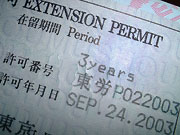 Any foreigner who's lived here a while knows the nail-biting tension of having a visa renewed. We are all here by the good grace of the Japanese government and once every three years we must submit ourselves for inspection and a new seal of approval. Yoroshiku onegaishimasu!
So what's it like?
After collecting reference letters, employment contracts, tax documents, marriage certificates, and university diplomas, a trip to the Immigration office and several thousand yen worth of revenue stamps get the application in the queue. It vanishes into the fog of Japanese bureaucracy.
There is no way of knowing what is going on behind the scenes; only a sketch of the rules is written down for applicants. Do they check all those letters and contracts? Do they consider you by nationality, income, criminal record, age, or some sort of karmic merit system?
Who knows?
We sailed through the process this time. Whatever mysterious tests were applied to us, we passed. Our visa applications were filed on September 10 and we received the renewals yesterday. We've been granted another three years' stay in Japan. Our life continues, uninterrupted by any immediate international moves.
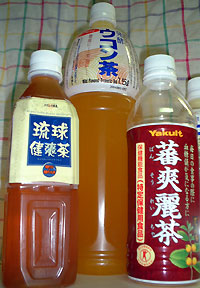
The change of season heralds a change of products at the convenience stores. The Rose Pu Erh tea that Tod enjoyed this summer is gone, and we're casting around for some new drinks to take us through the winter.
Tod came home with some Ucon Cha yesterday. It's turmeric tea. I love Okinawan black sugar and turmeric candy and turmeric is a good tonic for the liver, so can you go wrong with turmeric tea? No, you cannot. It's really tasty. This brand is mild and subtly nut-pepper-ginger-citrus flavored.
Turmeric has been used in Indian cuisine as a flavoring and a food dye for 2500 years. It works great as a dye in modern times, too, it stains the plastic bottle yellow!
Tod also found a tumeric tea with ginnemu, a weedy mimosa that's used in the tropics to feed cattle. The ucon-ginnemu tea has a distinctive flavor. When he opened the bottle, it smelled a little bit like urine. I think I'll stick to the Ucon Cha.
Another tonic tea on the market contains guava. Guava is supposed to be good for your blood sugar levels. I don't understand that at all, but the tea has a minty-anise flavor that I enjoyed.
There are scads more new teas, mostly oolong and sencha variations. I'm sure we'll try them all over the next few weeks.
Last night was the flash mob; 9 people played rock paper scissors in the middle of Tokyo station. With only nine, it wasn't much of a mob but it was all over in 2 minutes, so it definitely qualified on the "flash" part.
I had a small role in the game. At 19:32, I dropped off the instructions at Cow #20. There didn't seem to be too many people there, just three guys hanging around on one corner of the space near the Maru Biru. So I sort of held up the papers a little bit and without breaking stride, walked over to the cow, sat the clipped together slips on the ground near a hoof, and walked away. MJ and I were the only non-Japanese there; I bet it must have confused everyone to see a foreigner with the secret instructions.
MJ got some pictures of the mob; I had my camera but was having too much fun playing to take it out and document.
Competing with the mob fun for most memorable moment of the evening, were two funny toilet incidents after. At an izakaya in Yaesu, MJ fell in love with the toilet paper. "It has stuff written all over it; steal me a roll," she requested. I didn't manage a roll, but I did spirit away these two sheets:
Boss, the location of your part has changed, hasn't it?
As long as it's for a purpose, we'll walk for anything (SIGN: a good man)
Definitely odd toilet paper.
My other toilet experience was in a different izakaya (it was a busy night) under the tracks at Yurakucho station. The ladies room is tucked into a tiny space with a low slanted ceiling--less than five feet off the ground at the highest point. I was so distracted by bumping my head that I forgot to lock the door. The woman who opened it moments after I sat down was not more shocked than I was. How do you gracefully exit that situation? I did my best with hastukashii---atama wo ki otsukete! (embarrassing--watch your head!) as I ducked out.
4:20 am - Tod comes to bed.
4:35 am - I rise for a glass of water...
4:50 am - 7.8 magnitude earthquake in Hokkaido. It rocks our house gently for about 45 seconds
5:10 am - First train rumbles past.
5:51 - 5:59 am - Rainbow over the Toppan building. I can see both ends. (Click for larger images.)
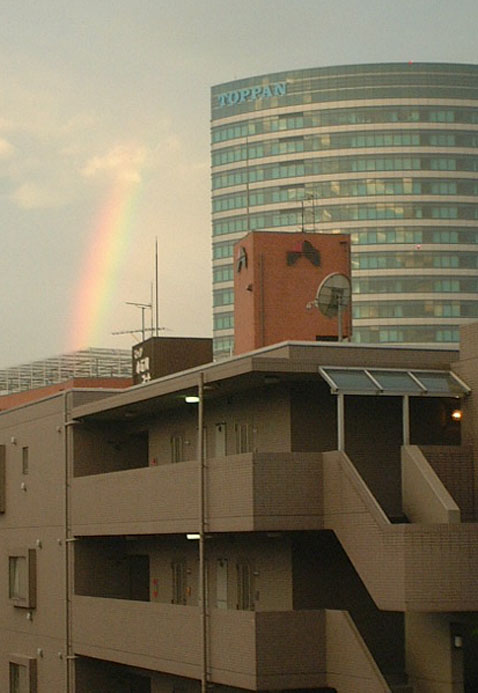
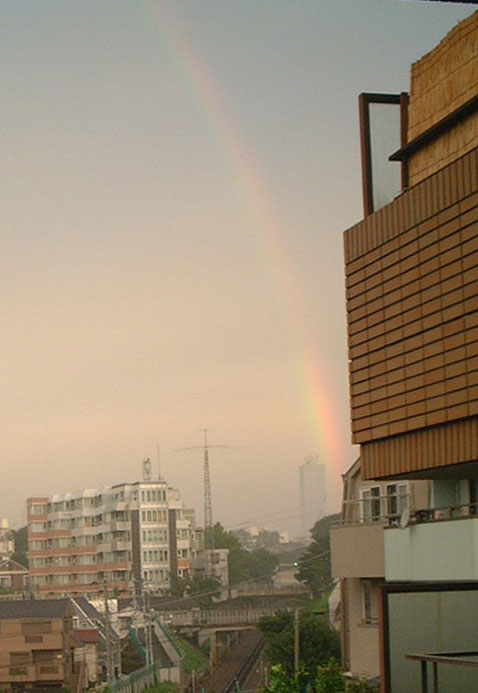
6:11 am - Coffee's brewing...
When you indicate the number 8 with your hands, how do you do it?
If you're American you probably hold up your hands like this:
 Side by side, in front of your face. The left hand indicates five and the right hand shows the remaining three.
But in Japan, it's done like this:
 With the hands held palms together. The hand behind shows five and the hand on top gives the rest.
I imagine that other places use this method as well, and it makes sense. The person looking at your hands only has to focus in one location and to check out the fingers on top to know the number. With the American method, I always end up scanning across the hands, taking in the face of the person holding them up, too. Not nearly so efficient.
A similar ease of use follows in the Japanese method for marking groups of 5. It uses the five strokes of the kanji for five. This is used all the time in restaurants:

At a glance, you can see the correct number. The American system of four vertical lines topped by a diagonal a slash across always forces me to double check wither it's three or four lines marked down and so on, though I have no problem when it's five or one. Maybe I'm just a little slow.
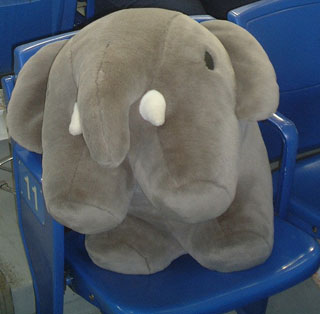
We went to a baseball game with a flock of friends and Zousama looked at me so sweetly as we left that I picked him up and brought him along.
But when we reached the entrance gate the guards were a bit bemused.
"Um, is there a Japanese speaker?" said the man doing the bag check as he scanned our group for Nihonjin. We assured him that we'd be OK if he spoke Japanese.
"So, well...." he started.
"Oh, it's like a pillow," MJ said enthusiastically patting Sama's back. But the guard looked dubious and glanced over at the more seriously dressed superior off to the side who nodded in a "go ahead, continue" fashion.
"Well, um...well...." he stammered. His cohort chimed in with "You see, the seats are narrow..."
At which point, Tod came forward with Zousama's ticket. We had an extra. He placed the ticket on Sama's back. "This is his ticket. Is that OK?"
The guards attending to us giggled. So did all their friends who'd come over from other gates to watch this spectacle. Elephant with a ticket? Well, let him in!
Sama had a great time at the game, as did the rest of us.
At lunch today, an elderly man occupied the table next to mine. He dined in the company of his portable oxygen tank.
I've seen him around before, ambling along the sidewalk with his tank in tow. Narrow plastic tubes pass under his nose allowing easier breathing. His hands are bloated and unwieldy. Maybe he suffers from emphysema. He's sometimes accompanied by a woman I assume is his daughter and a little boy that must be his grandson. Today he was on his own.
After finishing the tuna-tomato pasta (we ordered the same thing), he had a cup of coffee. He fumbled with the tiny tab on the container of "coffee white" for a moment or two before using his teeth to hold it while his hand pulled the packaging open. Then he struggled with his medications--five blister-packed pills--and with some effort managed to push them open.
It's a bitch getting older. Nobody escapes the inevitable physical decline and we can't predict how gracefully we'll age. But this old man was out there living life. He's slowed down, but hasn't stopped. I hope I can say the same thing in 30 years.
Yesterday was "Respect for the Aged" day. 19% of Japan's population is over 65.
Looks like Tokyo's finally going to have a flash mob. This appeared in my Inbox last night:
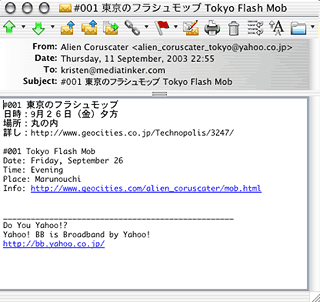
There have been gatherings of strangers doing weird things in public in Tokyo and around Japan, like the Matrix events in June, and a group of people posing like comics covers. These are called "off" (presumably for off-line), but as far as I've been able to tell, there hasn't been anything called a flash mob here.
The idea of a flash mob, in case this Summer 2003 fad passed you by, is that someone sets a date, time and location for participants to gather (the "mob" bit) and do something silly for a very brief time, then disperse (the "flash" bit).
There's a bit of mystery, too, as the exact instructions aren't given out until minutes before the mob starts. People meet at published staging areas and get the final details there.
It's sort of performance art by strangers. Sounds like fun. Will I see you there? Details are forthcoming, the English website is http://www.geocities.com/alien_coruscater/mob.html
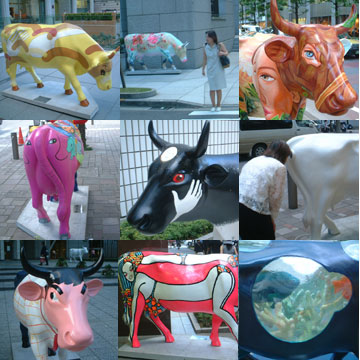
The Cow Parade has reached Tokyo. To be specific, it's come to Marunouchi. There's a lot of bovine weirdness along the corridor between my office and Tod's.
One of Tod's colleagues is convinced that these cows are going to explode tomorrow. They are all hollow fiberglass statues and would make mighty good places to hide bombs.
Should I worry? I have to be at the office tomorrow...
Something else to fear: a scientist (crack or crank, I'm not sure) is predicting that there will be a magnitude 7 earthquake in Tokyo within the next week. Maybe it's a good time to get around to checking the earthquake supplies, even though I should have done that on 9/1, Disaster Preparedness Day.
A dark shop on a busy street. A window display of antique reproductions. On a table outside, a display of manicure kits.
Interior decorations and grooming supplies are an odd combination; I was intrigued. And I have a fondness for manicure kits, even though my ragged nails can't be trimmed or trained into shape. So I stepped inside. And what do you know? More manicure kits. I ended up buying the one pictured above made by 777 Three Seven in Korea.
What an array! It contains: (l-r) toenail clipper, fingernail clipper, nosehair scissors, cuticle clipper, tweezers, cuticle knife, cuticle pusher, v-shaped cuticle trimmer, an earspoon, cuticle scissors and a file.
I am armed and prepared to declare war on my cuticles!
I've noticed an unusual trend in fall fashion--there's a lot of Japanese influence in clothing.
I don't mean kimono are popular. It's more of a fusion. T-shirts have things written on them in Japanese and sumi-e style drawings. Parachute pants and tunic tops have patches of chirimen (a textured silk with vivid floral patterns) sewn onto them.
This is strange. Once every few years an American or European designer will use Japanese influences in his haute couture line, but I've never seen locally produced, casual clothing with such a strong and obvious Japanese twist.
I like it. But I wonder if the slogans on those Japanese t-shirts are as weird as the English ones are?
The electricity crunch that we were warned about earlier this year hasn't come to pass yet.
Tepco managed to get enough of its reactors back online to cover the city's power consumption, and their collective corporate prayer for a cool summer was certainly answered.
Oddly, though, this summer's power consumption is nearly as high as last year.
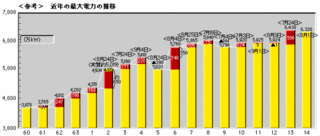
[click for a larger version]
This graph shows power use from 1986 (Showa 60) to 2003 (Heisei 14), noting the peak date of power use and the kilowatt hours/10,000. Our current peak was on August 1st. It was higher than everything except last year's all-time peak.
Maybe Tepco's denki yoho (electricity forecast) backfired. Everyday between 11:30 and noon, every radio and TV station announces how much power is available and what the expected peak is. Every time I've checked, the peak has always been well within the available power. I suppose that might make people care less.
The denki yoho is online, too.
Today's Forecast: http://www.tepco.co.jp/setsuden/corp-com/forecast/index-j.html
Today's Graph: http://www.tepco.co.jp/setsuden/corp-com/forecast/demand-j.html
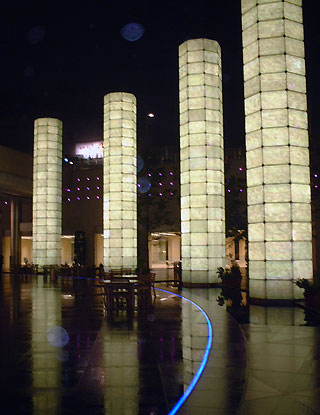
10 meter tall, opalescent glass light towers at Shiodome cast reflections on a rainy night.
Tokyo is so big, so bustling and so very full of attractions that every overwhelmed citizen has a dilemma: Where to go when you're feeling bored or stuck in a rut? Luckily for us, there is a popular market for city guides. Every bookstore has a section devoted to them.
They are all in Japanese but you don't have to be completely literate to use them. As long as you take the time to decode the key points, they books are perfectly useful. The more you can read, the better, but it's not strictly necessary.
We picked up Tabearuki Navi Tokyo ("Trying the food at various restaurants Navigation Tokyo") published by Shobunsha. It lists "from old favorites to the new open, 500 delicious restaurants."
In typical fashion for Japanese non-fiction books, there is a huge amount of information squeezed into a small space. In each entry's 7x10 cm slot, a photograph dominates the left half, with a sample menu and prices as the caption. On the right, symbols indicate whether this is a good place for a date or dining alone, whether it's best for families, salarymen or women. There's information on the location and type of restaurant, as well as the average price for lunch and dinner. A short paragraph explains what makes the restaurant worthwhile. Below that, come all the necessary details: phone number, hours, address, how many seats, credit cards details and so on. The final row of symbols encodes whether they restaurant does parties, private rooms, has parking, smoking or take-away.
This is just one of scores of guides. Hanako women's magazine publishes a range of mook (magazine-books) directing trendy office ladies to the hottest eateries and boutiques; OZ magazine gets into the act with its OZ mini guides for Tokyo neighborhoods. Kodansha, Japan's largest publisher, has a bewildering number of monthly magazines focussing on new products for men and women, food, and city travel.
So next time you're bored and looking for something new to amuse yourself, go to the bookstore.
 Edo, the city that became Tokyo, was founded in 1603, so Tokyo is celebrating its 400th anniversary this year.
This afternoon, Tod & I visited the fabulous Edo-Tokyo Museum to learn a little bit more about the history of our city. It's been quite an interesting ride for the Edoko (children of Edo).
Tokugawa Ieyasu founded Edo after being sent here in 1590 from Kyoto, the capital of Japan, where he was a powerful nuisance. He built up his power base in Edo and took over. His descendants held on to power until the Meiji Restoration in 1868.
But it wasn't easy. I learned dozens of facts and stories today, but I think I'll focus on two choice tidbits about the Edo era economy.
The Shogun's 5,000 retainers were paid three times a year--in rice. Near the granary in Kuramae where the payments were made, there were rice exchangers who traded rice for cash. When the price of rice dropped, the retainers couldn't afford to to keep up their households, and would promise their next season's payment to the exchangers. Needless to say, the economy wasn't very stable. Currency was devalued several times in the hopes of making things better.
The Tokyo economy ran on the gold standard; in Kyoto silver was the main currency. Currency exchanges in both cities traded silver for gold and vice versa. In a closed economy this worked fine. But when Commodore Perry's "Black Ships" appeared from the US and forced Japan to open its doors to free trade, the Westerners realised that gold in Japan was very cheap, snatched it up, and left Japan considerably richer.
Not long after that, the Meiji Restoration began and that was the end of the Shogunate and its economic woes.
Happy Birthday Tokyo!
To see what else is planned as 400 Years From Edo to Tokyo festivities see the official Event Calendar (Japanese). I'm particularly interested in "Tokyo Lifestyles," September 13 - November 16, at the Edo Tokyo Museum. I'll definitely be going; if you'd like to come along, let's plan a date.
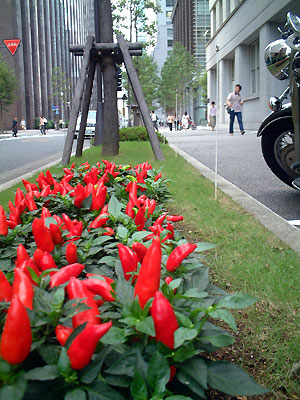
The berm along this section of Marunouchi Nakadori is a green oasis in a new retail desert. Each season it is planted with with fresh sod and flowers to brighten up an otherwise drab block of corporate headquarters. This summer it features red peppers. No one even considers picking them.
Unlike the rest of Marunouchi, this particular block hasn't felt the touch of urban renewal. It maintains the cold granite face that the entire street had just five years ago--imposing architecture with minimal exterior signage, curtained street-level windows, and shops tucked into basement hallways. You had to be introduced to the neighborhood's great restaurants by your coworkers because it was unlikely that you'd find them on your own.
But times are changing and elsewhere along this corridor between Otemachi and Ginza, buildings are turning themselves inside out. They've removed their uninviting marble facades and replaced them with plate glass windows opening into high-end boutiques and restaurants--Prada, Kate Spade, Hermes and Emporio Armani all have shops here. There's a website to promote the area and help shoppers find their way: Marunouchi.com
I think this renewal was precipitated by the Marunouchi Building which opened last December after several years of construction. Perhaps "Maru Biru" made neighboring building owners realise there was as much profit in retail as in office space. The Mitsubishi Trust Building completed their renovations a few months back with a lot of tasty restaurants, including a posh Dean & Deluca, and there are three more huge construction projects along the street.
But I still like the block with the pepper plantings the best. It's the only non-retail stretch remaining in the neighborhood. I can breathe a little easier and relax the tight hold on my wallet as I go past.
Hello Kitty gets around. Usually you find these location-specific Hello Kitty omiyage only in their featured city, but a Sanrio shop in LaQua carries all of them in one place. No need to travel to get your Hello Kitty geegaw. Left to right: cans of chocolate creams (representing Kobe in a red dress), strawberry creams a the purple can, and two yellow cans of corn cream candies (Hokkiado).
If you're not fond of sweets, why not get some other treats? Up at the top, Kitty-chan's pictured on handkerchiefs in Kyoto and Kobe. On the second shelf, it's a variety of items from Kumamoto and other cities.
This shop has about 200 keychains and keitai straps with Kitty posing in traditional costume or with signature items from famous places: Mt Fuji balanced on her head; dressed like a Okayama bonodori dancer; sitting on a Okuwadani boiled egg.
Mr. Janitor, I do not know your name.
You mumble Itterasshai!
Greeting me kindly as you polish the big brass gate.
I try to engage you in idle conversation
But chitchat and weather are unimportant
When it's trash day and there are fingerprints on the glass.
You sometimes bump lightly against my door
On Tuesdays, as you vacuum the hall.
Like a tree-fall in the forest, I hear you excuse yourself to no one.
Godliness is no match for cleanliness.
Today, I caught you wiping a city property--
The sign outside our building that tells how to put out the garbage.
After work, you change into a suit to go home.
I hardly know you without your blue coveralls.
But you recognize me and say hello as we pass in the street.
 Boys don't make passes at girls who wear glasses.
If I thought it was likely that any boys would make passes at me at my age, well, I just ended an era for myself. Today I went to get glasses.
Although they are "just for reading" I know this is a slippery slope. Once Mom was fitted for reading glasses, she never went without again.
To anyone shopping for megane in Tokyo, I can recommend Zoff. They are quick, professional and inexpensive. My new glasses were only 5,000 yen.
And best of all, the cute, 20-something optometrist spoke English. I was slightly worried about the examination in Japanese, so I was very happy when Hikage-san just jumped right in and spoke perfectly fluent English to me. He made the whole experience much easier.
But he didn't make a pass...
 Summer fireworks festivals are a tradition dating back hundreds of years. Originally for the powerful elite, there were public fireworks along the banks of Sumidagawa in 1733.
These days summer fireworks are an excuse for everyone to get dressed up in their yukata and spend some time outdoors. Over the last 50 years, the weeks spanning mid-July and mid-August have become an increasingly loud and colorful time of year.
Last night, we picnicked on the embankment of Edogawa and watched competing fireworks companies shoot off 14,000 fireworks in 75 minutes. It was splendid. This video doesn't really capture the jaw-dropping majesty of the event, but it gives a taste of three moments during the spectacle.
Edogawa Hanabi 0'50" (2.8MB Quicktime)
Summer fireworks festivals are a tradition dating back hundreds of years. Originally for the powerful elite, there were public fireworks along the banks of Sumidagawa in 1733.
These days summer fireworks are an excuse for everyone to get dressed up in their yukata and spend some time outdoors. Over the last 50 years, the weeks spanning mid-July and mid-August have become an increasingly loud and colorful time of year.
Last night, we picnicked on the embankment of Edogawa and watched competing fireworks companies shoot off 14,000 fireworks in 75 minutes. It was splendid. This video doesn't really capture the jaw-dropping majesty of the event, but it gives a taste of three moments during the spectacle.
Edogawa Hanabi 0'50" (2.8MB Quicktime)
Henna gaijin literally means '"strange foreigner" but it's got a somewhat more derogatory sense than just strange.
A henna gaijin is someone who has a deep knowledge of some Japanese arcana--the esoteric details of the tea ceremony or karate or Japanese food or kanji--but fails to understand the daily basics. In other words, someone who can create an exquisite flower arrangement in the ikebana-morimoto style, but who buys sushi to grill it.
I worry sometimes that the longer I stay here, the more I am becoming a henna gaijin. I am concerned when a Japanese person expresses astonishment at some bit of Japanese trivia that I know. "Oh really? I didn't know that!" sends shivers of dread down my spine.
But what can I do, really? I love to learn and it's details that interest me. Fortunately, I don't focus my study in any one area, but drink in whatever comes my way.
For example, did you know that most Japanese people didn't have surnames until the Meiji Restoration (1870)? Ironically, when they selected their new family names, they borrowed from the powerful shoguns that had recently been deposed.
Or that if you keep a bit of iron in your nuka pot (for pickling) the eggplants will keep their color? Iron is a mordant for cloth dye as well.
Or that the genkan entryway where you take off your shoes, was originally in farmhouses where the animals and people shared the same structure? It was a practical way to keep mud and dirt from getting into the living quarters and was much higher than the small step commonly found today.
I hope these bits of knowledge aren't enough to make me a henna giajin but all this talk of henna makes me think I need to dye my hair.
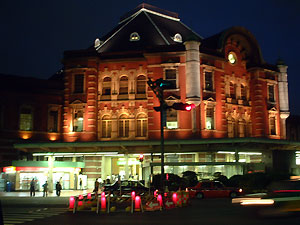
Yesterday between 3 and 7 pm, I travelled counter-clockwise around the Yamanote line to capture images for Yamanote29. I rode through all 29 stations and stopped at most of them, though for a few, I was so quick that I got back on the same train I jumped out of. Got my picture and a few bemused looks from the other passengers.
I decided to walk between Komagome and Sugamo, and between Shinjuku and Yoyogi. Those pairs are pretty close together and I made detours to two of my favorite places in the city: Rikugien, a 300 year old garden in Komagome, and the 45th floor observatory at the Tokyo Metropolitan Government Building. Lovely views at both places, but they couldn't be more different.
I skipped a few stations so that I'd end up back at Tokyo station in time to meet Tod for dinner, so I will have to go back for pictures at Harajuku, Shibuya, Ebisu and Meguro.
But I got plenty of photos to keep me busy--I filled up my digital camera's 64 Mb memory card. Slowly but surely the site is getting ready to launch. And I've already received two contributions. (Thanks, and keep them coming, please!)
Every new apartment building that goes up in our neighborhood has a silly name and a website with Flash animations. Imagine the prices!* Or look for yourself...
Glorio
Qualia
PIAS (Personal & Intellectual Architecture Space)
Precise
Park Square
Atlas Tower
Viequ Court
Brient
Parterre
*These apartments range from 19,800,000 yen to 135,000,000 yen (about $166,500 to $1,134,500)
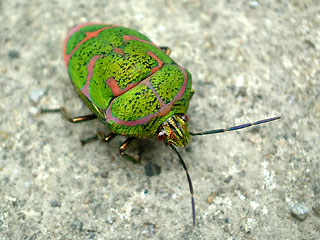
I'm not sure what sort of beetle this is, but it's lovely, isn't it? I spotted it on the steps in a park near Kourakuen station.
The praying mantis appeared in the same location the day after the beetle. The toad, bufo japonicus formosus, also known as Azuma-Hiki Gaeru or Common Eastern Toad, also lives in the park. There are dozens of them and they like to hop around on rainy nights.
In the news is the story of four 11 and 12 year old girls who were held captive in Akasaka from Sunday to Thursday last week.
I'm not sure whether the true substance of the story is about poor parenting, bad police work, the naivete of little girls, or whether it's just about a social deviant.
Kotaro Yoshisato, a 29 year old man from from Saitama just west of Tokyo, lured the girls to his condo in the city on the pretense of discussing part-time jobs at his fictitious shop, Petit Angel. In reality, he was looking for girls for his prostitution business. For the past few years, he's paid high school girls as talent scouts to find new, youthful recruits.
He'd met one of the four 6th graders previously and persuaded her to do "part time work" for him and offered her a bonus if she would bring her friends, too. When they all met him again last Sunday, he handcuffed the four to heavy objects, blindfolded them, then bound them hand and feet. On Wednesday night, he committed suicide by poisoning himself with carbon monoxide from a charcoal stove.
One of the girls escaped from her handcuffs on Thursday and went for help. The four sets of parents, all from a Tokyo suburb called Inagi, were very relieved to have their daughters home unscathed but you have to wonder why they let their the girls go into Shibuya unaccompanied.
On Friday, 3500 police officers and social welfare workers spent the day in the area around Shibuya station, reminding young people of the dangers of talking to strangers. According to Kyodo News, they talked to about 1500 kids--2/3 of them boys.
To add to the drama, Kotaro Yoshisato was investigated a few years ago on suspicion of selling illegal pornographic tapes featuring young women. But despite the evidence of sales flyers, a client list and 1000 video tapes, the investigation was dropped.
I rescued a butterfly.
It was struggling against the electric breezes in the hallway between the Oedo line and Mita line at Kasuga.
A sucker for struggling creatures, I bent down to help it. As I extended a hand to shield it from the breeze, it crawled onto my finger then clung on for three minutes while I carried it through the station to the nearest exit.
It kept its white wings, fringed in butter underneath, folded as we took the escalator up. Its darkly striped antennae held perfectly still during the journey but as we crested the top of the escalator, it gracefully uncurled a steel blue proboscis longer than its fuzzy pale green body. I couldn't feel it tasting my finger.
When we drew near the exit, I gave it a quiet word of encouragement, said goodbye then tried to sit it on the edge of a sign. It fluttered off, alighting briefly on the wickets before heading up the stairs to the fresh air.
Then I turned back and caught the train to work.
I met Sayaka when we were volunteering for a local magazine called Yanesen.
Actually, Sayaka found me through my weblog, figured out that I lived in the neighborhood and recruited me. I was happy to help, though I don't think the English edition we worked on together ever went to press.
Now Sayaka lives in Oita and publishes a weekly mail magazine for Japanese speakers wanting to improve their English. It's called "Sayaka and Kristen's Simple and Useful Lunchtime English."
Despite the prominence of my name in the title, I don't do anything. Sayaka uses entries from my weblog and other sources, deconstructs them, explains the weird things that I write, gives a brief lesson on vocabulary, idiom or a grammar point, then asks comprehension questions.
Tuesday's lesson is followed by the answers on Friday. On Fridays our names are reversed in the masthead--Kristen and Sayaka. That's Sayaka being very humble (though she does all the work and should take all the credit) but I think it's also quietly proving that I have all the answers. Hehehehe.
I've noticed that Sayaka is catching up with me. It used to be that the entries she selected were older ones, but this week's issue featured the one on shopping for the U101. I'd better write a few exclusives for the magazine, otherwise Sayaka's going to have to deconstruct and explain the kitten post!
If you're interested in paging through the back issues or subscribing (it's free), visit Macky, a Japanese e-zine clearinghouse.
When I was a teenager with her first job, I developed a financial coping skill that I will share with you, though I'm sure I'm not the only one who does this. I think of buying, selling, earning, and saving in terms of an object I care about whose price I know.
At age sixteen, I used a $40 wool sweater as a reference. I earned about a sweater a day as a lifeguard during the summer.
As a college student, my reference was pizza. The $4.99 Corleone's large cheese special (with two 32 ounce Cokes) was usually out of my budget, but it made a fine comparison tool.
After we bought a house, my reference became our mortgage payment. The apartment the company rented for us when we first arrived in Japan was eight mortgage payments. Yikes!
My latest reference is a lovely Abssynian kitten for sale at "Dog and Cat Nana." He is priced at 120,000 yen--about a thousand dollars. So now I think of things in terms of kittens. "That job just earned me 1.5 kittens."
Economics via Kittens
1 kitten = 1000 vending machine drinks
1 kitten = 136 Zoupi
1 kitten = 120 rides on the LaQua rollercoaster
1 kitten = 50 CDs
1 kitten = 42 Zousan
1 kitten = 30 dinners at Ampresso
1 kitten = 10 pairs of jeans
1 kitten = 10 kg of Japanese beef
2.5 kittens = 1 month's rent
5.2 kittens = 1 G5 + cinema display
7.3 kittens = 1 1996 VW Beetle 1600i
350 kittens = 2LDK apartment at Lions Square
6,662,369,081 kittens = 1 US national debt
Money seems so much cuter and accessible now.
When I was a teenager with her first job, I developed a financial coping skill that I will share with you, though I'm sure I'm not the only one who does this. I think of buying, selling, earning, and saving in terms of an object I care about whose price I know.
At age sixteen, I used a $40 wool sweater as a reference. I earned about a sweater a day as a lifeguard during the summer.
As a college student, my reference was pizza. The $4.99 Corleone's large cheese special (with two 32 ounce Cokes) was usually out of my budget, but it made a fine comparison tool.
After we bought a house, my reference became our mortgage payment. The apartment the company rented for us when we first arrived in Japan was eight mortgage payments. Yikes!
My latest reference is a lovely Abssynian kitten for sale at "Dog and Cat Nana." He is priced at 120,000 yen--about a thousand dollars. So now I think of things in terms of kittens. "That job just earned me 1.5 kittens."
Economics via Kittens
1 kitten = 1000 vending machine drinks
1 kitten = 136 Zoupi
1 kitten = 120 rides on the LaQua rollercoaster
1 kitten = 50 CDs
1 kitten = 42 Zousan
1 kitten = 30 dinners at Ampresso
1 kitten = 10 pairs of jeans
1 kitten = 10 kg of Japanese beef
2.5 kittens = 1 month's rent
5.2 kittens = 1 G5 + cinema display
7.3 kittens = 1 1996 VW Beetle 1600i
350 kittens = 2LDK apartment at Lions Square
6,662,369,081 kittens = 1 US national debt
Money seems so much cuter and accessible now.
It's been unseasonably chilly the past few weeks. I am grateful for the extended coolness.
The average high temperature for July 9th over the last 30 years is 28 degrees (82F) with a low of 21 degrees (72F). This year's going to drag the average down; JWA's forecast a high of 24 and a low of 20 (75/66F).
No doubt the mercury will creep up as July heads towards hot, sticky August. I hope that in the middle of the wilting season next month, I can look back and remember this cool morning when my feet felt chilly and I could see the steam rising off my coffee.
 Sumomo mo momo mo momo no uchi.
Plum and peach are both in the peach family.
This tongue twister turns around the word momo which means peach. Sumomo is a plum and all those extra mo are roughly equivalent to 'and' and 'also.'
Niwa no niwa ni wa, niwa no niwatori wa niwaka ni wani wo tabeta.
In Mr. Niwa's garden, two chickens suddenly ate a crocodile.
The key word here is niwa which means garden. Niwatori is a chicken, niwa means two chickens, niwaka ni means suddenly and wani is a crocodile. All the extra ni and wa are particles that emphasis the preceding words or give them a location, sort of like 'in the.'
There is another "niwa" tongue twister that I can't say:
Uraniwa niwa niwa niwa niwa niwa niwatori ga iru.
There are two chickens in the back yard and two in the front yard.
Uraniwa is the backyard. I can't figure out which of the niwa are 'two', 'in the' and 'garden.' Ack!
Today is Tanabata, a day honoring the legend of the stars Vega and Altair in the Milky Way. Really it's just a great excuse for a festival.
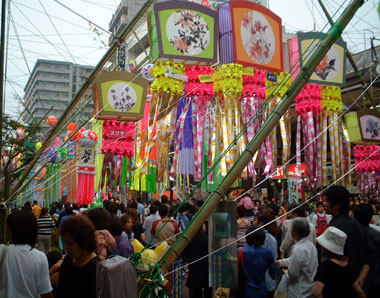
A sea of people came to Hiratsuka in Kanagawa Prefecture to wander the streets and look at the decorations.
But it's not all decorations. There are games, too. Catching bright rubber balls from a swiftly moving stream is very popular with little kids.
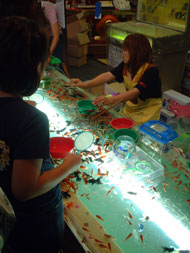
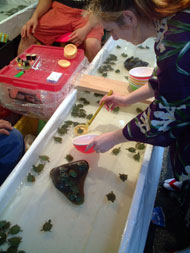
Older kids (including me) like the fish game. And MJ is the proud owner of two tiny turtles that she won by scooping them from the water with a monaka, like a cup-shaped ice cream cone that droops when it gets wet.
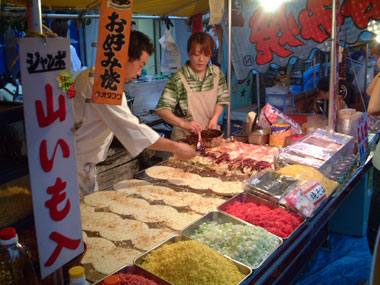
Mmmm, festival food. This is okonomiyaki a cross between pancake and omelet. My favorite is the choco-banana but I was too busy eating them to get any photos.
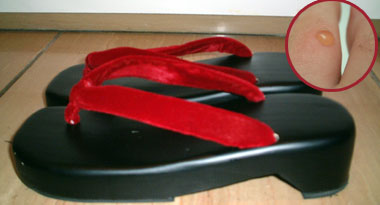
My Japanese sandals. (inset: inter-toe blister)
No other footwear is appropriate with yukata and kimono. Unfortunately, geta hurt. The price of fashion, I suppose.
On June 19th, five students from three of Japan's prestigious universities were arrested for gang raping a woman after getting her drunk at a bar.
Apparently these five and others had a party promotion business/student society with 20 members. Gang rape was one of their sidelines. There's a story in the Mainichi with details.
Last Thursday during a public debate on youth crime and the declining birth rate in Japan, a 57 year old Diet member, Seiichi Ota, said that the declining child population is due to Japanese men being afraid to commit to marriage. When asked by the moderator if that meant the university gang rapists did it because they lacked the courage to propose, Ota replied,
"Gang rape shows the people who do it are still virile, and that is okay. I think that might make them close to normal. I know I'll get in trouble for saying that, though."
Naturally, he did get into trouble. There was outrage from his party, the Prime Minister, and a lot of women legislators. He apologised publicly, so all will be forgiven soon and I'll bet he gets reelected.
 A friend in the US offered to send us some of our favorite Middle Eastern food if we'd go shopping for him. He wanted Sony's tiny laptop, the U101, which isn't sold outside Japan.
Well, as of Saturday, it isn't sold in Japan either.
Tod went to Bic Camera on Saturday afternoon, after he'd received the full shopping list of accessories (why buy a computer if you don't get a case, DVD drive and more memory!), but Bic Camera salespeople told him that Sony isn't making the U101 anymore and it's not available for sale.
On Sunday, checked kakaku.com, a website that shows prices all over Japan, then scoured Akihabara. No U101 at Yamagiwa (where he had seen it before), not at Llaox nor at any of a half dozen other stores. Finally he found one, the last one in all of Tokyo it seems, at a store so obscure that their shopping bags sport the name of a florist.
Tod definitely earned his finder's fee.
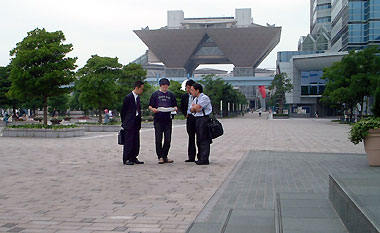
CEATEC is an electronics show that will be held in October. Last week UltraBob, who is working on the CEATEC website, asked the JapanBloggers mailing list for two volunteers to model in a photo shoot for the CEATEC poster.
I caught him on chat and gave him a hard time about asking the Bloggers to model. We're really just a bunch of normal people, not the Beautiful People. Apparently I was the first female to mention it at all and he talked me into doing it. Hmmmm. I'm a little old to be a model, but sure. Experience points.
So this morning, I headed out to Ariake for the shoot. I caught a glimpse of the mock up--a lot of product shots collaged together. Some of the photos had people in them.
But if there is any shot with my face in it, I will be surprised. Maybe the art director agreed with my self assessment of 'aged model.' I believe I have a hand, shoulder, and unkempt hair in one shot, a blurry torso in another, maybe a hand playing with the car navi in another. Seth, the other model and also a Japan Blogger, was more prominently featured--he faces the camera and is even talking on a cell phone in one shot.
Since the focus was on the gear and not on us, the photographer's assistant carefully dusted and polished every bit of equipment that was photographed, but Seth and I didn't even get a glance. No instructions to comb our hair or adjust collars. It was a little bit strange, to be honest. When I photograph people, even when they aren't the primary subject, I do fuss with them a little bit...
Mostly Seth and I waited around and talked about tattoos, writing and the lack of good bagels in Tokyo. It was interesting to be on the other side of the camera, but as I am reminded every time I venture there, I really do prefer being behind the scenes.
Summer clothes are not so bright and beautiful this year. Look around you on any train and you'll see mostly dark brown, navy blue, and black punctuated with tan and white. I've noticed a fair amount of a subdued blue-green, as well.
Two years ago, everyone was dressed in orange and fucshia. What happened? Is this a "sophisticated" summer season? Is the bad economy dulling fashion? Did the fabric factory have an excess of black dye in stock?
Maybe everyone is waiting until tsuyu is over before wearing their bright summer clothes.
I hate mosquitos that attack me at night when I'm defenseless.Swatting at them isn't very effective when I'm sleeping. Tod burns campfire-scented mosquito coils on the veranda while he works outside, but the smoke from them doesn't reach the bedroom.
 So I decided to get some mosquito poison for the bedroom. I selected Earth No Mat, liquid DDT in an electric warmer.
DDT was synthesised in Germany in 1874 and hit its peak in the US in 1959 when 80 millions pounds of DDT were deployed. DDT was banned in the US in 1972 because it contaminates groundwater and soil and accumulates in wildlife (and presumably humans as well).
But DDT's used pretty much everywhere else as a general purpose insecticide, so why not jump on the bandwagon? Earth No Mat claims 500,000,000 units sold (World's Number 1!). Yes, I'm sure Rachel Carson is turning over in her grave. But she isn't plagued with Japanese mosquitos.
I don't know if I'll continue using the poison, though I have a 60 day supply. It seems unsporting to gas mosquitos and I am little bit worried about the effect of breathing in DDT, even in small quantities. I guess if I poison the mosquitos, the bedroom will also be free of jumping spiders, which makes me sad.
So I'll have to choose--avoid possible long term health and environmental effects or enjoy blissful mosquito-free sleep? Hmmmm....
(Thanks to all the comments, I'm not so worried about the poison. It's not The DDT, but a synthetic DDT.)
The rollercoaster at LaQua climbs a track so high that you can see across the glacial white expanse of Tokyo Dome. Last night the sky was clear and the lights and neon from other parts of the city were so captivating that for a brief moment, I forgot was was about to happen.
It was after a baseball game, nearly closing time, and our companion Ben said, "C'mon, let's go ride!" What a brilliant idea. There was no line. We've seen waits of several hours with people snaking down the stairs and out into the hallway. But we waited the length of one loading and unloading and then it was our turn.
We piled into the back of the roller coaster. Ben and two other friends sat in the last car. Then us. Then a lot of little Japanese folk. After everyone was strapped in and checked, they were about to press the button to release the brake when there was some hand-waving at the front and an announcement.
"There will be a short delay for a safety check. Please wait a moment." And in the operator's booth, they started pulling out manuals. Hmmmm. Maybe they'd never had so many overweight gaijin sitting in the back before. How would that affect the ride? Too much power down the hills? Could we fly off the track on the curves?
After a few minutes, during which a sixth companion (who had bailed in fear) mocked us, they closed the manuals, pushed the big green button and we took off. Up the steep hill with the view and then...
Terror. The first drop plunges nearly straight down. I screamed. People aren't supposed to plunge straight down. I closed my eyes before we hit bottom.
But as soon as I felt the coaster curving up (ah! safe!), I opened them again to see our ward office passing by sideways. The ride was exhilarating and over way too soon.
But we'll go again. I'm happy to contribute to LaQua's money making machine.
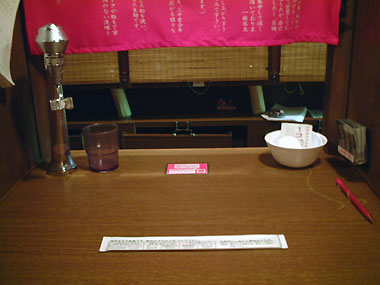
This ramen shop at LaQua, Ichiran, allows the diner to be almost entirely anonymous--just like a love hotel.
After selecting and paying for your meal at a ticket vending machine, you are handed a slip of paper and sent to your own private eating booth ion a row of similar booths.
The paper lets you choose the amount of garlic and spice in your ramen, how you want your noodles cooked and wheter you want slices of charshiu (Chinese pork) or not. After you circle your selections, you ring the bell and from the other side of the red curtain, hands come forth to take your ticket.
 A perky voice behind the curtain, accompanied by a glimpse of apron-covered midsection, explains that they will make your ramen now and please wait a few minutes. An egg in a bowl appears. You can have this for just 100 yen, if you want it. An empty water glass is set on the counter next to your private tap.
In a few minutes, a steaming bowl of ramen is delivered. The egg, being unwanted, is removed. You are wished a pleasant meal and the bamboo curtain is lowered. Whether this is to keep you from watching the staff moving around mysteriously, or whether it's to spare them the sight of your slurping, I'm not sure.
It's quaint and different. The ramen is good with a Hakata-style broth. I can understand why there is always a queue to get in.
The construction site across the way is using its crane to move roof trusses into place today.
They are huge iron arcs, charcoal ribs gracefully curving from end to end and narrowing to a point decorated with a white flag.
Twisting a little as they are hoisted up and across the building, they give the illusion of a giant Calder mobile.
What a shame when they are welded into place.
Tsuyu, the rainy season, began on Monday. Oddly enough, it rained neither Monday nor today, so how did they know it was tsuyu?
They checked the calendar, then confirmed by looking at satellite photos of the cloud cover.
Himawari, Japan's weather satellite, was retired a few months ago. Now the Japanese weather agency has to rely on American satellites which don't give them 24 hour coverage over Japan. There's a plan to launch a new satellite - MTSAT - later this summer but it won't be in operation until the end of this year.
I suppose tsuyu proclamations don't have to be very precise but it sure would be nice to have good coverage for typhoons.
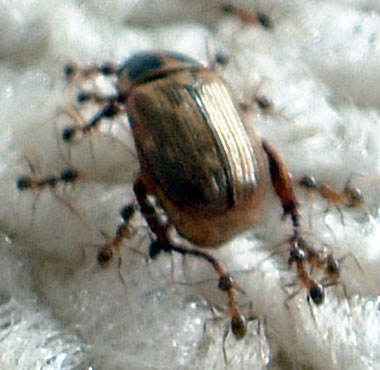
This morning, I found a tiny ant crawling across my foot as I sat at my desk. When I went to put him back into the wild outdoors where all ants belong, I discovered his brethren carrying a dead beetle out of my house. It was like a military strike.
While dozens of scouts and support troops scurried around helping and searching, a small platoon had the beetle by its legs and was booking it across the carpet and then down the ethernet cable we have draped across the threshold. In five minutes, the beetle was hauled from beneath the heater, trucked across the veranda and slid under the palm.
In less than ten minutes every ant was out of the house. Their efficiency was extremely impressive. Do you think ants work with the same ants every day? Or do they get assigned to the tasks at random? Do ants get assignments??
Since getting a sewing machine, I've been paying a lot more attention to what people are wearing. This summer's hot trend in shirts weems to be something they are calling "cut and sewn." As if most clothes aren't...?
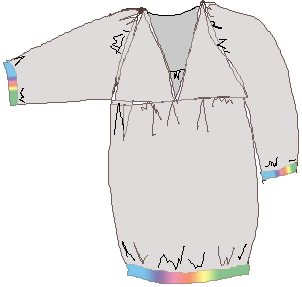 "Cut and sewn" are knit tops made of lightweight t-shirt fabric. They're gathered along some of the seamed edges--I guess that's why they have to be cut and sewn, rather than merely flat expanses of fabric.
I observed a "cut and sewn" on the train yesterday that was really over the top.
Done up in a pale grey heather t-shirt knit that was so thin it was nearly see-through, it had 3/4 length raglan sleeves (the kind on zoupi's t-shirt), gathered at the crest of the shoulder. But that's not all. It also had a V neckline and an empire waist gathered front and back along the seams. And it was finished with a sporty pastel rainbow ribbing at the cuffs and tunic length hem.
The woman was wearing it with a salmon-pink wool suit skirt and strappy high heels. Repeat after me: fashion victim.
"Do you have any spare floppies I could borrow?" Tod asked me 30 minutes ago.
"Uh. No. My computers don't even have floppy drives. Maybe there's an old one in the drawer?" I suggested.
"Already looked."
"Ah. Well, probably the conbini then."
So we walked over to the local 7-11. It's really amazing what you'll find there. Towards the end of the first aisle, between the ball point pens and the cell phone chargers, is the blank media section. MiniDiscs in single, 3- or 5- packs. CD-R and CD-RW. Video tapes of all sorts--VHS (three brands), Hi-8 and miniDV.
And, yes, floppy disks. A three pack of Maxell for 270 yen. Whew.
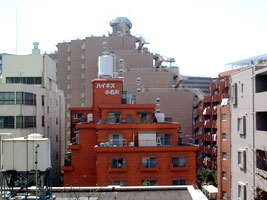
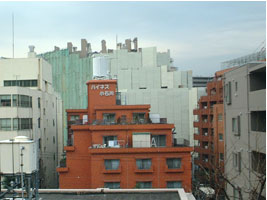
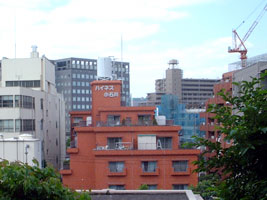
As promised on February 18, here is the complete series of photos of neighborhood destruction. Each week revealed a new vista of buildings in the background. The blue tarped construction in the later photos is a new Daikyo Lions Square luxury apartment complex going up next door to the destroyed building.
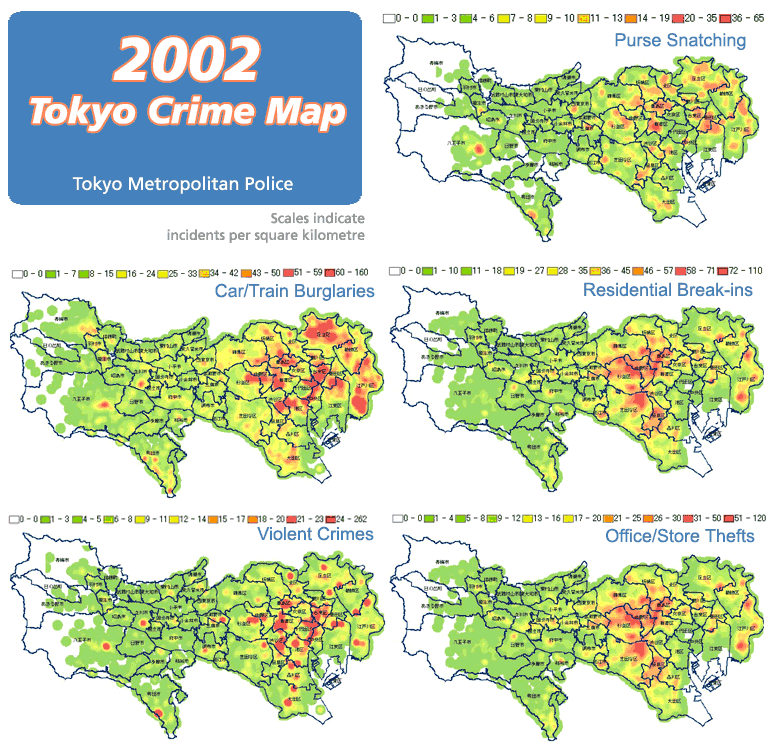
The Tokyo Metropolitan Police publish an annual map of crimes in the city. It's fascinating to see where the hubs of bad behaviour are. I'm happy to say that Bunkyo-ku seems to be the safest inner-city section. Shinjuku, on the other hand, is a dangerous place.
Click the map above for a larger version, or visit the police site for even better detail in Japanese.
I don't know for sure, but I suspect that Japanese women have some sort of special training in "posing for cameras."
We all know about the V sign that everyone, young and old, makes for the camera, but there's another common pose struck only by fashionable women. It's a modelesque chin-down-pouty-smile-eyes-focussed-on-lens-legs-poised pose that I can't believe is entirely unlearned.
Yet they do it gracefully and without consideration for the surroundings. I've seen women arranging themselves this way in front of landmarks, in clubs, in purikura photo booths, on the street with friends. It doesn't seem to matter what they are wearing or who is holding the camera. The ones who are best at it go on to become event models at technology and automobile conventions.
Perhaps there is a special schoolday in the 6th grade or so, when boys and girls are taken into separate rooms and the "facts of life" are explained. Same as when I was a schoolgirl, but in Japan the girls get an extra lesson in modelling. We missed out on that in my elementary school, so all I can do is look slightly goofy in photos.
 Last summer's trendy drink was tea. There were at least a dozen new brands of cold tea in the convenience stores. Boutique teas--Chinese specialties, green teas, oolong tea--all unsweetened and refreshing on a summer day. This one, Rin, is a Chinese green tea scented with jasmine and herbs.
It's Tod's very favorite tea, ever. He loves it so much that he drinks two 2-liter bottles a week to keep him going through his long nights at work. The local liquor shop, Kashiwaya, faithfully stocked Rin for him all winter even though it's a summertime drink.
When they ran out of Rin last week, the clerks at Kashiwaya were very sympathetic, but there's nothing they can do; they can't get it anymore.
Asahi has stopped production and seems to be selling off their stock--their Rin webpage shows a dearth of container sizes. Tea is no longer the fashionable (and profitable) thirst quencher.
So my quest, and yours if you should choose, is to find the remaining 2-liter bottles of Rin. There must be some out there, gathering dust in the back corners of mom-and-pop liquor shops. If you see any, would you please let me know where they are?
 Last spring, we discovered tadpoles, otamajakushi, in a nearby park. We watched them develop and took delight in stopping on our way by to peek at them. In Tokyo, you have to enjoy the little details of nature when you can find them.
Needless to say, we were surprised and disappointed when they vanished. It was shortly after they started to bud legs, but before they were fully developed into frogs. Maybe a cat ate them or perhaps schoolboys had carried them off in jars. We didn't know.
 So this year, we've been watching the new crop with interest but expecting another vanishing act. Only they didn't vanish. Instead, we caught them in the act of escaping the pond.
Dozens of miniature frogs, no bigger than a garbanzo bean, struggled out of the water yesterday afternoon. They weren't hopping, exactly. They were more like froggy toddlers trying to keep their balance without toppling back into the pond.
They lined up along the border between the water and the land. Waiting for something, but what?
 An interesting conversation is going on over at the DigitalEve Japan discussion list about searching in Japanese vs English. One poster commented that searching for red Pajero at images.google.com and images.google.co.jp doesn't bring up the same results. Later she revealed that she was searching for it in Japanese on the Japanese Google, and in English on the English Google.
Which is not the same search at all. Why not?
Well, as I explained on the list, if you search for aka pajero and for akai pajero (with aka/akai in kanji and pajero in katakana) you get different results: 11 for aka pajero and 3 for akai pajero. If you spell out aka or akai in hiragana you get 0 results.
Yet all four variations are definitely the same idea of "red Pajero" that any Japanese reader would understand.
This must give Japanese search engine developers nightmares. I didn't even start on the variations of spaces between words or not. Generally, there are not spaces between words in Japanese. I usually search with spaces between words, though.
If you search for red Pajero in English on either images.google.co.jp or images.google.com you get 49 hits. Quite a few more than searching in Japanese.
So there are two issues involved:
1. There's more than one way to write "red Pajero" in Japanese.
2. There are more results in English than in Japanese.
Regarding 1, you must try all variations to find all results. No way around it.
As for 2, I'm not sure whether there are more hits on this search in English than in Japanese becasue there are simply more pages on the web in English, or whether Japanese webmasters tend to name their images and pages in English or romaji even on otherwise Japanese pages.
Does anyone know the breakdown of English pages to Japanese pages? I assume a whole lot more English than Japanese, but I don't know where to dredge up the actual numbers.
I don't care what the Japan Meteorological Agency says, I declare today the start of tsuuyu, the rainy season.
Officially, it won't begin until early June. Doesn't matter that we've have wet tsuuyu-like weather for the past week. It's not actually 'til June. And it ends in July. That's the traditiaon and weather patterns be damned.
It really makes no difference when it's official. The extended wet weather means that it's time to drag out all the mould-preventative and dehumidifying things.
 Containers full of dessicant, DryPet brand, will sit on shelves in my pantry for the next two months. Sachets of the same stuff need to go into the dresser drawers. I must to stock up on kabi-killa, mould killer, for the bathroom.
No matter what you do, no matter how much dessicant you put in strategic locations or how careful you are with cleaning, the damp and humidity make it a challenge to keep dry. Follow tsuuyu with the sticky summer and there's no way to avoid mould. But battling it keeps it to a minimum, and I'm ready to get armed for the fight.
 I really hate patterns. From the time in 8th grade when I was sewing letter-shaped pillows in Home Ec, I found all those tissue paper notches annoying. And the super-detailed instructions might be good for some people or when you're learning a new construction technique, but... Align reverse side to front side at notch, pin. Turn 1/2 inch. Sew to notch, reinforcing seam with double row of stitches. Yuck!
Here in Japan, none of the patterns are in my size, so I'm spared this trauma. I have experience drafting patterns, though it's been a long time and my skills are rusty. What I need is inspiration. What do current fashions look like?
Enter the fashion book. I've fallen in love with these and already own three of them.
 Each book has a front section with photos of the designs on models. Then each item has a one or two page spread that shows you how to place the pieces on the fabric, a numbered list of instructions, and details for any special construction points.
There are assumptions about your ability to sew. You must know how to cut a pattern, sew a seam, turn a hem, etc. These books are not really for true beginners, though they are not difficult things to sew if you have the basics under your belt. The instructions are sparse but there are illustrated sections to cover some techniques and I've learned a clever ironing tip from the "Men's Shirts" book.
The books also have pullout patterns--a single sheet with all of the pieces printed on top of one another. You are suppose to trace them out. Of course, they are not drafted for my shape, so I will have to redo them to fit my waist-hip ratio and my wide shoulders.
This page shows the skirt I made last week. It doesn't even have a pattern, just measurements for the various rectangles. The instructions include some detail on putting together the pocket, but other than that, it's 7 easy steps:
- Sew side seams
- Make the slit
- Assemble pockets, attach
- Create a tri-fold casing hem
- Sew the waisband casing
- Insert the waistband elsastic
- Insert the cord at the hem
It was so easy, I made two. Summer wardrode is sorted. Have I mentioned that I now know the kanji for "fusible interfacing" in Japanese?
50 members of a cult group have been driving their dying leader around the countryside of Japan for the last three years, looking for a place that is free of electromagnetic waves. The Panawave Laboratory members say that their cancer-ridden leader, Yuko Chino, 69, feels worse in the presence of EM radiation.
They stop along country roads and break out their supplies--meters and meters of white fabric, which they use to drape trees, guardrails and the vans they drive. Apparently, white reflects the waves. Everyone wears white and they use mirroed shields to hold back the police who come to move them off the public thoroughfares.
Harmless kooks, more or less. Except that they are also doomsday cultists. Panawave believes that the world will end this Friday, when an EM surge realigns Earth's axis, or Planet X appears on the horizon, or some such drivel depending on which account you read.
Here are a few for you to sample:
Profile of cult leader Yuko Chino (Daily Mainichi),
Photo essay on the Panawave cult(Daily Mainichi),
An overview of the recent Panawave attention (The Independent),
City council gives cult a year to close shop even though the world ends in two days (via Japan Today),
and the Panawave Laboratory home page (in Japanese).
I have plans for Saturday, so the Earth had better not end on Friday!
50 members of a cult group have been driving their dying leader around the countryside of Japan for the last three years, looking for a place that is free of electromagnetic waves. The Panawave Laboratory members say that their cancer-ridden leader, Yuko Chino, 69, feels worse in the presence of EM radiation.
They stop along country roads and break out their supplies--meters and meters of white fabric, which they use to drape trees, guardrails and the vans they drive. Apparently, white reflects the waves. Everyone wears white and they use mirroed shields to hold back the police who come to move them off the public thoroughfares.
Harmless kooks, more or less. Except that they are also doomsday cultists. Panawave believes that the world will end this Friday, when an EM surge realigns Earth's axis, or Planet X appears on the horizon, or some such drivel depending on which account you read.
Here are a few for you to sample:
Profile of cult leader Yuko Chino (Daily Mainichi),
Photo essay on the Panawave cult(Daily Mainichi),
An overview of the recent Panawave attention (The Independent),
City council gives cult a year to close shop even though the world ends in two days (via Japan Today),
and the Panawave Laboratory home page (in Japanese).
I have plans for Saturday, so the Earth had better not end on Friday!
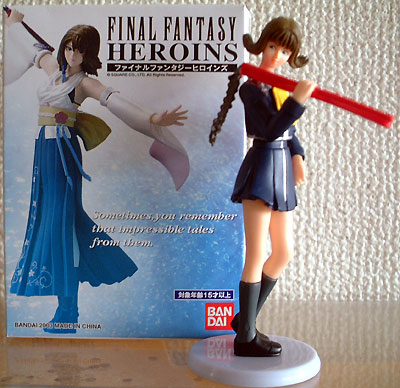
Meet Selphie Tilmitt of Final Fantasy VIII. Schoolgirl with a weapon, or just another omocha from the convenience store? Attitude with a splash of "Engrish," I say.
Does Bandai need an English copy editor?
 Last spring I bought some greenery for the veranda of our new apartment. This rather dull-looking, waist-high shrub is an orange jasmine. The people at the shop told me it would bloom wonderfully scented flowers.
But last year, there were no blooms, just a collection of green leaves. We were disappointed.
 Two days ago, the plant fulfilled its promise and produced a single blossom. It's not much to look at; about 2 cm long and hardly distinguishable from a leaf unless you look closely.
But it's so highly perfumed that this one tiny flower can be smelled from the far end of the veranda and even in the office when I leave the door open.
I truly hope that it makes flowers one at a time. The jasmine scent sort of clashes with the toilet paper...
Looks like it's time to buy a UPS or two for the office.
Kyodo News - The Tokyo metropolitan area may face serious power shortages as early as the end of June due to the shutdown of nuclear reactors operated by Tokyo Electric Power Co (TEPCO) over a defect cover-up scandal, TEPCO officials said Thursday.
Concerns about a possible power outage in the Kanto region centering on Tokyo have grown since TEPCO shut down all of its 17 reactors for safety checks on April 15 following the cover-up scandal that emerged last August.
If I promise not to run my aircon, can I keep power for my computers?
 Tod & I documented our part of town yesterday as part of Tod's birthday festivities. It was a lovely day for a walk and we had fun really paying attention to the details and quirky things that make our neighborhood different from others. I've posted the fruits of our labor on mediatinker.com so you can take a tour of Kasuga.
Soon, these will also be part of the Neighborhood Project run by UltraBob. You can get your neighborhood featured there--just send in your pictures and captions.
 It's Nepia's Japan no Kaori toilet paper. Just what is Japan's fragrance? According to the package it's No. 1 SAKURA fragrance.
I'm not fond of scented toilet paper. I mean really, who are you trying to fool? The smell of your tp's not going to make toilet odors more pleasant. But Japan no Kaori has an interesting fragrance. It's a floral, but not sweet. It's almost citrus. Very similar to cherry blossoms, just as advertised.
It's also pink, another strike against it. I'm generally a plain white toilet roll girl, myself.
So why did I buy it? Three reasons. 1) I am fascinated by the idea of marketing toilet paper as "Japan's frangrance." Such agreeable cultural connotations for a such a mundane commodity. 2) I hoped it might inspire me to finish the lyrics for the other toilet paper song. 3) I wanted to share this oddity and ask you what you think America's fragrance might be. New car? Plastics? Shopping mall?
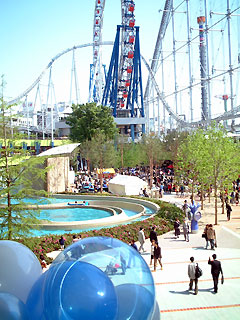 The newly opened LaQua looks like an amusement park, doesn't it?
Only from this angle. There are also 46 stores and 19 restaurants area, a fitness gym and a spa that includes baths filled with hot spring water they drilled for specially. Nestled between Tokyo Dome and the Bunkyo ward office, this is another of the city's new "urban destinations."
LaQua opened yesterday and I dragged Tod out to have a peek. We had lunch at Maharaja and afterwards I walked through the mall to see what it was all about. More of the same as everywhere else, really, but I will be able to reduce the number of trips to Shinjuku and Shibuya.
The rollercoaster, the Thunder Dolphin, makes a double loop around the roof and through the center of the hubless Ferris wheel at a breakneck 130 km/h. The entire building shakes when it goes past--in one store, a display of glasses toasted one another with chattering clinks every few minutes.
At 1,000 yen a ride, Tod calculated that they take in 480,000 yen an hour on a busy day. That works out to about 15 million USD a year if they are at full capacity on 300 days.
I'll bet the ward office civil servants are already weary of the people screaming past their windows every 3 minutes.
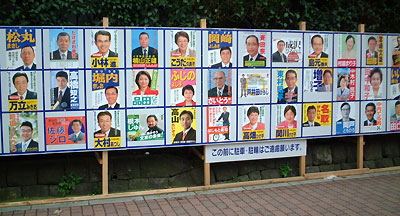
This Sunday, Tokyo wards elect their mayors and Diet representitives. Forty five men and women are running for the Diet. Only two men are hoping to be Bunkyo's mayor. Election signboards like this one are placed at intersections and other public property.
But campaigns aren't entirely neat and tidy. People also paste posters to their garden walls and other surfaces. Things get pretty colorful around election time.
They get noisy, too. Many of the candidates have loudspeakers mounted on little vans and they drive around the city waving out the windows and thanking everyone for their support. They stop at train stations to get out and give speeches that none of the harried commuters listen to.
 Spotted in Kanda: nostalgic advertising. The coffee shop doesn't seem to be there anymore but the sign lives on.
I think it's from the early 60s, judging from the building its painted on, the typeface, drawing style, and the name--cha cha hit its peak as a dance fad in the late 50s. And the name's a pun. Cha means 'tea' in Japanese. But with the dog pictured, I wonder if this Cha Cha was the owner's pet?
Just below the sign is a koban, a neighborhood police station, complete with policeman on display with his patrol bike:
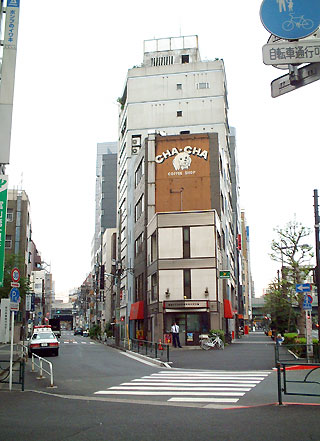
Tod is looking very thoughtful as he waits for a plate of fried rice at a restaruant in Suidobashi.
Above his head, hanging over the door, is a small tapestry embroidered with the kanji for "luck." It caught my eye because it's hanging upside down.
"Oh, yeah. Luck falls from heaven," Tod explained. "So you hang the kanji upside down."
Just like putting a lucky horseshoe over the door with the opening at the top so the luck doesn't fall out.
 It's hard to believe, but I've been living in Japan for long enough to have my gaikokujintourokusho, foreigner registration card, expire. Today I went to have it renewed. That's a once-every-five-years event. I feel like a long-time resident now...getting there, anyway.
So sayonara to the old tourokusho with my smudgy fingerprint. They don't subject us untrustworthy foreigners to the criminal-feeling inky finger anymore. I wonder what will go in that space?
I'm looking forward to being able to read the new one--the ink on the old one was starting to get rubbed off. Every time I had to copy down my registration number I had to think hard about whether it was a 3 or a 5 that I was looking at.
My original purple card was issued in Meguro-ku where we lived when we first arrived in Japan. My new card from Bunkyo-ku will be another color, I believe. I saw someone picking theirs up today and it was sort of salmon-pink colored. It's a fitting color for this ward, more subtle and refined than the brash violet of funky, urban Meguro-ku.
 I am happily saying goodbye to the bad photo circa 1998 from when my hair was growing out and I had to pull it back to keep it out of my eyes.
But now I'll have this one instead. Just as bad, but different. I'm not so crazy about seeing my face aged five years but I like this haircut better, even though it's a little too long right now and looks like a lopsided helmet.
Five years in Tokyo has made me look my age, at least in this picture. Maybe when I'm moving around and smiling I look a little younger. I hope so.
But what can I expect? ID photos are rarely attractive and I don't make any effort to look great. It's too much fun to whip out the old IDs at drunken get-togethers and compare to see which is least like the person it belongs to.
 I couldn't resist these pantyhose when I saw them in the store. They are enriched with amino acid and vitamin C. We dressed up to go out to dinner tonight and I slipped them on.
Do I feel any genkier? No, though the drinks I had with dinner went right to my head. Maybe vitamin C and amino acid is an alcohol catalyst.
I wondered if these health-impregnated pantyhose would give me a rash, but my legs seem to be unblemished.
 The package shows that you can wash them and the vitamins stay in becasue they are "pro vitamins." Amateurs always come out in the wash.
There are several ranges of pantyhose like these--some are fortified with specific vitamins, others claim to give you relaxation or superpowers or the ability to get through a difficult work day. All of them are aimed at female office workers. I wonder if we'll soon see an equivalent product for men? Maybe vitamin Y-fronts.
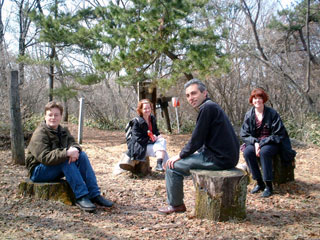
Yesterday's get-away to Ikaho in Gunma prefecture was a refreshing escape from the city. We climbed up to the top of one of the local peaks. There were signs warning us of bears and wild boars, but we didn't see any.
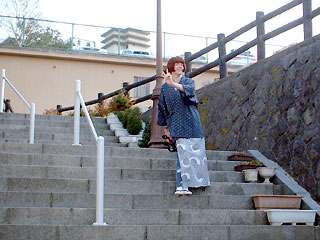
Ikaho is an onsen resort town, so it's fine to wear your yukata out on the street. The main corridor is a long flight of stairs lined with shops and ryokan.
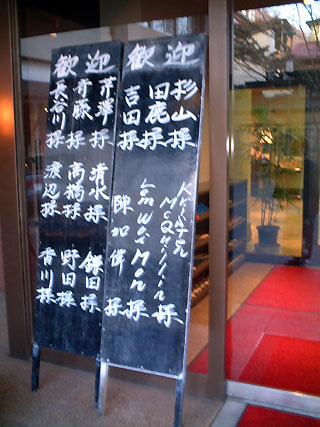
We stayed at Kishigon ryokan which has been run by the same family since the town was founded in 1576. The current matron is an Aoyama University graduate who speaks fluent English. Look carefully and you'll see my name on the sign greeting the day's guests.
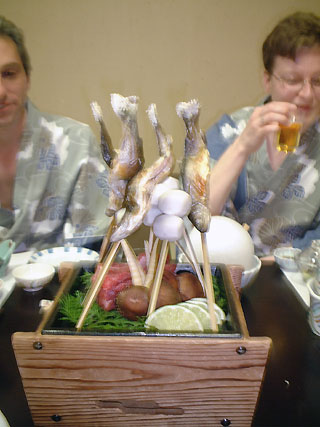
The food at the hotel was amazing. These are fish and skewered potatoes that we grilled at our table. We were served 36 dishes for dinner--truly a feast.
After climbing a mountain, eating dinner and enjoying three onsen baths, we were ready to collaspe on the lovely futon. Ah, sleep!
 The postal services in Japan were privatised on the April 1. All the post offices changed their logos, took down the cute seasonal decorations and the postal workers look slightly more grumpy. Other than that, not too much seems to have changed.
But now that mail delivery is a commercial venture, the parcel services are keen to get a piece of the action. Kuroneko Mail will take your 50 gram letter for 80 yen. It costs 90 yen at Japan Post. Sagawa, another parcel delivery company, also runs mail services.
But Japan Post is fighting back. Starting later this month, they're planning a package delivery service, EXPACK 500. It will cost only 500 yen within the central business areas of Tokyo.
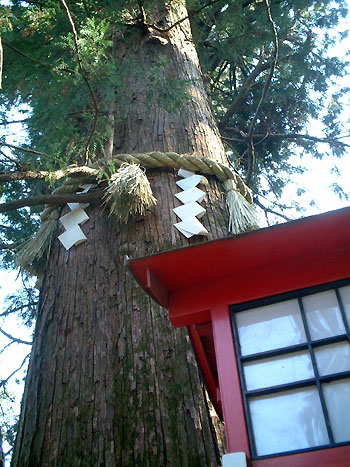
A sacred cypress.
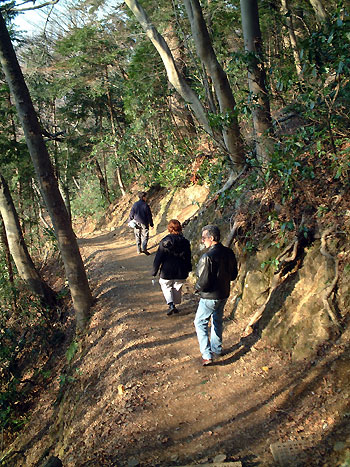
Hunting for spot-bellied tree shrews.
Fence details.
Self-portrait with sun.
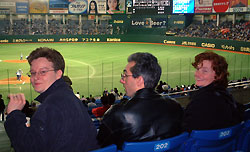 The Nippon Ham Fighters lost tonight. But it wasn't due to a lack of cheering by us.
Baseball teams in Japan are not known by their hometown, as in the US, but by their sponsor. Nippon Ham owns the Fighters. But Nippon Ham Fighters? It's so tempting to call them the "Ham Fighters."
Tonight, maybe 'ham fisted' would have been a better moniker. They dropped the game 5-1 to the Daiei Hawks.
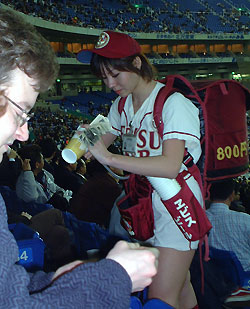 But let's be totally honest. Baseball in Japan is not about the game. It's about the Beer Girls. These hard-working hotties run up and down the aisles in satin shorts selling beer, whiskey and confections.
Here, Tod's happily paying 800 yen for another cup of Ebisu draft beer. The beer girls are cute.
I enjoy drinking too much beer and shouting at the players. It's a lot of fun. I'm sure the people around me, all the salarymen in their suits and ties (direct from the office), are disturbed by my loud gaijin catcalls. But I'm having fun.
They're having fun, too. They make notes in little notebooks, go off to the smoking area frequently, and order lots of beer from the beer girls. The beer girls smile no matter what. It's amazing.
 After the Ham Fighters' pathetic showing, we decided they must be the Chicago Cubs of the Japan league (or whatever the Japanese baseball consortium calls itself) and we had to have shirts. Here, John and I are modelling our new baseball jerseys. We've almost managed to get close enough for the shirts to spell out "Nippon Ham" across us.
I've never owned a sports jersey before, though I wore my friend Mike's hockey jerseys from time to time "back in the day." I'm not sure how to accessorise a baseball jersey...
 Here's me working with my new sewing machine!
It's a Janome 2860, last year's model in Janome's range of basic mechanical machines. Janome also makes computerized sewing machines with RS-232 and USB ports, touch screen displays and super-complicated interfaces that can embroier you a Winnie the Pooh at the touch of a button, but I don't need that. I love my 2860; it's everything I need to sew a huge range of stuff and it was on sale. :-)
It has a very clever needle threader, an overlock stitch that I've already fallen in love with, and a blind hemming foot that works well. (The last one I had was a nightmare.) Something that new to me is a free arm for sewing cuffs and such with out having to turn them inside out. What a blessing.
Now I just need to decide what to sew first.
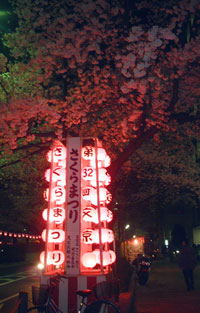 The cherry trees exploded into full bloom over the weekend. The city is absolutely gorgeous with pale pink flowers overhead. We went for a walk this evening under the trees near Myogadani. There were revelers picnicking with various levels of preparations. One family had obviously just been to the convenience store--their tarp was chock full of Pocky and potato chips. Another party of business suited salarymen had brought along folding tables and a barbecue grill. One of them was sauteeing onions in a pan.
Tomorrow. we're going out to party under the trees in Inokashira Park. We'll be taking along our "konro" gas burner and cooking up a stew, or maybe we'll take yakitori. I guess it will depend on what looks good at the grocery store tomorrow morning. The menu's not set yet, but I'm sure it will include plenty of beer and sake.
Right now, Kris is baking me a birthday cake for the party. John and Tod said they'd do it, but they are outside playing with the laser pointer instead. They got frustrated over measuring butter. Tod whipped out a calculator...a bigger production than necessary, I think.
 Anyway, back to the hanamiPeople pack in for their hanami parties, and it's a tradition for the junior members of a company to stake out a good spot and sit all day, wiating for their colleagues to show up after work. But along this street, there was another way to reserve--taping a message on the sidewalk.
Here, you can see that Isuzu (probably a company, but maybe a family) is holding this spot for Saturday the 5th. They've marked it out in letters a meter high--there's no missing it. And in case you do, they've left additional details marked in permanent ink on the border of the tape. Isuzu - 4/5- 12:00 ~ We know they are planning to start at noon and they have no plan to finish. I'm sure by the time 9 pm rolls around, they'll be falling over drunk and singing silly songs.
 And here, in a close up, the Itou Company is reserving the same space for Wednesday night.
The entire 10 block length of prime space under the trees has already been divided up with similar duct taped boundaries and multiple signs bearing dates, times and company names. Regular people who hope to party under the trees are going to have to arrive early in the morning!
This system would definitely not work in the US. There would be ripped signs, carefully moved duct tape and fisticuffs. I wonder if there will be any confrontations here? I doubt it. Personally, I found the week-in-advance reservation of a space rather irritating. How dare they not follow the "first-come, first-served" rule? But maybe that's just me.
I hope we find space at the park tomorrow. I'd be very disappointed if the entire place was neatly divided into sections that had all been claimed.
Our health insurance is through a company called TSK that specialises in insurance for employees of computer-related companies. It works in conjunction with National Health, but I'm not exactly sure how, though I know that every hospital that accepts National Health takes this insurance, too.
But it's more than just covering doctor's bills. TSK sends out a magazine every now and again that lists all of their services. Healthy, Sports & Resort Life Magazine Toco Toco came this week and it's full of curious things.
 The first section of the magazine is devoted to statistics, policies and health checks. TSK has 4,065 companies registered and insures 156,876 people.
Insurance companies run their own clinics. TSK has 3 in Tokyo, where the insured can go for an annual physical. This includes a chest x-ray, ultrasound and bloodwork. Men over 35 get a bonus-- a prostate check. I know how much all the Perot guys look forward to turning 35. If you're over 50, you can have an elective MRI every three years.
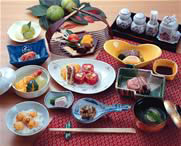 When you're finished with your check-up, perhaps you'll be feeling a little peckish. In the same buildings as the clinics, the insurance company has restaurants.
Prices for meals are discounted for TSK members--the dinner course shown here is 3,000 yen for members, 5,000 yen for others. Weddings and party banquets also catered and conference rooms are available for half-day or full-day functions.
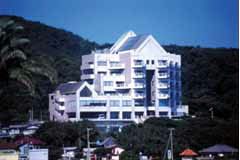 If you're hoping for some relaxation, why not spend a few days at a TSK "TosLove" resort? There are four of them, all offering bathing and pools, meals, and relaxing environments outside Tokyo for only 5,000 per night (including breakfast and dinner). I think the one at Tateyama sounds best because there's a horse riding club nearby for only 900 yen, and a place to try making your own pottery. The other resorts also have attractions, like a ropeway, a water park and all of Hakone's sights.
But if TosLove's resorts aren't your style, TSK offers discounts at hotels and resorts all around the country as well as package tours to Guam, Hawaii and domestic locations. There's a place in Sapporo where you can spend the night for 1,000 yen. Fancy a night at the swanky Hotel Okura--only 5,000 yen including breakfast. Usually rooms at the Okura are 30,000 and up per night. Of course, there's a small catch. You have to apply through TSK at least two months in advance for all these places. But if you're planning a holiday, instead of just winging it like I ususally end up doing, this is a great bargain.
TSK's benefits don't end there, though. If you want day tickets to the gym or golf courses, those are available, too. As are tour events, like a "bus hike" to go fishing in the countryside, or a trip to Universal Studios Japan. Just plan ahead and get in line...
400 years ago today, Edo (now known as Tokyo) was founded by the wily shogun, Tokugawa Ieyasu. Tokugawa was planning to build his own seat of power away from Kyoto. He succeeded beyond his wildest expectations. The balance of power shifted to this new "eastern capital" and it grew (and burned down) faster than expected.
There's a good overview of the city's ancient history at Metropolis this week.
Happy birthday, Tokyo!
Shinjuku station is a huge, crazy maze. There are three subways, dozens of buses and five or more train lines all converging. It is always full of people. This is not a place for the faint of heart.
The best way to navigate through the station is to turn off the logical left brain and let the right one squeeze through the crowds. With the spatial right brain in control, you won't run into anyone, you'll find the place you need to be without stressing and, maybe best of all, you'll notice all sorts of things you don't expect.
Memories of my walk through the station are a collage of magazine pictures and video clips: the laminated cardboard Dumbo on a young girl's keitai; the shadow of a three day beard on a black man; the tilted head of a rushing traveller; the reflection of the overhead lights in someone's sunglasses; the sound of the TVs flickering in a display; the herky-jerky movement of a suitcase with a bad wheel; the whir of the blenders at the Snap'py juice stand; the scent of hot dogs in the Food Pocket; the subtle texture of the plastic wickets at the Oedo line; the warmth of Tod's hand in mine (he hates getting lost in the station).
I have no idea how I got from point A to point B, but I did. Just like I always do. Follow me.
Today's the spring equinox, a national holiday in Japan and my favorite holiday of the year. It's the only one I've managed to celebrate consistently for the last seven years. Every year--grilled mushroom and pepper sandwiches.
You might not think that's such a big deal, but I've lived in three different countries in the course of the last seven springs. Few other holidays are consistent from nation to nation but the Sun is faithful. Every year we have a Spring Equinox and the other three solar holidays, too, and I never forget them.
To celebrate, I wanted some flowers for our table so Tod & I walked to the flower shop that's recently opened up the street. They don't seem to have a name, but they do have a great selection and the lady who runs it is really nice to me, unlike Hana Ban on the corner where they never make suggestions, offer the same three flowers (roses, orchids and mums) every week, and always seem like they'd rather not wait on me.
Tulips were what I craved and I found seven different kinds at the nameless flower shop. After a 30 second inner debate on the luxury of buying a lot of tulips, I picked up the entire display jug, sat it on the counter and said "Zembu de."
"All of these pink ones?" she said, pointing at the four pure pink ones that were bundled together.
"Well, all of them!" I gestured a bit more broadly at the whole jug full.
"Arigatou gozaimasu!!" she beamed. She got a big sale and I got a discount. 17 tulips for the price of 15. I love that flower shop and the living room looks a lot more festive now.
Happy spring!
 I got it into my head that I'd like to go to Okinawa for my birthday as a nice tropical treat. I know domestic travel is usually cheapest if done on a package tour or plan that includes hotel and flight, so I went to the local JTB office and grapped some pamphlets.
Well, they aren't pamphlets as much as 40-60 pages of messed-up layout and advertising.
From these slick brochures, I cannot tell which island and hotel combo has the right atmosphere. I just want a quiet place with great food and some beach activities. Maybe snorkelling or sea kayaking--something a little physical to burn off the fruity drinks, awamori and tasty dinners.
Wanna leaf through the ANA's Okinawa Sky Holiday brochure with me?
 Let's start with the basics. Here on page 2 we're already discovering that you can get better flight times by paying extra money. Leave Tokyo earlier on the first day and return home later on your last day. Only 1,500 - 3,000 yen/person. Is that per flight or does it cover round trip? I'll bet it's per flight but I can't tell without looking up some kanji.
 Flipping forward past the bus time tables and rental car details, we find this ad on page 22. At the Renaissance Resort, you can get the resort's most popular attraction, a Dolphin Encounter, for 7,800 yen for 40-60 minutes. I'm not exactly sure what this includes, but the fine print has an awful lot of dekimasen in it. Never a good sign.
 Hotels in Japan all seem to have twin beds. Even if you pay an extra 15,000 yen/night at the Busena Terrace, you don't get a big bed, just a large 43 square meter room with bath, toilet, big balcony, welcome fruits and the Stepford wives in the lounge. Let's move on to another page, shall we?
 Page 25 of 58. What fun! Free dress up in Okinawan-style traditional costumes. Good for women, men and children's use. Please bring your own camera. This is point 6 at the Laguna Garden Hotel. Some of the other points include 50% off rental cycles; 10 game corner tokens, and discount coupons at the American Village amusement area. This is obviously a family resort. Run away!
 None of the places feature their food, though they all offer optional dinner plans through the ANA Sky Holiday service. 2,500 yen/person gets you a choice of Chinese, a Japanese buffet, or an Okinawan buffet at the Rizzan Sea Park Hotel. This is a bit pricey and limited in scope as other hotels offer 5 choices for 1,500 yen. So maybe the food is better here.
 All of the previous resorts were on the main island, about 80 minutes' bus ride north of the airport at Naha. If you go out to some of the other islands, you get to do more sedate activities. This ox cart photo is featured in every brochure page listing Yufujima, a speck that doesn't even seem to have a hotel. You have to go there special to ride the ox cart. Hmmmm. Pass me another Tanqueray and tonic, please.
To go on the Free Plan ("free" meaning you don't have to go on all the pineapple plantation tours and have set menu dinners during your holiday), not including optional dinners, upgrades or any activities, I will have to shell out between 53,000 and 67,000 per person. Am I willing to spend that much to discover that I've guessed wrong about the resort's ambiance?
I think I'll plan to stay home for my birthday this year.
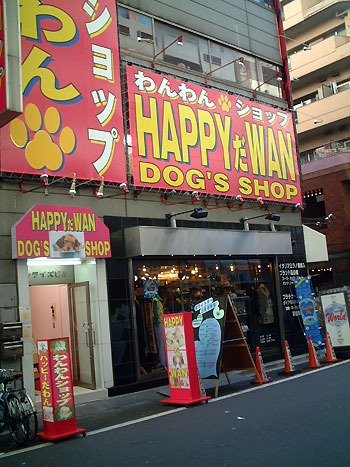
2nd floor puppy mill shop. Ikebukuro. ("Wan" is "woof" in Japanese)
When you see signs in the US for "White Day" it usually means that sheets and towels are on sale.
In Japan, White Day is a different sort of marketing dementia. Today, men all over the country will be giving chocolates and cookies to their secretaries, female coworkers, girlfriends and maybe even their wives. It's payback for Valentine's Day when they received chocolates they didn't want from women who felt obliged to give them. Feel the love? I sure do.
For weeks--pretty much since February 15th--conbini, depato and other stores around town have displayed White Day presents: boxes of sweets and stuffed toys gift wrapped in every hue of paper except red or pink (After all, we must differentiate this holiday from Valentine's Day somehow). Dark green and navy blue seem to be popular this year and teddy bears bearing chocolate are a hot seller.
I'd rather have sheets.
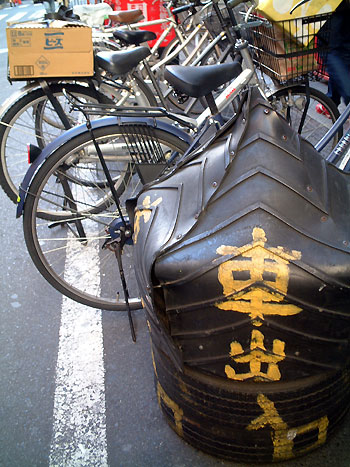
Side street bike parking. Ikebukuro. March 9, 2003.
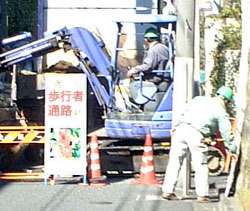 The sewage department was working on my street today. As I went out this morning, they had their equipment splayed across the street and a sign up that said "Pedestrian passageway." The sign was embellished with a close-up photo of flowers; I think these were camillias.
Lots of construction signs in Tokyo are decorated this way and it's ironic, since there's not all that much foliage around and sometimes the flower photo is the only nature in evidence. But it's a cheerful (if futile) attempt to make a construction mess a little more tolerable.
I was on my way out this morning to get my hair cut. I hauled across town to the stylist I like (I'm not going to repeat my December mistake again) and spent three hours being cut, colored and coiffed.
Beauty under construction. They really should put a sign with flower photos in front of me while they do their thing. I can't watch Dan as he works; I stick my head in a fashion magazine the whole time because if I look up, I see this middle-aged woman with crow's feet, a sagging chin and circles under her eyes staring back at me.
I'm not sure what it is with Watanabe's mirrors but they reveal in too, too vivid detail the mortal, aging side of me that I try to deny. I noticed that this was the case with everyone there. We all looked...weary. Moth-eaten and friable. I think I'll blame it on the lights.
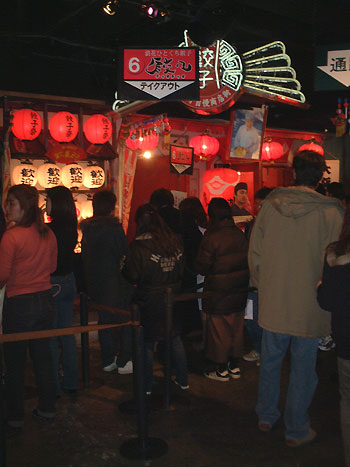 A few months ago Namjatown, Namco's indoor amusement park, opened a new attraction called the Gyoza Stadium, featuring a dozen different kinds of Chinese dumplings. We love gyoza and have been looking forward to visiting the Gyoza Stadium. We tried to get in on a weekend just a few weeks after it opened but there was a three hour wait and we were too hungry.
But yesterday afternoon there was no wait, so we paid 300 admission and stepped in.
Namjatown is divided into five sections, differently themed. We didn't even consider the other parts and headed straight for the gyoza section.
It gave me the creeps. Decorated like a downtown Tokyo neighborhood in the 1960s, it was a maze of alleys and turnings.
 This map shows part of the layout. The blood red parts are the gyoza stands. The blue bit is an a mosquito-themed ride where you go around spraying mossies while riding a giant pig-shaped mosquito coil holder. All the little lanes in between are filled with nostalgic signs and antiques. And little benches where you can sit and eat the gyoza.
 In addition to the gyoza, there are several other attractions. There's a public bath "converted into a studio, to participate in a quiz show" according to the brochure. There is a little shrine and a pilgrimage; this cat is supposed to be Bishamonten, one of the 7 Lucky Gods. Or you might want to search for clues to a detective game.
All I wanted to do was to eat some gyoza, but the atmosphere was so dark and claustrophobic that I couldn't do it. By the time we navigated to the gyoza stands, I was entirely too wigged out by the noir lighting, the well-faked cracked cement streets, the falling down building facades (they were in fine repair, just made to look like they were old and falling down) that I had to go without standing in line for gyoza.
It was a scary carnival funhouse. Is this how Tokyo views its recent past?
The Times reports that the Japanese government is looking into the possiblity that the Crown Prince's daughter will someday reign. Aiko, who turned one on December 1st, is causing quite a controversy.
Japan hasn't had a woman on the throne since 1770 and the Imperial Household Law specifies an Emperor, never an Empress. Personally, I think that's just because MacArthur and his cronies were mysoginists who couldn't even imagine that a woman might be in charge. Let's face it, they had a big influence on the current constitution whether or not anyone actually admits that.
So I suppose Japan's going to have to alter the law to replace "Emperor" with "Emperor or Empress" and "he" with "he or she." It doesn't really seem like it should be that big a deal, but government officials are worried that making any change will rile up the People and they will demand dissolution of the monarchy entirely.
Japan's Imperial family seems pretty mild and is part of the charm of Japan for me. America needs a monarchy. I think I'd make a good monarch--sort of like the Red Queen.
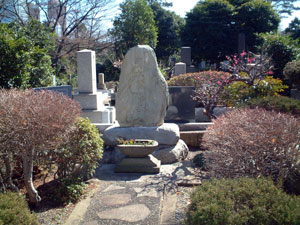 I have a thing for cemeteries. Walking among the headstone, thinking of the people memorialised there; wondering what they were like; why their families keep up their plots (or not). And, of course, there's always a bit of a sexual element running through my head at the same time. After all, sex is what brings all of us together, it may be the only thing we all have in common.
All cemeteries are enjoyable, but Japanese cemeteries in particular are peaceful and orderly. Each plot is for a full family; there are rarely monuments to individuals. Some sections are quite severe; others, like this one, are beautifully landscaped.
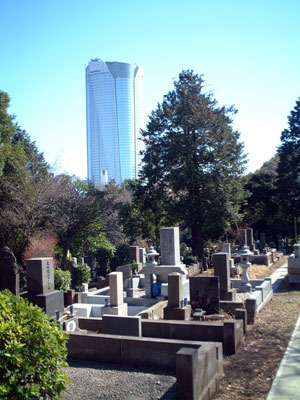 From Aoyama Cemetery, where I took these photos yesterday, you can see the huge Roppongi Hills complex in the background. It's new construction that's nearly finished now. The pictures doesn't really do it justice in terms of its amazing size. Towers over everything in the vicinity.
I like the contrast of old and dead with the new, vibrant Tokyo in the background.
Standing on the Sobu line platform yesterday afternoon, I was approached by a middle-aged (but not all that much older than me) salaryman sporting a punch-perm and wearing a dark grey suit, a blue polyester tie, a pale blue shirt and some sort of office ID on a neckstrap. Pretty bog-standard salaryman. We had the following conversation in Japanese.
Him: Do you understand Japanese?
Me: Yes, a little bit.
Him: (not hearing me) Huh?
Me: A little.
Him: Are you French?
Me: No.
Him: Are you American?
Me: Yes.
Him: (glancing at my hands). Ah, you are married.
Me: Yes, I am.
Him: Is your husband Japanese?
Me: No, he's American.
Him: Would you like to come to a hotel with me?
Me: I don't understand your Japanese. I'm sorry.
What this man thought I was likely to answer is beyond me. I thought about punching him, but he apologised and walked away before I could let my violent American tendencies reach the surface.
Expatriate Americans really get bent over when it comes to taxes. We pay income tax twice--once to Japan and once to America. There are only two nations in the entire world that make their citizens abroad pay tax: the US and Libya.
Japanese taxes are due on March 17th. I've got my forms and the instructions in English and have been trying to figure out exactly how to fill in the forms. I've completed the one that tallies my small business earnings and expense. That was easy.
But looking at the main form, I can't figure out where to put this total. There are two sections where this might go: Amount of Earnings and Amount of Income. But it's not clear which number I should use where. Check out this explanation:
How to Complete Form B
Write each amount entered in the 'statement of earnings and expenses' or 'financial statement for blue return' in the following blocks of the first page of the return here: amount of earnings, etc. 'business (sales or agriculture)' [blocks a and i], 'amount of income (business (sales etc. 1 or agriculture 2)' [blocks 1, 2].
Government instructions are the same the world over...confusing! I will try to figure this out this afternoon so that I can then get started on my American taxes. Argh!
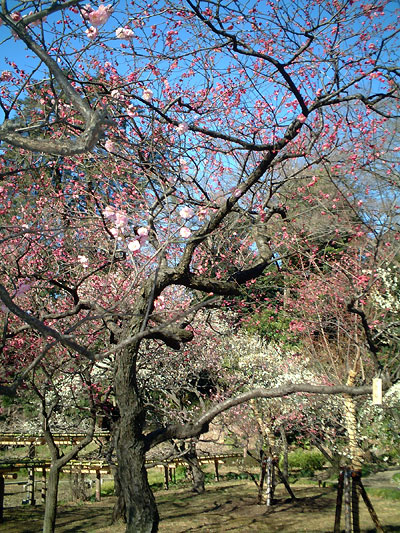
Yesterday I walked over to Korakuen, the traditional Japanese garden not too far from home.
I strolled through the plum orchard and breathed in the delicious sweet scent of the blossoms. All the trees smelled different; every shade of pink keyed to a different olfactory tune. The breeze smelled like perfume. Mmmmm.
March 2002
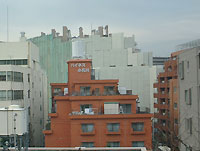
February 2003
It's pretty cool to see the equipment cracking off walls and pushing them over. Concrete kicks up a lot of dust. I have no idea what will be going up in place of this very large apartment block. Maybe just another very large apartment block.
Stay tuned for further photos of the destruction and reconstruction.
Beautiful, beautiful, beautiful weather!
It's 12 degrees (54 F) and sunny. The air feels mild and smells like Spring; there are plum blossoms everywhere. I have the doors and windows open to air out the house. What a joyful day.
I'm missing the first day of spring in Japan.
Today is Setsubun. All around the country, people are throwing dried soy beans to scare away demons and bring good luck for the beginning of the lunar year. (It's not actually done on the lunar new year anymore but close enough, I suppose.)
When I return to Japan, the plum trees that herald spring will be in full bloom. I'm looking forward to seeing them and feeling the mild weather. I'm getting a little bit tired of Pennsylvania winter...
Oni wa soto! Fuku wa uchi!
Mad cow # 6 was announced today. This one came from Wakamatsu via Hokkaido.
To put this in persepctive, Britain's mad cow epidemic was 155,000 cases over a ten year span--as many as 1,000 new diagnoses per week at its peak. So Japan's six cases in a year isn't as bad, but it's still not good.
I've been eating beef. Have I also been playing prion roulette?
Until today, I'd never seen a naked Japanese baby.
But we were invited to dinner at a friends' house this evening and got an entertaining bonus--admission to the daily bath. Our friends' son is such a cutie and so patient as his mama washed his hair and baba held his legs. Junior thinks he's swimming in his tub and kicks like crazy.
And I learned something interesting from this bathing 6-month old. Many Japanese babies are born with a blue birthmark in the "sacral region." It looks like an ink blot or a dark bruise. But it's not a bruise and it fades with a few years. His is just at the end of the tailbone.
Apparently this Mongolian Blue Spot is a genetic marker traced back to the Mongols and it appears not only in most Asian races, but also Turks, Greeks, Africans, Eskimos and Native Americans.
I've uncovered two folk explanations for the spots. The Mongols say they are the mark left by the spirit who slaps the baby to life. Chinese believe that if you are reluctant to be reincarnated, the King of Hell prods and kicks you until you agree to go. The more spots, the more reluctant you were to be reborn.
The sewage department has been busy on our street this week--the entire neighborhood smells like benzene. Or maybe it's some other aromatic hydrocarbon but whatever it is, I'm glad that I'm inside where I can't smell it.
The workers are out there, unprotected. Nobody I've seen is wearing a filter or mask. Won't long exposure to something so strongly scented cause them harm? Just walking along the street past the construction area, I was really happy to go a little faster than usual.
I'm not even sure what they are doing. Two days ago, they were airing out the manholes with fans and aluminum ductwork; yesterday they had a camera on an optic fiber--sewage endoscopy?
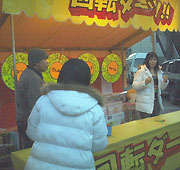 While on a pilgrimage tour to see the 7 Lucky Gods yesterday (read all about it below), we were distracted by a festival in a nearby temple.
Among the food stalls serving up everything from mashed potatoes with butter to whole grilled fish on a stick, there were games. I was drawn in by the Kaiten Darts game and had to play. For 500 yen, I got three darts. The target was given a good spin and I threw my darts hoping to hit the thin red line that indicated Big Prize. My first dart hit a yellow prize section; the second dart hit home in the zannen "too bad" section and the last dart bounced off the surface of the spinning board.
Even though I didn't hit the Big Prize section, I did win a prize that I will have fun playing with.
In the first week of the new year, it's traditional to make a visit to a temple. The first visit of the year even has a special name, hatsumode. Posters in the train stations and articles in the newspapers give suggestions on which temples to visit. Some of the more popular temples are listed with the number of visitors during the new year so you can decide whether you want to brave the crowds.
Another tradition is to make a pilgrimage (meguri) to seven shrines of the shichifukujin--the Seven Lucky Gods. This year, I decided to try a shichifukujin meguri in Koto-ku. Thanks to the Exploring Old Tokyo page which lists the addresses, I was able to cobble together a map and find my way to all seven. Of course, I dragged Tod along, too.
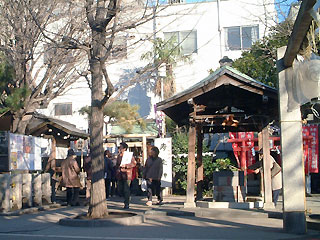 All of the lucky gods offer prosperity, but each one also has a special aspect he or she watches over.
  Jurojin carries the secret to longevity in a scroll. He usually wears a scholar's cap and has a long white beard and a staff.
At this shrine, there was a long line of people carrying big white envelopes that said "Fukugawa Shichifukujin Meguri" on them. We got in line there and paid our respects to Jurojin by bowing and clapping. I think he most appreciated the coins we tossed into his offerings box.
We looked around for the place that was selling the envelopes, but couldn't find it. There were plenty of trinkets and things on sale, so we settled for an omikuji, a fortune, and some amazake, sweetened sake with rice floating in it. The amazake wasn't quite ready, so the vendor gave us each a mikan, mandarin orange, to eat while we waited. We considered having a cup at each shrine--sort of a spiritual pub crawl--but ended up with one here and one at the last shrine.
My omikuji was #47 - chuu kichi, middle luck. You can get a range from great misfortune (dai kyou) to great luck (dai kichi) so middle luck isn't too bad. Tod got dai kichi - great luck.
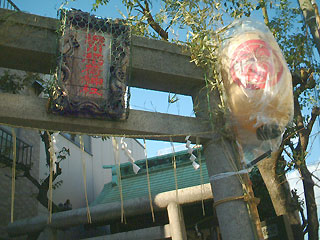 After finishing our amazake, we headed toward the next shrine. Along the way, I realised I really didn't need my map. The route
 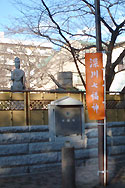 was marked with bright orange banners! The map was helpful anyway, to give an idea of the distance, but it was possible to put it away and just follow the banners.
They lead us to a small inari jinga on the corner of a small street. This is where Hoteiis enshrined. Officially, Hotei embodies happiness (and prosperity) but I think of him as the god of hospitality. Whether that's because his name looks like 'hotel' or because there is a company in Tokyo called Hotei Wines, I'm not sure.
Hotei is usually shown sitting down, fat and laughing. He is the model for the "laughing Buddha" that is so popular in the US. Hotei is the Japanese name of the eccentric Zen priest, Pu Tai, who wandered around China with a cloth sack over one shoulder. Hotei is sometimes shown with a cloth sack containing riches.
There were no omikuji to be had here, so after offering our respects, we headed back to the street and followed the banners.
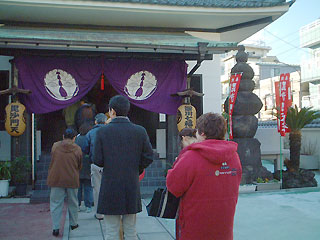 Bishamonten scares the crap out of me. He's the protector of righteousness. He wears armor, carries weapons, and has a fearsome glare in his eyes. Does righteousness really have to be so scary?
I lost a little of my fear when I fell into line behind the woman in the red coat. It's covered with Japlish on the back: Dog*O*Shop; Come on a DOS walk with me; DOS is our important friend. It was hard not to giggle.
But then it was our turn to pay our respects. Bishamonten standing inside the shrine was staring down at me, daring me to be unrighteous. I smiled, bowed and drop him a hefty donation before fleeing down the stairs. Wrath of god, indeed.
I bought an omikuji and was delighted to discover that this one came with a special treat. Wrapped up in a slip of gold-flecked paper was a tiny Bishamonten charm. He doesn't look quite so frightening when he's scaled down to 2 centimeters, so I'll put him on my desk and hope he draws in some righteousness for me this year. The omikuji was #30, another chuu kichi. Tod picked up a kichi, but with a kanji we didn't know. When he looked it up later, it means lowest. So lucky, but not too lucky.
 At midnight on New Year's Eve, we visited Daikokuten in our own neighborhood. Now were were going for a second visit. I'm not sure if that brings us more attention and luck, but I hope so. Daikokuten looks after food. Back in India, he fights evil but here in Japan, he watches over the kitchen and harvests
Daikokuten is easy to recognise. He's one of three short, fat guys in the pantheon of lucky gods and he's the only one who carries a mallet. It's a magical wish-granting mallet. In his other hand he usually has a bag of riches and he's almost always standing on top of rice bales.
In front of us in line was a woman with two terriers. Sort of a compliment of the DOS coat woman from the previous shrine. The dogs were nattily dressed in little sweaters with sports motifs. One was Baseball with bats and balls and doggy bones, and the other was sports of all kinds. I don't understand the desire to put dogs in sweaters, but it's very popular here. Fodder for another essay,
perhaps.
Daikokuten's shrine was full of foodstuffs. And the omikuji system was a little different here. I worry that I did it wrong. At the other places, you went off to the side to purchase your omikuji. There was a bin or a basket for your 100 yen coin, and you pulled a slip out. But here, the omikuji were right along side the offering box. Since we'd each tossed in 100 yen, we took an omikuji, but I wonder if we weren't supposed to put in an extra 100 yen...
My omikuji was #23 - kichi - luck, which is the same as chuu kichi. On New Year's Eve, I got a han kichi - half luck. So maybe combined I'll get 3/4 luck in the kitchen this year. Tod's two omikuji from Daikokuten were kichi and dai kichi. If you're coming over for dinner, be sure Tod's manning the kitchen.
When we left Daikokuten's shrine, we couldn't find the route flags to lead us. So I pulled out the map and noted that the closest shrine was about 6 blocks away and around the corner. But where was everyone else? Earlier we'd noticed that the other pilgrims seemed to be following the route in the opposite direction from us. They were coming from the shrines we were going to. Now we were all alone. Peculiar.
As we crossed over one of Koto-ku's many canal's we discovered our error--the flags were on the next bridge over! We detoured along a canal-side path to the other bridge and rejoined the proper route. Maybe that was a little silly, since we were about a block from the next shrine when we did that, but the marked path lead through the town's scenic areas. May as well make our pilgrimage pretty as well as prosperous.
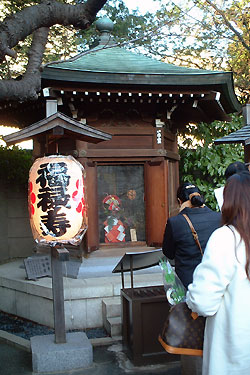 After our detour, we ended up here to visit Fukurokuju.
This pretty octagonal shrine, like some of the other shichifukujin shrines, is just a small side area that's part of a much larger temple or shrine. Buddhist temples have no problem mixing in Shinto shrines as part of their grounds, though I've never noticed Shinto shrines with Buddhist fixtures. Three of the lucky gods we visited were at Buddhist temples and four were at Shinto shrines. Fukurokuju is enshrined at a Buddhist temple, as were Daikokuten and scary Bishamonten. I don't know if these deities are specifically Buddhist or Shinto or whether they are claimed by both or neither.
Religion in Japan is not easily delineated for the layman. I'm sure if you are a priest or a faithful follower it is all clear and obvious. I'm at the level of ignorance where I can confidently say that Buddhist ceremonies are for sad occasions, Shinto for happy ones. And I know that Shinto shrines have torii gates and the pretty bead rosaries are Buddhist. Beyond that, I'm guessing.
Fukurokuju carries a scroll containing the world's wisdom. He's also associated with longevity, like Jurojin. They are both depicted as old men with flowing white beards, but Fukurokuju is bald and has a very tall forehead. An egghead deity!
Although his name, Fukurokuju, has kanji that mean "luck amount longevity" I think it's interesting that the sound of the name, fuku-roku-ju could also mean "lucky 60." The 12 year, 5 element cycle of the zodiac (2003 is the year of the metal sheep) means that it takes 60 years to go around once. When you reach your 60th birthday, you've seen it all--and have achieved wisdom and long life.
Although there were no omikuji to be had here, we later picked up an all-purpose shichifukujin omikuji from a big Buddhist temple that wasn't part of our meguri. These special omikuji came with gold-plated charms and mine was Fukurokuju. The omikuji was just shou kichi, little luck, so maybe I'll only be a little bit wise this year. As long as I'm not a little more of a wiseass than usual, I guess I'll take what I can get.
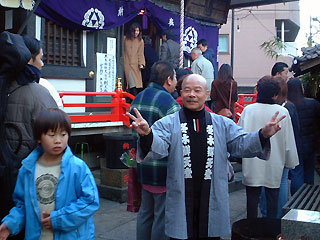 Next we were on our way to the shrine we detoured away from earlier. Benzaiten, also known as Benten, is one of my favorite of the shichifukujin because she is the only goddess among them. I wholeheartedly support women in power. Not only is she the only woman, but she's also patron of the arts and sciences, literature, and virtue.
Inside her shrine she sat leafed in gold and looking lovely playing her biwa (a Japanese lute not the biwa fruit that's known as kumquat in English). Her interior decorator had gone overboard with flowers, gold lotuses, cushions in rich colors and offerings of fruit, sake and rice. Benten has a cozy home at this shrine. Very inviting. I might have crawled in and played the lute myself except for the long line of other people wishing to pay their respects. And my lack of lute-playing ability...
My omikuji was #47 again (just like Jurojin) -- chuu kichi. I also purchased a little gold Benzaiten charm to go with Bishamonten and Fukurokuju. Tod got dai kichi from Benten, so he'll be prospering in the arts and sciences this year.
I hoped to get a photo of me at this shrine but this nice man offered to take a picture of Tod and me together. However, my camera is not friendly to others and he didn't actually get the shot. So instead, I took a picture of him. He was funny and did the classic "V for victory" that everyone does in photos here.
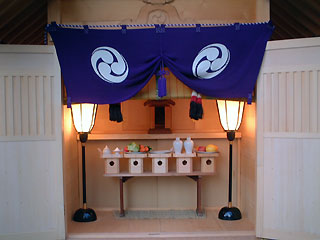 If you've been counting your way through this essay, then you know we're up to the last god on our pilgrimage. He is Ebisu--the same name as the Yamanote line station. Ebisu guards over occupations and is also a deity of rice paddies and fishing. He's easy to spot because he carries a fish and instead of a staff, he's got a fishing pole. For a god of careers, he's got a surprising leisure theme going on. At least in this day and age...
We actually took a wrong turn on the way there, despite the banners and our map, and ended up at the Buddhist temple next door to Ebisu's shrine. We were distracted by the festival at the temple--rows of brightly colored stalls selling food and games--and completely missed the signs across the street saying "Ebisu this way."
But we went into a temple that was lovely and very rich and that's where we got our all-purpose shichifukujin omikuji. Mine came with a Fukurokuju charm, as I mentioned. Tod's charm was Jurojin and his omikuji was han kichi. But there was no shrine to Ebisu in sight, so I consulted the map and realised my error. We walked back through the festival, I played a game of spinning darts and we crossed the street to our final destination.
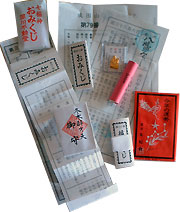 Ebisu's shrine is newly rebuilt. We were reaching the end of the worshipping day (temples and shrines close at 5 pm) and not so many other people were around so I got a nice clear picture of it. Where Benten's shrine was cluttered with all sorts of decorations, Ebisu's was spare and tidy. Extremely calming.
I finally got a dai kichi omikuji so I am looking forward to a very lucky year in my work. Tod's was only small luck.
In addition to our omikuji, we bought birthday fortunes in bright red packets. These are horoscopes and they're really long, so I've only read a little bit of mine. As these things always do, the profile part says I'm a bossy leader who thinks only of herself. So true. The other part, my horoscope for the year, is divided into four sections (wishes, relationship, money and career) but I can't read enough of it without the dictionary at hand.
So if you've been keeping track, it looks like I'm in for a pretty steady middle luck year but Tod's going to have a wild ride with big luck in some areas and little luck in others. Neitherof us got any kyou (misfortune) omikuji. Whew.
Have you ever wondered what it's like to shop in a bustling, old-fashioned Tokyo shopping district?
The Shimaura Discount Chocolate Shop webpage will give you a taste (including a very loud WAV file) of what it's like to stand in front of their stall in the alleys of Ameyoko near Ueno station.
Frenetic showmen, they work as a team--one man on a platform, surrounded by candy, takes handsful of chocolate bars, boxed candies and seasonal treats and holds them aloft then thrusts them into a plastic bag held up overhead by his assistant on teh ground. 4000 yen's worth of candy for only 1000 yen! Not a bad deal. It's chocolate that's almost reach it's sell-by date or overruns of special promotions.
They've been featured on TV and in print and for good reason. They not only give you candy, they give you a performance, too.
We stumbled across Shimaura a few years ago at the New Year and visited it again this week. You might like to see it for yourself if you're in town, or virtually if you're not.
 At noon today, seeing the cold, snowy weather outside, I figured we might want to put off our plan to hike around Koto-ku to see the seven lucky gods. I shouted down the hall to Tod "Let's go to the circus! If we hurry, we can make the 13:00 show..."
And so we did. It's really convenient living so close to Tokyo Dome. We arrived just as they were finishing up taking souvenir pictures with the elephant.
The Bolshoi Circus, is the Japan-travelling branch of the Russian National Circusand will be in town through the middle of February. They have all the classic acts--a trained bear riding a motorcycle, dancers, magic, acrobats, trapeze artists, tightrope walking, clowns, elephants spinning hoops, a woman juggling birds, bicycle acrobatics, and horse stunt riding.
Tod had never been to a circus; I haven't been since I was a kid. It was really, really fun. And much warmer than walking around Koto-ku. :-)
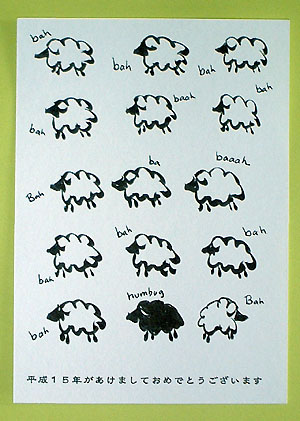
We're just back from our local shrine (Daikokuten) where we rattled the bell and had some tasty tonjiru, and Denzuin temple, where we stood in line and rang out Sin #108--the last one of the pantheon of human sins and sorrows.
Tod declared #108 as "being mad at you" but I interpreted in a broader sense of "peevish." Because, really, I know what "being mad at you" is all about. ;-)
Afterwards we enjoyed sake and notariety as "local foreigners" before heading home to unleash a light stick on the lawn. (Tie a lightstick to a string, activate it, cut a hole in it, swing it around, enjoy the new constellations.)
Now, there seems to be a coffee in my hand and a movie waiting in the other room. Wow!
Happy New Year.
Two nights ago, the neighborhood fire patrols started their year-end rounds. These are our neighbors out there carrying lanterns and wooden sticks. They walk around the neighborhood in pairs or small groups checking for fires. Back in the days when Tokyo was all wooden, I guess this had some meaning. Now it's just a tradition for the new year holidays. A festive addition to the season.
I love the sound and rhythm of the sticks they beat together to signal all is well. Wood makes a hollow, ringing tick sound that echos against the concrete buildings. It's an unmistakable sound and always brings a smile to my face.
Some of the patrols keep a faster rhythm than others. Some are very lax with their timing, others are precise, but they all follow the same basic pattern. TICK (...2...3..) TICK (...2...3..1...) TICK-TICK (...1...2...3...)
Someday I'm going to figure out how to join our neighborhood association so that I can go out on fire patrol, too.
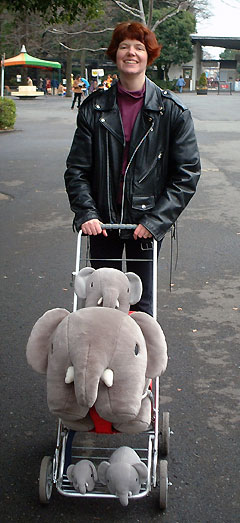 "This is an art project; we are not taking our stuffed animals on an outing to the zoo," Tod & I agreed as we left our building with the Zous in hand.
It really did feel like performance art.
It's pretty amazing the reactions you get with a stroller full of stuffed elephants. Adults were generally enchanted. They smiled and pointed. "Kawaiiiiii!" Older men and women were more likely to talk to us. Security guards cracked smiles. Middle-aged matrons laughed aloud. The whisper of a trendy young woman to her friends got them all to turn their heads subtly to peek. Mothers with children sometimes saw us before the kids did, and directed their kids to look. One very brave, stylishly dressed college boy petted Zousama even though his girlfriend disapproved.
Little kids had mixed reactions. Some were a little scared and clutched at their parents' legs; some warmed up to the idea after a few seconds and snuck another look and a smile. Others came toddling over to play with the Zous right away. Sometimes the Zous were a more interesting attraction than the animals in the cages.
Some people saw the Zous, but not us, then glanced up to see who was holding the stroller. Whether they stopped smiling because we were watching them watch us, or because we were foreigners and they were surprised by that, I don't know.
Tod estimated that the bemused to amused ratio was about 30:70.
The Zous have their own version of the day at the zoo on their blog and in pictures.
Last week I made a tactical error in the sartorial department. I decided to not go all the way across town to my usual stylist for a haircut, but to try a beauty shop in my own neighborhood.
I took the photos of my Amelie cut that MJ snapped. I explained that I just wanted my hair cut a little shorter. I ended up with...not the same thing and about 2 months of regrowth before I think I'll be happy with my hair again. I might hand MJ the scissors next time we get together and see if she can do something to fix it. It can't get too much worse, really.
The trouble started when trying to make small talk, I asked the hairdresser--a 20-something man with dyed yellow hair and a nose pierce--whether Japanese hair and foriegn hair are similar. His answer was pretty standard (No, Japanese hair is thick and springy) but the word he used for Japanese really took me by surprise.
Nipponjin. This is the way is used to be said in Japan's expansionist, Korea-is-really-our-colony-and-so-is-China history. Before the war, Japan was commonly called Nippon and its people were Nipponese or Nipponjin (hence the wartime word for the Japanese enemy, Nips).
But after the war, as a concession to peace, the country renamed itself to the softer Nihon and its citizens became Nihonjin. So when I said Nihonjin and Mr. Hairdresser answered with Nipponjin, I really didn't know what to think. Is he a nationalist? Am I having my hair cut by someone who hates foreigners? Does he drive those loud black trucks on his days off--the ones that cruise around town blaring the national anthem and shouting for foreigners to go home?
So with that dread in mind, I sat back and tried to enjoy my haircutting experience. It was OK until he attacked my head with the thinning shears. Some thinning is OK, but he really went at it. I think he was trying to cut away all of the waviness--which simply cannot be done to my hair.
Now I have sections that stick stright down, really short bits underneath (I found one last night that's about one centimeter long) and one nice wave in the front that flies off into the air like a wing. There used to be other hair that supported it, but it was all thinned away. My head looks like a badly waving flag.
Leafing through "Trendy" magazine yesterday, I was fascinated by a long article titeld New Stype of Shopping. It featured (and compared) all the recently opened shopping theme parks around Japan.
Japan doesn't have too many American-style shopping malls. There's not much room in the cities for fields of parking lots surrounding a low, broad building full of shops and anchored by a big-name store or grocery. There are a few of these, but they tend to be out in the further suburbs. This is in contrast with American cities; Chicago has numerous shopping mall complexes in the urban centers.
What we have here are more like Chicago's Water Tower Place or Pittburgh's Fifth Avenue Place, a collection of stores stacked up on many floors of a single office-tower sized building.
I mentioned the Marunouchi Building the other day. Nicknamed Maru Biru, it sits just across the street outside Tokyo Station on the site of Japan's first skyscraper (which was also called the Marunouchi Building). It's got two floors dedicated to restaurants which are booked out months in advance. There are shops of all types on 6 floors, offering everythign from clothing to an Xbox gaming parlour. There are distintively high-end chain retailers and a few boutiques. The architecture is amazing--even jaded Tokyoites stand in the atrium and stare up at the glass elevators and exposed beamwork.
Newly opened this month is Caretta Shiodome. It's another skyscraping shopping mall whose tagline is "Enjoy the taste of lesiure." With "sky restaurants" on the 46th and 47th floors, a theatre and restaurants on the lower floors, and a shopping concourse in the basement floors, they may be giving Maru Biru a run for its money. I haven't been there yet but will put it on my To Do list.
There are so many similar shopping places: Takashimaya Times Square, Sunshine City, several new complexes along the Yokohama waterfront. I think the "Trendy" article got it right--these shopping plazas and others like them are theme parks.
What amazes me is that Japan is still in a recession. How can these very upscale locations survive? Maybe they pander to the good old days of the Bubble when everyone had more money than they could spend. Back then regular people could afford to splash out on fancy food, designer handbags and clothes with labels. Perhaps the last few years of less money, uncertain job prospects and making do with two-year old toasters has finally got everyone ready to backlash. I suppose if consumers are spending money in places like Maru Biru and Caretta Shiodome, then the economic outlook will improve...for the importers and brand name retailers, anyway.
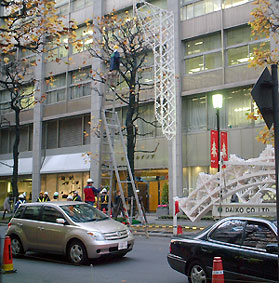
Preparations are afoot for many of Tokyo's year end activities. These workers are putting together the Millenario, a light display for Christmas and the new year.
The Millenario is a series of illuminated latticework arches across one of the streets in Marunouchi. It runs for several blocks and is a big attraction, with thousands of visitors every night. It started in 1999/2000 and has been popular ever since. This year they asked a famous designer to do the latticework. I can't tell, though. It looks a lot like last year's. I guess there's only so much you can do with lattice, or maybe my design sense isn't subtle enough.
It's beautiful from a distance. The perspective looking down the street is amazing; it looks like a tunnel of fairy lights. Walking through it is a bit of a let-down. It doesn't *do* anything. Arch after arch, all the same. No changes as you go further. No movement, except for the other people around you. It's not a close up sort of thing.
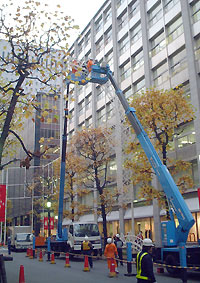
But watching the workers put up the sections of arch was fun. They had a small crane and a lot of very tall ladders. There were many more people on the ground standing around holding clipboards than there were guys actually doing the work. A few of the clipboard people were directing cars when the crane and ladders got in the way. Otherwise, I really couldn't tell you what they were doing. Smoking. Looking up. Comparing notes?
Marunouchi is a surprisingly nice part of town now. When we first arrived, it was just a lot of big, older office buildings on squarely laid out streets. Everything looked the same to me and I sometimes got lost trying to find the office I worked in! Now the area has been redeveloped. It's full of big newer office buildings, but they've claimed one street for shopping boutiques and restaurants. The Maru Building anchors it all. But that's a blog for another day.
Last night's DigitalEve Japan bonenkai was great fun. We enjoyed a yummy Italian buffet at Trunk in Omotesando and it was fun to catch up with some of hte members I haven't seen in a while.
After the party, a handful of us decided on a short nijikai (second party) and walked up to Harajuku to have a drink at the Pink Cow, an eclectic house turned into a bar. We met some interesting people (a guy who programs for Sega and a voice recognition geek) there and the owner, Tracey, offered to let DE-J use the space for meetings.
When we left at midnight, MJ invited me over for a pajama party. We stayed up 'til 6 am chatting about everything from pets to parents at our own private sanjikai (third party). We fell asleep before Yoshi came home at 8:30, but I got up, said good moring and left around 9.
I'm not so much of a party person, but this was a fun evening. I'm exhausted now, though!
"Sweaters" is what the shipping form claimed was in the box my mother sent to us for Christmas.
The shipping box has been opened, examined, resealed with kraft tape emblazoned with Japan Post in big red letters. It was shipped on to us with a duty fee payable.
I've never had a parcel containing gifts opened and examined. Maybe we've just been lucky; maybe the Customs office is cracking down to make up a budget deficit. Perhaps they have a thing against sweaters. Who knows? It's a pretty decent racket the Customs Office has going. Here's what the customs form says:
- - - - - - - - - - - - - - - - - - - - - - - - - -
Classification:
JERSEYS, PULLOVERS, CARDIGANS OR SIMILAR ARTICLES 6110.92-2
Rate of Duty: 11.50% (of assessed value)
Consumption Tax: 4.00% (of a different assesed amount)
Area Consumption Tax: 25% (of a very small assessed value)
- - - - - - - - - - - - - - - - - - - - - - - - - -
And the post office charges 200 yen to handle the Customs duty payment! I truly do not mind paying the duty, but it's a bit of a surprise out of the blue like that. I expect duty on commercial shipments--shoes in particular always get slapped with a hefty extra fee--but on a private gift from Mom? Outrageous...good thing I picked up freebie a Customs Office pen at a community fair a few years back.
(Sorry for simply copying this interesting wire story here; it explains better than my paraphrasing might.)
TOKYO (Kyodo News) A group of citizens in Japan said Monday they will launch a mock tribunal to try U.S. President George W Bush on war crime charges over military attacks on Afghanistan last year in retaliation for last year's Sept 11 attacks on the United States.
The organizing committee for the "International Criminal Tribunal for Afghanistan" will hold public hearings in some locations in Japan, beginning with one in Tokyo next Sunday, before handing down a "ruling" on Dec 13 and 14 next year, the group said.
The group, co-chaired by Akira Maeda, professor of international criminal law at the Tokyo University of Art and Design, said it will deliver the ruling to the White House.
It said it has visited Afghanistan three times to look into war damage there.
Former U.S. Attorney General Ramsey Clark, who organized a similar tribunal in New York in 1992 against then U.S. President George Bush over the 1991 Persian Gulf War, is a special adviser to the upcoming tribunal, they said.
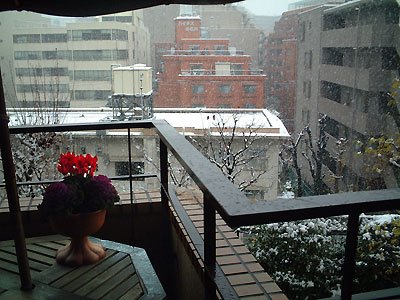
Wow! It's snowing!

Real snow from the sky, not imitation snow.
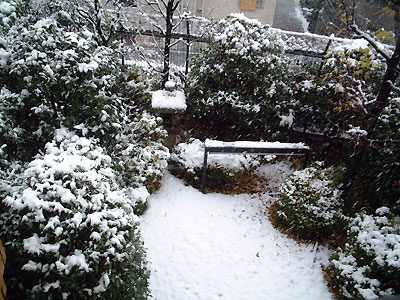
It looks so peaceful and there's almost 2 inches of very wet snow.
Tod woke me up at 2:15 this morning to show me the snow. It snows so rarely in this heat island that it's quite an event when we get some. I had no idea it would still be snowing this morning. The blanket of snow on gardens and rooftops looks lovely.

It won't last long (it will turn to rain this afternoon) so I'm going back outside to enjoy it.
Tonight was the first of this season's bonenkai (forget-the-year parties) that mark the end of the year. This was the UBS party, a grand affair in the ballroom of the Westin hotel in Ebisu.
The theme was Las Vegas Night and in addition to a huge buffet spread, a magic show and a very good live jazz band, there was a casino with the proceeds going to charity. I won about 200 dollars in chips playing roulette, then handed them to the woman next to me to play with--gambling doesn't hold my interest.
UBS' charities (UNICEF Japan & the Children's Cancer Society) will be receiving a nice donation. A signed Manchester United jersey was auctioned for 350,000 yen (about $3,000) and one of the evening's prize winners auctioned his "trip to two to Las Vegas" prize for 150,000 yen.
Most people opted to keep their raffle prizes which ranged from a bottle of champage to a DVD player to two round-trip tickets to London. At one of the UBS parties a few year back, when the economy was surging, one lucky winner got an entire year's paid vacation.
I suspect that this was the most elaborate of the year-end parties we'll attend this year. Next Friday is the DigitalEve party which will be fun, but on a much smaller scale.
When I was a girl, I had an illustrated book of ballet stories. It was one of those oversized books that was challenging to read in bed because it was heavy and awkward and hard to keep open, but I did it--numerous times. I remember the beautiful paintings that illustrated each of the classics: Coppelia, Swan Lake, The Nutcracker, Giselle, Sleeping Beauty.
So when Tod got us tickets to see the Shanghai Ballet performing Swan Lake, I was delighted. But I should have suggested that Tod read the story ahead of time.
During the intermission I asked if he understood what was going on and he wove a fantastical tale of a king who couldn't dance and a madman with a crossbow chasing after a bunch of ballerinas in white skirts. Extremely entertaining, but not quite right...he didn't even realise that the dancers in white were the swans.
He also believes that Tchaikovsky wrote the theme music for the Death Star in Star Wars.
I think we need to incorporate more cultural events into our schedule.
I've told several people about the badger sighting and they have been incredulous.
"But they are mountain animals..."
"Maybe it was a tanuki?"
So I decided to seek the opinion and comments of my neighbors. I tacked a notice on the community bulletin board.
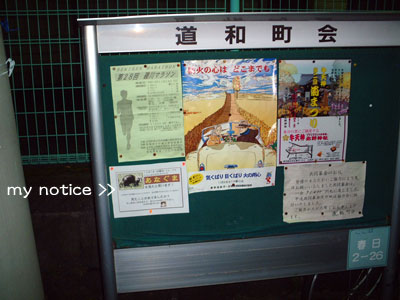
It says "Sunday 12/1 around 10:30 at Kawaguchi Apartments, I think I saw an Anaguma. Is it someone's pet? Am I going crazy? Have you see it? If so, please e-mail me."
I included a picture of a Japanese badger (not the one I saw) and my picture so everyone will know that I am a crazy badger-sighting woman.
At about 10:30 this evening, walking home from returning the rented DVDs, I spotted what I thought was a big grey cat slinking up the stairs at the apartment building next to ours.
Only it wasn't a cat at all. But I don't know what it was. I've been searching on the 'net to no avail. It's not a weasel/stoat, tanuki, raccoon, or ferret, as far as I can tell. It might have been a Japanese badger, but from the photos I've found, the tail is different...can anyone identify this animal? I didn't have my camera with me (drat!) but here's a description:
length: approx 1 meter (including tail)
legs: short, black, no defined joints or hips
tail: pretty bushy, grey with black at end. length is about as long as the body
fur: sort of fluffy, grey/brown with black legs, tail end. lighter markings on ears and top of head
ears: small, pointy, dark
head: about as wide as body, triangular, whitish stripe down the middle towards nose
What the heck is a wild animal doing in my paved-over neighborhood??
MJ mailed me these snapshots as she took them with her cell phone.
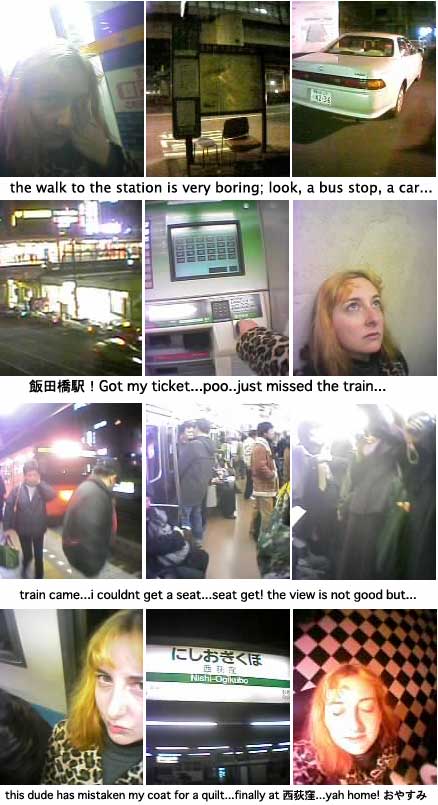
I had a bunch of things to write about here today, but then Tod pointed me at this essay on quitting smoking by Kenji Tsuchiya, a member of the philosophy faculty at Ochanomizu University. It's so funny!
I don't smoke; Tod does. We were both in hysterics reading this. It's in English, translated from the Japanese. There are a couple of grammatical errors, but not enough to be distracting. Kenji is a funny guy. If you like this, I can recommend his other essays, including Did You Know the Origin of Christmas Pudding?.
Here's an excerpt from the Christmas Pudding essay that Tod & I absolutely related to and laughed over:
"Imagine someone is talking to you at the University. Even in a light chat, it is important, in order to promote friendship between Britain and Japan, to carry on the conversation without it being discovered that you don't understand what he says. Suppose you pick up just the words, "How long ?". Success is almost yours, with this small clue. You can easily infer by the direction of his eyes that he is not asking how long the corridor is. You can also infer that he is not asking how long one million miles divided by thirty nine thousand feet is, or how long the Onin-War in ancient Japan continued, using common sense that one usually does not ask such questions in the first part of coversation. By the process of elimination, you reach the conclusion that he is asking either how long you have been in Cambridge or how long you are going to stay in Cambridge. The rest is easy. You can give an answer which fits both of these questions, such as "I came here last September and shall be staying until next June"."
If you bellylaugh while reading this, you've probably lived in a country where you didn't speak the language very well.
This is a wall with a boarded up entrance to something.
The mysterious wall is about 20 meters away and at an angle to the support wall of the Korakuen (Marunouchi line) train station off the image to the left. It seems to be a retaining wall for the park above, but what's inside the arch? There are stairs leading down the hillside from the park to the now-weedy area that was once a garden, judging from the plants running wild down there.
My best guess about this is that before Tokyo Dome was built in 1988, back when this area had a different stadium dating from 1952, this was part of that complex. Maybe it was the entrance to the Baseball Hall of Fame, or a pedestrian walkway from somewhere... but the Marunouchi line opened in 1959 and the train station would have been in the way then, too, woudn't it?
I had drifted off while reading, taking a nap because I'm feeling not 100% today, when I realised I was hearing music. Had I left the stereo on? No. Was the neighbor playing their good jazz music (their living room is one thin wall away from our bedroom)? No...
This was the Mickey Mouse Club theme song, tinkled out in loud, electronic tones. As I identified it, it morphed into the "yaki imo" truck's traditional Japanese wail. The sweet potato truck drove slowly through the neighborhood and I didn't hear any more mouse music.
I know our potato vendor doesn't deviate from his usual tape loop. Where was the other music coming from?
 This little guy is my officemate. I call him Jumping Spider. Every morning he makes his way across the wall above my desk. He usually pauses around my monitor and I give him a cheery "good morning" then he's on his way again. I'm not sure what variety of spider he is, but he's fairly small and not very threatening. I like his little white legs.
 But this morning, we both noticed an interloper on our wall. Ms. Big Brown Spider . She's maybe not that much larger than Jumping Spider, but she's bulkier. Jumping Spider ran in her direction and she retreated, but after JS turned away, Ms. Big took a second look. For a moment, I thought there might be a fight, but eventually they headed off in opposite directions.
I think these are both Hasarius adansoni (Adanson's House Jumper Spider) of opposite sexes. These "house jumpers" eat mosquitos so I hope they stick around a while.
Japan has some amazing spiders. These little guys aren't too impressive, but check out Common Spiders in Japan to see a gallery of spiders with good photos.
 I have a distinct fondness for slippers with weird sayings on them so when I saw this pair at the "My Chamy" convenience store down the street, I had to have them.
Please don't think I'm the Imelda of slippers, really my collection is pretty small and they all are all replacements for old, worn out slippers. So far I've had:
Planet Well-known
The Tree-lined Avenue
Every cloud has a silver lining
Wonder what I'll find next season?
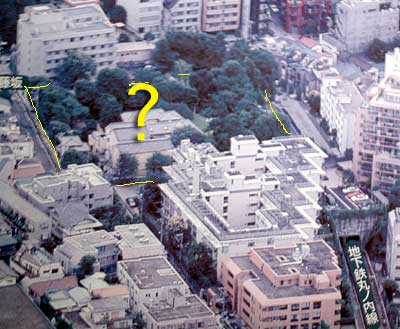 We found this arial view of our neighborhood on a flyer promoting an apartment building currently under construction.
That's our building, the orangish one in the lower right hand corner. 5 floors with 4 or 5 apartments per floor. Not a huge place, but not small, either.
The building marked with a big yellow question mark, surrounded by its own forested park, is a mystery. It seems way too big to be a private house but there is no sign outside except for a family name on a single mail drop in the wall.
Although there's a big entrance gate, we never see any traffic going in or out. Once in a while there is a car parked on the horseshoe drive. Maybe someday when I'm feeling extra brave, I'll stride up and knock on the door to find out what's up there.
Sun set at 4:36 this afternoon. By the time we reach December, the sun will disappear at 4:28. We may as well live at the North Pole.
Every year at about this time, I'm suddenly surprised by the short days. I know it's nearly winter and I should expect it, but come on--4:28? There's still too much to do for the day to be over. Maybe it's because I'm a morning person, but after the sun sets my activities slow to a relaxed halt.
Still, we have it better than Chicago, where things got dark at 4:33 today, or London, where people were turning on lights after 4:16.
If you want to see what time the sun sets today, go to Time And Date.com and type your city's name in the Search box. They also have a nifty countdown that tell you how long until a date. It's 1234 days until my 40th birthday!
The past week has been an early blast of winter--chilly wind, even a hint of snow in the air, though none's actually fallen. Everyone is predicting a cold one this year.
On the streets, the fashionable are wearing velvet blazers or light jackets and have wrapped incongruously thick and bulky scarves around their necks. I see this every winter and I wonder if there is a Japanese superstition about keeping your neck well bundled.
I don't have a scarf, but today I dug out my fuzzy slippers and tossed my lap blanket over my legs as I sat in the office. My fingers are chilly, but I'm not willing to turn on the heat so early in the season. After all, it's still 14 degrees (57F), hardly icy by anyone's standards.
The sun is setting now. Tonight I'll warm myself with some oden or maybe just lots of nice, steamy tea.
 Why does MJ look so horrified? Is it the giant glowing Godzilla towering over her in Shinjuku?
Or is it because it's only early November and stores around Tokyo are already putting up lavish, illuminated decorations for a holiday that isn't even recognised here?
Oh, wait. That's what horrifies me. MJ's probably just scared of Godzilla.
I hate commercial holidays. They aren't fun to participate in whether they are Western or Japanese. Bah, humbug.
Japan's economic bubble may have broken a decade ago, but holiday frenzy seems to have expanded as shops try to get people to spend their money. More holiday decorations put up earlier, more hype in the press, more promotional campaigns around Western holidays. Christmas Eve is date night when women hope for expensive showpiece jewelry from their partners. For Valentine's Day, women give chocolates; on March 14th, White Day, men distribute gifts to women. Mother's Day is all about pink carnations.
Japan has its own gift-giving traditions that are not linked to holidays. At the end of the year, you send gifts to people who did you a good turn--clients, friends, relatives. They may respond in kind with a gift of equal value. This is echoed with summer gifts, as well. For weddings, guests give money in specific denominations and the couple buys gifts for all their guests. For funerals, mourners receive a gift--often bath towels--in regard for their donations to the deceased's family.
Japan's official national holidays are so low key most people don't seem remember why we have the day off. Monday was Culture Day. There are no Culture Day decorations or presents. Later this month we celebrate Labor Thanksgiving Day. No big meals, no Labor Thanksgiving Day carols (that I know about, anyway), no rush to buy gifts.
I like making my own traditions as I please, so these holidays suit me just fine.
November must be a time to launch strange products. Here are two products that hit the market on Friday.
 Corrective eyewear for pets. Menicon introduced contact lenses for dogs & cats. What I want to know is how do you get the cat to sit still while you put them in?
A cigarette called Peace Acoustic. The Peace brand debuted in 1920 to celebrate the end of WWI. The latest addition to the family has 20 mg less tar than the original and a vanilla aftertaste. But why is it called Acoustic? Maybe it makes an interesting noise when you draw on it.
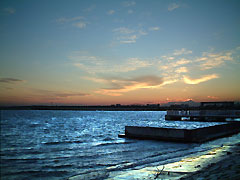
I'm not sure what people are supposed to do on Culture Day. Go to museums, maybe.
We went to a seaside park, had a chilly picnic lunch and wandered around the embankment enjoying the breeze and the sunset. After dark, we abandoned our plan to ride the ferris wheel (an hour is entirely too long to wait for an amusement ride) and went to the arcade instead.
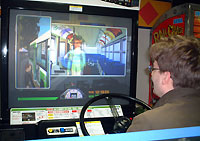 Tod tried his hand (but not both) at driving a city bus. He managed to pick up a few passengers before his time ran out but he wouldn't cut it as a Toei Bus driver. I tried the game, but kept crashing and driving in the wrong lane. Just like real life...
I did much better when I played a "walk the dog" simulation. I walked on a treadmill and held a leash while watching the antics of a video dog. The dog loved it when I ran with him. So did the people who were watching me. I was tired by the time we got to the "pet store."
So our culture day celebrated pop culture. As Tod jokes, let's get some petri dishes...
In 1995, the Aum cult attacked Tokyo's subways with sarin nerve gas. Since then, they've regrouped, renamed themselves Aleph and have focused on computer technology.
In April of this year, the CIA listed Aum in a report to a US Senate committee on potential threats. "[Aum] is the terrorist group that places the highest level of importance on developing cyber skills." So what is Aum getting up to?
A year or so ago, there was an article about how a Japanese government IT project was being fulfilled by an Aum-connected contracting company. Oops.
TOKYO --The telecom ministry said Tuesday Japan intends to hold talks with the United States in Washington on Monday over a U.S. demand to have Nippon Telegraph and Telephone Corp (NTT) cut hookup fees charged on non-NTT carriers.
"We would like to hold talks in Washington early next week," Kaoru Kanazawa, vice minister of the Ministry of Public Management, Home Affairs, Posts and Telecommunications, told a news conference.
I guess the US-based international long distance carriers complained. Or maybe the US doesn't want its telecom companies to get any big ideas about higher hookup fees. Who knows? I don't and I'm really confused about why the US government thinks it can make requests like this--they don't even own any telephone companies anymore.
But I shouldn't complain. I've benefited from their last intervention with NTT. Internet access in Japan is superfast and very cheap because the US bitched about NTT rates being prohibitive to broad acceptance of the 'Net by regular folk. So now I pay monthly fees of only 3,700 yen to NTT and 2,300 to my ISP for 8 Mb ASDL! Cheaper than in the US, and faster, too.
Arriving back in Japan, I checked the local news. The top headline:
Soga observes crested ibises on Sadogashima Island
"OK, what's this all about," I wondered. Is Soga a minister I've never heard of? A famous ornithologist? Are the crested ibises of Sadogashima more important than other ibises?
Then I read the story:
Sunday, October 20, 2002 at 18:00 JST
MANO -- Hitomi Soga, one of the five Japanese nationals on their first homecoming since being abducted to North Korea in 1978, enjoyed observing crested ibises Sunday on Sadogashima Island, Niigata Prefecture.
Soga, 43, and her supporters visited the Sado Japanese Crested Ibis Conservation Center in the village of Niibo. (Kyodo News)
Geeez, it's just the Japanese media making the most of the North Korean abductees. There are tons of stories about them--will this couple register their marriage and three children in their hometown? This woman visited the site of her abduction. One abductee's father said his son was told by the North Koreans that he was useless and should go home to Japan--but later retracted that comment. One abductee is married to an American defector.
With all this trivia about a dozen people filling the news channels, I wonder what else is going on in the country? What is the government (through their tightly controlled news kisha) hiding with all this "news" about what these dozen people are doing on their visits to their hometowns and the sites of their abductions?
No matter where in the world you live, it's a good feeling to be become 'regulars' at a favorite restaruant.
Our restaurant is Ampresso, an Italian place with fabulous food only 5 minutes' walk from our house. When I walked in last night, the staff commented on the haircut.
If that weren't enough to assure me that we are valued customers, Satoru Ito, the owner and head chef, shared his recipe for a delicious sauce that goes with tuna carpaccio. He drew it in pictures with English and Japanese captions then explained it all to us step-by-step. Plus he gave us a litre of the special soy sauce from Kyushu we'll need to make the sauce. I guess we'll be making a lot of tuna carpaccio!
After dinner, Ito-san treated us to cake and coffee. Could you ask for anything better? What a nice guy!
Ito-san, who loves to fish and lived in Italy for a while, has a website. It's mainly in Japanese but there are lots of pictures and some of his Ampresso recipes.
According to an investigative panel presented earlier this week, as much as 80% of Japan's food supply may contain Diethylhexyl phthalate (DEHP), a suspected endocrine disrupter.
DEHP is used to make plastics flexible and it's a big component of vinyl and some food packaging. In low levels, it's not likely to harm you too much, because the body can break it down pretty quickly. But high level, long term exposure in rat studies did nasty thing to the poor rats, like kidney damage and reproduction problems.
Of course, rats aren't human. Should we worry? Maybe not about this specific problem, but the combined chemicals and manmade things in our environment have got to have an affect on us.
I've always had a suppressed urge to run away to the countryside and live more in harmony with nature,eating grains I grew, using energy from renewable sources, raising animals for food and clothing but I'm not sure I could give up my computer. Articles and reports like this make me think about it more seriously.
At 7:00 am the sky was cloudy and by afternoon it looked like we were in for a good, long rain. It was pouring buckets when Tod called at 5:00 saying everyone was being sent home early because of the typhoon.
The rain slowed at about 7:30 and we went out for dinner. The wind was blowing nicely and everything smelled fresh and clean. By the time we finished eating, we finally had our typhoon. We walked home through gusty winds and driving rain. Typhoon 21 was a bad one, the strongest in 60 years. Two people died during the storm, a ship ran aground, 270 flights were cancelled, and there was a blackout of almost 12,000 homes in Kanto.
Despite the dangers, there's something delightful about bad weather. On the way home, I smiled, ran and danced in the rain. I laughed as I wrung my skirt out before going into the convenience store. After arriving home completely soaked to the skin, we put on cozy pajamas and laid in bed with our laptops.
This morning the sky is clear and blue.
It's been an awfully long time since I felt an earthquake...there's been a few in other parts of Japan but nothing in Tokyo for well over a month.
I get nervous when I don't feel the earth wiggle a bit. If the pressure builds up for too long, there's a bigger chance that things will topple when it finally does give.
Wonder if people who've always lived on fault lines feel this way? Am I especially sensitive because I've only been in the danger zone for four years? Earthquakes are starting to feature in my dreams; I hope I feel the earth move (just a little) soon.
This morning, I spent some time typing up tour itinerary ideas for a visiting acquaintance. This is the third time I've done this in the last few months, so I figured I'd use today's write-up as the basis for a web page. There are so many other ideas, that it's taking me longer to put together than I expected. But I will have a list of my favorite spots to vist online soon.
But I did re-discover a nice resource on Tokyo's Metropolitan Parks that I'd lost track of a while back.
Although almost everyone in Tokyo has a washing machine, very few people seem to have dryers. Laundry is usually hung outside to dry.
In apartment buildings, that means hanging your undies out on the balcony and draping futons over the railing or out windows. Sunny days look a little bit like a bazaar with clothes flapping in the high rise breezes. Several buildings in our neighborhood have communal space for laundry on the roof--they're completely caged in to keep things from blowing into the streets below.
I have a dryer but I still like to dry things outside. I'm amazed at how quickly towels dry in the sun. Half the time of doing them in the dryer. Sheets are dry in 30 minutes on a breezy day. And despite the polluted Tokyo air, things dried outside smell fresh.
After teaching a digital photography workshop with 23 participants, and after a delightful dinner at a restaurant on Sotobori Moat, the outermost of the Imperial Palace defences, I met a cat.
Cha-chan was sitting on a makeshift plywood and crate shelf outside an old house. I couldn't help petting her. Fat and friendly, I held out my hand and she tested me out with a gentle bite. I passed muster by not flinching and was allowed to pet her.
Her owner, an older woman who never gave her name, came out to talk to us. "Cha-chan runs away from scary strangers and dogs," she said. I guess since Cha-chan didn't run away from us, we weren't scary. I'm pretty sure I'm not a dog (no comments from the peanut gallery, please).
Obaasan chatted with us for ten minutes before we said goodnight and left. I think this was the nicest, longest conversation I've ever had with a stranger here. This old woman was lonely and not too concerned that we were foreign or didn't always understand what she was saying. Cha-chan liked us and that was good enough for her.
Prime Minister Koizumi is in North Korea today, attending a summit with tetchy neighbors.
The hot topic at the summit--abductions. Japan claims that North Korea abducted a dozen or so Japanese citizens in the 1970s and 80s. NK has sometimes completely denied this; at other times they have launched "missing person" searches in cooperation with the Japanese Red Cross.
What isn't said is why NK would want to abduct Japanese citizens in the first place? Did these people have specialised knowledge NK needed? Was it just to cause terror and piss off Japan? Digging around on the 'Net as not brought the answers to the surface.
It's a long holiday weekend here. Yesterday, I stayed away from the computer for most of the day.
Tod & I went to Ikebukuro to check out the Gyoza Stadium, a pot-sticker theme park operated by game giant Namco. For 3,500 yen you get all-day, all-you-can eat gyoza in a dozen different styles from around Japan. Unfrotunately, the wait was 2 hours to get in, so we opted to eat elsewhere. We'll go on a less crowded day.
We also sought new rings. In addition to our wedding rings, we wear matching bands to seal our friendship. These have varied over the years because they are usuallly inexpensive bits of stone or pressed silver that Tod somehow breaks. A couple of weeks back he snapped the silver one we've worn for the last few years. I don't feel right wearing one if he isn't and my hand felt bare so now we're sporting simple milled silver rings that we found in a tiny litle shop near the movie theatre where we went to watch Star Wars Episode 2 (at long last).
On the way home we did the unthinkable. After stopping at a convenience store for our dinner, we nibbled chicken nuggets and drank beer as we walked home. How naughty!
Who knows what's we'll get up to today? Putting on makeup on the subway? Littering? No doubt we'll be up to no good now that we've broken the taboo of eating while walking.
 Bloodlust for mosquitos.
I'm not the sort to kill insects but mosquitos are an exception. I despise them. The damp weather has caused a boom in the population and they are finding their way inside. That's not too hard since we have no window or door screens in this building.
When I see one, I attack before it can bite me. In fact, I think I just jammed a finger slamming it into the ceiling during an assault. However, the foe was vanquished so I'll enjoy a bit of pain with my triumph. One less mossie to bite me. The world is made safe--or at least my office is.
(Props to mjd-s for the supa-graphic!)
How do you cure hiccups in Japanese? By answering a simple question: What is tofu made of?
Daizu.
This evening at dinner, it worked better than holding my breath, drinking out of the wrong side of the glass or being frightened. Soy beans have magical powers...
 These are digital camera print kiosks. For 50 yen a print, you get your images printed directly from your camera's storage media--Compact Flash, Smart Media, Memory Stick, PC Card, even floppy.
These are at a big electronics store, but our local Family Mart convenience store has one, too. Ah, technology.
Personally, I like to work with my images before I print them--touching them up in Photoshop usually improves them. I print mine on photo paper with my ink jet printer. Not archival quality, but who archives birthday snapshots? Someday they're going to be found in a box full of photos and somebody's going to wonder " Who are these people? Maybe Great-Aunt Kristen still remembers."
 This sleepy commuter was completely crashed out on the Mita line last night. When I snapped his photo, the flash went off but he only stirred a bit then settled back into his snooze. I wonder if he got off at his station?
Oyama sensei is on holiday in Canada this week. We'll have a substitute teacher tonight. But instead of a regular lesson, Oyama sensei left us a page-long composistion to translate. We'll discuss it in class tonight.
I've finished deciphering the first three sentences. This makes me realise how few kanji I actually know--there's a lot of dictionary work for me this afternoon. I have four hours to complete the rest.
Every summer we hear about the "heat island" effect of too many buildings, air conditioners, cars, heat-absorbing asphalt and other inconveniences of the modern environment. The average summer temperature has increased 3 degrees Celcius in the past ten years. Tokyo's supposed to have some rules about roof gardens and open/planted land per square foot of new building. A small measure of concern for a big problem, right?
Wrong. In some of the areas of Tokyo currently undergoing huge building projects, the rules have been amended. It looks like you can "swap" square footage in one building location with another to allow you to have fewer green spaces in a commercial area. So I guess you count one 100,000 sq ft building as only 50,000 (so you need to include only 1/2 as much garden) but add 50,000 to some other building you're putting up where it's more convenient to have open green space.
So much for small measures.
People do weird things on roofs in Tokyo. Across the tracks, on top of an office building, a man is practicing the trumpet. He comes out to play at lunchtime once or twice a week. He's not too bad, though he's not really playing more than scales and phrases. On a nearby apartment building, Tod tells me, a man practices swordfighting late at night. I've never seen him at it.
I literally dragged Tod out of bed this afternoon at 1 (he's quite heavy!), got him into the shower and out of the house by 2. We went to Yokohama.
So much has changed since the last time we trekked down there. Before there was lots of construction around Sakuragicho station but MInato Mirai 21, the harbor area, is all built now with bridges and walkways connecting shopping/restaurant/entertainment areas. We cruised Landmark Plaza on several small shopping missions and only ended up with a few things we didn't expect--mainly books, which can never truly be considered an unexpected purchase.
Our main goal was to go to Chinatown for dinner. Although we were tuckered out from being in the shopping center. we summoned the energy to walk the 2 kilometers to Chinatown. It was worth it. At Tung Fat, we feasted on dim sum, char siu and chahan washed down with jasmine tea. Afterwards we picked up some Chinese sweets then headed home. The sweets and my new book await, so I'll cut this short...
 For two weeks, a tinsel draped signboard at the end of our street has reminded us about the Kitano Jinja matsuri around the corner from us. Saturday 8/24, 5-9 pm. Rain or Shine. The main selling point was "Dad, we'll have beer at good prices!"
By 8 pm, the lanterns leading up the stone stairs to the shrine cast a soft red light on the scene. Things were winding down and some of the food stalls were closed but the beer stand was going strong with a very long line. Kids were catching cicadas with a net and squealing as loudly as the bugs; teenagers were shoving one another in play fights. Moms, seated on wooden benches under pergolas of bamboo and bare bulbs watched the kids and nibbled on yakisoba. Every available seat was taken and there wasn't much room to stand so we made a quick circuit, skipped the beer and walked back home.
We saw fireworks peeking above the skyline to the west--one of the nearby towns is having their hanabitaikai tonight. I stood on the veranda and watched the sky glow pink and green as booms echoed against the mountains and sprinkles of lights popped over the sillhouette of buildings.
Another mad cow. This one is #5. It was noticed during the Agriculture Ministry's testing process this week so it hasn't been sold or served. They didn't say it wouldn't get mixed into cowfeed, though. That happened with one of the other mad cows earlier this year. I was really hoping to have some tasty sukiyaki this autumn, but maybe next year.
In another food chain scandal news, Snow Brand Milk (caught recycling old milk into new products that caused food poisoning) has partnered with several other milk producers to form a new company that will market its product as "Megmilk."
Nippon Ham, meat packager and owner of the baseball team the Nippon Ham Fighters, is in the news this week for scamming the government. They bought 5 tons of cheap, imported beef and passed it off as domestic during the mad cow beef buyback program.
So what's their penalty? They've announced that the founder/chairman & his son, the company president, will be demoted to "honorary chairman" and "senior managing director" and will not receive any pay until the business situation improves (meat sales are way down after the mad cow outbreak). Three offices will be closed and the company is setting up an auditing department.
But there seem to be no outside sanctions. The Agriculture Ministry is going to examine the Nippon Ham offices now that the company has admitted its fraud. I wonder what that examination will yield. Probably nothing.
Japanese TV is silly. This afternoon I watched as two young male TV talents met the lovely spokeswoman for the upcoming Pan Pacific Swimming Championship. They challenged her to a high-stakes Jenga game. If she lost, she had to go out on a date with one of the guys. To add to the hilarity, each Jenga block had a truth-or-dare style stunt to perform. "Do a 3 second promo for the Pan-Pashi (Pan Pacific) in a baby voice" "What's your favorite sport for a date?"
 Following the game (the spokewoman lost), I changed the channel and watched a food travel show. A portly, but very genki woman enthused about the famous uni (sea urchins) of eastern Hokkaido. I find uni extremely revolting. The yellow-brown color of baby poop, it is a mass of slightly gritty eggs. Blech. But the woman was funny to watch. As she checked into the ryokan where she would stay and have her dinner, she asked several times about the uni. "Do you have it with your dinners here?" She was assured that there would be plenty of uni. When dinner arrived, she had uni in abundance--raw, steamed, over rice. She was so excited that she couldn't even manage "Oishii!" after her first bite. A squeal of delight was her only utterance. It was subtitled, ala the 1960s Batman TV show, naturally.
Obon holidays are upon us and the city is emptying out. Everyone's going back to their hometowns, vacationing overseas, or at least not going to work. Businesses and restaurants are closed. Yesterday's trains were virtually empty; I got a seat on 3 out of 4 I rode.
 I should try to find a festival with some bon odori. I love those Japanese folk dances. Circling a small, square stage decorated with paper lanterns & red and white striped fabric, dancers in yukata shuffle along in a big circle, waving their arms, twirling fans, clapping and spinning. The music is a steady beat of taiko drums with shamisen and flute picking out a melody. Sometimes there is a dish-shaped bell ringing a counterpoint.
I remember my first bon odori 6 years ago. I stumbled upon it accidentally and stood there watching and grinning until an old man handed me a fan and dragged me into the circle. I was quite a spectacle but not because of my dancing skill--I was the only foreigner there.
 Last night, Tod & I (and the UBS staff outing) had arena seats for the Jingu Hanabi Taikai. In addition to two spectacular 25 minute firework displays, there were concerts featuring famous musicians we don't know but the 30-something crowd went wild, so I guess we should have. Then again, the crowd were also excited about the sing-along version of YMCA, so maybe it's best that we don't know who these musicians are.
Usually my fireworks viewing is on someone's balcony or among the crush of people gathered, so having a seat and the perfect view was a nice treat. It was interesting, too, to realise that each flight of explosives was sponsored and to see the commercials placed between each group. The sponsor was announced while a video clip or animation flashed on the big screen of the baseball stadium where we sat and a laser show picked out the sponsor's logo. Then the next set of fireworks started.
Everyone in the crowd was surprised when the stage lights went on andTakefuji Yen Shop dancers appeared live on stage. Yen Shop, a loan company, is known for its ads featuring leotard-clad jazz dancers. I've no idea what jazz dance has to do with loans, but the girls on stage were great dancers and fun to watch. And the Takefuji fireworks were pretty good, too.
Tonight we should be able to see the Perseid meteor shower if today's bank of heavy clouds goes away and light pollution doesn't spoil the show.
I remember the first time I saw the Perseids. I was at a drive-in with a friend during a university break. The movie was too stupid to capture my attention, so I was scanning the sky for constellations. Tim thought I was nuts when I distracted him from the on-screen action to look at the meteors.
It was a good display that year; I saw about 20 in the remaining hour of the movie. I hope I catch a few this year. I like being reminded of my place in the universe--a tiny speck of animate carbon on a pebble orbiting a spark of fire.

 Pop superstars SMAP's latest album cover art has been turned into a promotional soda with a discount price--just 105 yen instead of 120.
What's the flavor of SMAP? Its a cola/orange baby aspirin/gum fantasia. I haven't had a cola drink in years and the contents of the can took me by surprise. I've become accustomed to white cans with blue writing bearing grapefruit flavored sports drinks!
It's quite tasty and refreshing but I won't finish it because as MJR knows from a notorious flight from Portland to Pittsburgh, "Coke makes Kristen cranky" and I have too much to do to be cranky today.
On Monday, a national "resident registration" system launches. Japan's citizens will be assigned an 11 digit number associated with their name, date of birth and other vital statistics, similar to the US's Social Security Number.
But not every citizen will be enumerated. Two communities in Tokyo, Suginami and Kokubunji, and several other towns around the country, will not participate until better personal privacy legislation is enacted; Yokohama's mayor is making this national registration voluntary for his constituents. This is a hot issue; PM Koizumi received threatening protest letters full of shotgun ammunition.
I don't know the mechanics of the registration process; I wonder if individual citizens will refrain from signing up? All foreign residents are required to carry an alien registration card, so I'm already a number in a Japanese database somewhere. If I had a choice, I wouldn't sign up.

Man studying piano score on the Namboku line between Nagatacho and Kasuga.
 This band of elderly urban adventurers has just been to visit the graves of prominent historical figures at Denzuin. After crossing the street with their guide waving his flag to point the way, they are heading to the station to conclude the tour. The guide looks back and waits for stragglers who have moved into "casual chatting" mode after spending too much time in "paying attention to important sights" mode.
 Kristen's Guide to Identifying City Sightseeing Tours
- All members of the touring party will be wearing hats.
- Look for matching hatbands (this group wore light turquoise) or badges with the tour company name.
- Attire is always long pants, a long sleeved, button-front shirt and sensible walking shoes.
- Most adventurers will carry daypacks and some will sport extra accessories, such as water bottles and cameras.
- In challenging weather or hiking conditions, you may see: white cotton gloves, raincoats with hoods (never umbrellas as they restrict the view) or rustic walking sticks.
 When I desperately want to get out of this hot, humid city I seem to choose the time it's most difficult to do so.
August is holiday month. And many (most!) Japanese take a summer holiday this month. Consequently all the trains are booked up and planes cost twice as much as usual. It's maddening for spur-of-the-moment travellers.
I want to go to Onomichi, a beautiful little town on the northern shore of the Seto Inland Sea. I was there for a just one day a few years back and it captured my heart. It is my very favorite city in Japan: quiet, lovely, & friendly. I've been wanting to return for a long time.
I'm not sure how I can make this work. It might come down to buying two $500 round trip plane tickets (plus a bus and a train), or maybe two $350 Shinkansen tickets. Seems rather extravagant for a one-day trip, though. Maybe we'll just go to Saitama, instead. Train fare's $10 and there's a nice onsen only an hour away.
 To brighten up the summer school holidays, Metron's Stamp Rally 2002 is underway through 8/18. In 44 subway stations around Tokyo, you'll find a rubber stamp chained to a small table, an ink pad secured to the table and a pile of paper slips for stamping.
The game is to collect all the stamps in a special-purpose rally book. 2002 is the Corocoro Comic All-Star series featuring famous Japanese cartoon characters like Doraemon and the Pocket Monsters. In Hibiya station, I found this stamp--Kongo-kun, a former TBS anime character who now features in a Konami game called Muscle Ranking. I've never heard of him, but I suppose he's an all-star to the elementary schoolkids this stamp rally is meant to entertain.
I found an inchworm creeping up the spearmint in my garden yesterday. Last week there was a slug slithering alongnear the thyme. A month ago, a caterpillar grew huge on my basil and parsley. Spiders love the bush basil.
I seem to be harboring a nice little ecosystem of plants and bugs. Quite surprising, really for a 2nd floor container garden. I've never seen a slug or an inchworm in Tokyo before.
 Who knew buying a plant could be such a festive event? We walked down to the Bunkyo-ku Asagao and Houzuki Festival at Konyaku-Enma shrine to get a Chinese lantern plant (houzuki) and were greeted by a dozen festival staff. They were so friendly and quite surprised when Tod conversed in Japanese.
Houzuki are old-fashioned summer flowers and every year there are stalls set up at shrines around the city to sell them and asagao which we know as morning glories. I remember houzuki growing in a neighbor's garden when I was a kid. So they are natsukashii even for me.
 In addition to the plant, we received a furin. These delicate glass windchimes are painted on the inside with summery patterns; ours has purple flowers and a blue stripe. The tinkle of glass in the summer breeze is ice in a cold drink.
Flower and furin weren't all we took away. Two nice men took our photo as a souvenir and the staff at the register gave us a pen and a handkerchief printed with the festival flowers. It was quite a shower of presents. Maybe because it was the end of the day and they were getting ready to pack everything up or because we were the only customers. Maybe because even in this huge city our foreign faces are a novelty.

8:45 pm. Two girls heading off for an ice cream from the Family Mart after the asagao festival at Denzuin.
I've been reading Underground by Haruki Murakami. It's a work of non-fiction about the 1995 Tokyo Sarin Attack. Murakami interviewed people who were vicitms and members of the cult that perpetrated the attack and compiled them into a very compelling read.
The attacks occurred well before I came to Japan and I never really learned much about what had happened. Needless to say, my eyes are opened. A dozen people died and five thousand were injured by the poisonous nerve gas released on five trains during rush hour. The subway lines and many of the stations involved are on my daily routes around town.
Riding the subway the past few days and thinking about what happened seven years ago, I've been more aware of how vulnerable we all are to terrorism even here in this relatively safe country. You might think those musings are a little late, considering all the press that terrorism has been getting in the past ten months. Maybe so, but reading about the attacks from the view of individuals has given me new things to think about.
One big point is that it's not entirely wise to rely on agencies and services to save you in a crisis. Not that you can be prepared for every possible situation, but a broad knowledge of how to handle various disaster scenarios is probably good preparation. I realise that I lack a great deal of that knowledge. For example, I don't even know precisely where the nearest hospital is...
 I'm going to tell you a secret. Those saccharine little collectible plates you've been giving your mom every year on Mother's Day? They may not be worth much.
Last night at Hakunincho Yataimura, a food court featuring really decent Asian cuisine in Okubo, we asked for extra dishes. What did they bring? A dozen "Cherished Moments Last Forever, Mother's Day 1981" plates. Two of us turned them over to see where they came from and laughed aloud to read "Made in Japan exclusively for Avon."
After dinner, I checked on the 'Net to see what I could dig up on Avon plates. They sell for $10 to $20 on the collectibles market and apparently for next to nothing out of some "ChEAp DIshEz" box on the street in Kappabashi.
 Linguistic Deductions
"Remain Heart is a funny name for a restaurant," I said as we approached this sign at Iidabashi station.
"Maybe they meant remain heartful," Tod suggested. In katakana English, heartful seems to mean 'loving and caring.'
"Maybe. But why is the picture a brain with a heart in it?"
"That's not a brain. It's a lettuce."
"Do you think they meant 'Romaine Heart'?"
"Aha, hearts of Romaine! Of course."
next week: deciphering the menu. stay tuned...
 After four years, I am converted to the flow of Japanese holidays and seasons. In my imagination, summer is indigo and white, with kingyo, morning glories, glass chimes, cool somen noodles, and mosquito coils in pig-shaped pottery jars. (Check out Hide Itoh's excellent collection of summer icons at pixture.com)
There are two holiday traditions in July. Tanabata is my favorite because it celebrates stars, love, and wishes and features fancy decorations. Obon is a festival for the dead. It's celebrated twice, in mid-July (traditional) and in mid-August (modern), so that people in Tokyo can go visit their hometowns and fete their ancestors as well as feasting the generations that grew up in the metropolis.
There is an actual national holiday coming up, Marine Day on the 20th, but nobody really seems to celebrate it. That's one of the things I love about Japan, nobody waits for the national holidays to celebrate.
Yakatabune! Dining on Tokyo Bay.


Floating parties on ships like these are a summer tradition dating back centuries. Poetry readings and courtly music have been replaced by karaoke, but the spirit is the same. It was fun to dress up in yukata.
 Typhoon Chataan blew through yesterday (so much for too little rain) and by 2:30 this morning, it was extraordinarily windy. We battened down the hatches and went to sleep. This morning the sky is bright and clear except for an appalling haze of pollution around the horizon.
It's stopped raining. Yesterday's weather was hot and humid--typical Tokyo summer. We're due to have thundersorms over the next couple of days, but that's not a typical rainy season all-day drizzle. Looks like tsuuyu is over. If so, that was a very short rainy season.
Farmers rely on a long tsuuyu to keep the rice wet while the grains start to form. Not enough rain early on and the crop could falter or fail, driving up the price of rice in the shops. Rice is already expensive; a 2 Kg bag runs about 1,000 yen. That's about $1.85/lb compared to $0.80/lb in the US. Now in the US it's not a big deal since rice is a side dish but here in Japan rice is the main dish and everything else is a side dish!. So expensive rice is bad for the family budget.
Bring on those thunderstorms...
Tokyo has a lot of hills with names.
Streets generally don't have names, but the hills do: Andozaka, Tomisaka, Dangozaka. A few of them are well-known for their neighborhoods or train stations--Kagurazaka, Nogizaka, Akasaka--and there are plenty that loan their names to busy intersections, but many are only etched onto historical signs dotting the local landscape. Who ever heard to Shichimencho-saka? Just the few people who've stopped to read the marker.
Some are named after notable Tokyo citizens; some names come from historical activities or local fauna. But it doesn't explain why hills have names and status, yet streets do not.
 Julianne is a musician I know through DigitalEve. Last night she played at the Artist's Cafe, a bar/restaurant on the 43rd floor of Tokyo Dome Hotel.
Although I've heard her music recorded, I've never heard her live, so Tod & I met at the hotel after work and listened to a set. Julianne's music mixes ambient and ethnic influences with jazz. She plays piano and sings. Tod loved it--he even heard bits of things he's been experimenting with when he plays.
Julianne plays at the Artist's Cafe again on 7/16. If you'd like to join us, drop a note.
Shortly after Tod & I arrived in Japan, we saw a big billboard with a digital display counting down the number of days remaining until the 2002 World Cup. It was a lot of days in the future, why should anyone care?
In Shibuya this week, I noted a sign counting down the days to the 2005 World Exposition in Aichi Prefecture. It's 1000 days from now. So what? When it rolls around, will we head out to Aichi to see it? Will we be caught up in the excitement of a big, international event in our backyard?
I'm not sure. But I've got to go prepare snacks now. The World Cup final kicks off in a little while.
 I've never been sure whether to believe the idea that Japanese are excessively fond of brand names. None of the Japanese women I know display flashy, expensive belongings that are outside their means. If they have them, they don't flaunt them. Since showing off is the main purpose of brand name goods, I think they don't have them.
On the other hand, there was a two-hour long line to get into the "super brand discount fair." Once inside, shoppers made a beeline for the booth that was selling expensive handbags. Here they are, crammed in ranks against a counter, looking at wallets under glass and the bags on display behind the counter. Even in discount stores, items as lowly as house slippers have "brand names" emblazoned on them--Lewis Vittal, Polo Pony, and other copycats.
I don't like perpetuating myths, but maybe brand name fever is truth.
The education ministry is setting up a committee "to propose ways to prevent too many imported words from entering the Japanese language."
Spoken Japanese is a mishmash of Japanese and 'loan words' from English, French, German, Dutch & other languages. Rendered in katakana, often both the pronunciation and the meaning change from the original.
Are loan words necessary? There are plenty of Japanese words that are being forced out of service in favor of 'cooler' loan words. In those cases, loan words aren't necessary and only confuse things. But some words, such as computer terms, are new in every language. Why not use a common jargon in those cases?
The French have been fighting this same losing battle for decades. Maybe the education ministry should go have a chat with the people who tried to ban "le weekend."
Japan is one of the most smoker-friendly places I've ever lived. So many people smoke here I forget sometimes what it's like to breathe non-smoky air. But one of Tokyo's wards just passed a new ordinance against smokers--the first one of its kind in the country.
As of October 1, Chiyoda-ku is banning smoking outdoors in busy places, like outside Akihabara and Ochanomizu stations. There will be a 20,000 yen fine for smoking in those areas. I don't know if the idea is to clean the air or minimize the litter of cigarette butts, but either way, it will make Chiyoda-ku a nicer place to be.
Chiyoda, Yes we love!
 This was my view of last night's exciting US-Germany game. Although the US lost, they played well. One shot on goal really might have been a goal, but it was ruled not. Even in the instant replays, it was hard to tell if it went in or not. Half the US team got yellow-carded for fouls. The Germans were tough and they won the match, but I think the US played better.
Tod called me from Korea to say he'd arrived safely and was watching the England-Brazil game at an Irish pub called "O'Kim's" before the evening's match but I didn't see him on TV later that night. I watched all the crowd shots carefully, but the cameramen seemed to like the scantily clad women and fans with full-face paint. I guess Tod's pedestrian American flag just wasn't worthy. I hope he had a good time.
 The Marunouchi line is a subway, but it peeks above ground several times along its route. Here is a view of the track between Ochanomizu and Awajicho where the train crosses a bridge over the Kanda River.
I love this tiny section of track. It takes about five seconds to traverse it, but the view is beautiful and on a sunny day, the sudden switch from darkness to light and back again is refreshing.
Well, the World Cup is quickly drawing to a conclusion. After a flurry of qualification games, the "round of sixteen is over and we're down to eight games remaining. I'm surprised at how much I've been paying attention. It's sort of fun, even if I don't understand the esoteric rules of big-league soccer.
The quarterfinals begin on Friday. Japan is out after losing yesterday 0-1 to Turkey. Although they lost, Japan should be proud that they made it so far; they've never been out of the qualifying rounds before. Yeah, Japan!
Korea won over Italy in double overtime 2-1 last night. It was an upset and the Italians looked so disappointed. But the Korean team was jubilant. How well will they stand up against Spain in the quarterfinals? I guess we'll have to wait until Saturday to see.

50 men parading a mikoshi through Ginza.
 Bunkyo-ku merchants have banded together to create a point card system. Pink banners with cartoon figures of bees declare "I (heart) Bunkyoker" let you know which shops give points.
Last night, I filled up my first card. As a reward for spending 35,000 yen at the ward's independent stores, I get 500 yen off an upcoming purchase. It's not much of a prize really, but it's nice to get to know the local shopkeepers.
It took me 20 weeks to fill the card; that means I should see my next one filled in early October.
 What on earth are these construction workers doing? They are taping a battery powered, blinking light stick to the hand of their colleague--the mechanical flagman whose head and helmet are visible in the upper right corner of the frame. I guess his must have burned out; he's not really able to just grab himself a new one.
Mechanical flagmen are pretty common, but they don't seem to take jobs from the human ones. Walking through this construction zone near Roppongi last night, there were six men pointing the way along the already well marked paths around the site.
The flesh-and-blood flagmen bow and ask you to be careful as you walk. They apologise for the inconvenience they're causing. Quite a contrast from the wolf whistles you'd get in the States...
 otama-jakushi is the Japanese word for tadpole. We've been watching these grow in the Tokyo War Memorial Park near Korakuen station. Their heads are bulging out now and if you look carefully, you can see the budding legs (not in this photo, though, sorry!).
 The park was also the site of my first dragonfly (tanbo)sighting of the season, across the tiled plaza hovering near another manmade pond.
I cling to the small wonders of nature in my overly paved environment.
 23:56 on the way home from a meeting and dinner.
Kasuga Dori, the main street through our section of town, is lined with glowing red cones. They have been doing improvements to the undergrown conduits for over two years.
The end is in sight. Last night, they were snaking pedestrian traffic through corridors of cones and barriers so that the workers could lay bricks into the sidewalk. When they are finished and the trees are replanted, the area will be transformed.
But it looks so pretty at night. I think I'll miss it.

This traditional gate belongs to a private house on my street. It's usually closed but I caught it open yesterday afternoon. What a lovely landscape inside.
 Someone flipped a switch and turned summer on. The weather is sunny and hot during the day with just enough humidity to feel sticky. The evenings are wonderfully warm. There's no excuse not to spend lots of time outdoors.
The veranda has become our extra, outdoor room--we eat breakfast and dinner out there, carry our laptops out to work and generally spend as much time as possible there. We've got charcoal arriving on Friday, so we'll be set to grill this weekend. Soon enough it will be tsuyu and we'll be soggy with the rain.
Last night we tried a Mexican restaurant in Ochanomizu and on the way home, paused on a bridge over the Kanda River to take this photo looking towards the train station and Akihabara.
It was about 9 pm--look at all the people on the train platform! They are heading home after spending dinnertime at sports bars watching Japan's first game in the World Cup (it was a 2-2 draw against Belgium).
Tree trimming in our back yard. From forest to manicured garden in a day.
 Hamster's Lunch. "Seed shape rice cracker and hamster figures will provide you a enjoyable tea time."
The box also explains that there are 12 different figures and each comes with a Hamster Facts card. The rice crackers are shaped like sunflower seeds and are made of 100% mochi rice, in case you should mistakenly think they are actual sunflower seeds.
My figurine is Roborovski's Hamster. I bet he's annoyed that I ended up with it. What a silly snack.
The 2002 FIFA World Cup starts tomorrow. The papers are full of articles about hooligans and what's being done to avoid trouble. Extra police are on alert, of course.
To support that, pachinko parlor owners have agreed not to install any new machines during the World Cup because the law states that police must be on hand for such installations, so this frees up a few patrolmen for Cup duties. How quirky!
In a positive spirit, one town council printed up a pamphlet for shopkeepers with tips and phrases to help them greet visitors (including "England are a great team" spelled out in katakana.) I've noticed more signs and directions for visitors--little "Welcome to Tokyo!" stickers on the train doors, and a multi-lingual poster explaining the guide symbols in the subway system.
There's a special "hooligans" list that Immigration authorities are using to check all incoming visitors. Two British men on the list were turned back from Turkey earlier this week; yesterday another one, arriving from London with 175 game tickets was deported. A few men from Mexico were arrested for attempting to steal someone's wallet.
The general press is full of stuff like this--but not too much info on the upcoming matches, the rivalry between teams, or why this is at all important in the world of sport. And not a word of what's going on in Korea, where the tournament is being co-hosted. Maybe I'm just not reading enough of the Sports section.
 The joys of container gardening are not to be overlooked. On my tiny balcony, I've got a healthy dose of nature. And most of it is edible: mint, rosemary, sage, basil, marjoram, thyme, parsely, bay. What's not edible is flowering: daisy, lavender, marigold, impatiens, pinks, petunia.
It gets my attention every day. I water it, pluck dead blossoms and harvest herbs for dinner. It pays me back by bringing a smile to my face when I brush my hands across the scented plants.
From the street, it's pretty unremarkable, just another Sapporo Lion beer hall with a display of plastic food in a big, modern building.
But stepping inside this place was a surprise. This beer hall was designed and built by Eizou Sugawara in 1934. It's gorgeous. It's an art deco cavern. At the far end, a tall bar made of German marble and flanked by five foot tall planters (no plants anymore, but the historic photos showed them brimming with foliage) is the hub of action. On the wall behind the bar a mosiaic of glass tiles depcits half-nude women harvesting wheat. Grapes hang above them and in the distance is a brewhouse.
The ceiling of the room is stone. Once white, it's been aged to a patchy, nicotine brown. But the discoloration doesn't diminish its beauty. The stone weeps in intricate layers of angular forms downwards, forming pointed archways and capping the green-tiled columns that support the ceiling.
The walls are covered in brown tile, with large glass mosaic still lifes between each column. It was apparently extremely challenging work to create the glass and the art; the restaurant's own description said it was done through trial and error. The experiment was successful--the mosaics are charming.
The lighting is delightful. Two rows of large, frosted glass globes etched with overlapping circles run down the center of the room. Attached to the angled part of each column, just above where the stone meets the tile, is a light fixture of extreme beauty. Six frosted glass globes--some white, others pale blue, rose or green--hang from a wooden armature that looks like a double cross. The hanging pieces are made of wooden cubes and plum-sized colored glass beads. It's a shining example of Arts & Crafts style.
The floors are tiled in blocks of colors that look like throw rugs. Pale green, bright blue, brick red, black and white dominate and all are pockmarcked and cracked. But considering that this building rode out the war and numerous earthquakes, a cracked floor is almost expected.
I'm kicking myself for not having my camera with me.
Two articles in today's news:
Police raid firm in Mister Donut case
Gov't to abolish Food Agency
The juxtaposition generates amusing ideas about what the Food Agency is doing. Covert food ops, no doubt.
Ack! It's 11:45 in the morning and haven't blogged yet today. I've been caught up in writing an article and answering e-mail. Now I have to leave to go wave a dead chicken at MJ's computer so forgive me if all I give you today is a photo series. This is Denzuin, an old and famous temple near our house where Tokugawa Iseyasu is entombed.


 As we prepared to leave the house yesterday morning, we heard drumming echoing around the neighborhood. "Hey, let's go find that!" I said. I'm always interested in local festivals.
As it turns out, the drumming came to us. We left the building, we saw a parade of children and parents pulling a little shrine at the end of our street. They were just turning the corner and heading towards us.
Realising my camera was still upstairs, I dropped my bags, grabbed my keys and dashed. I sprinted up the stairs, ran into the office without taking off my shoes (I'll have to clean the carpets extra well today!), and made it back downstairs just in time to snap a couple of pictures. The kids looked like they were having a good time, especially the girls beating the drum. The fathers who were doing the bulk of the pushing and pulling looked a little tired--it was warm yesterday and they'd just come up a hill!
In video stores in Japan, foreign movies make up the bulk of films for rent. And they come in two varieties: dubbed in Japanese and subtitled in Japanese. Which means the unwary English speaker sometimes ends up with a subtitled movie where the original language isn't English.
As an example, we rented Jackie Chan's Accidental Spy. It incorporates Cantonese, Mandarin, Korean, Turkish, English, and French. Fortunately, the key plot points are given in English by a reporter who seems to turn up exclusively to do so. And it's not necessary to follow the plot in a Jackie Chan movie--it's the action sequences that are the fun, anyway.
I'm usually pretty careful to check the "country of origin" on the tape, since that's the only clue about which language the film's in. Accidental Spy fooled me completely--it had the English title (instead of the Chinese one) and I didn't check!
Yesterday I went to the tax office; I needed to pick up a copy of a form I'd failed to fill in at tax time.
I pondered for a moment over which office to enter--the none of the complicated kanji combinations on the directory in the lobby exactly matched the one on my letter--and finally decided to choose the office closest to the front door. It was a good choice.
A young man leaped up to help me and handed me the form I needed. As I moved towards the end of the counter to fill it in, he gestured me to the center of the counter, saying there was more room there. Then he proceeded to find me a sheet of carbon paper and clipped it between duplicate forms.
After I'd finished filling in the form, he looked it over, then reached down to a closed file box at his feet and pulled out my tax return. He checked everything over, made copies and told me that my refund would be transferred to my bank account in June or July.
Now that's good service.
 I think we're in for a tropical summer. First, Mango Colon. Now the candy shelves are crammed with tropical fruit flavored goodies:
- Pineapple KitKat is pretty tasty. The pineapple flavor is strong and a little plastic, but not bad. I like KitKat and this is a nice change.
- Mango Cream Pocky is excellent. Pocky is a classic--thin breadsticks dipped in chocolate. The mango cream coating has little flecks of dried mango in it that add a real fruit flavor and the slightest edge of mango bitterness.
- Syun-ka Mango Pudding wafer chocolate is nothing to write home about. The outer chocolate coating is thin and waxy, the wafer is like styrofoam and the mango flavor is extremely subtle.
- Colorful Stick (not pictured here because I tore into it before I photgraphed) is similar to Pocky, but not as good. It's a mix of tropical fruits and the sticks are coated with multi-colored sugar crystals in white chocolate. Beware pretty candy--it rarely lives up to its promise.
Just when I was starting to think it might be safe again, another Hokkaido cow tested positive for BSE. It's been five or six months since the last known mad cow. Good thing I'm not overly fond of beef.
But I was looking forward to some yummy yakiniku on our grill this summer. Oh well, my Korean barbecue can wait. Maybe next year...
 In a tiny alley bordering Kausuga 2-20, is the White Snow restaurant. The noren was out as we walked past at lunchtime yesterday, so we slid open the wooden door, ducked under the curtain and tried our luck. What a delight.
It's a classic place that could be 50 years old, or five. An L-shaped dining bar surrounds the tiny kitchen which is screened from view by a cabinet full of dishes and foods. Handwritten paper strips hang over the bar; each one bears a different menu item and price. Bottles of soy and other sauces, little jars of toothpicks, and napkins stand evenly spaced along the upper edge of the counter.
To the left of the counter, several low tables rest on a tatami dias under two paper-shaded windows. The room is dim and comfortable. And although White Snow's deserted on this Saturday afternon, we know they do a steady trade in the evenings--there are two dozen "keep bottles" on the shelves, mainly sake and a few whiskey, each with a date and its owners name written in indelible marker on the bottle.
 At the end of the counter where we sat is the altar of popular cuture. A television rests loudly on a high shelf where most patrons can keep up with the televised national obessesions of food shows (daytime) and baseball (evening). It broadcast a "wide" show of talk and variety while we ate. Below the TV are several shelves of knicknacks, books and magazines. And who is making an offering at this altar? It's Happy, the ever-cheerful dwarf of legend. He's got a bucket of red silk roses in his arms and looks thrilled to offer them to the gods of media.
Speaking of the gods of media, if you haven't read Neil Gaiman's American Gods, I urge you to try it. It's a dark, funny, and thought-provoking story of old vs new. A book certainly worth your time.
 You know Latte, Sony's cute white Aibo pet. Meet LonLon--Latte dressed as a panda to promote Suntory's oolong tea.
Suntory's gone all out with its LonLon campaign website devoted to silly Flash games, clips from the TV commercials, a contest to win a keitai strap and some very kawaii LonLon wallpaper.
Translation is slow and painstaking work. Not my favorite, but I'm faced with an e-mail full of Japanese answers to my English interview questions.
It's easy enough to get the general meaning of text by reading for the nouns and verbs. but the nuances are in all of the joining phrases and particles. Using ga instead of wo casts the entire sentence in a different light. Conjugations are key, too. "Can not know" and "do not know" are close but not exactly the same, are they?
I need to quote this interviewee for my current article but in English, not in Japanese. So I'm sitting here with my dictionaries, grammar books and online translation aids trying to get the shades of meaning right. I will never be a professional translator, that's very clear!
Japan Gensuikyo is a national anti-atom bomb, anti-nuclear organization that was founded in 1944. They do grassroots awareness and fundraising for vicitms of nuclear war, nuclear testing, and disasters like Chernobyl. They call these people hibakusha.
Yesterday, they began their annual march from Tokyo to Hiroshima. They take a rather long route--curving around the country to spread the word--with plans to arrive in Hiroshima on August 4th, just before the anniversary of the bombing and in time for the 2002 World Conference against A & H Bombs.
 Japan's international political affairs seem quite parochial. North Korea, South Korea and China get into snits about various slights in ways they would never fuss with othercountries.
As some examples, everyone complains when Koizumi visits Yasukuni Shrine, where the war dead are entombed. Diplomatic letters fly across the sea from the neighbors and complaints are strongly made and relations are strained.
The North Korean spy ship that sunk in Chinese waters after being fired on by Japan on the high seas might be raised--if China smiles upon Japan and says yes. But North Korea is pissed off that Japan would dare accuse them of spying (though the US military confirmed that the ship started out from North Korea). Who will China support?
I don't recall the US's neighbors being so tetchy about things.
Today the weather is forecast to reach 28 degrees (82 F). It seems like a good day to break open the box of summer clothes. Although it's too early in the season for shorts, there are a few favorites that I'm looking forward to unearthing.
But it's also time to shop for there are two dresses that I've worn so frequently in the past three summers that they need to be replaced. I packed them and moved them to the new apartment exactly so I could find their replacements this summer. Shopping online is a bother and a half, but I know the clothes will fit when I buy at J.Jill and Eddie Bauer.
 Taste testing two new sweets may not be the healthiest way to begin a new day, but it is entertaining.
This "sugar milk" flavored Petit Toast (118 yen for a 40 g cup) has the identity of a breakfast food but I'm not fooled. The toast nuggets are about an inch square and lightly coated with a sugar glaze on one side. They are pretty bland, which is a disappointment made more bitter by how cute and inviting the package is. Petit Toast also comes in "consomme" flavor, which I suspect would easily subsitute for a salad crouton.
The joys of Collon are not to be missed. I have a secret fondness for (vanilla) Cream Collon that dates back to my first trip to Japan. How can you lose with a creamy center, the texture of fluffy bakery icing, nestled inside a roll of
crispy wafer? Mango Citrus Collon (98 yen for a 60 g box) should be a winner but the flavor is too sharply acidic and lingers on the tongue with a tingling aftertaste. But I might be biased--I don't think mango goes well with the coffee I'm using to cleanse my palate.
 Today is Greenery Day, the first of the official Golden Week holidays. We got a jump on it by strolling through Koishikawa Korakuen this weekend.
This is the oldest park in Tokyo and was laid out by a Chinese landscaper for the Tokugawa clan in 1629. It's full of water and bridges, minature mountains, shrines and all of the wonderful variety of plants and trees that make Japanese gardens so enjoyable.
 And it's a short ten minute walk from our apartment. What a treasure. From inside the garden, you can view the local skyline--Tokyo Dome sports complex hovers like a giant cloud above the tops of the trees and the Tokyo Dome Hotel tower shows its profile.
The name, Korakuen, comes from a Chinese poem and means "a pleasure afterward." The poem, as translated in the garden's brochure, is oddly discouraging. Be the first to take the world's trouble to heart, be the last to enjoy the world's pleasure. Doesn't that mean you'll be the one to shoulder the world's troubles the longest?
 It's new product season.
In the late spring, all of the summer products start appearing on the shelves of conbini around town. Many of these new items are simply variations on a theme, taking a twist to accomodate whatever lifestyle fad is current. Last year it was blueberries and cranberries--drinks, chocolates, yogurt, ice cream, pastries. This year, it's too soon to tell what the theme is.
We must try the new things while we can--most of them will be one-hit retail wonders. Just like the sadly missed Jet, a gin-flavoured tonic soda from summer of 1996.
 These are two new sports drinks. WELL is full of vitamins and good stuff but no so full of flavor. It tastes like watered-down grapefruit without the bite.
Its claims of "heart and body maintenance" really don't hold any weight when I see the "non-calorie, non-fat" notes at the bottom of the bottle. Combine that with the polka-dotted label and we can tell this is marketed to women despite the man wearing the leotard and bathrobe in the ads on the product website.
Concept-san (Mr. Concept) gets right in your face with its experimental nature, doesn't it? It's a notch up on flavor, a fantasia of grapefruit and sweet peach nectar that's not awful as it sounds. The label design is a carefully planned "we couldn't be bothered to make this pretty, because it's just a concept" look that probably cost Asahi a huge amount of money.
In addition to the usual panoply of vitamins and minerals, Concept-san includes citrate, malate and succinate which are meaningless without more detail but sound very important.
After trying them both, the verdict. WELL: will not buy again. Concept-san: might buy if feeling whimsically pseudo-scientific.
Coming soon: new summer candies.
Yesterday morning a bomb threat claimed the Tokyo Stock Exchange, Nomura Securities, and Tokyo Station would be blown up. They're still standing today; apparently it was a hoax. But here's an interesting point:
800 people were evacuated from the TSE while the police spent 30 minutes looking for bombs. Nomura's office building and the train station were not evacuated or disrupted in any way (though one must assume the police did check for bombs there). Why evacuate one and not the other two?
 Octogenarians if they're a day, these croquet fiends have a little course of three wickets, all numbered with faded flags, and they laugh and cheer one another as they make their shots. Tod passes them in the park every morning on his way to work. Today I snuck a photo to share.
Thank goodness for tachiyomi. Literally "standing reading" it what everyone does in bookstores here. It's perfectly acceptable to stand at the shelves and read books and magazines. It's a great way to kill time.
I had some time to kill when Ben called to say he'd be an hour late meeting for lunch. He was having a rough day--cleaning, closing bank accounts, shipping boxes, final packing--as it turned out we didn't have time for lunch. Ben had to catch the Narita Express to the airport becasue he's moving back to California today. Another foreign friend bids a fond sayonara.
It's always hard to say goodbye. Maybe I should take a cue from those long-timers who only befriend foreigners with permanent residency.
 Cogaru Club! Only 18,000 yen!
What's Cogaru? According to Jeffrey's Japanese-English Dictionary she is an "obsessively trend-conscious teen-age girls who may offer themselves for enjou kousai [ aka "compensated dating"] with older men in order to finance their lifestyle."
This leaflet appeared in my mailbox last night. In addition to listing off the sexual treats in store for the customer, the ad claims that they are a specialist in slim schoolgirls. Home and hotel meetings. Low price, but we have good figures, manners, service, and confidence. Credit cards ok.
I've edited out the phone number. No girl needs a Louis Vitton purse that badly.
The view from the top of the Bunkyo Civic Center is really beautiful. It's the highest building around and has a semicircular viewing lounge and restaurant on the 25th floor. We dined there last night and got a bird's eye view of our neighborhood and the metropolis.
To the west, the Shinjuku skyscrapers huddled together like very tall sheep, herded by the brilliant neon of the sleezy Kabukicho nightclubs. To the north, a vast, seemingly infinite expanse of low residential neighborhoods twinkled. The huge Ferris wheel at Odaiba peeked out between the business district skyscrapers in Otemachi and at 8:30 we watched the fireworks from Tokyo Disneyland, way off in Chiba.
We also spied another "tall restaurant" and made plans to thread our way through the city, eating in upper floor restaurants we can see from the one we're currently in. We have some spectacular views in store for us.
 Another entry in the Buildings with Strange Names series, Random Koishikawa houses a hardware store in the basement, a doctor on the first floor and offices on the upper floors. En Es Tee has offices on 2 and 4 but different company with a very long name in kanji (another sign for them reads "Human and Nature") is sandwiched in on 3.
Most buildings in Koishikawa are similar in their size and tenancy and even the distribution isn't too unusual. Once again, I'm left wondering why they selected this name.
 Yesterday, I headed out to Yokohama for the press preview of Robodex 2002, a robot convention that I'm reporting on. I wandered around snapping photos and taking in what was there. On Saturday I'll go back for some interviews and more photos.
The highlight of the preview was the Robot Parade on the MegaStage. All of the press corps photographers crammed in to get video and stills of the popular robots. I managed to wedge myself right in the front between TBS (a TokyoTV station) and Kyodo (a Japanese news wire). My tiny digital camera looked pretty silly compared to the professional equipment surrounding me, but I truly did not care. I got a few good shots, so I'm happy.
The Robodex staff are dressed in white; they look like nurses. In more than one case, they needed to assist their mechanical charges. One robot shed parts as he moved down the catwalk and had to be pushed back home. Another of the robots wouldn't wake up when called. Oops. They aren't as reliable as they need to be, yet, but they'll get there eventually.
There's a naming contest going on. The Prime Minister's new residence needs a name.
"It would be good if it will have a name like the White House in the United States. Let's look for one," Yasuo Fukudama, chief cabinet secretary, said on Wednesday.
What great timing. I might suggest something from my list the other day....
If you're ever curious about the weather in Bunkyo-ku, Tokyo, you can check out Yahoo Japan's Bunkyo pinpoint weather page.
I love this page because it's so granular. Forecast, temperature, anticipated precipitation, and wind are shown in three hour increments. It's updated four times a day and it's almost always correct. I'm looking forward to a warm, sunny afternoon though it's cloudy and grey right now.

Happy Spring! It's official. Today's the vernal equinox and we have a national holiday to celebrate.
Tonight, we'll feast on our traditional Spring dish--grilled mushroom sandwiches with handmade herbed mayonnaise. I hope Tod remembers to buy a new grill today...
 Intersecting interesting English with strange building names, we get Himalayan Hights. Check out that cool 1950s script typeface.
This is a pretty typical Tokyo apartment building--six blocky stories of yellow brick, dark brown trim, and not a mountain in sight.
I would like to own apartment buildings to that I can give them names. I'd try to base them on some realities of Japanese dwellings.
- The Ice Palace
- Mildew Mansion
- Mini Heights
 This is, hands down, the strangest store name I have ever encountered. It's a "recycle shop" which is called a second hand store or a thrift store in the US. I had a hard time remembering the English for recycle shop.
"Does that say 'poop dick'?" Tod asked incredulously as he read the Japanese sign above the street. I sounded it out, then discovered a second sign with English to confirm it.
What were the owners thinking?
 My prediction was wrong. The sakura appeared on Saturday!
Our long walk took us along the Kanda river near Edogawabashi. The park there is lined with cherry trees that hang over the water. So beautiful!
The trees should be in full bloom later this week. I wonder if the season will last until next weekend; once they start to blossom the trees get it over with pretty quickly. The local sakura matsuri are all scheduled for early April--about 2 weeks from now--I think the trees will be green by then!
 We have library cards.
We took a long walk yesterday and discovered a small library not too far from our house. We stopped in and marvelled at all the books: a huge children's collection, cookbooks and magazines on the first floor; music, novels and non-fiction on the second floor. Mainly in Japanese, of course.
We decided that we'd get library cards. The librarian was a little bit flustered when we wrote our names in English. But with the help of her colleague, she got us sorted out and presented us with cards that allow us to take books from any of Bunkyo's twelve libraries.
Having a library card makes me feel really settled in.
 Outdoor workers are often accompanied by a photographer to document their work. In a case like this, it would be difficult to tell in a few weeks' time if the work had been performed adequately, so photos tell the story and prove the work was done.
The sign notes the date and location as well as cryptic notes. This one says ikegaki karikomi nezumimochi 4/m in chalk. Ikegaki karikomi means "hedge trimming" But as far as I can tell, nezumimochi is not a real word. Nezumi means mouse or rat. Mochi is a sticky rice cake. Perhaps it is a gardener's codeword for a style of cutting.
The sakura are almost ready to bloom. The buds are huge and swollen but not quite popping out yet. Wednesday or Thursday next week, I'd guess. That's about ten days earlier than usual. I'm looking forward to walking under the pink clouds of trees that give up their petals within a few days of blooming. Looks like Spring is really here.

Here is a place you don't want to live. Maison Commode.
You've really got to wonder what possessed the owner to choose this name. No matter whether someone intended 'commode" to mean a chest of drawers or a toilet, this doesn't conjure up a pleasant living space!
Was it a joke? Probably not, as "commode" means convenient in French. Convenience is a favorite concept in Japan; you see it in plenty of nonsensical ad copy. Heartful convenience life. Your convenient life. Let's convenient.
Convenient or not, Maison Commode has the look of a bathroom fixture, with its rounded corners and metal trim. The cracks around the windows are an added asthetic bonus. I wonder where the toilet paper goes?
Tokyo Transportation Series
Oedo subway. 11:56 pm.
 Words I've learned this week:
buji: safe, untouched
chukei: live video
tero-jiken: terror event
minkanki: commercial airplane
fumei: unknown, no information
zenbun: full story
doujitahatsu: simultaneous occurance
 It could take all day to explain this calendar page.
Today is Sunday, September 2nd. On the lunar calendar, it's 7/15 and the feast of the dead, Bon. Today is also "lottery day" (takarakuji no hi).
In the ancient calendar today is a dragon day (the seahorse is known as "dragon's child") and its element is earth with a positive pole (tsuchi no e).
The proverb at the bottom says "Shouji ni kodawari daiji wo wasureruna" which means "Don't sweat the small stuff."
I guess it didn't take all day to explain, after all.
 9:01 am. The extremely cute, bright turquoise mini-digger (model SKR-301) is doing a balletic dance from its flatbed truck to the ground. The skilled operator uses the digging head as a fulcrum to slide the machine off the raked bed of the truck without bouncing it off the asphalt.
Sadly, it is a Sunday morning....one that I had hoped to sleep through. Construction crews begin their work on the dot at 9 am. This timing is so consistent that I suspect it must be mandated by law. Because it is challenging to rest when the SKR-301 is dancing and digging underneath the bedroom window, I'm in the office, checking e-mail and working on a Sunday--I swore I wouldn't. Maybe I'll have better luck next week.
"Hey, come quick. There's a man walking on the power lines outside the window," Tara urged from the office.
Sure enough, there he was. He and his companion were dressed in the uniforms of the electric company and were walking along the power lines, inexplicably unbundling the wires that were spiralled together.
Tara stuck her head out the window for a photo op. The lineman looked up, smiled and held his hand up in the V for victory gesture thatis commonly used for photos here. His coworker, standing closer to the utility pole, laughed.
Japanese lawmakers are angling for more long weekends.
This year saw the change of two holidays (Coming of Age Day in January and Health-Sports Day in October) from fixed dates to floating Mondays to create long weekends. This is great for overworked salarymen and a boost for the economy as many people turn these three-day weekends into travel excursions.
In 2002, a new bill in the Diet proposes, two more holidays will change to Mondays to create long weekends in July (Marine Day is currently on July 20) and September (Respect for the Aged Day is now September 15).
In total, Japan chalks up 16 national holidays, two more than the US. America has 14 federal holidays but some of them, like Flag Day and Inauguration Day, are still work days for most people. There are only ten "day off" national holidays in the US.
Japan's population is about 125 million people. 20 million of them carry DoCoMo's i-mode mobile phones.
i-mode allows its users to send e-mail and text messages, read news, access web pages, even play games on the color displays of the tiny mobile handsets. You can also make travel reservations, do your banking, find a restauant, get a map, and program your own ringing sound.
Of course the phone takes messages, keeps track of who called and when, allows you to set up "speed dial" lists (that you can activate by saying the name of the person you want to call), and all the normal functions of a phone.
 Tod's i-mode phone (model P209i) weighs only 55 grams (about an ounce and a half)--less than a candy bar weighs. But that's not good enough for me...
I'm one of the shrinking group that does not carry a cell phone. I'm still waiting for an interface that integrates all the digital gadgets (phone, PDA, Internet, camera, music playera) into one device that is easy to use and impossible to lose. Like a chip implanted in my head. I think I have a while to wait.
Although there's no phrase for "tongue twister" in Japanese, the language has quite a few words that are challenging to say.
Japanese has 5 vowel sounds (plus a few dipthongs) ah (a), ee (i), oo (u), eh (e), & oh (o). Paired with the 11 consonant sounds, this means pronunciation is very regular. Ko is always ko. Bu is bu.
But it means you have to be careful in the words you say. A slip of the tongue can cause you to lose all meaning. For example, kabu means turnip but kaba is hippopotamus. I'm sure I've gone to the produce section and asked a question that made me sound like I was on safari.
But the words I have most trouble with are the long strings of similar syllables. In class this week, I encountered mitsukerarerusou desu. I've been practicing it for the past couple of days and it still comes haltingly from my lips. Mitsu-ka... rats. Mitsu-ke-rrrrrrra-re-ru.
What does mitsukerarerusou desu mean? "It is said that you can find" Fortunately that doesn't come up in conversation too often.
Today, one day only. Japan Webgrrls 4th Anniversary event, e-Lifestyles
This is the volunteer project that's eaten up all my spare time this fall. In fact, it's eaten all my sleep, too, at least last night. We'll have a video premiere, "e-Lifestyles" demonstrations, speakers and a keynote presentation. Plus refreshments, and really great door prizes.
Registrations are accepted at the door. We open at 2:30 and run through 8 pm tonight. Even if you're not interested in computing, it might be worth the 3,000 yen entry fee to see me trying to hide my jet-lag/video production lack of sleep with makeup and coffee.
At 4:00 am, Tokyo is very quiet.
The hum of my computers drowns out the distant sounds of sparse traffic. Birds are asleep; school children are asleep. The construction sites all around me are still.
The sun is waiting in the wings for his cue to come onstage. The sky is inky; streetlights dot the roads with circles of blue white light.
And I am up writing and working in this cool, quiet morning. Soon enough, the trash trucks will cruise by, commuters will parade past the house on their way to the station, and the world will wake up. But I'll have several hours of work tucked in under my belt. Maybe I can take a nap this afternoon.
Ah, home.
The familiar sounds and smells of Tokyo welcomed me back home this evening. The musical train announcements, the sound of bicycles swerving to avoid pedestrians, the scents of oden and ramen wafting over the smell of car exhaust.
It's good to be home.
On the Narita Express, 60 seconds from the airport station, Tod's cell phone rings. It's Susan Tani calling to give us the billing information for Sunday's move. "Can you pay promptly?" she asks.
We want to pay, but we're on our way out of Japan for two weeks. What can we do?
On the way from the train to Departures, Tod spies a Citibank ATM. We can transfer the payment from our account to the Tani's.
Tod's a wiz at furikome (electronic bank transfers) and his fingers blaze through the touch screens, inputting bank and branch, account number, name and memo. He's finished and we're on our way in 60 seconds.
If only the rest of the trip were so quick!
Finding the trash collection point in our new neighborhood was an adventure.
Shimizu-san, a neighbor, paid a call on me yesterday afternoon to welcome me to the neighborhood. Or maybe she was a spy for her friend, Matsuino-san, who used to live here.
But I put her to the test when I asked if she knew where I should put my trash.
First she looked around the street for the city's color-coded trash sign. I could have told her she would not find one.
As we stood in the middle of the street, discussing the options, a woman preparing to mount her bicycle spoke to us. She suggested that the utility pole near our garage was an acceptable place. But it has no sign and Shimizu-san was doubtful.
So were were off to the mansion up the hill. Shimizu-san was sure there was a trash point there. But was it where Matsuino-san had put her trash? We asked the caretaker of the building.
"Do you speak Japanese?" he asked me right off. His wife, in the background, encouraged him with a hearty "Gambatte!" when I explained I spoke a little but was studying and getting better.
The trash collection point at the mansion is ours to use, but we must put our burnable trash out precisely on time at 8:30 in the morning on Monday and Thursdays. Too early make the neighborhood ugly. Recyclables are on Wednesdays and landfill day is Saturday.
I owe a debt to Shimizu-san for helping me find out what I needed. She lives "over there" up the hill. I hope I'll see her again soon.
In Tokyo, everyone is registered with the city office.
Now that we've moved, we have to visit the Bunkyo-ku office and let them know our new address. It's fun to watch the clerks pull out the very thick, detailed city maps and note the change for our house. Our "green cards" will also be amended with the new address.
The registration helps the city keep track of people in emergencies, something you definitely want in an earthquake-prone place that's way overdue for the Big One.
Our new neighborhood is a symphony of workday sounds.
Along the street there are two construction sites, one at the front of the house and one across from my office window. I think the workmen may be trying for a gold medal in Syncopated Hammering.
Opposite the front door is a small printing company. The whirring and clunking of the press is nearly drowned out by the noise from the dump trucks hauling dirt away from yet another construction site over the hill.
I've been assured that the construction will end in December. I can only hope that they aren't building a jet engine laboratory!
Today is census day.
For Japan's first census (1920), bells and sirens sounded at midnight on the appointed day. Where ever you where then, that's what you were to put on your census form. Apparently a lot of nighclubs and brothels closed early that day!
Today, we only have to mark our home address as of midnight.
There was a lot of marketing to promote the original census. Epigrams set to shamisen music were used to promote the new census.
- "Although I do not speak out of jealousy, I wonder where you were at midnight."
- "I let you start for home not because I turned sour on you, but because the census was on my mind."
- "You are quite self-willed and I am so self-centered, but the national census is just self-evident."
Ah, those earnest, playful Taisho-era Japanese ad men. Their campaign worked. 56 million people were counted that year. 75 years later the population of Japan stood at 126 million.
The current census is expected to show the trend of an aging population. And more foreigners than ever...
Nutrition guidelines vary from country to country. Japan recommends that you eat 30 different foods a day. It doesn't matter what--they figure if you get 30 different things into you, you're probably eating well.
What a challenge! Yesterday I managed 20 different things. I would have fared worse if I had not selected the mix sandwich for lunch. I improved my score with five different small half sandwiches: tuna, egg salad, ham, potato salad and tomato.
I don't know the exact guidelines, so I'm not sure about some points. How much counts? If there's a teaspoon of shredded carrot on top of my salad, is that one of thirty? What about condiments and sauces?
Regardless, these guidelines are an encouragement to eat a traditional Japanese diet, which is full of small dishes of foods made with many ingredients! I'll never get to 30 eating pasta and bread.
Yesterday's crisp fall day inspired us to have lunch in the Imperial Palace north garden. It is an oasis of nature in the middle of the business district.
As we sat on a bench eating our lunch, we could see Tod's office building, but the wind through the trees scrubbed the air clean of city sounds and smells.
It is a quiet time of year for gardens, summer flowers are mainly done and we are another month away from leaves turning color. But sitting among the trees and sculpted shrubs with large expanses of green on every side helped to put me back into balance.
Stress just melts away when you're sitting on a park bench, eating a sandwhich and listening to the sounds of crickets.
A glint of light caught my eye.
A red-bodied dragonfly angled its wings to soak in the warmth of the morning. The gossamer wings reflected the light of the sun.
I moved closer to look at him. As I approached, he raised his long, crimson body and turned his head toward me to assess the danger. His giant eyes framed a cat's smile.
He didn't fly away. He turned his head back and settled himself, readjusting his wings to meet the sun. I wished I had wings for sunbathing, too.
I love the seasonality of Japan because it's based on seasons. Sounds silly, but...
In America there are periods and cycles for clothing, decorations and food. But often they are based on a holiday: Christmas decorations; turkey dinner and all its trimmings for Thanksgiving; Easter bonnets. Some things have no season at all. You can buy blueberries in January in any major US city.
In Japan, the cycles are by season. In summer we see dragonflies adorning things, flavored ices, peaches, and yukata (cotton kimono) with uchiwa (fans) in hand. Autumn brings lots of rustic wooden decorations, simmered foods, nashi, and long pants.
Holidays don't add much to the mix here. Excepting the New Year, most other holidays are either quietly religious--the Autumnal Equinox is a time to tend graves--or civil holidays with little pomp or ceremony to mark them. Nobody decorates for "Health-Sports Day." We just take a day off.
Japan is having a census this year and we are being counted.
Last evening, a census enumerator showed up on our doorstep with a form for us. It's a one-page, computer-readable sheet with a small booklet of instructions in Japanese. There is also a separate multi-language translation.
The translated directions ensure us that the information in the census will not be shared with Immigration, the tax authority, or the police. I doubt that assurance is in the original!
Census day is October 1, the same day we are moving, so we won't be here for our enumerator to collect our form. When Tod explained and asked if we could mail it back, the poor woman ran off to find us an envelope. She returned five minutes later with exactly what we needed.
So we're ready to be counted. Next time you see statistics about the number of foreigners in Japan, think of us!
"Geinojin ha koko ni kitta, ne..."
"An entertainment star came in here" the young convenience store clerk giggled nervously to a customer.
"Sou desu ka? Kowaisou?"
"Really? Was it scary?" the customer asked.
The word "kowaisou" means frightening or scary. Beware not to confuse this with "kawaisou" which means pathetic, or kawaii which is cute. I guess the star could have been any of the above!
When ordering a dish with shellfish in Japan, be prepapred to see the shells and to participate in the removal of meat from animal.
Last night at dinner in an Italian restaurant, we ordered a crab and tomato pasta. The presentation was lovely--liguine piled on a plate and topped with a half a crab shell. The bright orange of the shell and the red of the tomato sauce were really pretty. When I reached in to dish some onto Tod's plate, I hit something hard and crunchy. A leg. There were threee legs and a claw nestled in there. Tod got them. I ate my pasta unadorned.
Our second course was scampi impanata. The portion was two 8 inch long shrimp, split open and breaded with garlic crumbs. The shrimp still had their eyes, antennaes, and all of their legs which were decorative splayed.
I really don't like knowing who I'm having for dinner.
3:00 am. The strains of "La Cucaracha" invade my dream...and grow louder.
The song is so loud I suddenly realise it is not part of my dream. I look out the window in time to see three motorcycles, tricked out with the glow of blue and violet neon and a sound system loud enough to wake the dead (and certainly me), racing down the street with a police car chasing them. The police cruiser had its light on, but and mercifuylly spared us the siren.
I've heard of these motorcycle gangs, the bosozoku. They drive around the city at night making lots of noise and raising rabble. But usually in seedier areas--Shinjuku, Otsuka, Ikebukuro. I hope their trip through our neighborhood was the result of a wrong turn; I hate La Cucaracha.
The weather is cooling, finally. For the last two days I've had the aircon off and all the windows open. We get a nice breeze through the house and the fresh air enhances the grassy scent of our tatami floors.
But I'd forgotten how noisy our street is--particularly at 5 am when delivery trucks start making their rounds. With the bedroom window open, I could hear every truck, all the scooters, the paperboy. But the chilly draught from the window was so comfortable. I snuggled into the covers for another ten minutes' snooze...
Mikoshi are portable shrines set on poles.
Once or twice a year, Shinto shrines bring out their mikoshi and parade them through the streets. Dozens of men carry the heavy wooden beams that support the small, ornately decorated shrines. The bearers wear short coats and white shorts. They bind their heads with towels or scarves and don white, split-toed socks. As they carry their mikoshi, they shout and jostle for position. It's very lively.
Some mikoshi are accompanied by a large, festive cart with a taiko drum. Others have a more sedate procession of traditionally garbed priests waving stalks of bamboo as a blessing over the onlookers.
 Typhoon season is upon us. From August's hot and muggy weather, we've reached September's torrential rains.
 Yikes! Mt. Oyama's erupted (again).