The Wider World
I ran away to the circus, learned lots, shared everything I could, observed my environment, got inspired, explored my limits, and discovered the unexpected. I opened my heart, met new friends, connected with the (g)old ones, and fell in love many times over. I still can't juggle.
Stories and details to come.
Info on the Tassie Circus Fest is pretty sparse. Details on the official website get wiped as soon as tickets are sold out. There are a few e-mails with info, but they don't give a feel for the event at all.
In the interest of helping out people who haven't yet been to the Australian National Circus Festival in Golconda, Tasmania, here are some packing tips and general information and observations based on my experience this year.
The basics first:
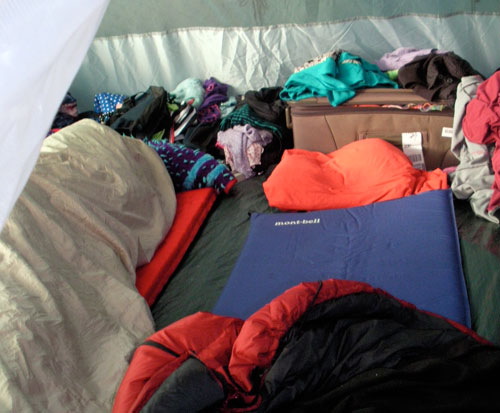
Inside our tent
Tasmanian summer is not like summer elsewhere. One day I woke to a 9C tent and that same afternoon sat in 38C sun watching a performance. Be prepared for anything.
Protection from cold. Bring warm things to sleep in and under. Raising yourself from the chilly ground is a good idea; a yoga mat + inflatable camping mat is better than either alone. A cot would be wicked. Bring gloves and warm socks, a warm hat, and maybe even a winter coat. A sweater/jumper is essential when the sun sets or the wind picks up.
Protection from sun. Sunscreen! You're going to be outdoors 24/7. When it isn't cold and raining in Tassie, it is sunny as hell. Slather up and consider a hat. If you are training, you'll be sweating, so have a water bottle to keep from dehydration.
Protection from rain. At least bring an umbrella and carry it with you every day, along with your sunscreen and a jumper. Honestly, you will likely need all three in one day. If it rains too much, training sessions can be canceled, so bring something to occupy yourself on a wet day, just in case.
Protection from dark. A torch is handy. There are no lights in the camping areas. The moon and stars are bright enough to light the oval, but not helpful when you're inside your tent.
Protection from pain. Training can be quite tough, so bring whatever you need to perform personal first aid. Painkillers, bandages, ointments for cuts, antiseptic lotions, arnica for bruises. Plus, there are aggressive biting ants, but crushed bracken root will ease that pain.
A carry bag. You will end up lugging your jumper, umbrella and sunscreen around with you, as well as your wallet and any training gear you need. A bag to put it all into is a smart idea.
Camping gear. A tent (or rent a camper van). Cooking gear as desired. You've been camping before so you know what you like in your camp site.
What to wear
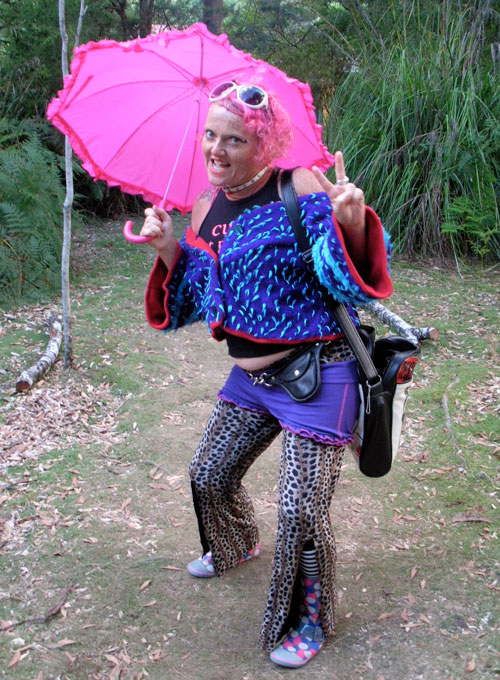
Jewelz has her own unique style!
For training, anything goes. Shorts, yoga gear, t-shirts or whatever you normally put on to train is great. Of course what that "whatever" is does vary by skill, so it's good to have some cross-purpose pieces in case you want to branch out and try something new. This year, there were lots of black tops and stretchy pants of various lengths - practical and can be worn more than once.
Layers are smart for peeling on and off as the weather changes. Shoes you can slip on and off make getting into your tent easier. Jeans are great in the evening. An extra jumper is essential all day long. My lightweight fleece jacket was on my body at least 12 hours a day. Something that blocks the wind would be useful.
At night during the public festival, the dressing stakes go waaaay up. The Bedouin Club is posh. Fur wraps (smart and warm!), vintage dresses, hats, full makeup, glitter, sequins, jewelry, handbags, and heels are du rigeur for ladies and men. Whether you choose a dressy or a quirky style, you want to look great. During the public festival, there are second hand clothing stalls to help you find the right pieces to complete your ensemble. I do recommend something warm to cover your shoulders on the walk from your tent to the club. (And do your makeup before sunset - it's challenging to make up well with a torch and a hand mirror in your tent!)
Other stuff to bring:
A notebook and pen. Take a few minutes to write down things you learned every day. There is so much to experience, you will be surprised when you review your notes at the end of the training. Good luck trying to describe those tricky physical moves but even a weird description may jog your body's memory.
Business cards. To hand out to people you want to keep in touch with. Just in case they didn't bring a notebook to write your name in.
A camera. Photos are a great way to capture memories and add to the documentation in your notebook. Snaps of stance, grip and those other hard-to-describe details can really help you take home the right information.
Ziplock bags. Useful for storing opened food packets, tidying your tent and keeping small things dry in the rain.
What not to bring
Video cameras. Still photography without flash is fine, but no videos. Stay in the moment and enjoy the magic. This can be frustrating when you want to capture something you are involved in, but suck it up and make your body do the remembering!
Cell phones. There is zero coverage, unless you are a lucky Telstra user who can find the magical square meter with one bar of reception. There is a booth under the pine tree with an old desk phone that takes prepaid cards (available at the Playground Cafe). There are sometimes long lines to use the phone. Don't promise daily calls home.
Bathing suit. There are no swimming facilities. There is a beautiful pond next to Tony's house, but it is for the platypus and duck. Look but don't dive in.
Zip ties and gaff tape. Waste, waste, waste.
Alcohol. There is plenty in the cafe and bar. Please support the festival by buying it in the licensed venues. And don't forget to put your empties in the recycling barrels.
Pets. Poochie stays at home. Cats and dogs don't do circus training. If your act includes a trained monkey or dancing bear, check with Tony, I guess! Children of all ages are welcome.
About the facilities:
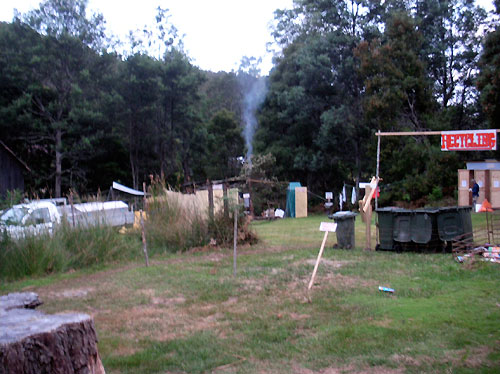
A peek at the showering, toilet and recycling area
It is a Zero Waste Site. Circus Fest is held on private property owned and loved by the man who runs the festival, Tony Rooke. He's lived there 40 years and the place is amazing. Do your best to keep it pristine. Pick up your micro-rubbish - the bits of wrappers, bottle caps and feathers that blow away or slip out of your hand...
There is extensive recycling for your use. You will dump your food scraps into composting bins, recycle glass, tin cans, cardboard, and plastic bottles. Don't forget to clean them out and crush them; don't be gross. Any other garbage you generate, you must take away with you.
There are two sinks for washing dishes near to the compost bins. There is a basin for doing clothes and a convenient clothesline near the showers.
There are three rustic shower stalls that are usually not very hot. To heat the showers, build a fire and wait 15 minutes or until the boiler makes a distinctive rattling noise. When the water cools, add more wood to the fire and wait again. There's one passive solar shower, too. There are also rather long lines for the showers at peak times, even with the 100 second shower water limit. Plan accordingly. Use organic, biodegradable soap and shampoo, please. Personally, I showered every other day and just wiped off the worst of the grime in between and dabbed on some tea tree oil. We were camping, everyone was sweaty and dirty and it didn't seem to matter too much. But maybe I would have made more friends if I had showered more frequently.
Toilets are a fascinating system at Circus Fest. First, there are urinals for men and for women. The men's is basically a tin-lined ditch behind a screen. Women have squat toilet style stalls - so learn to aim, ladies. The drop toilets with seats are for solid waste only, "no pee pee" Paper is provided. The stalls are cleaned every day and sprinkled with loads of lavender from a nearby farm. The odor is bearable and distinctive, though not pleasant.
It took a while to get my body learn to to stand in line, pee, stop, stand in another line, and then poo without peeing. But it was possible - 95% of the time, anyway. Many jokes and conversations revolved around the odd arrangement of the facilities, but we all seemed to manage with as much grace and good humour as possible.
About the workshops:
They are incredible. There is more to do than you can imagine. 60 workshops every day - some run as a course for the full five days, others are repeated daily, some riff on their topic depending on who attends. No matter what you decide to do, you'll learn heaps. Your fellow trainees have lots to share, too, so be prepared to make firends and pick brains. There is a great feeling of camaraderie during training.
The one thing I really didn't like about Circus Fest was the workshop sign-up process. There are two sign-up sessions and you are allowed to sign up for a certain few number of workshops for the whole week (eleven was the number, so about two workshops a day) with no repeats. After the official sign-up sessions are over and everyone has had their chance, the rosters are left open for anyone to fill in the gaps.
Ostensibly this is fair. But the mechanics of it are very awkward. There are long lines to get access to the 60 clipboards arrayed on tables, then it is an all-arms-and-pens crush to find the workshop you want and scribble your name. There is effectively nobody monitoring the number of workshops you sign up for, so anyone could cheat for more than their fair share. The geek in me thinks there would be a smoother computer-mediated solution, but that's not really in keeping with the offline spirit of the festival. Maybe if there were more space to move, or assigned times based on your ticket purchase date or your seniority at the festival or...I don't know. Something to reduce the stress of sign-ups would be good.
As it turns out, after the first couple of days, you get to know the instructors and they let you attend again whether you are registered or not (as long as there's not a limited number of props or gear). So it's all pretty chilled out in the end, but the signing up part was stressful.
Food and drink options:
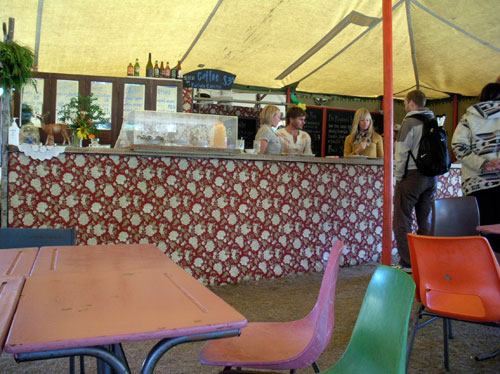
The Playground Cafe
Mealtimes are a little tricky - training starts at 11 and runs straight through until 6, but there are yoga and warm up sessions that begin at 8 am and there is a cabaret stage every night during training. There are no breaks for lunch or other meals unless you make them for yourself by skipping a session.
You might want a lot of easily carried, high calorie snacks to munch in the minutes between workshops. Dried fruit and nuts, crackers, stuff like that.
Our camping crew ate breakfast together every morning and we cooked dinner most nights. It was economical and a pleasant way to unwind and share our training notes before going to the cabaret. We ate well. I think next time, we'll take an esky to keep produce fresh a bit longer.
There are two restaurants plus a bar open during training. Restaurant meals are between 10 - 15 dollars and the menu is limited to your choice of the meal being served at Trevor's or the one at the Playground Cafe. Dinner is different every night; breakfast is always the same big plate of traditional yum (vegetarian at Playground, with bacon and/or wallaby at Trevor's). The food was consistently delicious. When the public come for the last three days, there are extra stalls and tents selling food.
Coffee is $3, soft drinks are available and various prices, and alcohol starts around $5. Be sure to try the homebrewed Horehound Mead. It's wonderfully bitter.
Water! "Bring your own" said the FAQ this year and that sort of startled me. A week's worth of water? That is a lot! You won't have to bring it all, but bringing some of your own (in the form of large jugs from home or from the supermarket en route to the property) is not a bad idea because there are only two spring-fed taps providing drinking water for 200 trainees. There is also water available for sale at the Playground Cafe for $1/litre.
On the day off:
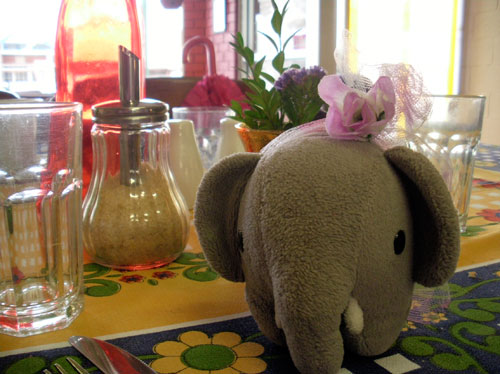
Zoupi liked the cafe in Scottsdale
The day off between the training and public festival is a good chance to restock and relax. We enjoyed a bit of shopping and lunch in Scottsdale, about 20 minutes drive from Lone Star. Alternately you can go to Lilydale, a similar village a bit further in the opposite direction from camp or all the way to the town of Launceston, about an hour's drive away.
In Scottsdale there is a Coles and a Chickenfeed ($1 store), several op shops and some lovely cafes. We restocked with produce and bread, did laundry, and generally had a nice day in civilisation that included four walls and air conditioning. It was a treat to use a toilet that flushed and offered hand soap. But it was awesome to come home to camp at the end of the day. Camp is good!
We arrived back just as the public were starting to arrive. We expected a long line of cars and campers, but it wasn't bad and we got to skip ahead through the side field to the entrance for trainees/crew/performers. The public and trainees camp in different sections of the property, so that security can be maintained for those of us with equipment and stuff.
Security:
Everyone is assigned a color-coded tag on a string on arrival. I tied mine around my neck and kept it on for the entire time - slept in it, showered in it, pretty much forgot it was there. Lovely necklace!
It's not so critical to wear it during training but at the public festival, your tag will get you the trainee discount in the restaurants, gives you access to the Bedouin Club, and allows you to enter the camping area. so do your best not to lose it, though we were told it was the string color that really mattered - the tags do tend to fall off.
We had no problems with theft or vandalism, but I would not take your very precious valuables to camp with you. Just in case.
Shifting from training to festival mode:
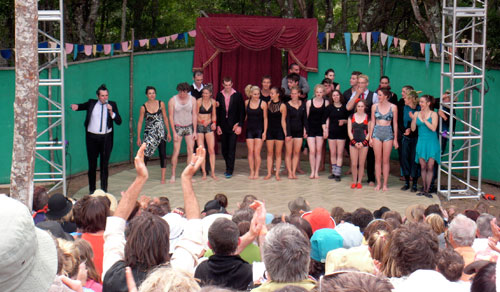
The Birdmann leads the crowd in a round of applause
They are both fabulous experiences. During training you are working hard, forge new friendships, play with your craft and get into the spirit of living outdoors. During the festival you can relax and enjoy the spectacle of dozens of shows, feast and shop at the new stalls, and party as hard as you like. The festival crowds are bigger so the atmosphere is different. Someone described it as being invaded, but for me, it was much more of a celebration. I loved both parts of the event equally.
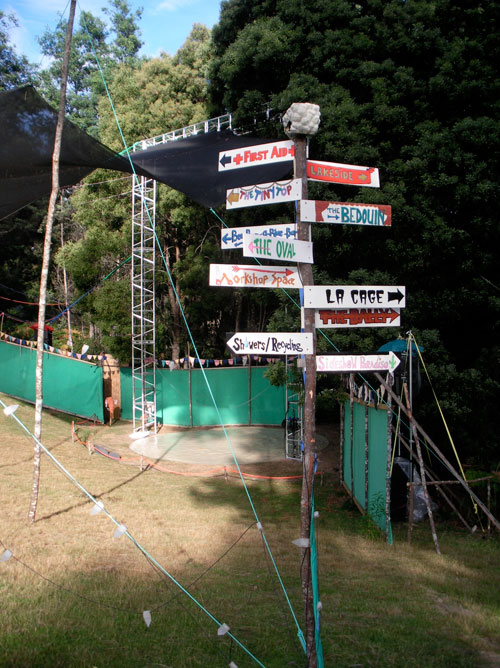
I honestly don't know where to begin with this life-changing experience. If I start at the beginning, last October when Jewelz suggested I attend, the tale will take ages to get through. If I start at the beginning of the training week, I think you might not understand how big a leap of faith attending this professional circus event was for me. So I guess I'll just skip the beginning entirely and merely jot a few of the lasting impressions.
I was overwhelmingly inspired by individual performers, teachers at the workshops I attended, and my fellow trainees. My goodness, the energy flowed and multiplied every day. I swam in the current of it with lots of happy splashes. Nearly drowned a few times. Came home drenched.
"It's not how far you go, it's how uncomfortable you feel." -- Jeff Turpin
Tassie Circus Fest is actually called the Australian National Circus Festival. It is five days of training workshops, then a day off, followed by three days of performances for the public. So including arrival and departure, I was there for 11 days. There were about 200 trainees and 2,000 members of the public. This is a big festival!
The youth circuses were incredible; Slipstream, Spaghetti Circus, and Circus Arts Byron Bay
Lone Star, Golconda is one of the most beautiful places I've been and Tony Rooke, who organises the festival on his private property, is a kind and generous man.
Tasmanian summer is damned cold. I wished I'd had mittens.
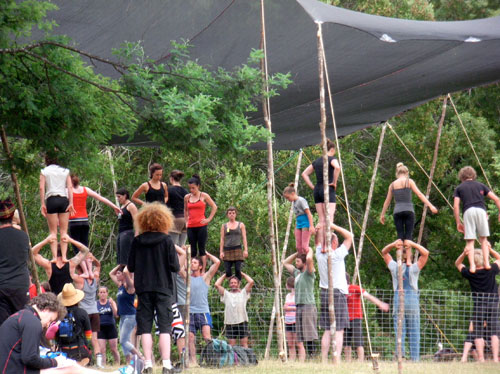
The training workshop schedule is tantalizingly complicated. You simply cannot do everything you want to do because there are 16 venues holding 60 workshops every day. The sign-up sessions allow you to book into only 11 total for the five days and some workshops fill to capacity. The ones that aren't full, though, you can usually drop into as you like.
Creativity flows in groups and duos. We came up with new acts every time we talked.
Circus folks are not scary or intimidating, as I'd feared. They are welcoming, crazy creative, committed to their craft, open to new ideas, all over the map in shape, size and age, intense in every aspect of their existence and yet relaxed and fun-loving at the same time. There are professional bonds, friendships and love affairs among performers - and it is difficult to guess which is which at first glance. No doubt feuds, too, though I didn't notice any of those. Everything they do is 150% bigger than life size. Circus people have some of the most fully-lived lives I've seen.
The riggers are possibly the coolest people on site.
During the training, I shared everything I could - from hoop dance flow and tricks, to ideas for costumes and music and staging. It was a relief to realise little beginner me did have knowledge that these amazing circus professionals could actually use.
Egg in a Sack is a pickled egg in a bag of crisps. Yum.
I learned more than I gave. Specifically in yoga with Jeff Turpin, hoop workshops with Sherrelle Dolphin and Lilikoi Kaos, Intro to Acro and Tumbling with Shannon McGurgan and Malia Walsh of Circus Trick Tease, Persona with Trent Birdmann Baumann, Performer's Voice with Tessa Leon, Viewpoints with Laura Sheedy, Zen Thai Shiatsu with Monique DeGoey, Got Game with Rachel Kramer, and a Performance and Choreography Intensive with Sarah, Diana, Molly and Lollo of LAVA from NYC.
"Has anyone lost a sock?" -- Daryl
I was cowed by the aerial and other physical workshops. Even though I'd have liked to try them, I decided the risk of a major physical injury wasn't worth it. Plus, trapeze, tightrope, and teeterboard aren't accessible to me in Tokyo. I had good rationalizations, but I feel like I wimped out. Maybe next time I'll be stronger, more capable and fearless.
A good MC makes a show 10 times better.
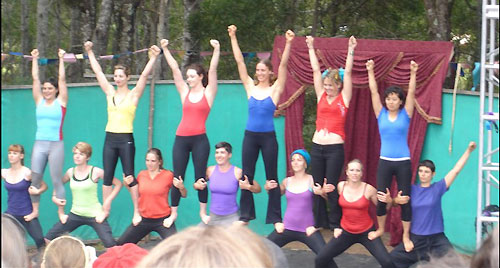
I performed on stage in front of the full public festival crowd. This was the culmination of the workshop with LAVA and it was great fun. Eleven of us trainees threw ourselves at the floor like ocean waves, ran, and balanced in synch. In between the group work, Sarah, Di, Molly and Lollo did gorgeous trapeze, acrobatics, and hoop diving combined with contemporary dance. I did double duty as stage manager, calling cues and making sure props and people were in place.
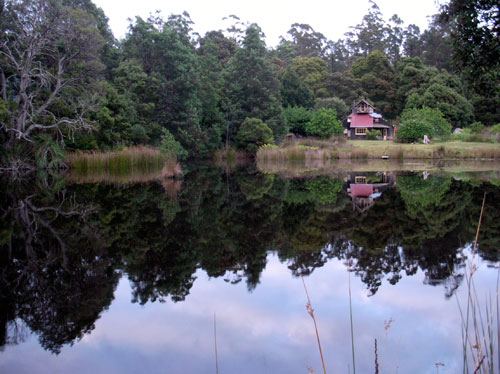
I saw a platypus in the Lake.
During the public festival, I taught two renegade hoop workshops alongside Amelia Cadwallader's scheduled one. With her permission, since her class was overflowing with a range of skill levels. I did an intermediate off-body hooping session and a workshops of special requests/intermediate trick help.
Australia is home to innumerable circuses and circus schools.
I made a list of acts I loved at the festival. Without being able to share them with you properly, here they are: Olivia Porters's "bottle of pills" juggling routine; Ruby Rowat and Sharon Gruenert's "John Henry" duo trapeze act; Intrika's contact juggling duo; Lords of Strut ladder and manspray routine. MC slots by Eloise Green, The Birdmann, and Astrid Rot. Honestly, there were so many that it's silly to try to list them all.
I can hardly wait to return in 2013.
The Tasmania adventure begins with a flat tire.
Jewelz' friend, Robin came to pick us up but her car got itself skewered with a screw in the airport parking lot. We jacked up the car and pulled out the spare to discover that it was flat, too. Fortunately, we had hoops to keep us occupied while we waited for the RAA to arrive. And while we had the tire repaired in Hobart, we enjoyed lunch at a yummy cafe. So it wasn't a bad start to the adventure, at all.
Robin's a dancer, hooper, aerialist and teacher who met Jewelz at Circusfest in 2009. We were visiting for a few days before heading to this year's Circusfest. Jewelz taught hoop classes in Cygnet, a charming village and the farthest south on the planet I've ever been.
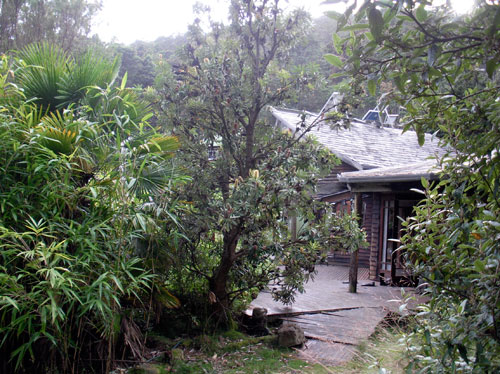
I love Robin's place. It's a large parcel of land that supports Robin, her cat, three chickens and some wild paddimonts. Her house is amazing - octagonal open plan in design with a combined kitchen garden and bath space off the kitchen. It's off the grid - power is solar, there is an outhouse (or the bush) for toilet needs, and water is catchment. It is peaceful and I relished staying there while we geared up for Circus Fest.
On Saturday morning we loaded the car with hoops, gear, and the three of us as we drove north to Launceston. We picked up Lara in the park there, crammed her and her bags into our remaining space and then hit the supermarket for fresh produce. We arrived at the campsite with enough daylight to set up our tents and cook a great dinner.
And then the fun really began.
I flew out of Tokyo winter and into summer in Sydney on the 21st. Thanks to the hospitality of Jewelz and her family, I had a great time staying in Cronulla in the Shire south of Sydney. We were on the beach in a minute's barefoot walk, and two minutes' walk from some excellent coffee and cheap shopping for sandals and $6 dresses. And with the RSL next door, there was an entertaining happy hour with the veterans one afternoon.
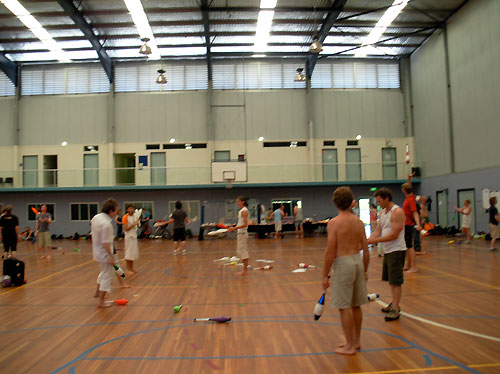
The Sydney Juggling Convention was my aim and I went with hoops and enthusiasm. The atmosphere was casual but intense at the same time. Of course there was talent in abundance. Jugglers do make me swoon, and I kept finding myself just standing there, staring at all the motion and concentration in the room. It was like a drug.
I swore I'd learn to juggle in an environment full of inspiring tossers. But I didn't. I managed better than I ever had, though, and especially when I was hooping at the same time. Weird. I bought a set of clubs because there are these mechanical moves called legos that are mind-twisting and teasing to get right. Even if I can't juggle my clubs (yet), I can enjoy them in interesting ways. Plus, clubs are really fun to swing and a challenge to pack into a suitcase. Who could want more?
Despite desiring a juggling breakthrough, I was there to hoop and make friends. I did both.
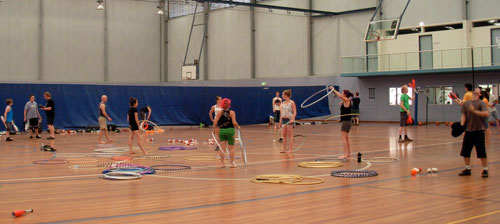
We hoopers took over a section of the gymnasium for our play and training. We ran the gamut from serious circus stars to fun-seeking spinners. I discovered the differences between circus hooping and hoop dance (I'll share that revelation in a separate post soon). I learned drills which will become a firm foundation of my hoop practice. There were numerous corrections and suggestions for improvement in my hoop stance and style. It was hard and fulfilling at the same time. And it wasn't all serious. There was lots of trick sharing, laughing and general jolly play. One afternoon, we rolled hoops down our backs in a long line, then passed a hoop foot-to-foot around a circle of a dozen of us lying in the ground.
During the convention, I taught a few ad hoc workshops including off body, hand and isolation hooping with Lisa and a morning warm-up featuring my favorite Kundalini sequence combined with Jewelz' leading the Tibetan Five Rites. I spun so fast and furious during the rites that I popped the blood tiny vessels in my hands. That was freaky.
After three wonderful days at the convention, I was on my own for Australia Day, as Jewelz and Lisa were teaching a workshop, so I went into Sydney and wandered around the harbour area, listening to bands in the Rocks and sitting in the shade of the botanic garden with an ice cream and a long phone call to Tod.
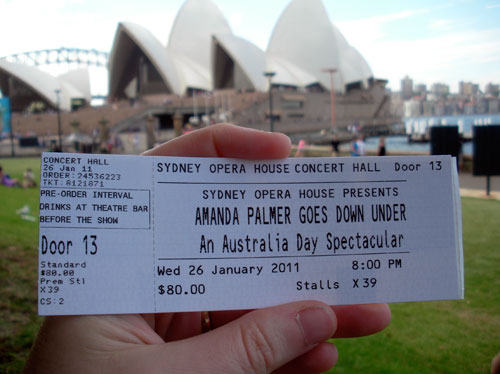
Really I was just waiting for the Amanda Fucking Palmer concert to start. I love Amanda Palmer. She is hot and smart and sings like I do in my dreams. Her show was fabulous and the backing band, Mikelangelo & The Black Sea Gentlemen, were equally incredible. There was a working barbecue on stage, she drank VB (what were they thinking) pulled out of an icy eskie, and wore an Australian flag corset.
I was lucky to discover that one my new juggling friends, Adam, was also going to the concert so we met on the stairs outside the venue and went in together. Another stroke of good luck had us sitting next to each other thanks to an observant usher. We squealed, shouted, and whispered, squeezed hands and generally enthused wildly through the entire concert. Neil Gaiman read three of his short works and I closed my eyes and imagined he was reading to me - never mind the other thousands in the opera house. I loved hearing you read about megafauna; thank you, Mr. Gaiman. And thanks, Adam, for being an awesome concert date.
The next morning, Jewelz and I packed up our luggage, shouldered our hoops, and headed to Tasmania. The main event was about to begin - Circus Fest!
Stepping off the train into Krakow was like coming home. I can't explain the familiar feeling of this place, but it was utterly comfortable to be there. Even though I speak no Polish, it didn't matter. The people looked like folks from my childhood and were just as friendly. The buildings reminded me of some of the architecture in Pittsburgh. The food was heavenly, but that's a post all in its own.
Poland Itself
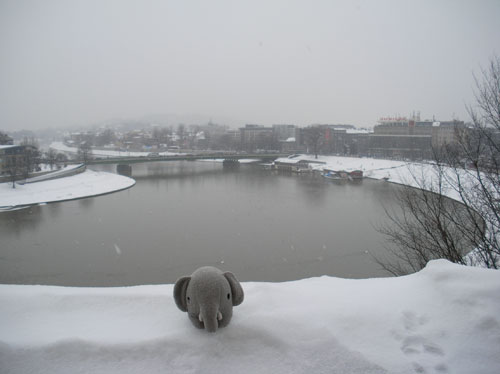
Zoupi and the snowy Wisla River
I had no clue about Polish history, so it was a surprise to learn that Poland was once invaded by the Swedes. That was back in the day (let's call it 1600) when they formed a commonwealth with Lithuania and their borders stretched up to the Baltic Sea. And then there was that time that Poland ceased to exist entirely. For the whole 19th century it was split up and doled out to neighbors.
After WWI, Poland got its mojo back, but then got into a mess of horror during WWII. Faculty of the university in Krakow were rounded up and either killed or exiled. The university continued to teach classes in secret by meeting in people's homes. Pope John Paul II, one of Krakow's truly beloved, attended this underground college when he was a young man. During Communism, universities were reinstated and free to attend, but the church was where you went to learn about things outside Poland and to borrow contraband literature and movies.
Today many of the buildings in the Jewish quarter and elsewhere in town are crumbling to ruins because the original owners can't be found and can't be proven dead. All 65,000 Jews in Krakow were exterminated by the Nazis leaving no paper trail; and later on the communist state did nobody any favors when they redistributed the wealth of the landowners to the people. Some of the nobility got their buildings back after 1989, but many couldn't provide proof of prior ownership. It's a shame that the government doesn't find a way to resolved the untitled buildings.
And one silly thing: Polish is the cutest language. Lots of words end in y: Planty is the park that surrounds central Krakow; you can easily guess what lampy and laptopy are. Really Polish is a morass of consonants that are not pronounced as I expected. So I didn't try to speak much, though I did get good at "piwo" and "Żywiec"!
Chopin & Other Music
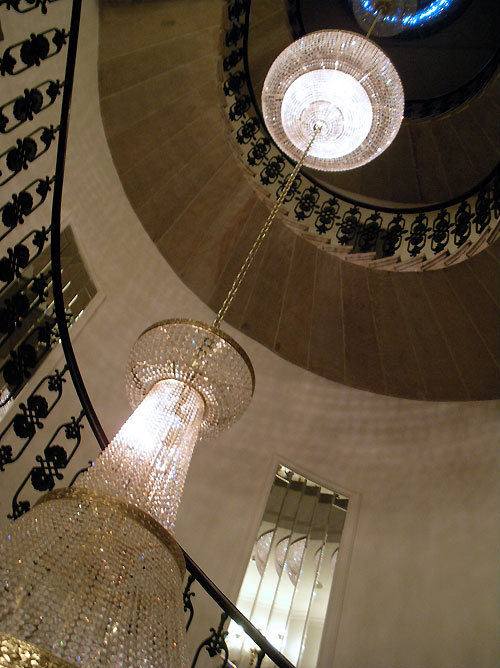
Part of the 22 meter chandelier at Palace Bonerowski, where we heard a Chopin concert.
Krakow is very proud to claim Chopin amongst its luminaries. There are daily Chopin concerts; we attended one played by a Japanese pianist from Hachinohe, Kazuko Tsuji. It was a pleasure to hear Chopin played live in a lovely old palace building.
Our tour guide, Anna, recommended we get a recording by Rafel Blechacz who won the International Chopin Contest in 2005. He is one of the best pianists I've ever heard; listening to his CDs made me cry. Blechacz is highly expressive and interpretive.
I was surprised to hear music I know and like on the radio. One day, I heard Magnetic Man playing in a restaurant. That made me smile.
Shopping Mall Entertainment
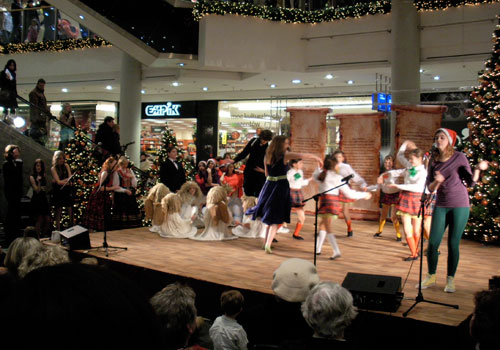
Christmas performance at the mall. Watch a video clip.
It was cold, so we sheltered in the huge Galeria Krakowska and did some shopping. There was lots of holiday buzz, including a gingerbread station, complete with oven and icing.
We stopped to watch these kids performing on the special holiday stage. There were a couple of standouts among the older kids - two girls who were developing an interesting stage presence, and one was a strong dancer. The older boys were quite lively and funny. In one number a girl sang a solo while all the boys pantomimed winter sports that devolved into a snowball battle, complete with pratfalls. At the end of the song, the boys zipped themselves out of their snowsuits to reveal tuxedos and stepped into place for the next piece. It was brilliant.
Christmas Market
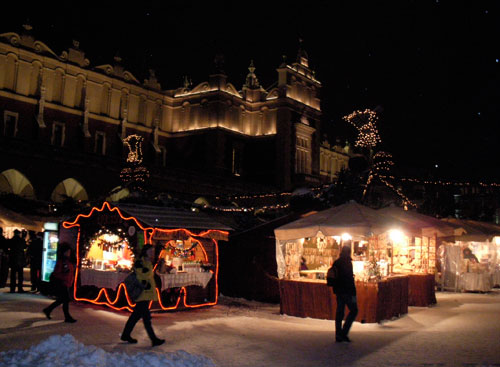
The Christmas Market glowed at night
The reason I wanted to go to Krakow in the first place was the Christmas market. It was delightful - stalls of kitchy stuff, but mostly lovely handcrafts, holiday decorations, stained glass, dishware, and lots of food. We ate and drank rather than buying lots of goods from the market, but that's just how we are. All the things I really wanted to bring home were just not going to make it - fresh mistletoe, candle wreaths, and more cookies that Tod would allow. (He let me have plenty, just not as many as I really wanted...)
Wieliczka Salt Mine
One of the things on our must-do list was the salt mine at Wieliczka. Like the ossuary at Sedlec, the salt mine is a UNESCO heritage property.
We had another transport adventure, taking the bus one way and the train back, but it didn't compare to the three hour, 3.5 km underground walking tour of this mine that's been in use since the 13th century. There were corridors and caverns, a chapel, salt chandeliers, salt lakes, some silly sculptures and some beautiful art.
One 30 meter high chamber was buttressed with huge, tree-sized timbers that were placed by hand in the relative dark of lamplight. What an accomplishment. People do such amazing things that it touches my heart to see their feats. I get all choked up over engineering.
During the tour we were encouraged to taste the walls; they were salty.
We waited for the shaft lift to take us back to the top with several other groups of people, including a couple of garrulous, drunk old-timers who got the evil eye from some of the more prim and proper ladies. One of them had a beaked nose that reached down almost to his upper lip. It was monumental. They reminded me a bit of the mill hunkies on the South Side of Pittsburgh and wondered if they might have been miners back in the day. (The mine stopped commercial operations in 1996).
Hotel Pugetow
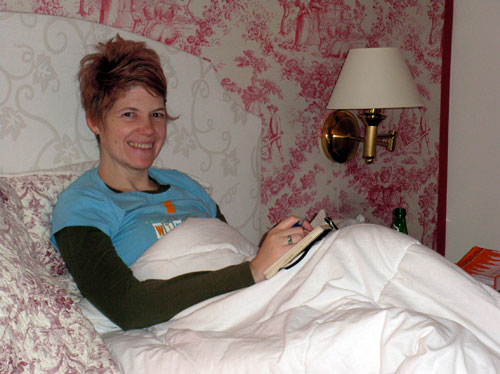
Me in bed taking notes about our adventures
I loved our hotel in Krakow. It is a little boutique place with just six rooms that was once the carriage house of the palace it's named for. Hotel Pugetow had the best staff - always friendly and helpful. We arrived very early on Saturday morning and not only did they let us leave our bags until check in, but they also gave us breakfast. And on our last day, when we came back to pick up our bags before our train in the evening, Anna the receptionist made us tea, brought out some slices of cake leftover from breakfast, and we sat and chatted for a while. It was a great experience.
A friend recommended that while we were in Prague, we should take a side trip to Sedlec to see the Kostnice Ossuary. It turned into quite a day. Every transportation point was an adventure.
The subway arrives.
First we had to get to the bus station by subway. But we didn't have the right change for the subway, which sells tickets for 26 crowns - coins only - so it was off to Tesco for some juice and (yummy licorice) throat lozenges. When we got back with change, the ticket machines were being serviced. But eventually we got on the subway and when we got off, it took us a few minutes to locate the bus station. A nice young man at the info desk told us the bus for Kutna Hora, the nearest town to our destination, was leaving in three minutes from stand 12. We dashed and made it.
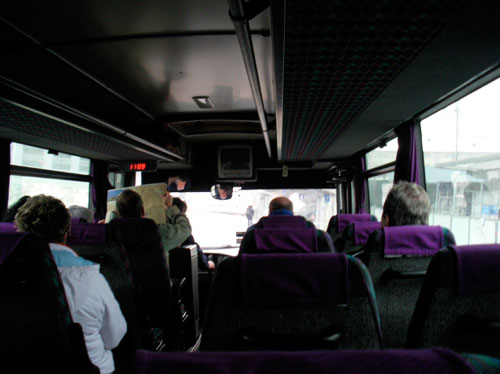
On the bus to Kutna Hora
When we got to the bus terminal at Kutna Hora, the signage was rather confusing. Could we catch the bus to the ossuary from there? The terminal was quite large, with outdoor bays for about 20 buses and they were all marked in Czech. None of them said Sedlec so we walked into the center of town by a circuitous route to find lunch and the tourist information center. We had pizza for lunch that was rather tasty, but the stressed out and squabbling Americans behind us were rather off-putting. After lunch, the tourist info center told us that yes, the bus did leave from the main terminal but also from near St. Barbara's Cathedral which is the area's other attraction. So we wandered over to see it. Wandering is the best you can do in Kutna Hora because all the roads are twisty and there are signs pointing in every direction. But wandering is fun in old towns and the cathedral is large and tall and hard to miss.
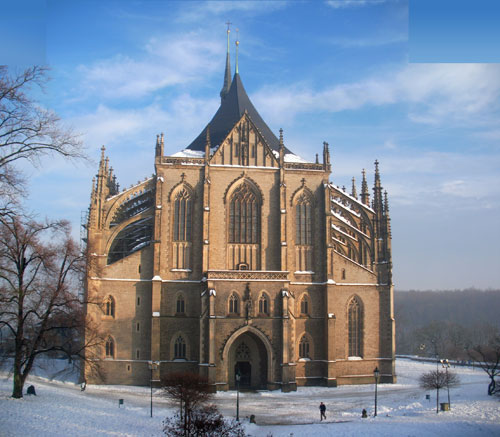
St. Barbara's in the snow
It was duly impressive with some beautiful stained glass windows and doors with gorgeous open keyholes and swirly curved hinges. After a short tour of the premises, we found our way to the bus stop that would take us to Sedlec and the ossuary. A few other people, locals and tourists, were also waiting there and we were all surprised when our bus passed right by the stop. But a few minutes later another bus stopped for us. We rode for about 20 minutes, managed to miss the right stop and had to walk back a bit to get to our destination.
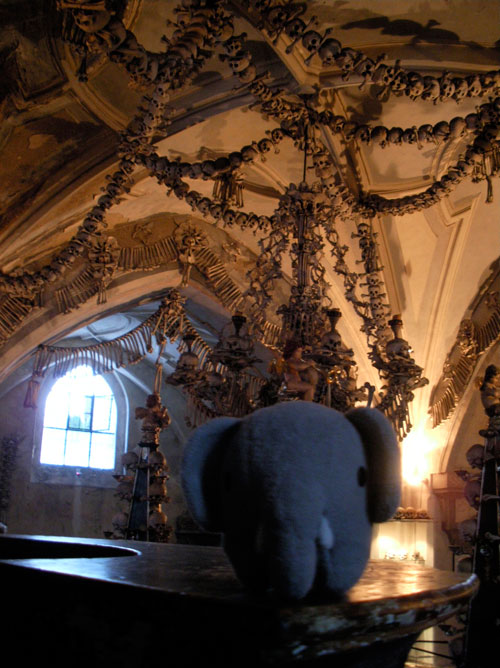
Zoupi in the ossuary
An ossuary is a boneyard. This one is remarkable because it contains the bones of about 40,000 people - ranging from Bohemian aristocrats to plague victims - and they have been artfully arranged in the crypts by a woodcutter who took on the task as his life's work in 1870. There are swags of skulls and frills of femurs. It is respectful, serious, and odd as anything. I really enjoyed it.
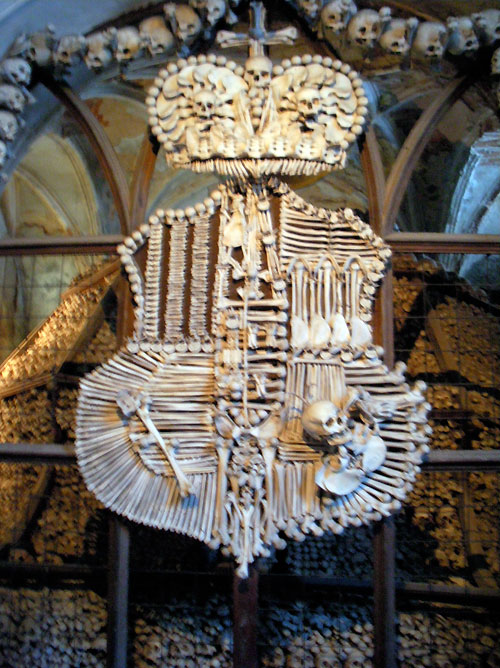
A coat of arms in bones
But it is small and in 20 minutes we had finished our long and thoughtful look at the place. We decided to head back to Prague. Maybe we could take the train. We popped into the other local tourist info center and a geeky man (Many of the info center workers we encountered in our journeys were long haired men who looked like they were displaced Unix hackers; it was strange.) looked up the times. If we hurried down the road and around the corner - not across the bridge - we might make the next train in 17 minutes. We did it, with about 30 seconds to spare. We hopped on the little two-car local and rode to Kolin, where we had to change.
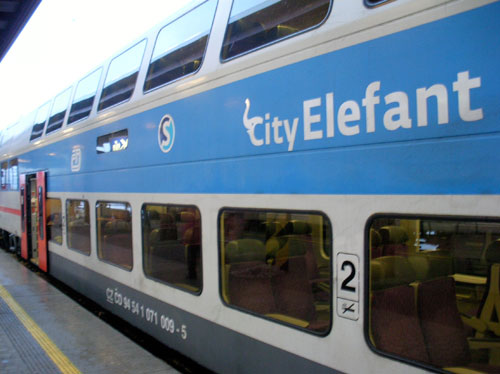
The City Elefant commuter train
We hoped we'd get to ride the City Elefant, but were directed to an express train from Berlin that was arriving late due to snow. We found our way through to the 2nd class open carriage and settled in for the ride back. It was quite comfortable but there wasn't much to see - from track to horizon to zenith, everything was greyish white.
Snow and fog from the train
We thought we were set when we reached Prague because we could take the subway back to our hotel, but the subway was broken! They were still selling and validating tickets, though. and everyone who had been swindled by this - there were not signs about the problem until after you'd entered the subway itself - stood in a ragged line by the one service window that was open. The woman inside the kiosk looked less that interested in our problems, but I stood in line anyway. She gave me a shrug, which may have been more than the Czech speakers got.
It seemed there was not much to be done about it, so we opted to walk back to the hotel. It wasn't that far, maybe 20 minutes through Wenceslas Square and up a bit towards the river. Chilly and slushy, but perfectly walkable. Tod was wearing a new pair of boots, though, and by the time we reached home he was hobbling at the pace of a geriatric waiting for a hip replacement. Ouch.
So we saw the ossuary, which was one of the only things on my wish list for Prague, and every step of the way was an adventure.
I wanted to take our vacation in Poland, but there's no direct flight to Krakow, so we went to Prague on the way. As all travelers do, we came away with our own set of stories and memories. Here are some of them.
The Boiler Upgrade
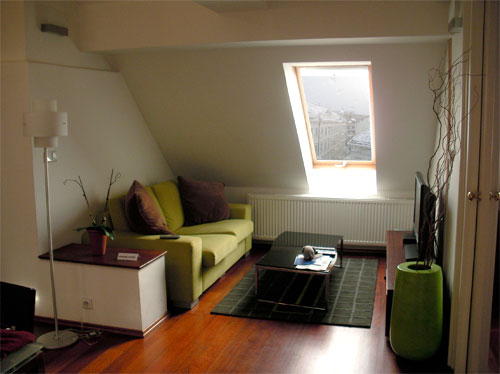
Karoline 54, our second home in Prague
For our first few nights in Prague, I rented us an apartment through Prague City Apartments. I found one, the Masna, that was near the main square and close to a supermarket. It was reasonably priced, too. We arrived late at night on the 6th and it looked great. Comfy bed, a TV, nice view over some city roofs. We had a kitchen with the necessary appliances and dishes. Perfect for our needs except that the hot water ran out after Tod's shower the first morning. Well, lesson learned - shorter showers and I'd go first the next time!
After a day of sightseeing and provisioning, we popped back to the apartment to drop our purchases and have a cup of tea before dinner. It was chilly. We turned up the heat a little but it never warmed up. After a while, we realised the boiler wasn't working. Tod ran upstairs to the next floor to use the hotline phone to the agent. It was broken, as was the Internet. Well! Adventure time. We bundled up and walked across town to the agent office to report our problem. It was really cold and snowy!
The receptionists on duty, two university students doing graduate studies, were sweet. We explained what had happened and they made us coffee and we sat and chatted while the technician, Vashek, came over. They were surprised we weren't angry, but why be angry? It's not like they broke the boiler on purpose. We knew it would get sorted out one way or another. They suggested that if the boiler could not be fixed, they could move us to another apartment - except in Masna all the apartments were getting boiler upgrades so we'd have to go to another building - a nicer one. I sort of hoped we'd be able to stay at Masna, because the location was so perfect.
Vashek arrived and drove us over to Masna, where he checked the boiler. No luck. We didn't know it then, but they'd conversed among themselves and decided to upgrade us regardless of the boiler. So we packed up our things and moved house to Karoline across town. The new apartment was much nicer, in fact; a stylish 1 bedroom apartment instead of a slightly frumpy studio. And the location was different but just as good. We were happy to have this as out home base for the rest of our stay.
Vashek and the Olives
On his way out of our new location, after checking all of the heating, water and appliances, Vashek offered to get together with us if we had time. "Let's have a beer or something," he said. Sounded OK to us. Vashek is an enthusiastic 25 year old with a degree in engineering and lots of dreams and ideas. He'd just started work at the apartment company a few days before we arrived.
We did meet up with him two nights later for dinner and a beer. It was a delightful night. He was so full of stories and told them with wonderful gestures and expressions, including this one about the first time his family had olives, about five years ago:
It was Christmas and we wanted to try something new. So my mother bought olives - green ones and black ones. We were excited to taste them, but when we opened the tin of green olives, they smelled really bad. "These must be gone off," my dad said. My sister looked at them. We emptied them into a bowl and bravely tried them. They tasted like gasoline! They were terrible. We decided they were not healthy and they must be very dangerous to eat. So we covered the bowl and put it in the refrigerator.A few days later, the bowl was empty. My mother admitted that she had eaten them. "I tried another one and it was still tasting strange, but then I got to like them and wanted more. So I ate them," she told us.
After that, my father learned to eat them, and then my sister and then finally me. Now we love olives.
The tale isn't the same without Vashek's funny faces and storytelling skills, but I think it is interesting that a middle class Czech family had never encountered olives until 2005. They were rather limited under communism until 1989.
Snow and Cold
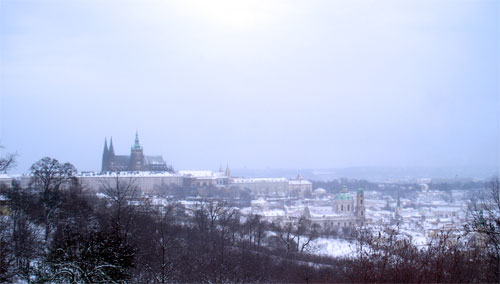
Prague Castle from the funicular
Prague doesn't normally get a lot of snow, except for the week we visited. The city was blanketed then slush-covered and icy. Our first day there, Tod bought waterproof boots at Bata and then stomped through puddles while I picked my way through the slush in my Doc Martens.
It was amusing to remember that it had been 23C in Tokyo the previous week. the evening we arrived in Prague, it was -9C. Some days it warmed up enough to melt the snow and slush a bit, but most days were simply freezing cold and windy.
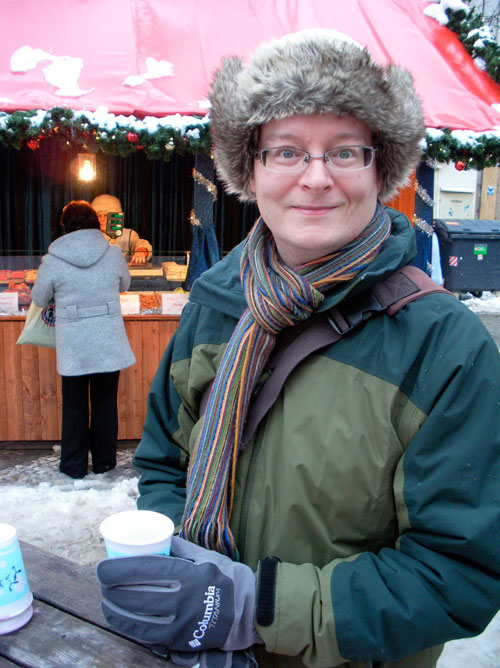
Tod warming up with hot wine at the Wenceslas Square Christmas market.
It was delightful to be in the cold and it gave us lots of excuses to get inside for a cuppa or to grab a warm drink at the outdoor markets. Yay for mulled wine!
St. Vitus Cathedral
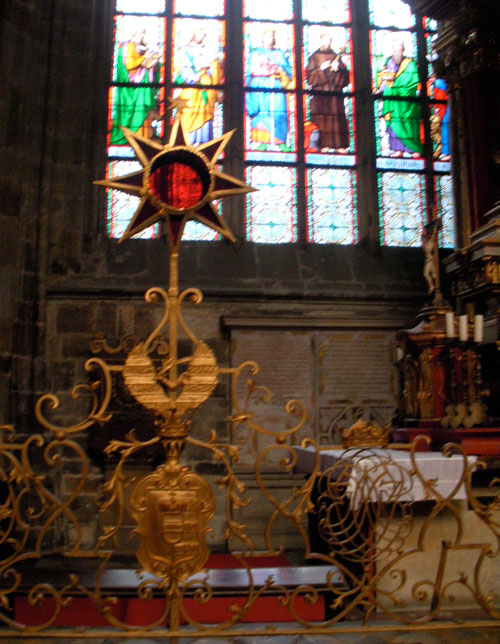
Gates and glass at St. Vitus
One of the ways we got out of the cold, though not by much, was visiting Prague Castle and the beautiful cathedral there. It was not heated, but it wasn't windy!
St. Vitus Cathedral is huge and we enjoyed walking around the periphery, looking at the gilded carved wooden gates and all the sainted class in the chapels. It was a testament to the power of the Church to hire skilled and talented craftsmen and artists.
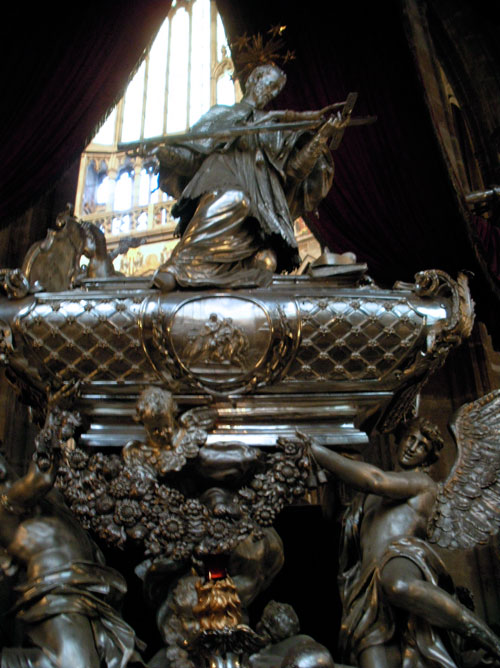
This is not as small as it looks...
As you round the top end of the church, there is an enormous silver sarcophagus. It is over-the-top gaudy with cherubs and garlands and even a bas relief of the silver miners who contributed to its creation. It is the resting place of St. John of Nepomuk, and he stands atop it much larger than life and cradling a tiny Jesus on the cross. This man must have been a giant in real life. Or had a giant ego.
At least stifling my laughter helped keep me warm.
Two things about being in Australia spin me out:
1. Sunny windows face north.
2. Orion is upside down in the night sky.
Of course I understand why these things are but northern hemisphere living has me oriented* the other way. Other hemispherical differences, like opposite seasons and solstices, don't phase me in the least.
*Actually, is there a north-south word pair like orient & occident?
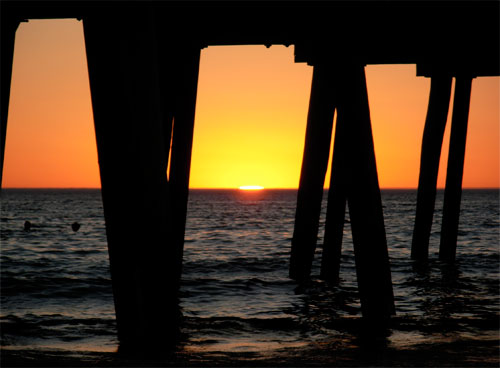
Sunset under the jetty at Henley Beach
Last week, Tod & I jetted out of winter and into an Australian summer.
Adelaide was blistering. For four days in a row, the temperature was over 41 degrees, kissing 43 on Sunday as we stood in a garden for Tracey & Ashley's final wedding. The heat is dry as a bone, sucking moisture from your eyes and skin with barely a shimmer of perspiration. I drank lots and lots of water but never felt fully hydrated. Air conditioned shops, hotel rooms, and pubs were crucial to keeping comfy, but they were dry, too.
On Saturday, Jo, Martine, Tod & I braved the outdoors starting with a lunchtime picnic under the banyan trees near the botanical gardens, then lazed around in the heat hooping a little and watching wedding photographers until scooting off for Greek dinner and sunset poi fun on Henley Beach.
When it finally started cooling off Monday night, the sidewalks radiated enough warmth to make arthritic joints happy. By Tuesday morning, it was raining and barely 22 degrees. I put on a jumper and shivered up in the Barossa before we hopped a flight to the Gold Coast and then back to winter.
What a shock to return to single-digit Tokyo. Now I am sitting at my desk dressed in layers with the windows open airing the musty smell from the house while the sun shines in our southern windows. I can barely remember the heat.
Chiang Mai is home to lots of elephant tourism. While researching our options, I whittled it down to two: Maesa Elephant Camp's 3 day mahout course and a two day visit to the Elephant Nature Park. We opted to do both because they were too different to choose between. Our experiences were like day and night, too.
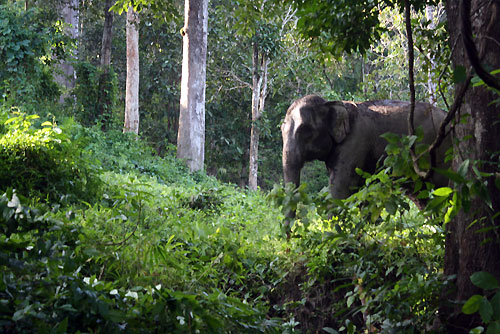
Maesa Elephant Camp
I loved our visit to Maesa Elephant Camp. We were the only overnight visitors during our stay. We were assigned a bilingual staff member, two mahouts (elephant keepers) and their elephants. Mui, our liaison, took all the photos, talked us through stuff, and was constantly cheery and friendly. Mr. May, 10 year old DuanPen's mahout, was often stern due to his military background but his sense of humour was good and he was careful with our safety. Handsome young Mr. Don handled 39 year old Mae Noi, our balky elephant friend and primary mount.
Based on the camp's website, I anticipated a morning of classroom lessons on elephant physiology and psychology when we arrived, but after a ten minute walk through a hall of elephant photos and anatomical drawings, we changed into our 'mahout suits" then watched an elephant show where the elephants played harmonicas, threw darts at balloon targets and painted pictures. Highly entertaining.
And then we were riding elephants!
"Grab her ear and her skin here, and then she puts up her foot for you. Step up her foot and put your leg over her. Sit on her neck. Put your feet in behind her ears." Mui explained. And that is how you ride an elephant. Simple.
Actually, it is is as simple as that. Riding an elephant isn't far off riding a horse. There's a similar motion and need to balance. It's tiring but gets easier with practice. Mae Noi definitely knew we were new riders and ignored most of our commands in favor of stopping for a drink or a few bites of tasty grass. Mr. Don confided that she doesn't really listen to him, either. Mr. May's commanding voice often got her moving, but she even ignored him. Headstrong elephant!
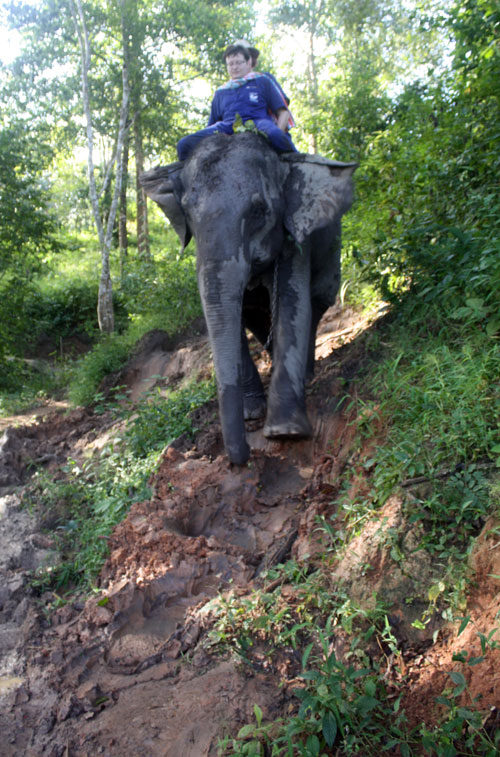
We rode her into the jungle the first afternoon and hiked back to camp in our flip flops. It was hot and exhausting and our shoes were sucked into the mud more often than not. We begged off going back for her the next dawn in favor of resting our aching thighs and backs.
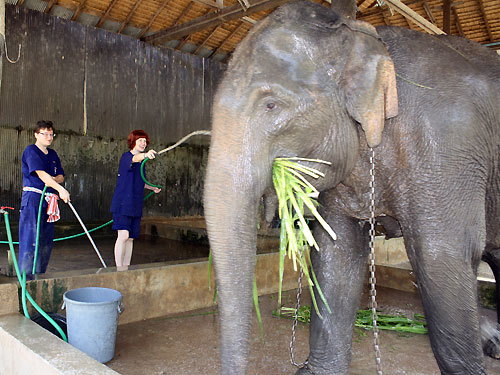
Elephants love to be wet, so we bathed our elephants in the river by splashing them with water from wicker baskets and brushing them. On the morning of our last day, after Mae Noi had spent the night getting herself covered in jungle mud, we used the elephant shower to hose her down and wash her off with soap.
We ate well, too. Breakfast was served after our morning jungle hikes/rides, then a large lunch in the afternoon, and we had cooking lessons with the camp cook at dinner time. Each meal I looked at the multitude of dishes and thought "Way too much food," but hunger snuck up on me and I nearly always finished what had been laid on the table.
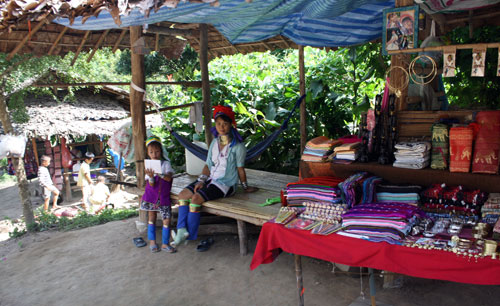
One afternoon we saddled up Mae Noi and climbed the mountain to the hilltribe village. It is a model village, government sponsored, with a central fish pond and lovely thatched houses. The villagers peddle their wares for tourists and run a good restaurant, too. There is a comfortable symbiosis between the village and the camp; commerce flows between them in the form of food, tourists, and jobs. In the evenings after the camp closes to day visitors, motorbikes speed up the hill and return with chickens and fish and other ingredients. Kids from the village come down to play soccer on the camp pitch. Dogs have friends in both places.
Some of the mahouts are villagers who go home at night. About half the mahouts live in the camp with their families. We walked through the mahout area with Mui for a look. It's a bit squalid, I guess, but the huts are comfortably lived in and everyone seems happy. We discovered that Mr. May runs the camp cockfighting ring and had a peek at some of the contenders, who were housed in special wicker cages.
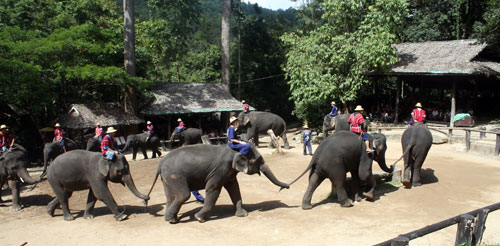
We had a chance to ride in the show parade on our last day. It was tempting to take off my hat and wave at the crowd, but DuanPen was a bit frisky so I settled for "staying on elephant" as my show trick. After the show, we played soccer with DuanPen and she painted pictures with us. We fed her and Mae Noi a pile of bananas, then it was time to leave.
When we left Maesa, I was so happy I nearly cried. We'd had a great time with the people and elephants there. I would absolutely recommend it to anyone. If you want to see more pictures, check my Flickr set all taken by Mui and presented to us on a CD to take home.
Elephant Nature Park
Elephant Nature Park is a completely different place. ENP rescue elephants from terrible conditions and give them a happy home with lots of freedom. No tricks or shows for visitors, just elephants ranging around a large field interacting with one another in a natural elephant way. They seem very happy and they are certainly well-loved by Lek, the park's founder, and all the staff there.
Even though these elephants come from different places, they form new family groups together. For example, there are several cows with babies and each has attracted a set of "aunties" who help to care for the little ones. If a baby gets spooked and squeals, mum and the aunties rush over to form a protective shield around the baby. The disabled elephants look out for one another. The younger elephants frolic together and swim in the river. It is heartening.
Elephant interaction with the visitors is not entirely restricted. Twice a day the elephants come in near the buildings to get baskets of bananas and other produce. Visitors are encouraged to feed them from the balcony, then allowed to go down to the river to splash and scrub them. There is a "close up with babies" time when you can try to get close to them, but they are frisky and unpredictable, so up close can equal 'trod upon' if you aren't alert.
In addition to the day visitors, there are overnighters and volunteers. Volunteers spend their days helping out with poop cleanup, road building, vegetable harvests, building maintenance and so on. Overnighters do the day programme twice, but get to sit in on the evening activities with the volunteers and get a special walk in the big field with the elephants in the morning.
The volunteers, while doing selfless work, are mostly oddballs. Very dedicated but vapid. Not critical at all nor interested that there is a spectrum of options. I didn't want to see what would happen if I made one of them follow the logical conclusion of ENP's grand missions: returning all elephants to the wild requires people to give back the land that used to be elephant jungles (which is much of inhabited Thailand).
Lek herself is celebrated as a brilliant conservationist worldwide and simultaneously despised by the local elephant tourism operators whom she condemns. She is thwarted by the tourism industry and tells stories of hearing that she is dead and her park is closed. She is passionate, well spoken and has very lofty goals that she tackles one elephant at a time. Her colleagues are equally passionate and dedicated.
As much as I truly admire the work they are doing for elephant rights at ENP and am delighted at how happy the elephants are, I wouldn't go back.
My problems began on the van ride to the park with a documentary that explained the history and work of the park and showed some of the brutal conditions of the elephants that had been rescued. Our tour guide continued the education with stories of elephant torture, rape and other horrors. I would have preferred if he had found a more positive delivery for the ENP message, rather than constantly reminding me of how terrible humans can be to animals. It was a bit like being in a PETA workshop. I hoped this was just a bad guide. He was overzealous and bossy. Others at the park were nicer but they all had the same depressing spin on their work: elephants are victims and people are bad.
ENP does good in an imperfect world and is trying to right wrongs. That is worth supporting. But if you are thinking of going, I suggest a day visit.
I am glad we experienced both sides of elephant tourism. Maesa was delightful and made me happy, but they might torture their elephants to make them docile and trainable. ENP was dreadful from my perspective as a visitor, but it is great for the elephants. One coin, two sides.
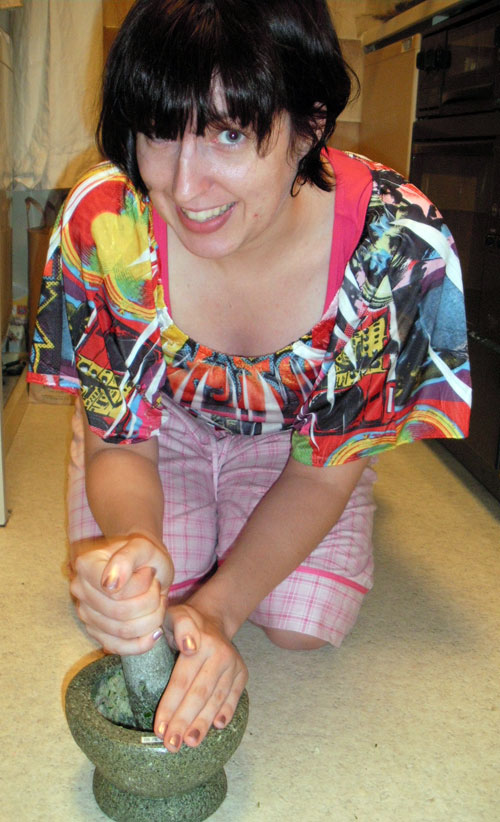
Amanda gets down on the kitchen floor with the curry paste tonight.
During our Chiang Mai vacation, we indulged in a lot of Thai food and took several cooking classes. The first class was a day at the Thai Farm Cooking School where we visited a farmers' market, toured the school's organic farm, ground curry paste by hand and made more food than we could eat, including curry with our fresh paste and a dessert of mango with sticky rice. A few days later, the cook at Maesa Elephant Camp led us through some simple recipes at dinnertime. Back in Chiang Mai we did an evening course at Baan Thai and made fish cakes, soup, more curry paste and the local noodle dish, khao soi.
I was sort of surprised at how none of the cooking methods were exotic - mainly stirfry and simmering.
Curry is basically fried vegetables simmered in coconut milk. There's no major mystery to making tom yam soup; it's just a lightly boiled soup. Steaming rice is a bit different than boiling it, but even that is just steaming.
It was the ingredients that made all the difference. So many good smells in Thai food, as Tod says. We worked with kaffir lime leaf, fresh lemon grass, members of the ginger family and oh, those tiny bitter eggplants! We despaired of ever recreating these dishes in Tokyo, despite our instructors' enthusiastic entreaties to "Please cook Thai at home!" But today, Tod discovered a Asia Superstore, a Thai grocery in Okubo near Higashi-Shinjuku station. He biked over and came back with a mortar and pestle and everything else needed to make curry paste. They even had the eggplants.
When we returned from the US on April 28, it was the very beginning of the swine flu scare.
Our plane was boarded by half a dozen officials who handed out questionnaires about our health. They were followed a man in a mask, gloves and surgical gown who walked through the plane with a thermographic scanner while the rest of his team realised they should have been wearing masks and ran off to change costumes before handing out the rest of the forms.
Eleven days after we landed, when the flu would have had sufficient time to incubate, I received a phone call from the government's special "fever clinic." They were checking up on us. Had we felt any flu symptoms since we returned? I was able to assure them that we were healthy and not feverish.
Interestingly, the four cases of H1N1 here in Japan are all from one school trip to Canada. There is also a student in China who returned from Canada with the flu. I wonder if they had the same vector? Watch out for those school trips to Canada, I guess.
WHO says there are now just about 6,000 confirmed cases worldwide. That is not even 0.001% of the world's 6.7 billion people. And with about 60 deaths in 6,000 people, H1N1 has a 1% death rate, which is about the same mortality rate as simply being over 60 years old.
I think we can all calm down now.
While in Ephrata visiting Mom, I got to help dress the set for the musical She Loves Me. I was lucky and got to do all the fun bits - making a dessert cart, dressing a shop window and four shop counters, decorating a Christmas tree. I also did a bit of painting and various dogsbody tasks to help get things done before dress rehearsal.
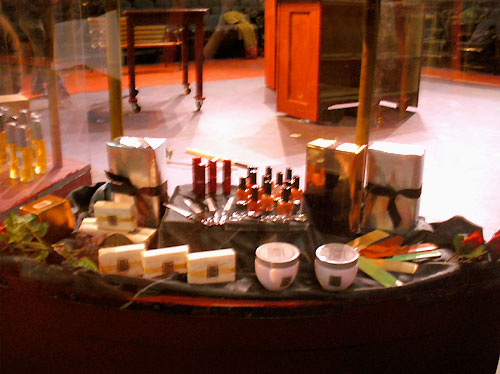
One of the counter displays in perfect condition.
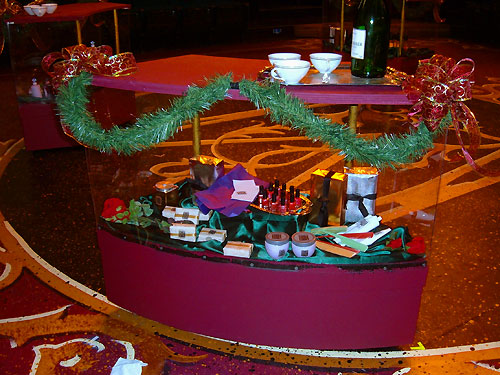
After rehearsal one of the soaps had toppled and some items were teetering.
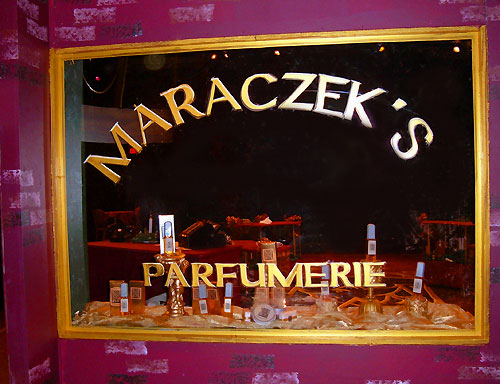
The window display with the scenic painters' lettering work.
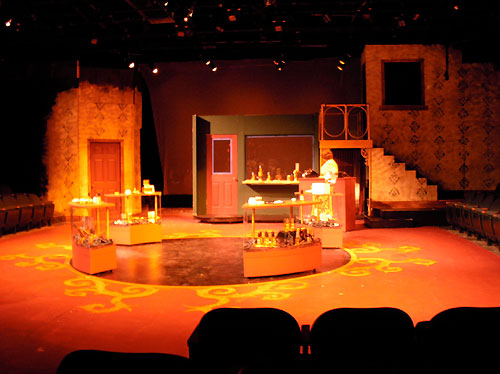
The whole thing before painting was completed.
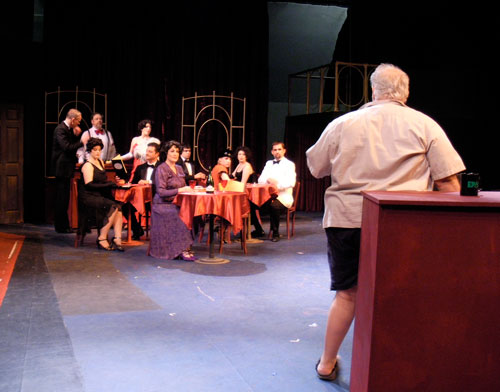
The cast and artistic director in rehearsal.
We sat in on dress rehearsal and I have never laughed so hard at a musical. The comedic songs were spot on and the acting was sharp. If you're in the Ephrata area for any of the run (Dec. 11th - 13th at 8pm; Dec. 17th - 19th at 8pm; and Dec. 20th at 2pm & 8pm ) be sure to go see it. Tickets are available online and you can see a snippet of the show and an interview with the directors here: http://www.ephrataplayhouseinthepark.org/
According to some, the world will cease to exist tomorrow when the Large Hadron Collider does its "first beam" at 9:30 CET (that's 4:30 pm in Tokyo). Others posit that LHC's man made black holes will fling us about in time. The scientists say we're safe, but haven't they said that about other experiments that turned out to be rather dangerous? I guess we will have to wait and see.
I'm planning to hedge my bets and have a pint or three in advance of the first beam ala Hitchhiker's Guide to the Galaxy, and I will have my towel in hand. Wonder if I should pack an emergency time travel kit? I can't even imagine what I would I put in it.
Hoop dancing is all the rage these days, and Jo ordered herself a nice hoop to play with, which we did before hopping in the car to the airport. I wasn't very good at hula hoops when I was a kid and I haven't magically improved with age, but it sure was fun to get out in the yard and try.
For much more impressive and skillful hoop dancing, see these videos:
http://www.youtube.com/watch?v=x6PEsM3rQpI
http://www.youtube.com/watch?v=oQAbJERbWAY
http://www.youtube.com/watch?v=N4ggKdyJf7k
As Jo & I walked home from dinner at a nice Greek restaurant last night, we saw a golden retriever sniffing along the street at the parking entrance to one of the city court buildings. He was unattended but wearing a collar with a tag. I gave him a pat, then read Toby's phone number off the tag to Jo, who rang the owner.
But as I chatted with the dog and Jo waited for the phone to answer, a loud authoritative voice called out to us. "That dog belongs to the dance studio next door. He's a regular here, it's OK."
I turned to face the speaker, who was a large, black dome mounted on the side of the parking garage. "Oh, OK. We thought he might be lost. Thanks," I called up at the wall and smiled at the unseen watcher behind the security camera.
Although I realise that I pass the watchful eyes of scores of security cameras every day, this is the first time I've ever been addressed by a faceless voice coming from one. (Video doorbells not included. )
Yesterday I spent a few hours in the Yatala Labour Prison. I was volunteering in the canteen with Jo and her boss, Jeff.
I'd never been in a prison before, but it was similar to what I have seen in movies and on TV. We signed in then walked through two controlled doors to reach the visit room where the canteen operates on weekends. After a quick preparation for sales, we heard the doors clunk open and visitors arrived, buying snacks and drinks in a flurry.
Prisoners, dressed in dark green, navy, or pale blue sweatshirts and trousers, sat in chairs marked "P" across low round tables from their visitors. All the furniture was bolted to the floor so nobody could get too cozy. Despite that, there were plenty of kids running about and getting hugs from their fathers, and a few prisoners greeting partners with a kiss or two. I saw a lot of awkward smiles and tense conversations, too. I imagine those 40 minutes are packed with a lot of information to be shared - both good and bad.
In the canteen, we microwaved dozens of pizza slices, sold out the entire inventory of Farmer's Union Iced Coffee, and bagged up many mixed lollies for the kids. I did my best to serve people quickly, but it was challenging since I didn't know all of the products for sale (for example, I know what an ice lolly is, but I didn't know the brand name) and my handling of change is slower than it could be. But I smiled and was friendly and I hope I did a fair job.
(On a similar topic of volunteering while vacationing, I donated blood last week for the first time in more than a decade. I was happy to learn that my iron levels were high!)
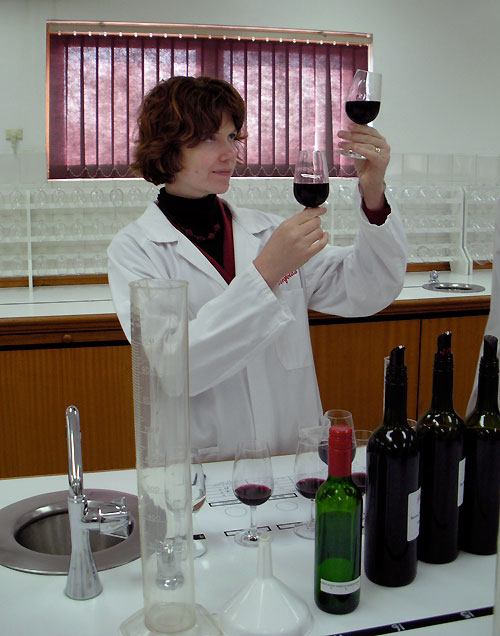
Examining wine at Penfolds
I spent two days touring the wine country near Adelaide with Barossa Epicurean Tours. What a great time! It was just me and Tom, my driver and guide, whose knowledge of wine, local history, geology, botany and current events made the trip exceptional.
The first day we spent in the Barossa driving around to cellar doors and trying local produce. At Penfolds I had a tour of the enormous operation (they are owned by Fosters) and then played at blending my own wine. Tasting wine before lunch made me tipsy, so we stopped at a well-known purveyor of dried fruit and nuts, Angas Park, and the Barossa Valley Cheese Company, where I picked up a delicious goat's brie. We had lunch at Kaesler, and did a bit of tasting and shopping at Rockford and the gorgeous cellar door cum gallery, Kabminye. We ended with a coffee and chocolate at Maggie Beer's Farm Shop and then I went to my B&B, the beautiful Marble Lodge in Angaston.
The next morning, Tom toured me through the Clare Valley. At Annie's Lane, I tasted the striking difference between grapes grown in clay and those grown in slate soils. Same grapes, completely different wines. They tasted like like farming and mining. We stopped in at the oldest winery in the area, Sevenhill Cellars, founded by Jesuits in 1851. More cellar door tastings at Pikes Wines and Tim Adams, a superb coffee at Wild Safron in Clare, then a delicious ploughman's platter lunch complete with homemade pickles and chutney at Penna Lane Wines. We ended with a tour of the local landmark mansion, Martindale Hall, before returning to Adelaide.
I am leaving out all of the fascinating history I learned, the stunning views I saw, and tasty wild plants that I experienced because those are things you will have to do for yourself. Get in touch with Tom; he's an excellent tour guide and when he is doing the driving, you can taste to your heart's content without worry of driving off the road.
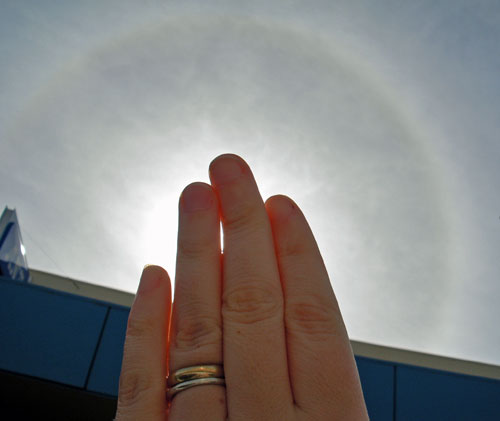
My hand blocks the sun to reveal the ice halo
As we drove to lunch in Glenelg yesterday, Jo spotted a rare phenomenon - an ice halo around the sun. We had just been talking about them. APOD posted a spectacular photo and good explanation of the phenomenon recently.
I put a digitally enhanced view from another angle up on Flickr.
Last night, Jo asked me "How long will it take you to get ready?" because we were getting up early to go garage sailing with her father. "Seven minutes," I replied and when I got up at 6:30, I timed myself. It was six minutes from eyes opened to clothes on, plus 90 seconds to make the bed. I took a few more minutes to have a coffee for a final touch to waking up.
Ray/Dad pulled up at the corner in his big blue station wagon with Grant in the front seat and Naomi in the back. We piled in and were on our way to the first garage sale, slated to start at 7:30.
Grant is the navigator and mans the well-marked newspaper ads. He and Ray have been going out to garage sales together for a long time, usually without Ray's wife, Naomi. Once Naomi observed the way people were interacting with the two and concluded that everyone thinks they are gay. They are cute together so I can see why people might make assumptions.
The first garage sale was not too far away and we were there before the stated time. So were the usual early morning garage sailors: the Bad Greek, Lego Man, the Dealer. We saw them and some of the other, unnamed regulars off and on throughout the morning.
The house was a beautiful one story brick and stone cottage decorated with iron lace around the wooden roof of the red tiled porch. The doors and windows had green, bronze and red Edwardian patterned stained glass sections. Peeking through the window, I saw fireplaces and high ceilings, though what interested everyone else were old wood furnishings and the few piles of "stuff" laying about.
The owner drove up at 7:25, let himself in while politely but firmly deferring a barrage of "How much do you want for...?" questions. A few minutes later, he opened the door and the crowd, no numbering a dozen or more, barged in, banging the door against something sitting behind it. A free-for-all ensued and I believe the major pieces were sold within 10 minutes.
Most of the other sales we attended were less frantic, but there was always a sense of urgency to get there quickly and avoid missing anything exceptional. There really wasn't much great today, apparently, though we all walked away with something. Dad & Naomi picked up an old cell phone and a keyboard for their foster child to play with. Grant, who is a painter, bought a few frames and a black Bakelite elephant pen holder that I wish I had seen first. Jo got some videos and a rattan corner stand for her apartment. I bought a paperback history of the Australian kitchen.
When we'd exhausted the list of interesting sales, we stopped for morning tea at Pat-a-Cake in Malvern. I had a slice of Apricot Jubilee, a homemade white cake with dried apricots and coconut frosting. We had a long talk about cakes and Grant suggested I try Australian classics Hummingbird (pineapple, banana, and coconut( and Lumberjack (apples and dates). Sounds like a terrible assignment, but I will choke them down before next Saturday when we go garage sailing again.
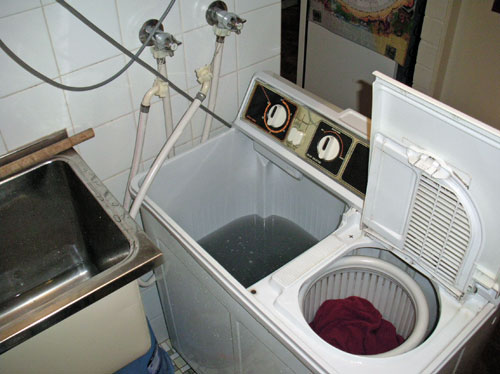
Jo's washing machine is a twin tub. I've seen them before but never used one until now. Jo had to explain how it works, because it is a little more complicated than chucking the clothes in and pressing Start.
First you fill the left side with water and soap. This wash water can be used multiple times until it is too dirty to wash with again, as shown in the photo. In a drought-stricken country, that is a big savings in water. Dials and buttons allow you to choose agitation strength and duration so away you go, washing.
The right side is the spinner basket. After the wash cycle, you take the clothes from the water (they are thoroughly twisted and tangled together), balance them in the basket, close the lids and spin them out for a minute or so.
Then they go into some clear rinse water you have arranged in the laundry sink off to the side and you let them rinse a bit, agitating with your hands or the laundry stick to loosen the tangles, and then you return them to the spin basket for a longer go before putting them into the dryer.
Each load of laundry requires your attention and some focus as the phases end, but it is not difficult and takes less time than the fancy electronic washer/dryer I have in Tokyo. I really like the twin tub.
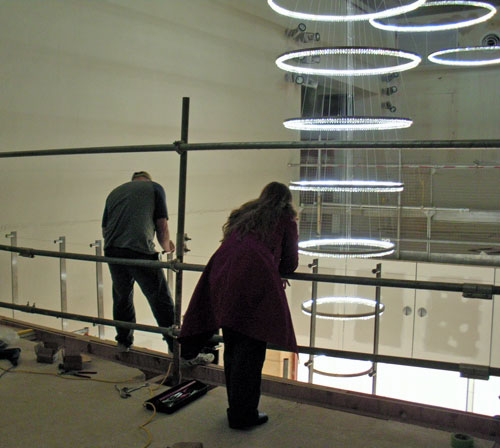
James and Jo
Last night, Jo & I paid a visit to her brother, James, on his jobsite. He is installing glass panelled railings at an upscale Rundle Mall property and told us we could drop by. So after dinner, we took a walk up through town and did just that.
When we got to the place, we peeked in and saw two blokes working, but they weren't James. He was hidden high up on some scaffolding, but his mates waved at us rather cheekily and the guard opened up the gate and let us in with a wink (also cheekily, goodness knows what he thought we were up to).
So now I have met James and he is no longer elusive. In fact, we all had lunch together today and did a bit of post-lunch shopping, made tentative plans for a TV night to introduce me to all the Australian shows I ought to know, and we have firm plans for a family party on Sunday. I like knowing my friends' siblings and am glad to have James counted among the ones I know.
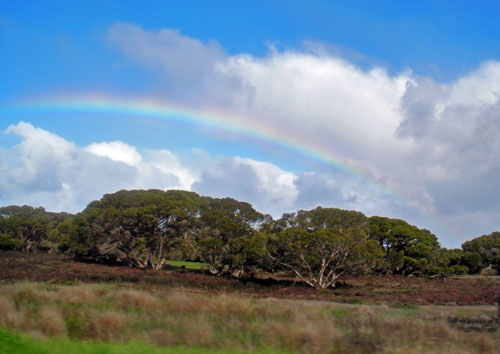
Rainbow after a storm
Jo arranged a trip to Kangaroo Island, just off the South Australia coast, a two hour drive and 45 minute ferry trip from Adelaide. For Jo, it was a chance to do a lot of longer distance driving, and her first ever trip as The Driver. There was lots of driving every day because Kangaroo Island is quite large. It took us two hours to get from one end to the other on the sealed roads. We hoped to avoid the dirt roads in the Blitz Buggy, a 25 year old Colt, and selected our inland explorations carefully.
Kangaroo Island was the first white-settled part of South Australia with a ship landing in July 1837. The ruins of the first settlement are now a park at Kingscote. We wandered through the cemetery and Jo picked out the names that are still common locally.
There are numerous nature reserves and natural parks. We visited a rock formation that is similar in geology to Uluru, but fractured and weathered from sitting on the edge of a seaside cliff. It is called Remarkable Rocks and they are.
KI is good farming land and there is a sheep dairy called Island Pure that makes delicious sheep milk cheeses. We also dug into the island's fresh water crayfish called marron, the local Ligurian honey, and free range eggs. And we enjoyed the local wines, which I tasted and selected at the cellar doors, as Jo is allowed zero blood alcohol in her first two years of driving.
The weather was surprisingly clear and beautiful, though chilly. Three of four nights we stargazed - the lights of Adelaide were a dim orange glow in the distance that couldn't match the bright white glow of the Milky Way. The southern hemisphere Milky Way is fractured and branching and so very full of stars. I was happy.
On the last day, it rained like mad off and on through the whole day but every time we got out of the car to look at the sights, the sky cleared for a little while. We even had a hailstorm but we were sheltered at eating lunch at Kingscote when it happened.
And after each rain, the rainbows came. I saw four yesterday and one the day before. Almost like Ireland.
We saw a lot of what the island had to offer, but there were still places that we missed this time and I am looking forward to returning to see them someday. There are some photos up on Flickr if you'd like to see the highlights.
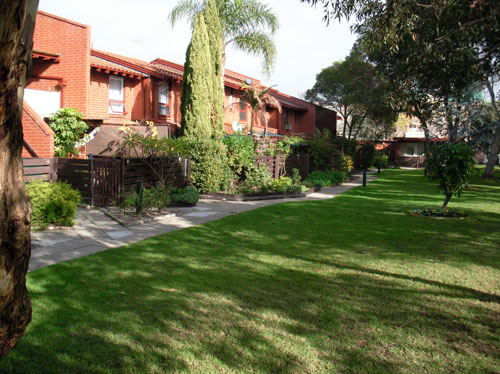
The apartment block where Jo lives
I am in awe of Jo's neighborhood. She lives in the central business district of Adelaide, within walking distance of everything interesting. 15 minutes gets you to the Central Market, where I will be spending too much time and money in the next few weeks. 15 in a different direction takes you to Rundle Mall, a street turned into a shopping and dining arcade. This neighborhood is the ideal location for a walker like me.
I am specifically in love with her block of apartments. They are two facing rows of two story buildings with a swath of lawn and trees between them and walkways leading from one end to the other. It is low and comfortable with lots of green. Truly charming.
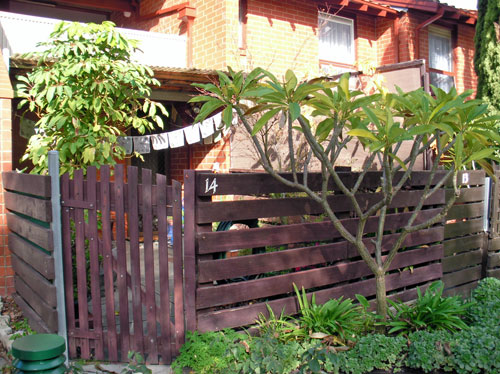
At the fence
Jo's apartment is on the first floor, so she has a garden and small courtyard. It is winter now, so the plants aren't as lush as they would be in summer, but it is still green and pretty. Sunlight filters into the house through the garden and it is very appealing.
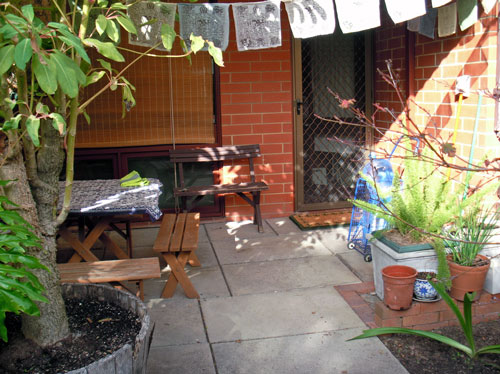
Jo's courtyard
Although her apartment is not large, the courtyard & garden offer an additional room about equal in size to her living area - maybe 4 x 4 meters. It is partially covered, protected with walls on two sides, and furnished with a table and benches. It feels simultaneously cosy and spacious and seems to be an ideal mix of private and public space, as you can sit at the table and watch people passing by, but be shielded from them at bit by the garden.
I think I will put that to the test and take a cup of tea outside and read until it is time to make lunch.

The Royal Mint had a contest to redesign the reverse of the UK coins. The winning designs are gobsmackingly clever. They are fresh and energetic, while still being completely connected to tradition. Well done, Matthew Dent. I love how six of the coins puzzle together to form the full image, with the one pound coin being the key. I can hardly wait to get a full set of these in change.
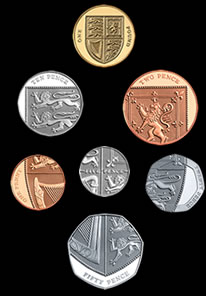
Read all about the coins and the young designer on the Royal Mint's site: http://www.royalmint.com/newdesigns/designsRevealed.aspx
In the past week, three undersea cables carrying Internet data to and from the Middle East have been damaged. It's really messing up data traffic in Egypt, India and throughout the Gulf region. They say two of the breaks were due to ships anchors; the third is undetermined.
Reading about it this morning, I came across a quote by Eric Schoonover, a senior analyst with TeleGeography, who was placating the American Internet users. "We have all the content here," he said. "It's not going to be felt other than we won't get the BBC."
What stunning hubris. Ouch.
Argh. It was only a few days into our three-week trip when our server crashed. So no blogging from the road and no e-mail either. I know you missed me.
Our trip was great. I'll backfill a few entries with things I want to remember (and to share, but 'remember' is the more important aspect these days), but to tide you over while I get caught up, here are some highlights:
Week 1
A November week on a North Carolina beach wasn't nearly as cold as I thought it would be. Most mornings, I dashed outside to the beach in my pajamas. While I was inside, I cooked a lot and I knit a hat and scarf in anticipation of the winter weather in NYC. Among all the McQuillin family, we filled up a whole customer appreciation card (in 24 hours) at the local shoe place and got a free pair of shoes. Seven of those pairs returned to Tokyo with me & Tod.
Week 2
Home for Thanksgiving was a once in a decade event. It was fun, even if we did have to cook two of almost everything - a vegan version for us and a regular version for everyone else. Jenn made an amazing raw foods cherry cobbler for our dessert. We helped Mom design and build hats for a 12 Days of Christmas program at the theatre. While I was in Ephrata, I bought a gown for the Australia Day Gala Ball; it's gorgeous and I can hardly wait to wear it. None of my new shoes go with it, though.
Week 3
Who could say anything bad about a week in NYC? Christmas in New York is a good time to visit; so many bright lights and pretty decorations. We went to the Radio City Christmas show, the Botanical Garden Train Show, shopped (briefly) at Macy's, sent gifts from Santa to some kids in Washington Heights and I am completely full up with holiday cheer now. We walked the city as much as we could which counterbalanced doing eating as much as we could. I managed to return home weighing the same as when I left, despite some stunningly large and delicious meals. I even ate cheese - no way was I going to pass up NY pizza.
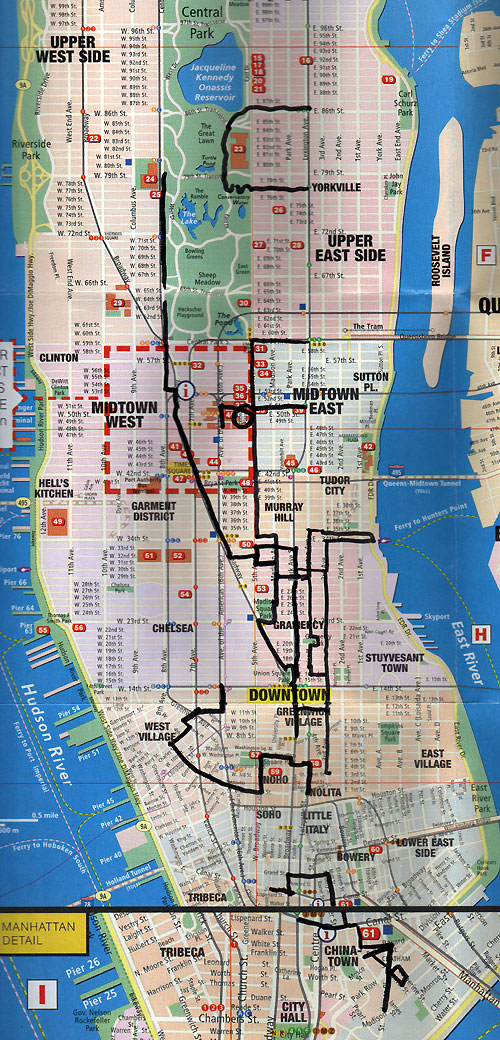
Thanks to the City Walks: New York cards that Jeremy gave me a while ago, Tod & I had some excellent and interesting strolls around the city. We walked a lot to work off all the food we had enjoyed. I'm not sure about the scale of this map, exactly, but we spent many hours each day on foot, exploring. Felt like we were going miles and miles.
We travelled longer distances by subway, taking the 6 line all the way up to the Bronx for pizza, the Q line to Brooklyn for pizza, and the B one day when we wanted falafel in another part of town. I was surprised at how unscary the subway was - it has a bad reputation, but it was fine.
The day we went to the Bronx, there was an "incident investigation" going on at 77th and Lexington and the 6 was shut down from 42nd to 125th, so we quickly sussed an alternate route involving a walk through Central Park (where we saw Lucy Liu taping for "Cashmere Mafia"), an express 5 to 125th and then the 6 from there. It took a lot longer than we planned and we were hungry by the time we arrived at the pizza place.
O the culinary delights of a huge city where everyone eats out (a bit like Tokyo, actually). We ate well and I took notes. Here are the standout places that are not to be missed.
Catch de Fish
3rd Ave @ 15th
***** (5)
This was so good, we ate here twice. Thai fusion with an emphasis on seafood. Choose your fish or seafood from a list and then pick a sauce or salad to go with it. The green curry sauce and the grilled eggplant salad were superb, and the ginger sauce excellent. Don't pass up the Avocado and Mandarin Orange Salad; it's complex and delightful. The soups were great , the appetisers appetising and everything was ideal. I wish they had a branch in Tokyo.
Dimple
30th between 5th Ave & Broadway
**** (4)
Indian vegetarian prix fixe dinner. $25 gets you over 20 dishes (two thalis' worth), including some stunningly hot appetisers, a range of sinfully good curries, fabulous rices and breads plus dessert and chai. If you like something, you can ask for more. There is no way to walk away hungry and I dare anyone to notice that there is not meat on the menu.
Di Fara Pizza
1424 Avenue J, Brooklyn
**** (4)
Mr. DeMarco makes classic, authentic Italian pizza by hand. He doesn't skimp, he takes his time, and every pie is a work of art. He's been in business for 40-odd years and plans to hand over the reigns to his kids, but they don't make the pizza - only he does. So get there before he retires! This was some of the best pizza I've ever enjoyed - crispy bottomed, thin crusted, with sauce that supported the flavors of the three Italian cheeses and fresh basil. Honestly, you must try it. Take the Q line to the Avenue J stop in Brooklyn.
Taim
222 Waverly Place
**** (4)
Taim serves falafel that doesn't sit like a rock in your stomach - the kind we can't get in Tokyo. We read about it in the New Yorker and made a beeline to the West Village to try it. It's a tiny take away place, virtually no seating but a half dozen stools in great demand, but that makes no matter. Go here, and order the falafel (green, red or harissa). Enjoy the subtle flavor of zarat, an ancient Israeli seasoning complementing the lemon in the salad that comes on the sandwich. Lick the hummus from your fingers as it escapes the pita. Be happy.
Louie and Ernie's
1300 Crosby Ave, Bronx
**** (4)
This was the quintessence of the NY pizza I grew up with. It has a thin, chewy (but not soggy) crust with a layer of cheese that equaled the depth of the crust. The sauce is tangy and the pizza drips orange grease down your arm if you tilt it the wrong way. It's nothing like the Di Farra pizza, but they are equally wonderful. I grinned like a little kid and wolfed down two slices - one plain, one with mushrooms. There's probably equally good NY-style pizza in Manhattan, but the adventure of getting to the middle of the Bronx was an interesting one.
Mom asked me to share some well-seasoned vegetarian recipes with her. She doesn't eat a lot of meat and wanted to learn a bit more about the tasty stuff I'm always going on about. So I made her a little cookbook. I called it "Almost Vegan" because although the emphasis is on vegan things, there are a couple of recipes with optional shrimp and one with non-optional eggs.
We cooked quite a few of these together, and I think she liked them. I used the recipes while we were in North Carolina, too, and the dishes were well-received. Everyone at the NC beach house claimed they don't have time to cook. I think maybe they just don't enjoy it enough to make time for it. I love to cook and it takes up too much of my time, sometimes.
Anyway, I wanted to share the little cookbook with you, in case you're looking for some nicely spiced, healthy, vegetable rich homemade foods. It's divided into sections based on region - Middle East, India, South Asia, and Europe - with a few recipes in each section. You might recognise a few from past Recipe Thursdays. Hope you enjoy it!
Almost Vegan 132KB PDF
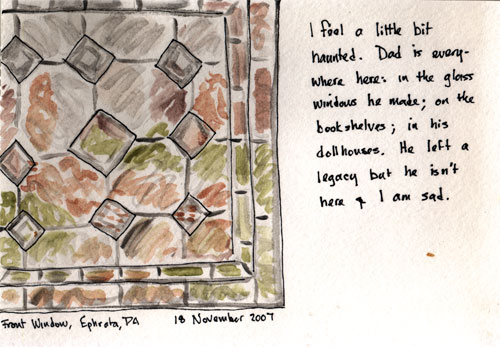
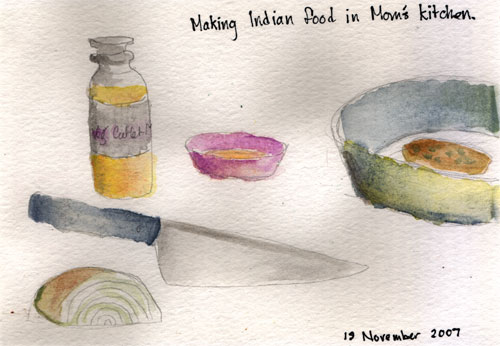
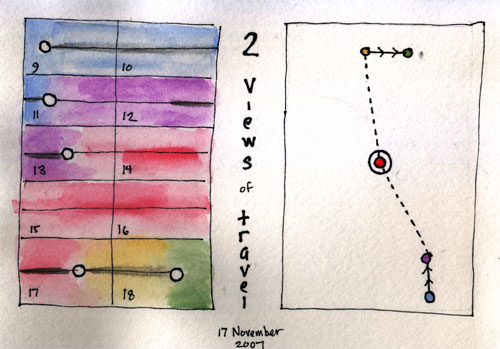
I'm pretty sure we could have driven faster, at least from DC to PA.
Stormy Day Walnut Cookies
serves the McQuillin clan
1 cup margarine
1/3 cup sugar
2 cups flour
1/2 tsp salt
dash cinnamon
2 cups walnuts, finely chopped
Cream the butter and sugar. Add the flour, salt and cinnamon. Stir in walnuts. Use your hands to work the mixture into a dough the consistence of clay. Depending on the flour and the humidity of the day, you may need a drop or two of water. Form the dough into walnut-sized balls. Bake at 190/375 for 10-12 minutes or until lightly golden.
Cookies may be rolled in powdered sugar while still warm, but they are delicious enough naked.
We're back from India. What a great trip. We visited cities, villages and towns. We took trains, cars, jeeps, buses, cycle- and auto-rickshaws and planes. We ate at street stalls, roadside rest stops, superior restaurants. My senses were overloaded with gorgeous colors and noxious smells, often at the same time. Some of my favorite aspects of India:
- Handcraft
- It seems that everything in India is made by hand. Workers mix cement one bowl at a time to create a sidewalk or a high-rise. Shops sport painted advertisements of their goods on the walls. Signs on trucks and buses are hand lettered and frequently misspelled. Cooks start dinner from scratch with produce purchased at farmers' markets. India defines DIY.
- Decoration
- Everywhere you turn your gaze, you'll find a decorative frill. In Rajasthan, trucks are hand painted with bright designs and depictions of gods and landscapes. In Delhi, Diwali lamps are still flying above the streets. Women all over the country wear colorful saris, gold ornaments, and jeweled sandals. Every surface seems to have a scroll, a flower, or a pattern painted on it or carved into it. All of this decoration is handmade by artisans, craftsmen and regular folk.
- Animals
- Cows really do roam the streets freely, crossing highways at rush hour, nibbling litter at the roadsides. Some are cared for by the neighbors and decorated with paint and flower necklaces. Some are apparently owned by "rogue dairies" who let them wander at will. There are also elephants that walk the streets attended but approachable. We had a good time interacting with them and their mahouts in several cities. Camels, goats, dogs, buffaloes - India's got lots of fauna.
- Food
- I have a much better idea of what truly good Indian food is and I'm excited to share it with you, so expect Indian recipes in upcoming Recipe Thursdays. I got hooked on the sweet milky masala chai and learned two ways to make it. We devoured endless curries, street foods, and sweets. There's so much to say about food that I'll save it for another post or two.
If you're interested in following our footsteps, we did Intrepid Travels' India Gourmet Tour. I'll get our photos edited and online soon.
Tod's fever broke overnight but now I'm sick with digestive issues. Par for the course, but rather annoying.
Hall of Winds, Jaipur
This morning we walked around the "pink city" of Jaipur with our group, ending up at the Hall of Winds, a five story facade of screened windows that the ladies of the court used to view the city since they were not allowed out in public. They peeked out the windows onto parades and markets without being seen. After our walk, we just couldn't face the aggressive touts, so we caught an auto back to the hotel and rested during our free time.
It didn't help me much. As we waited for the car to come around for our visit to Ladli, I nearly fainted. Then in the car, I suddenly felt hand-over-the-mouth, wild-eyed sick. Our travel companions screamed "Stop the car!" just in time for me to vomit out the window into traffic. Then I escaped out the other side of the van and disgorged my recently sipped orange juice all over the curb. No idea what caused it, but that's India for you.
Our destination, Ladli is part of the i-India NGO project. Ladli gives free vocational training to young girls from the slums and streets. They make lovely beaded jewelry and sell it to visitors like me. The founders of i-India are an Indian couple with backgrounds in sociology and journalism. They began their good works by going out and teaching kids on the streets. Their projects have grown into mobile school vans, healthcare and sanitation, shelters and vocational training for hundreds of street children every day.

Jaipur at Night (click for larger version)
In the evening, we had drinks at Tiger Fort with a view out over the city. The twinkling lights were beautiful, but the sounds carried up from below were better. We could hear not only a background rumble of city life, but people laughing and singing far below us. Such cool acoustics that I regretted not having my recording gear with me. You'll have to go yourself and have a listen.
Then we went to the Raj Mandir cinema to take in the 9:30 showing of a new Bollywood movie, Don. The theater is decorated in over-the-top pink art deco, like a fancy frosted cake. We had seats in the Diamond section (90 rupees) that had us sitting in a luxurious upper balcony. We had a great view of the audience below us, who hollered and cheered throughout the movie. We were worn out, though, and left the three hour film just before intermission, so we missed out on the snacks and chai that I saw being prepared in the Diamond lobby.
Poor Tod. He was up and down all night burning with fever. He missed out on all of today's activities.
While the rest of us wandered through Peharsar village in the morning, Tod slept. We drove to Jaipur and he crashed out on my lap in the back of the car. He went straight to the hotel in Jaipur while we toured the Amber Fort. When I reached the hotel, he was still burning with fever and feeling terrible.
I called in a GP to have a look at him. Dr. Arora arrived 15 minutes later, dressed in a blue shirt and brown slacks, carrying a briefcase with a stethoscope, blood pressure cuff and notepad. He talked to Tod for about 45 minutes, testing the vitals, asking questions about his symptoms and exhibiting a pleasant, fatherly bedside manner. Then he scribbled a prescription for antibiotics and various other medicines on his tablet. His charge for a house call was 400 rupees, or about 1000 yen.
I ran across the street (literally ran, dodging traffic as you do in India) to the chemist. I handed a young man the doctors orders and he moved through his tiny shop, opening glass-fronted cabinets and pulling out boxes from the ones stacked there. He took the boxes back to the counter, pulled out a pair of scissors and checking the script again, proceeded to cut off the right number of pills from each blister pack. The medicine totaled 170 rupees.
Here's some of what Tod missed:
Peharsar woman forms fuel from cow dung
Garden in the Amber Fort, Jaipur. "Winter, summer, monsoon palace; army barracks. Come. Look," said our guide over and over...
Maybe it wasn't just the hot day yesterday that had me resting on the marble floor of the Taj. By the late afternoon I had a fever and felt so blah that I skipped dinner and went straight to bed. This morning I'm run-down, but the fever's gone.
One of the courtyards at Fatehpur Sikri
Visiting Fatehpur Sikri cheered me up. The Emperor Akbar built this city. It took twelve years and was to be the center of his new religion. He had three wives - one Hindu, one Muslim and one Christian - and all three are commemorated in the architectural details, including some remarkable botanical carvings. Unfortunately, due to politics and drought, the city was abandoned after only four years. But I peopled it with my imagination. It was spectacular.
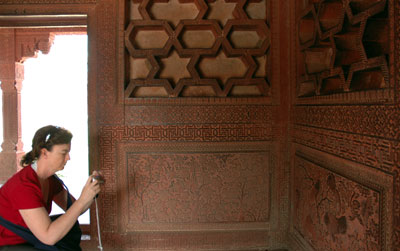
Sam likes the carvings, too.
After our visit we had lunch at Hotel Ajay Palace (everything is a palace here, even the most modest of hotels). It was quite a simple place, and like everywhere in India not 100% spic and span. Ajay's elderly father, JP, presided over the dark black lemon pickles, which he makes himself. Lunch was delicious. Homemade curd, a thali full of wonderful curries with condiments of super-spicy green chilis and a chili tomato sauce. I loved Ajay's cooking and hope to return someday for another lunch.
Too soon we were back in the car heading towards a tiny village called Peharsar and the Chandra Mahal Haveli, a charming old merchant's house renovated into a hotel. It has courtyards, gardens, thick walls with niches carved into them and bright stained glass in the windows. By the time we arrived, though, Tod was feverish so I put him to bed while the rest of us enjoyed a cooking demo and snack. Sam took notes and I paid close attention, so I should be able to reproduce the dry potato curry they made for us.
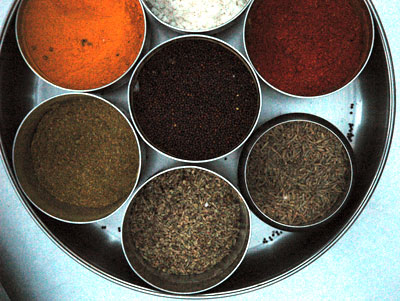
The Indian spice box
Tod rallied enough before dinner to come sit with us in the garden. We had fried spinach leaves, chicken kofta, dry cooked eggplant with a sweet seasoning and a different potato curry. Shortly after dinner, we made it an early night and went off to bed in our purple painted room.
I think it's required by law that visitors to India see the Taj Mahal. With that necessity in mind, I was not really looking forward to today's trip to Agra.
We caught a 6:15 train from Delhi. As we were served tea and breakfast with newspapers, scenery of ramshackle huts sped past us. I'd been warned that the poverty in India is terrible and would bother me. But it doesn't. Our world economy is not fair but we all share the same human emotions. Money doesn't change joy and sorrow. The people outside my window have happy and sad moments and so do I.
We arrived in Agra and started our touring at the Red Fort. Made of local sandstone, it really is red. The emperor who built the Taj Mahal lived here with his 3 wives and hundreds of concubines and you can tell it was a complex society by the way the courtyards and rooms are connected (or not). After Shah Jahn built the Taj Mahal, though, his son overthrew him for wasting public funds on the frivolous Taj and his red fort became a jail. Pretty nice jail, though.
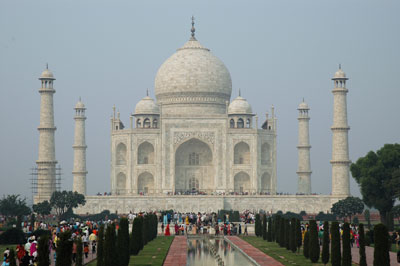
The icon of India turned out not to be such a waste of public funds after all.
Then we were off to the Taj itself. I was expecting to be bored and unimpressed. I mean, who hasn't seen a dozen photos of the building? It's a big white domed edifice. Whoopee. I figured Zoupi might enjoy it a little bit, but he wasn't allowed in. He had to go to "elephant and cell phone jail" while we visited. His jail was not as nice as Emperor Shah Jahn's.
I was wrong about the Taj. It is breathtaking. Inside the vaulted room where the mausoleums are, the tap of footsteps, the babble of talk, eand ven the visitors breathing all combine into the most chilling and enveloping sound that echos through the space. I got up close to the rail, closed my eyes and listened. Shivers ran down my spine...
Here are some un-touristy photos of the Taj and our visit there.
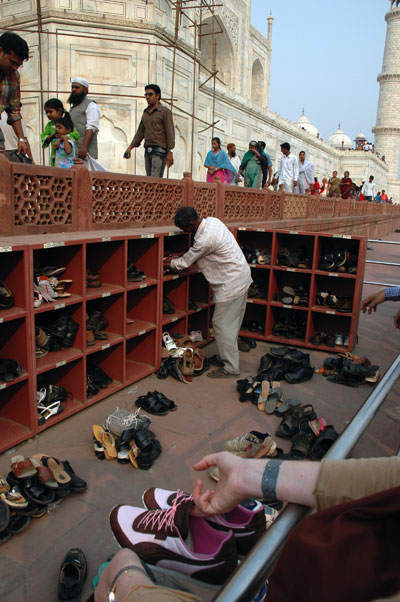
Waiting for the shoe wallah to take my sneakers.
It was so hot that we laid down on the cool marble floor in one of the porticoes.
We spent half an hour staring up at this domed ceiling.
We weren't alone in enjoying the a rest in the shade
Today we tried our first street food - from a vendor in Old Delhi that won a Times of India "Good Food Award"! Well deserved, too. Those were some tasty samosa, aloo tikka, and crispy pea-filled breads. Sarah, the ultra-cautious member of our group refused to try anything; she's fearful of falling ill. The rest of us dug in and enjoyed.
Onlookers cheer the parade from the balcony of the gudawara
Old Delhi was a madhouse today due to Guru Nanak's birthday. The main street was closed off for a parade of school children, flower-bedecked buses and men sword fighting. We skirted around them to the Jamma Mosjid, Jain Bird Sanctuary and then headed into the fray at the gudawara where all the action was centered.
Grilling chapati in quantity
We slipped into the gudawara's kitchen to watch the volunteers making chapati for anyone who wanted to eat. While Tod snapped photos, I was handed a long narrow spatula and nodded towards the grill. Everyone else was deftly flipping chapatis from one end of the griddle to the other. Mine all folded in the middle. It was a lot harder than they made it look.
Choosing nuts in the spice market
By the time we made it to the spice market (after another stop for glorious parantha from a 5th generation back alley dive), I was too tired to enjoy it much. But the colors and scents were sublime and almost reviving.
In the evening, we drove out to suburban Delhi to have dinner and a home visit. While her husband showed us their apartment and it's brightly painted blue and violet rooms, Alu made a feast for us with channa curry, spicy okra, potatoes with fenugreek, several homemade sauces and pickles and, of course, chapati. She gave us a try at forming and rolling chapati. Hers were so nice and round. Mine was rather heart-shaped. I think today was not my day for any aspect of chapati making.
This morning, we walked from Ram Nagar through Connaught Place down to Bengali Market for breakfast. Crab had suggested channa bathura at Bengali Sweet Shop and he was right on the mark. Heavenly fried bread with chick pea curry may not be to everyone's taste for breakfast, but we were hungry and it was delicious.
Before too many "five minutes look" moments
At 11, Didar was ready for us with the auto-rickshaw. We decided on a program of mainly religious places and took in a Buddhist temple, a Hindu temple made of striking red, white and yellow stone, and our driver's own Sikh gudawara.
The gudawara was very cool. Though they seem fierce with their religious accouterments of daggers, bracelets and combs, Sikhs sing their holy book and give free food to anyone who turns up at lunchtime and dinner. Their blessing is a sweet paste of ghee and flour that is sticky and delicious. There is a big Sikh holiday tomorrow - Guru Nanak's birthday, and volunteers were stringing lights and decorating. We walked around the enclosed reflecting pool, strolled through a book fair and bought a book.
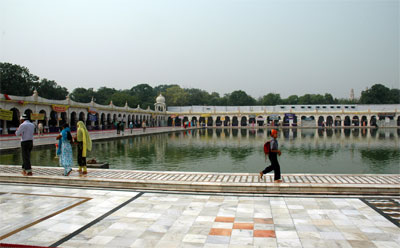
The reflecting/bathing pool and book fair
Auto drivers are notorious for taking tourists to places where they will get commissions or freebies, and Didar was no exception. By the end of the day we had been inveigled to "five minutes just look, no buy OK" at several shops. And we did "look no buy" at most of them. But I succumbed to an overpriced Aruvedic treatment for a blossoming headache and bought a really lovely silk scarf at just under Tokyo prices, I imagine, but it's beautiful and I need a head covering for visiting mosques and such.
Battling traffic at rush hour was quite an experience. I should have been afraid of the buses and trucks barreling alongside us and the other autos and cars performing a ballet of passing and crowding into roads without lane markers, but somehow I wasn't at all perturbed and enjoyed it immensely.
In the evening we started our Intrepid tour and met the group for a meeting. Expecting a party of twelve, we were surprised and pleased to find only five people on the tour, plus our tour leader, Paula. After the usual self-introductions, we talked over our itinerary, responsible travel, and Intrepid's projects. Then we went to dinner.
Dinner was fun and we talked a lot about food and ingredients. It seems that Tod and I are pretty knowledgeable even though I don't feel all that skilled in Indian cuisine. I smiled when the band struck up Pal Pal Dil Ke Paas, a classic Bollywood love song by Kishore Kumar that I've heard Jim sing to Yuka.
We will sleep well tonight and without the blare of morning call to prayers, I hope.

Random Delhi intersection
This is going to be an interesting trip. At first glance, Delhi reminds me much of Beijing - the chaotic traffic hurrying along on filthy streets past fenced off enclaves.
5:15 this morning at Hotel Ajanta in the Ram Nagar district, I heard a clang. A dropped pipe? A bell? It was the start of the dawn call to prayer - a very loud and melodic call for 30 minutes, followed by somewhat muffled prayers and chanting from the mosque next door. This, along with an extraordinarily inedible breakfast and a rip-off change of rooms when we were too tired to complain about it last night is the reason I will not stay at Hotel Ajanta again or recommend it to anyone.
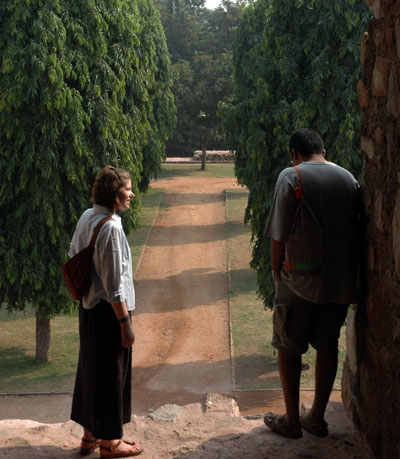
Me & Crab inside the uncompleted minar
The day got a lot better when we met our friend, Crab, at Qutab Minar. Crab, who is really named Abhijit, is an enthusiast of India's historical ruins and mausoleums and he showed us some fascinating details in the complex, including the first true arch ever built in India (along with some of the few precursors which didn't fall apart). We had a late lunch at one of his favorite South Indian restaurants, then he dropped us off at Hamayun's Tomb and went into work.
As we left the tomb later on, we negotiated a ride back to the hotel by an auto-rickshaw driven by a Sikh fellow named Didar. He persuaded us to use his service tomorrow for a ride around town to various places. I didn't want to, but recalled one of the bits of advice in Shantaram: surrender. So I gave in and arranged to have Didar pick us up at 11 am at our hotel.
Still full from lunch and exhausted from the busy day, we skipped dinner but walked through the Main Bazaar near the New Delhi train station. I was offered hashish three times but only bought some sandalwood soap.
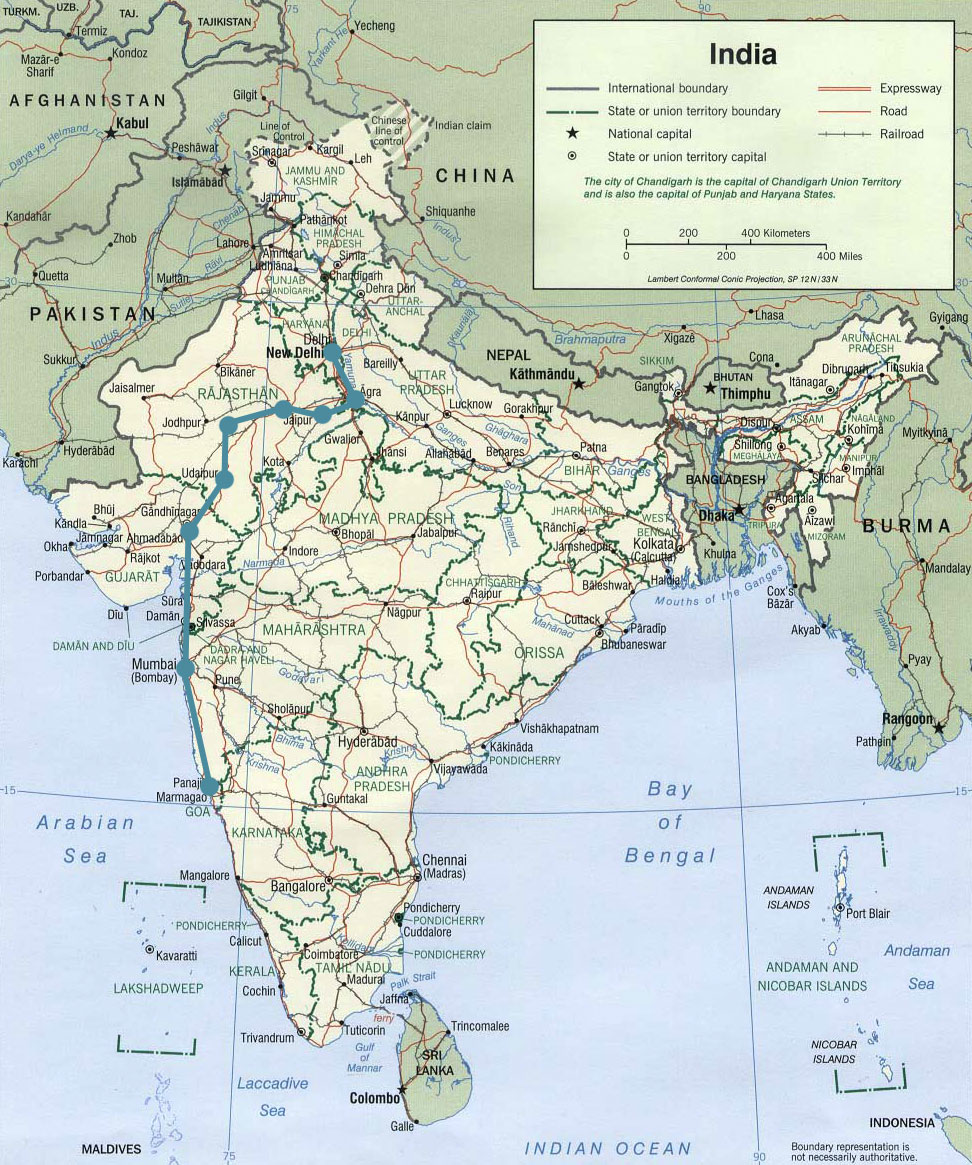
We're off to enjoy Indian food and culture. Mediatinker won't be updated until I return round and happy like Ganesha.
One of the sort of funny things about living in Japan and traveling overseas is that when you want a phrasebook to carry with yo, you either have to plan ahead and order online or buy a Japanese one.
I never remember to order one in advance, but fortunately, we've found a clever series called "Point and Speak" that has lots of pictures labeled in Japanese and the other language. We bought one for India (Hindi) because I'd like to be able to speak a little bit.
So I'll sound out a few words as noted in the book. I wonder if anyone will think it strange that I speak Hindi with a Japanese accent?
Having recently spent a total of 8 hours over thrree days at the Detroit airport, I'm pleased to bring you this list of things to do during your next transit on Northwest Airlines.
- Watch the acrobatic fountain in the center of concourse A (McNamara Terminal).
- Watch the indoor shuttle train run the length of concourse A.
- Walk a full circuit of concourse A .
- Enjoy the son et lumiere in the tunnel between concourse A and the B/C gates.
- Eat a chili dog or any of the all-American foods on offer.
- Stare at the really hugely fat people eating ice cream and extra large portions of fried food.
- Tap into a power outlet on the support columns and charge your laptop.
- Get frustrated by the spotty Wifi access you just paid for.
- Browse the magazines and books.
- Buy a snacksfor the plane, since NWA doesn't supply them for free on short flights.
I'm in the States this weekend and will return to Tokyo on Tuesday. I don't expect to have time to write anything here, so I'll see you on Tuesday with a list of ten interesting things to do in the Detroit airport.
Home is where you hang your jacket?
We're back in Tokyo this evening after our week in London. As much as I love to travel, I enjoy coming home more.
"Raw meat," the waiter succinctly announced when he brought us our plate of kibbeh at Maroush on Edgeware Road. None of the other dishes were named or described as they came to table, so I wonder if it was a final warning to the perhaps unsuspecting diner about the nature of kibbeh.
No worries, we knew what to expect and it was gooooood. And the spicy hummus was the best I've ever eaten - silky smooth with just the right balance of lemon and garlic, a peppery kick, and a generous amount of fresh flat-leaf parsley mixed into it. We devoured an entire bowl and could have eaten more, except that the next dish arrived to distract us - lamb-stuffed vine leaves and aubergine cooked in a spiced tomato sauce. Manna in a ramekin.
On previous visits to London, I've given the Victoria and Albert museum a pass. I always like to leave a city with at least one good reason to return and the V&A was my sacrifice. But not this time.
It has an abundance of interesting decorative and practical arts. More than enough to spend a full day enjoying. It's big and confusing and under construction, but if you don't mind being lost on the third floor desperate to reach the garden cafe on the ground floor but unable to find a stairwell not blocked off for maintenance, then the V&A is a great place. On the other hand, if you really want to get to the garden cafe from the 3rd floor, you're going to hate it.
I sauntered through the first floor fashion collection to start, admiring and examining garments dating from the 1600s to last year. There are some stunning pieces. A floor length white velvet and fur evening coat-dress from the 1980s took my breath away, as did the bold jungle-floral pantsuit from the 1970s - but not in the same way. I laughed when I encountered the "novelty bustle pad" from 1837 that played God Save The Queen every time the wearer sat down.
Upstairs, I found the textile galleries. I spent most of my time there pulling random "frames" from their cases. The frames are a catalog of textile samples - laces, embroidery, weaving, prints - from medieval to 19th century. The cloth fragments are mounted in very large glass-fronted picture frames and stored vertically, like books on a shelf. You slide them out to look at them. There are hundreds of them. I looked at perhaps 40 before I got too hungry to think
And that's when I got lost. It took way too long to find stairs heading where I wanted to go and I got frustrated. But that's not going to permanently taint my judgement of the V&A. Next time I'll eat lunch before I go...
The Tower of London isn't a tower. It's a complex of twenty towers built in different centuries, rebuilt in various ways and used for fine and nefarious purposes over its 900 year existence.
It reminded me just a little bit of the Forbidden City in Beijing. Not because they look much alike (though they both consist of great stone and wood buildings) but because they are the same class of place - former palace and prison turned to tourism. And places I've spent time drawing, too. I wonder what other former palaces/prisons exist in the world? Perhaps I should go on a tour and draw them all.
I'm a litle embarrassed to admit that much of my prior knowledge of the Tower came from Neal Stephenson's Baroque Cycle books, so I spent as much time recalling scenes from the books as I did people-watching. But I wasn't entirely daydreaming. I paid attention, too.
Something I learned today is the historical origin of some familiar nursery rhymes. Mary Tudor, who became Mary 1 of England, was fond of gardening. She spent so much time outdoors that she was nicknamed The Farmer's Wife. She was also a devout Catholic and when she became queen had over 300 Protestant leaders executed. She earned the nickname Bloody Mary for that.
Mistress Mary, quite contrary, how does your garden grow?
With silver bells [mass] and cockle shells [awards for crusades] and pretty maids [nuns] all in a row.
Mary couldn't become Queen until she seized the throne from Lady Jane Grey. Lady Jane's father-in-law was the architect of Jane's near ascent to the throne. When he figured that the army was going to support Mary instead of Jane, he sent three bishops to preach on Jane's behalf. It didn't work and the bishops ran away to beseech Mary for mercy.
Three blind mice, three blind mice [the bishops], see how they run.
They all ran after the famer's wife, who cut off their tails with a carving knife. [they were executed]
The English countryside in springtime is a riot of life. Everything is bright and fresh. Flowers bloom on all the hillsides. Trees leaf out in brilliant green, lambs frollick on hilly pastures, birds sing. The world vibrates with newness.
Lenora, a friend I met in Tokyo who's been transplanted to Harrogate in Yorkshire, extended her hospitality to me and shared her knowledge of local history, flora and fauna as she toured me around her lovely district. We visited Bolton Abbey and enjoyed a long walk along the River Wharfe to see the bluebells in bloom. Along the fringes of forest, they form a dense haze of vivid blue-violet punctuated with white stars of wood anenomes. Now I understand the color inspirations of classic English floral textiles.
Harrogate was formerly a spa town. Victorians travelled north from London on a new train line to take the waters. Today there's only one bath operating and the town is more famous for its civic flower displays, but back in the day, there were grand hotels, an opera house, and the beginnings of several long-standing culinary traditions including toffees (to help remove the sulphur-water taste) and Betty's cafe tearoom.
I spent two days in Yorkshire, but it passed too quickly. Enjoying the scenery of the Dales was a pleasure I hope to have again. I still have the theme song from the BBC's All Creatures Great and Small running in my head.
The City of London is not the London most visitors come to see. It is the center of commerce and banking with stone edifaces, imposing columns, cobbled walks and atriums in abundance.
350,000 people work here, but only 5,000 live here. And they all sleep in on Sundays, so jet-lagged travellers have it all to themselves. Tod & I walked through nearly deserted streets this morning past shuttered shops that won't open until Monday morning. The only people we encountered were those not speaking British English. It was wonderful to be in such a quiet urban space.
And such an old one, too. We saw a sign proclaiming a street protected by the City of London Police under the Metropolitan Streets Act of 1867. Down the street from our hotel, the pub where we dined in last night has been around since the 14th century. The Bank of England on Threadneedle Street has been there since 1734. the Royal Exchange across the street was originally built in 1571, though the current incarnation was erected in 1884 and it became a luxury shopping mall in 2001 - closed on weekends.
Did I mention we're going to London? Well, we are. We did. We're here. The weather is cool and wet. The forecast says more cool and wet. Good thing I packed the raincoat I bought last time I was here.

My dot painting
One of the most wonderful things we did while at Uluru was to take several walks and workshops with Anangu Tours, run by the local aboriginal community. My favorite was the Dot Painting Workshop.
We spent over an hour learning about dot painting: the symbols used in the paintings; the switch from traditional pigments on stone to acrylic on canvas; how the colors are meaningful but differ from painting to painting; and that many of the paintings are maps or textbooks, or just tell stories. Then we got a chance to make our own small paintings. We were encouraged to tell a personal story of our own.
Tod's dot painting
Independently, Tod & I told the exact same story. We had our own ways of telling the tale, but it's the same one, despite how our canvases don't match. Can you tell what it is? I can give you a hint: the C shaped curves indicate people (it's the shape left behind when a person sitting cross-legged in the dirt gets up) and circles symbolise places.
I edited 3 GB of holiday snaps down to a reasonable number. It may still be too many, but we did so many remarkable things. Did I capture the essence and beauty of the places we saw and people we met?
Elliston, South Australia 78 images + 4 subalbums.
Uluru and King's Canyon, Northern Territory 95 images + 1 subalbum.
Gold Coast, Queensland 39 images.
For the first time ever, I came home from travel and saw Tokyo as others claim to see it- ugly, grey and dirty. It took me a day to think this through, but I figured out what happened to change my perspective.

Elliston cliffside panorama. (Click for larger view)
Australia is huge and empty. It has vistas - views to the far horizon. Even the cities all have ocean coastline and those that are inland are surrounded by vast deserts and bush. So after a few weeks in Australia, I looked at things in the macro view. I took it all in from edge to edge. And when vastness was too overwhelming, I focused in on tiny details: a desert flower, a lizard, a stone.
Australia was most interesting and beautiful at macro or micro scale, but not so much in between.
Tokyo has few wide open spaces. The horizon is just across the street. Its details are predominantly man-made and drab colored or dingy from pollution. Beauty here is largely in sounds, smells, motion, and time. I will take a few long walks through the city, stopping to sketch and carefully observe Tokyo's details, to readjust myself to finding the visual beauty here.
We're home now. Here are some travel maps I sketched during our trip.
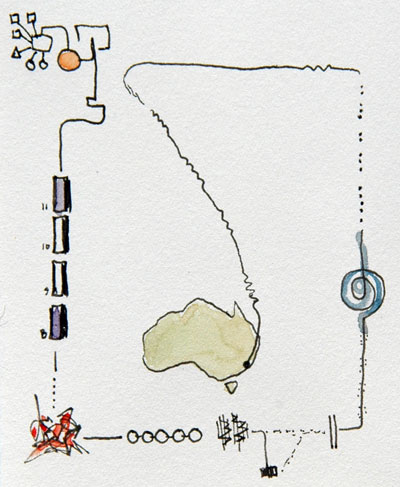
Mad Rush to Australia. December 16-17
I ran about finishing up the last minute details before we left. We met MJ & Yoshi on the Narita Express. Tracey was almost an hour late to meet us at the airport and she had the tickets, so this was rather stressful. We waited in lines, got through security, caught the shuttle across the terminal, dashed for the plane and as we reached the gate, they announced a delay of about 45 minutes. After the flight took off, everyone slept but me, I think.
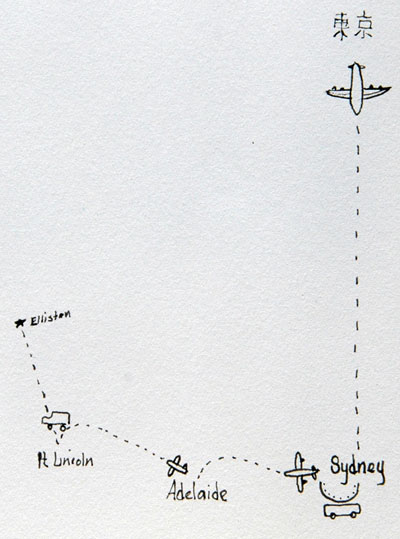
Into Elliston. December 17-18
Gettting to a small town in South Australia takes a lot of time and conveyances. Each plane was smaller than the last.
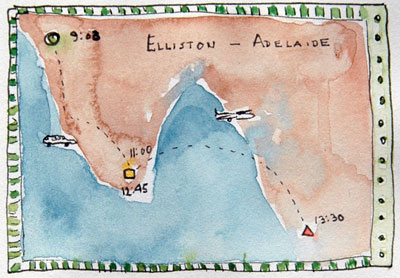
Out of Elliston. December 26
Elliston to Adelaide is a four and a half hour trip by car and plane. We spent the night in Adelaide before moving on to Alice Springs, Uluru and King's Canyon. I didn't draw maps of those coach rides, though.
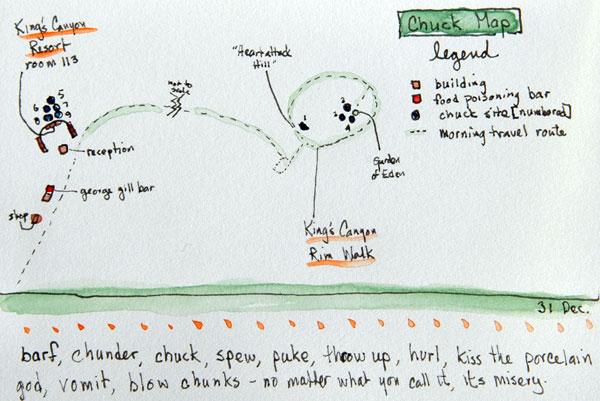
Chuck Map. December 31
Sorry to report that this one speaks for itself. You can click on the image to get a larger view and read the legend.
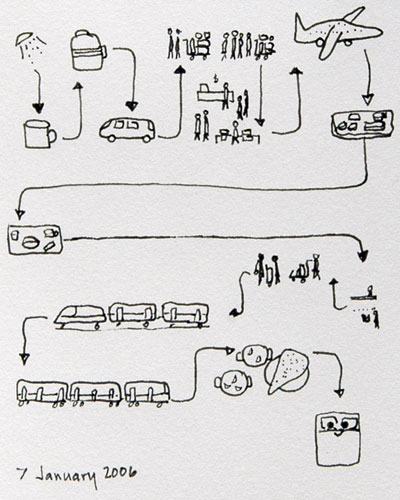
Homeward Bound. January 7
A quick shower and coffee, followed by packing the van and driving to the airport, where we suffered the usual queues and waits. Then a long, dull plane ride, interrupted by food service. Arrival in Tokyo put us in more lines, then onto two trains before dinner and bed.
Tod's dapper sunhat brough him good luck
Today we went to South Stradbroke Island for a picnic and some fishing. JIm ferried us over in his motorboat and I spent the day in the shade hiding from the "Extreme UV" sunlight. Everyone else went fishing.
MJ caught the most fish - we stopped keeping track after 9, but it was somewhere around 16. Every time she caught a fish, someone had to take it off the hook for her. But when we got back to home base, she did help to scale them all before we fried them up for dinner.
Tod caught the biggest fish, a fair sized breem.
Yoshi without a fish
Poor Yoshi lost his fish. He reeled it in and it jumped off the hook before I could get a photo. What a shame, it looked really tasty.
I wasn't idle while I sat in the shade; I sketched the beach in watercolors. I'm still having trouble with waves.
South Stradbroke Island, looking west
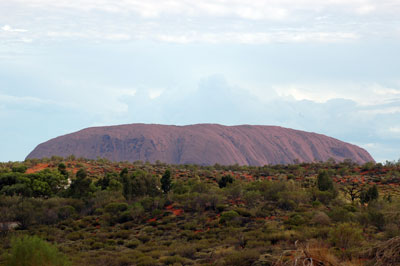
Uluru, afternoon. December 28, 2005.
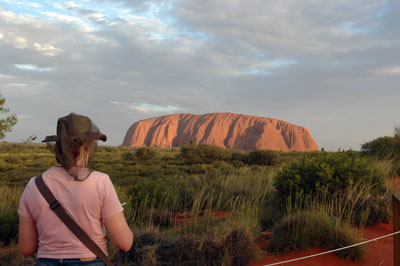
Uluru, sunset. December 29, 2005.
Uluru, sunrise. December 30, 2005.
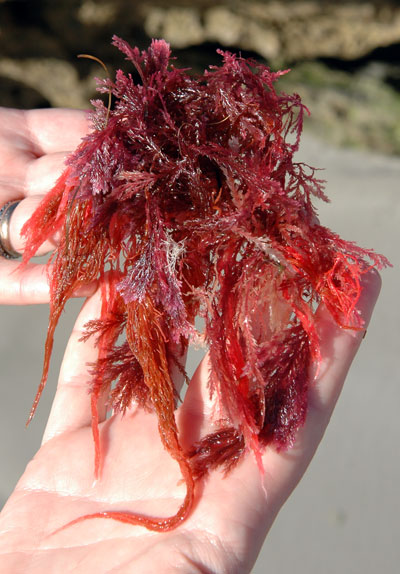
Vibrant seaweed
Seaweed sketch
One of the best things I am doing on this holiday is sketching. Not that the results are spectacular, but I've drawn and painted up a storm and will continue to do so until I run out of paper. It makes me stop and look and really pay attention to what makes the landscape and the details different from home.
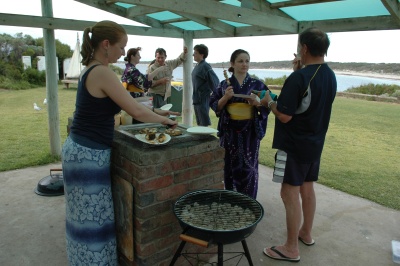
Jo cooks while MJ, Tod & Tracey chat with some Ellistonians
Our first-ever Elliston Matsuri was a success. Attended by a double handful of local adults and children, we cooked up a feast of okonomiyaki and yakitori, and had enough superballs to keep the entire town bouncing. It was a fun evening for everyone, I think.
Afterwards we spun out the folks at the pub by turning up in yukata and jimbei for a post-matsuri glass of wine. We met a woman and her well-trained dog, Pluto, a farmer and shearer who's lived in Elliston for more than 30 years and another rather blur gentleman who kindly invited us to come to the pub at 9 am on Christmas day for drinks.
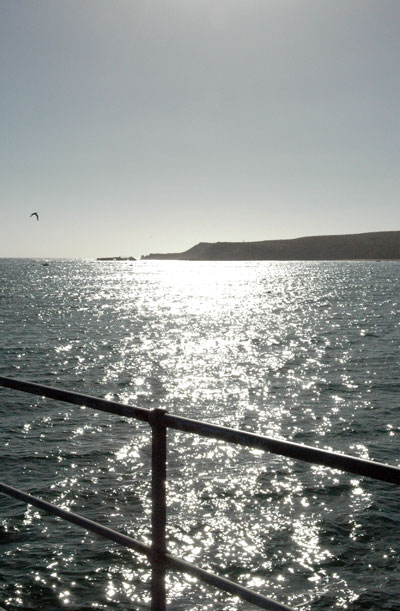
Waterloo Bay from the jetty in Elliston, South Australia.
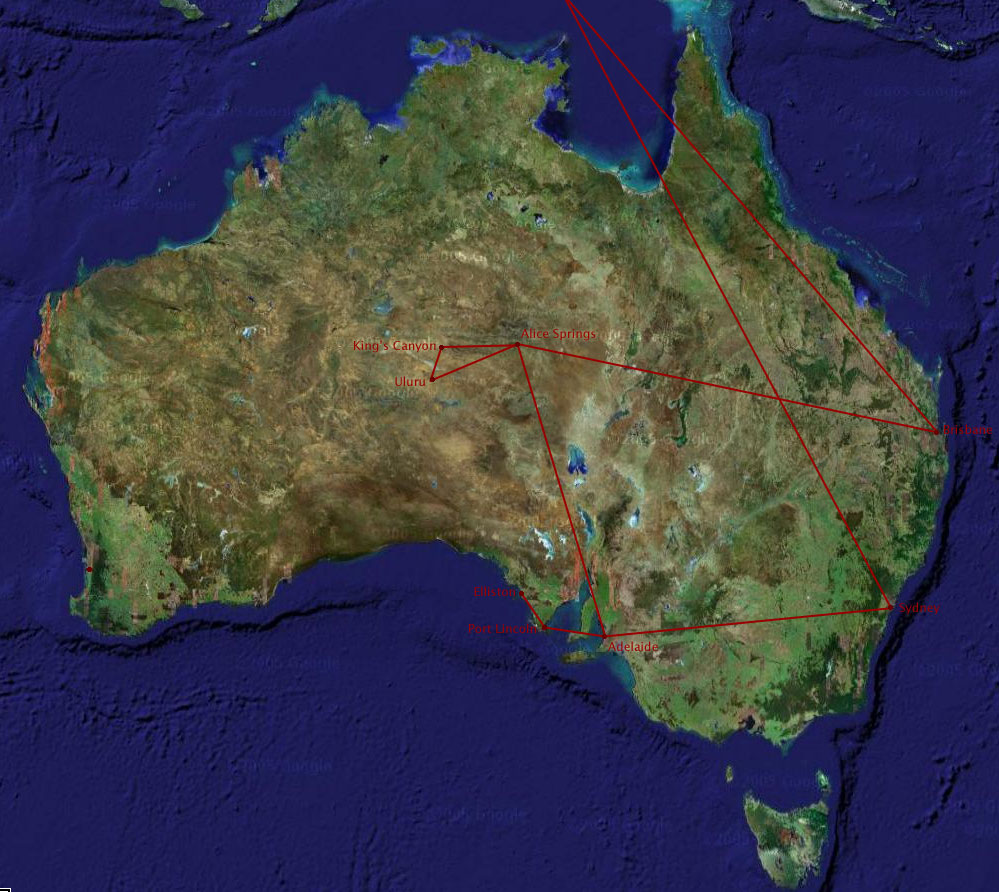
Click for larger view
We're in Australia for a couple of weeks. We will spend Christmas in Elliston, then tour the Red Center and spend the first week of 2006 in Brisbane. So If I post infrequently or don't get the comments moderated right away, it's because I'm having too much fun chasing gallahs and eating meat pies.
I'll bring back stories and photos!
Xanga profiles of the teens in question
In rural Pennsylvania this weekend, a young man shot and killed his younger girlfriend's parents after an argument over her curfew, then left with the girl. They've been found in Indiana and police are investigating.
And so are the reporters. The Philadelphia Inquirer has discovered the Xanga weblogs of both the young man and the daughter and extracted from them their interests and grammatical errors. Of course, the paper focused on the things that made him look disreputable and her look sweet.
I looked at their sites. They seem to be typical American teenagers. Entirely human.
They both like candy. He hunts deer with his friends. They both like Christian rock music. She plays soccer. He is precious about his hair. She belongs to her church youth group. She doesn't use capitals. He writes in full sentences. They both invoke God in praise.
There's nothing there to foreshadow what happened this weekend.
If I should ever become a criminal or the vicitim of a crime, what might reporters deduce about me from my weblog? Probably all the wrong things. Bad tendencies and good deed are feely intermingled on mediatinker, as well as terrible typing and an inherited tendency toward too many commas.
Our new passports arrived today, less than two weeks after we sent in our applications. We are valid to travel through October 2015.
Although ours do not contain RFID chips, there are some differences in the new passports.
- Digital photo: they photo I sent in was scanned. In the process, it lost a lot of its contrast, so I look like a mound of hair over a pair of beady eyes and a smile floating in pinkish space. I have neither eyebrows nor cheeks and my nose is nearly invisible.
- Holograms: the ID page is covered with a number of US-themed holograms that make it very difficult to read the printed information and see the photo. I guess as long as machine can read the codes along the bottom, that's all that matters.
- Font: the computer generated text on the new ID page is in a smaller sans serif font. It's much harder to read the passport number and other data in the condensed numerals they've used.
- New language: the headings in the old passport were in English and French. The new version adds Spanish.
- Important Information: expanded by one page to cover pages 2-7. The revised and reorganised text includes less detail about the topics mentioned, but lots of URLs. This is all printed in purple, instead of the old dark blue.
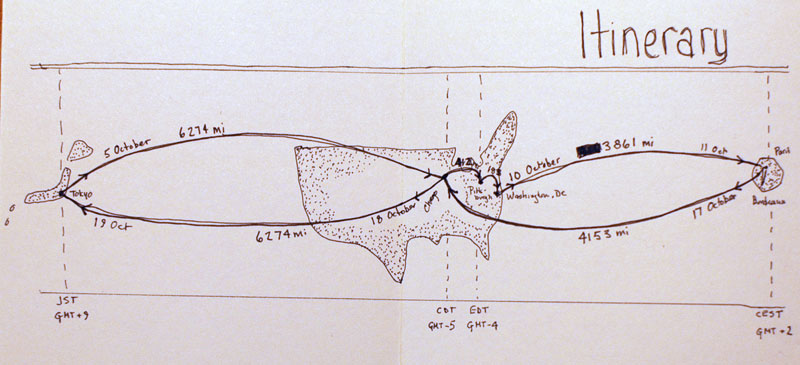
Here and there and back again
In two weeks, Tod & I have visited three continents, slept in four time zones, and accrued 21,157 airline miles each. That's enough to fly free to North or South Asia.
But I'm happy to be home for a while now. I'm tired! I'll redeem those miles another time.
Our last morning at the chateau in Bordeaux, I pulled open the tall narrow windows and thrust my head out into the ebony pre-dawn. Just in front of me was Jeremy's curve of stars spinning from Gemini to Orion--my first glimpse of that glorious golden mean since last winter.
At 6:45 when we departed, the full moon illiminated the vineyards, and as we rode an hour to the train station on the first leg of our two-day journey home, I watched the sun brush a faint glow across the eastern sky and the stars fade into a brightening blue.
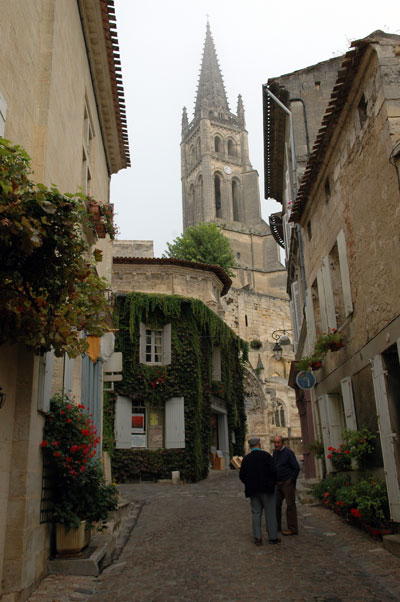
The narrow streets of St. Emilion
Our last full day we spent in St. Emilion, one of the most lovely villages I've ever visited. The town is built on the site of a limestone cave where Emilion came to hide after becoming too famous in his Robin Hood-esqe adventures elsewhere in France during the 8th century. It didn't work for him, though. People sought him out for cures and miracles and eventually he was canonised.
Today there is a cavernous church carved into the town's steep hill and all the buildings are made from the excavated stone that took two centuries to remove.
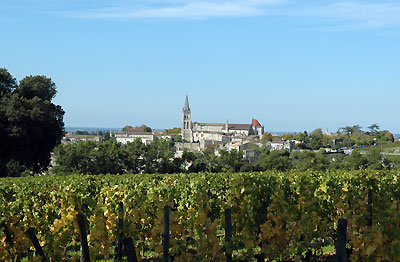
The town with grape vines in the foreground.
The area is well known for its wines, which are re-ranked every ten years. This is in contrast to the chateaux of Medoc which received their ranking in 1855 and have never varied. We tasted a few of St. Emilion's wines and bought one to drink at home later.
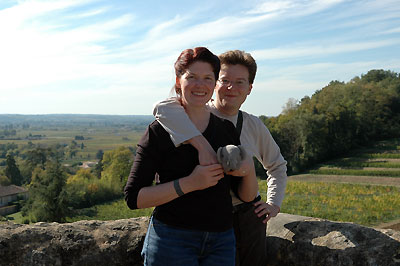
Tod, Zoupi & I take a break in the country.
After touring the town on foot and enjoying lunch, we went on a bike ride through the vineyards with Raphael, a local tour guide. He took us to
a series of grottoes on a cliffside overlooking the Dordogne before we turned back to town.
It was gorgeous scenery and easy enough terrain. But I still managed to pull a muscle and get a flat tire. I really am cursed regarding bicycles. I spent the rest of the afternoon trying to remember the French word for "flat tire." I knew it once from Milles Bourne.
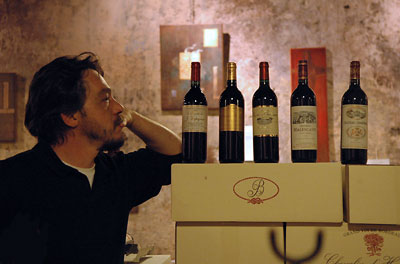
Monsieur is very serious about his wines
We began the day with a tour of the Chartrons district of Bordeaux city. This is the riverfront where the wine merchants had their warehouses. Back in the days before wine was bottled at the chateaux, the wine merchants did the bottling at their warehouses.
We were taught to taste wine properly--grip the glass by the foot, sniff the still wine, swirl, sniff again and finally roll a small mouthful across the tongue to see which tastebuds respond. It was fun. And who can complain about three or four good gulps of wine before lunch?
After a lunch at a cafe in town, we boarded a bus along with 50 other people and headed out to Medoc to visit some wineries. It was rather boring, to be truthful, though the countryside was pretty and we did learn more about the wine production process. We visited chateaux in two different appleations producing different classes of wine.
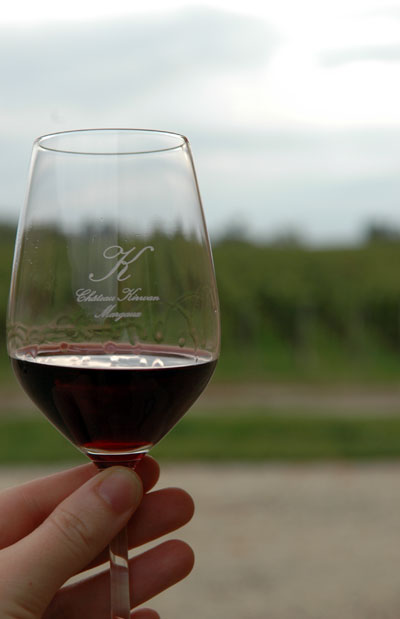
The best part of the afternoon was the tasting at Chateau Kiriwan.
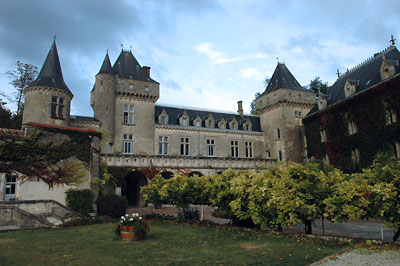
Chateau de la Riviere, Fronsac
It was hard to leave Paris behind. We'd had such a wonderful time and it was so beautiful. Could a few days in the countryside be as good? Actually, more than emotionally difficult to depart; the travel agent booked our TGV tickets for the wrong day.
But we sorted that out and soon found ourselves at Chateau de la Riviere, a working winery with a castle built in 1577. Our room was in the Renaissance wing, built in the 19th century by the renowned Gothic Revival architect Viollet-le-Duc. It was a beautiful place to stay.
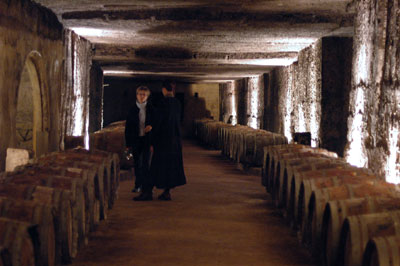
Melanie tours us through the caves
After settling in, we toured the chateau and its enormous labyrinth of caves. They stretch for more than 8 hectares beneath the vineyards and woods and contain over half a million bottles of wine and aging barrels. We sampled some wines from the chateau and the other family wineries and discovered that we can get at leat one of the vintages in Tokyo.
Drawing vines while the cat plays with invisible foes
For dinner, we walked to the nearest restaurant, Chez Carles, about half an hour away, using Melaine's loaned lamp to pick our way along the dark forest path to the road. In true proof that my French is really horrible, I told the waitress when we arrived, "Nous sommes reservation." We are a reservation. Well, she got the point. Dinner was surprisingly wonderful for a place where we were the only patrons.
As we finished up with coffee and dessert, the waitress, who chattered pleasantly though we simply didn't understand, brought over the phone. The owner of the chateau, M. Gregoire, was calling. It had begun to rain slowly and he insisted on bringing his car down to collect us. How generous and thoughtful.
Staircase in L'Arc de Triumphe
We celebrated our 16th wedding anniversary with another long walk around Paris, culminating in a climb to the top of the Arc de Triumphe.
We followed that with dinner at La Tour d'Argent, opened in 1582 and known to be the restaurant that introduced the fork to Europe, as well as being the vanguard of coffee and chocolate in Paris. We had both to end our meal at a window seat overlooking the Seine, preceded by delicious appetisers, the famous serial numbered duckling, and to my great delight, a flaming peach for dessert.
The number of our duck: 1,035,662
In gentlemanly fashion, Tod had the menu with the prices; I was not allowed to enquire. I peeked at the wine list and saw that our bottle of vintage 1989 Medoc wine was 150 Euros. I am glad I don't know the rest. It was worth it, whatever the price.
Parisian intersection
Paris is a lovely city. Redesigned in the late 19th century by Hausmann, the old buildings in the central city all have balconies on the 2nd and fifth floors. Most of the buildings abut the street and are six stories tall, so there is a consistency throughout Paris that is quite pleasant.
Yesterday and today, we walked through the central parts of the city extensively, sometimes with a guide from Context: Paris and other times on our own. There is so much to see. So many beautiful details.
I've started a photoset on Flickr with 18 of my favorite photos from the city. Most of them were taken by Tod, but a few are mine, too. I have black and white images on film that need to be developed.
5 kilos for my thighs at the patisserie
And another five kilos at the fromagerie
(photos by Tod; I was too busy drooling)
Tod left Japan with a cold (which I've caught just in time to go to France) and his sister bought him some of the oddest medicine I've ever encountered.
Sudafed Shower Soothers look and smell like urinal cakes. You put the hard blue disk on the floor of the shower and hop in. The hot water reacts with the chemicals and sends off pungent plumes of camphor and eucalyptus vapor to sting your eyes and nasal passages into feeling better as you exit the shower.
Not so soothing.
Library in the living room
Tod's mom shares a huge old house with two of her friends--they bought the place, moved in together last year and dubbed their new home the Old Biddies' Commune.
The house is wonderful brick building from 1938. There are lots of sunny windows and the stairway curves in a wonderful arc at the landing. Upstairs, everyone has her own suite with a bathroom. The first floor and basement are a large common rooms for dining, entertaining and just lounging around. Outside is a stone patio and a large backyard with a path leading into a quiet grotto.
The shared rooms are decorated with a mix of antiques, art, books and keepsakes from all three women's collections and it's difficult to tell where one's taste lets off and the others' begins. They have distinctive personal styles, but in good harmony.
We're staying here a few days during a family function, then we are off to Paris and Bordeaux to celebrate our 16th wedding anniversary. So if I'm not posting every day, please understand. I'll be back in Tokyo later this month with lots of photos and stories to share.
I have spent the last couple of days looking online for a reasonably priced hotel in Paris. I am coming to the conclusion that it is an impossible task. It's not that there is a lack of hotels but that there are entirely too many.
I'd like to stay in a quiet neighborhood near the center of the city, in a double room at a 2- or 3-star, small hotel for under 175 Euros a night. All the places I was most keen on are booked for the nights we'll be there in October. So now I'm faced with at least two dozen runners-up and a level of flexibility that puts me in the range of hundreds of hotels. It's mind boggling.
So I'm taking recommendations.
Anyone have a favorite Paris hotel? Tell me about it. Why do you like it? Where is it? Does it have a web page I could peek at?
I guess if I wait long enough, I could discover the joys of Paris' parks after dark.
Friday morning I rocked up to the United international check-in counter for my flight back home and while standing in line, took a look at my itinerary.
"I'm schedule to leave the 18th?" A burst of fear gripped me as I scanned the lobby for a calendar. "But today's the 19th, isn't it?"
Sure enough, I'd missed my flight by 24 hours. Crap. I was utterly certain that I was leaving on Friday, not on Thursday. What a screw-up! What to do? My e-ticket was non-refundable, non-transferrable, non-changeable, and non-flexible to the maximum stiffness.
However, the counter agent I talked with, Mr. Julio Mejia, was quite flexible indeed and got me on the Friday flight with no fuss and a minimum of additional outlay. (A one-way ticket to Tokyo purchased on the day would have cost me several thousand dollars, so I appreciated his efforts to save me some money.)
Now here I am, home safe and sound with an bonus day of Chicago holiday well spent with an architectural tour of "Downtown Deco" and a fine dinner in Greektown.
I'm still going to and fro in the world, but woke up this morning thinking about one of my film projects. It was slightly painful not to be able to get up, trot over to my computer and work out the idea I had. I hope I can keep that thought in mind until I return to my studio in a week's time.
That, combined with the cicadas in Jim's Hanashi Station program, made me almost long for home. I can see that this is a feeling that will come and go throughout my travels and I will need to learn to handle it without falling into homesickness.
Fortunately, there is much to see and do before I return. I've got another week in Chicago before I fly out of here, and I intend to use it for drawing some of the city's architecture and landmarks, as well as recording sounds and taking pictures. (And feasting on pirogies and other ethnic goodies.)
I bought a set of pan watercolors in New York. They are much like the ones I had in grade school and their limited palette of 8 colors forces me to work harder. They are quite a different experience compared to my double handful of watercolor pencils, but I can make many of the same colors with either. I might have to carry both forms of color along with me as I walk up and down in the earth.
The silent and vast Reading Room on the third floor of the NY Public Library
My seat in the Reading Room, with a volume of the OED
My first visit to the NY Public Library was all I could have hoped for. The Guttenberg Bible was on display along with a brass globe from the 15th century. After carefully examining both, I sat down with a volume of the OED in the odd-numbered book delivery wing of the Reading Room.
I could have stayed all day but we popped into Bryant Park to catch a lunchtime concert by the city opera. Here's a clip from the concert. I'm sure you can identify the music over the traffic noise and general hubub.
 Bryant Park, NYC Opera 1'43" MP3 (1.6 MB)
I had no idea I looked like Eleanor Roosevelt.
Jenn looks like a 1960s movie star.
This afternoon we're going to Evanston, a college town just north of Chicago. It has a lively downtown of boutiques and bars along with Northwestern University's campus. My grandfather grew up in Evanston and his father modelled for a statue of Peter Pan that was on display in one of the Chicago parks decades ago. I've been looking for evidence of it for years, but have never managed to locate it.
Today I plan to find a shady spot to sketch while Kris is in class and Tod & John run around looking at audio gear and aquariums. I'll post whatever I manage to churn out.
A slideshow with audio captured on a brief visit to the shore of Lake Michigan in Evanston, IL.
Evanston Lakeshore 2.5 MB 24" MP4

Yao woman in her farmyard. Jiang Yong village, Hunan Province
The photos I took with Jim's 1960s Olympus PEN camera look as old or older than the camera itself. I am thrilled with the way a bunch of holiday snapshots transformed into something that looks worthwhile.
Jim developed and scanned the photos for me on Saturday night. Here's a galleryof all the photos I took in Hunan and Guangxi provinces.
Tian An Men, Beijing (click for larger view)
I spent my last day in Beijing doing what I'd intended to do on the first--draw Tian An Men, the gate that leads into the Forbidden City.
Arriving at 10, I settled into a spot on the ground near a flagpole by the big obelisk in the square. Five hours later, I completed my drawing.
I'm never a speedy artist, but the work was slowed somewhat by numerous interruptions as Chinese tourists noticed me. I am the subject of half a dozen videos and countless photos. I talked to adults and children, putting forward my best "American representative abroad" smile and good cheer, even when I wanted to smack people for standing between me and what I was drawing.
At various points throughout the day, I had crowds of as many as thirty people watching me. Dozens of sweet little girls came and sat next to me, smiling while their parents captured the moment on film (I saw very few digital cameras and only one D70 like ours). Grown men gave me the thumbs-up when we established that I didn't speak Chinese. Many mutterings of "Very Good!", which is exaggerated praise considering what I drew.
My favorite onlookers were a group of bright blue-shirted students of various ages and their teachers. Their tour guide explained that they had come from all over China on a trip to Beijing that was a prize for an essay contest on the benefits of reading. Some of the kids spoke English and I asked them about the books they liked. None of them knew Harry Potter but it seems likely he's named something different in Chinese.
When I finished my drawing I can't say I was thrilled with the result, but I'd experienced a memorable afternoon. That makes up for any lack of skill displayed on the paper.
Turbulence over China
As the plane back to Beijing began to shudder and the Fasten Seat Belts lights came on, Jon told me that the air over central China is always turbulent. So I took that as a starting point and doodled a bit.
Ritan Park, Beijing (Click for larger view)
When we arrived, I dropped my bag at the Guardian office, left Zoupi to help Jon write up the Nushu article, and went into town. With a jillion choices of destination, I ended up at Ritan Park, near the embassy area. The park was used for sacrifices to the Sun, and there's a large circular altar space in the center. I thought of drawing the Divine Kitchen, but the name was its best feature, so I settled myself on a bench and drew a willow and pagoda near a pond where people angle for ornamental goldfish.
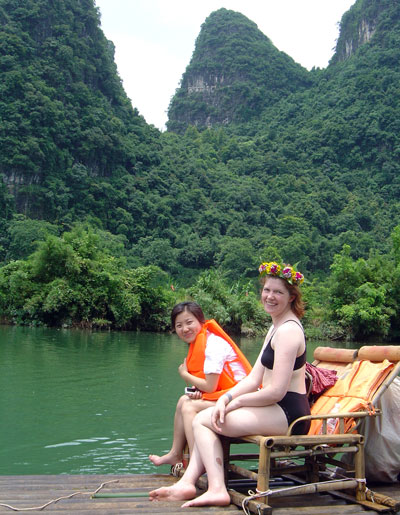
Queen of the River in a crown of flowers rescued from the Yu Long He. Lisa had her turn, too. Photo by Jon.
This was a day to play as we made our way back to Guilin. After breakfast and some shopping in the market (Lisa put her bargaining skills to good use for me!), we hired bamboo rafts and had a two hour trip down the Yu Long He. Jon & I swam alongside the boats for maybe a kilometer, but while I climbed back aboard and stayed put, he jumped back in at least a dozen times. I don't know too many people who like the water as much as Jon.
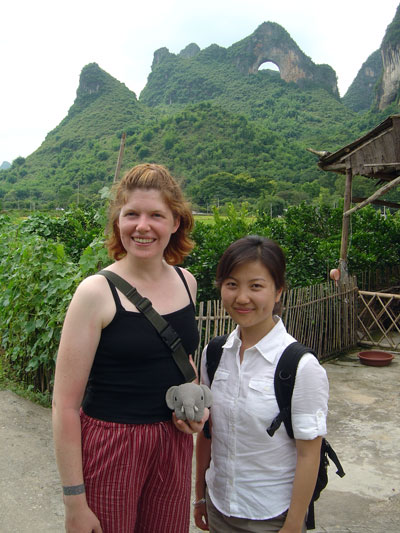
Me, Zoupi and Lisa in front of Moon Hill. Photo by Jon.
We stopped for lunch at an open air restaurant near the raft terminal and had a look at Moon Hill. This was another instance of Mr. Fong knowing just the right thing. As we drove along the village street near the restaurants, he told us to look out the window at the hill with the stone arch in it. He speeded up the car, and we watched the moon change phase as the hill behind the gap shifted relative position.
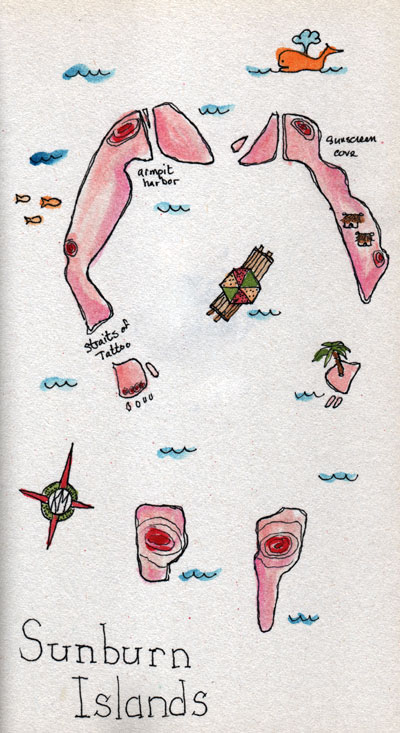
My sunburn islands
Maybe I should have swum with Jon some more because I ended up with a rotten sunburn from sitting undressed on the raft. When we reached town in the evening, we sought out some after-sun cream at one of the Guilin department stores and had a bowl of Guilin's specialty--rice noodles in spicy broth with bits of duck.
Our hotel, the four star Lijiang Waterfall Hotel, had broadband access, so Jon and Lisa holed themselves up in their rooms and worked for part of the night, then we all went out for a late walk along the shopping street before heading to bed.
Today we learned all about Nushu from various sources. I've updated Wikipedia's Nushu article with some of the information we learned on our journey, but the impressions of the old women telling us about their lives just doesn't fit into the encyclopedic format.
Weaving the traditional way. Photo by Jon.
These were remarkable women gathered at Nushu Garden, a local center for preserving the writing. A nearly toothless 80 year old, Ni Youju, told us that she had been engaged at age one, and married at 16. Her husband was still alive and she described him as a good man who didn't drink, smoke or gamble. (Jon blanched...) She learned Nushu by listening to the privileged women singing the songs, and figured out how to weave the patterns they used, but never learned to write or read it. She sang local songs in a strong voice as she worked on a belt weaving that incorporated some Nushu characters in the design.
 Before we left Nushu Garden, Miss Zhou presented each of us with a scroll she had written in Nushu. Jon's was a Li Bai poem about a waterfall; Lisa's was a wish for a happy future. Mine was supposed to say "A beautiful woman will always be appreciated by men" but Miss Zhou made a mistake as she worked with the brush and started over with a new scroll and a new saying. So mine is a hope that by sharing Nushu, all women of the world will become sisters.
We headed down a very rutted road to a densely packed village called Xiawan. The world's most accomplished Nushu teacher, Hu Meiyue, lives here. It is the most beautiful town in the world.
It is a maze of narrow cobbled alleyways between two story red brick buildings that have stood for nearly three centuries. The houses are solidly built and most have ornately carved wooden windows and doors, but the town has fallen on hard times and everything is a bit derelict. The old temple is littered with manure; the Cultural Revolution-era hall is a garage for farm equipment.
The center of the town is a big, green pond. It's the only place where you can see the unobstructed sky. Gates on two sides of the pond lead off to the temple and houses. One thing the village lacks entirely is commerce; there are no shops or stores in evidence. People in the village walk or bike to the nearest town.
Jon interviewed Mrs. Hu, who read from her great-grandmother's Nushu book, and after a quick stop back in Jiang Yong to see Zhou Shuoyi, who compiled the first Nushu dictionary, we were on our way to Yang Shuo.
On the way we stopped for a swim in a river. Yeah! Some water buffaloes were curious about our pile of discarded clothing, but I rescued our stuff before mama-buffalo could eat my skirt.
Another family of buffaloes swam across the river as Jon & I played race games with an unripe quince. He later chucked it at Lisa, sitting on the bank, and caused her to fall in. We were back in the car shortly after that.
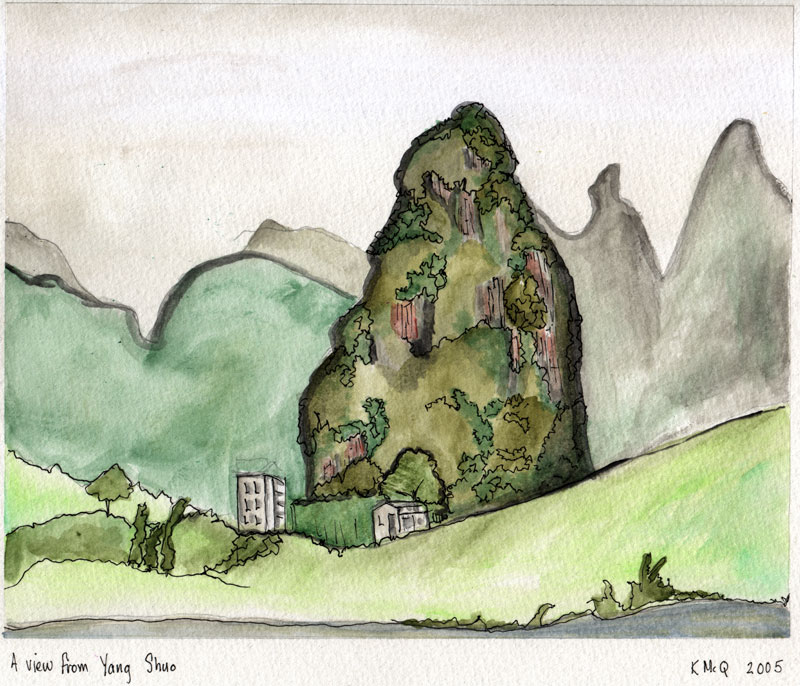
Across the river at Yang Shuo (cilck for larger view)
Yang Shuo is a tourist town popular with Western travellers. It has a nightlife/market/cheap hotel district just like Khao San Road in Bangkok. If the scenery in the area were not so terribly beautiful, I'd vow to never go again.
After arriving in Beijing on Friday night and staying up til nearly 3 am catching up with my friend Jon, the China correspondent for the Guardian, we made our way from his house at 6:20 to catch a flight to Guilin in Guangxi province. Huang Lisha (Lisa), Jon's able assistant, expert interpreter and government spy, was waiting for us with the tickets.
Stepping off the plane, we still had a 180 km trek to Jiang Yong, the Yao county village over the border in Hunan province, where Jon was doing interviews on the Nushu story, so Lisa hired a taxi and driver at the airport. We were blessed to get Mr Fong, who just happened to be at the head of the queue. He turned out to be the most useful resource and a kind man with a sense of fun. Not only did Mr Fong know the way, he knew all the sights and points of interest along the way. He was with us for the whole time we were in the area, always at the ready with the car when we needed him as if reading our minds. He bought us bananas, shared his mosquito spray, joined in our activites and meals. If you ever need a driver in Guilin, he's the man to call.
The day was a full one, meeting our guide, Huang Yuan, and having a feast of a Hunan lunch before making with visits to some of the important Yao cultural sites. We met the local Yao king, Zheng Shiqiu, elected ten years ago, who accompanied us and explained some of the local history and how the village is hoping to promote tourism with Nushu as a key aspect of the plan.
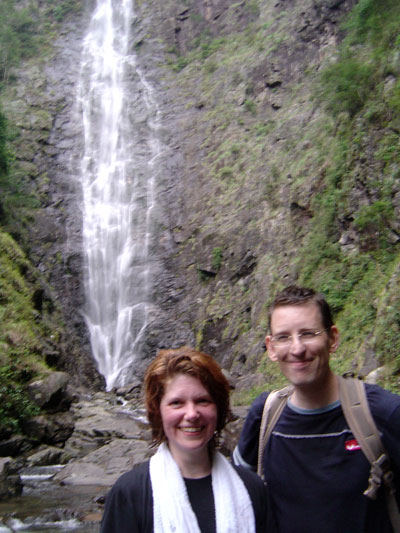
Jon & I after our swim. Photo by Lisa.
The highlight of my day was climbing a mountain to the base of a 110 meter waterfall. It was getting near dusk and the light was fading quickly when we reached our destination. Against the advice of our guide, Jon and I ducked under the barrier and ran towards the pool at the base of the waterfall. We shucked off our outer layers and went for a paddle.
I think it was the best swim of my life. The scenery was unbeatable, the water clear and cold. I glowed and bubbled with overflowing joy for the rest of the day. Even now, I smile broadly when I think of how the spray felt on my face as I stroked across the pool.
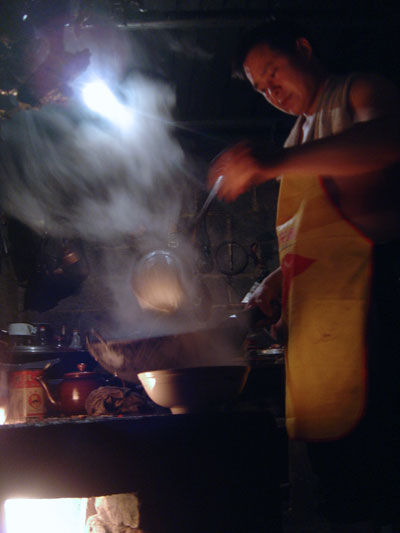
Cook prepares local fare in the glare of a bare bulb. Photo by Jon.
Dinner was at a family-run Yao inn. The kitchen was dark and above the smoky wok hung the carcasses of rats, chickens, ducks, and unidentifiable creatures. I don't think the smoky meat in our dinner was rat, but I couldn't tell what it was.
Jon watched the kitchen girl kill our chicken by slitting its throat, draining the blood for a minute, then whacking it against the side of the building until it stopped moving. The chicken soup was delicious, but I'm glad I stayed in the courtyard having a beer with Zoupi.
During the 15th century, rural women in China's southern Hunan province developed a secret written language. In a few days, I'm going to get to find out more about Nushu in person. A friend is doing a story on the efforts to preserve this language and I'm tagging along.
The last "sworn sister" of Nushu died in September last year at age 98, but there are others who still can read and write the language. It is a mix of Chinese characters and embroidery patterns, each symbol expressing a sound rather than an idea like normal written Chinese.
Women used the script to write letters to one another and when a daughter was married, her mother would give her a handbound book with the first three pages filled with songs from her hometown. The new bride would fill the blank pages herself.
I can hardly wait to learn more.
Forget moderation. Portion control? Out the window. And now that 107 million American adults are overwieght or obese, furniture manuafacturers are touting new, wider seats for restaurants.
UPI published an article on May 23rd: Eatery furniture confirms obesity trend
Furniture makers are selling bigger chairs and tables to U.S. restaurants, an apparent accommodation to growing customers.The National Restaurant Association's four-day conference in Chicago featured numerous displays of supersized furniture for supersized diners, the Dallas Morning News reported Monday.
Chili's has begun testing more spacious eating spaces and was looking at installing tables up to 12 inches larger at future Chili's outlets.

And at the other end of the process, there are also extra large toilet seats, Great John, winner of the Best New Bath Product 2004 at the Chicago Bath Show
The size of the average person has increased dramatically over the last century. Most toilets made today are manufactured from designs dating back to the early 1900´s. In the past, the pleadings of big and tall people went unanswered. For this reason GJTC engineers, medical doctors and artists took to the task of creating a NEW GENERATION of products satisfying the needs of today’s customers. Our goal was to create the most comfortable and safe toilet for Large-Size people in the market. The other challenge was to make a toilet that could also be used by any size person. The final result was the creation of a "SIZE FRIENDLY TOILET"

Hedwig & I trade hairstyling tips.
While in the States, we visited Mom's friends, Bob & Howard, and played with the chickens they keep in their large rural backyard. They have a huge variety of chooks and they husband guinea pigs, too. We have a gallery of chicken and pig pictures taken that afternoon.
Arriving in Chicago from Pittsburgh, the cabin attendant made her prepare-to-deplane spiel, but she ended not with the usual "Thank you for flying United" but:
"May the doors of Heaven open and abundant blessings rain upon you."
I was taken aback. Is that in the airline script? How did she sneak it in? Where did the phrasing come from; it sounds like it could be almost any religion.
Having plonked myself in front of the TV for too many hours over the last few days (to research modern American video editing techniques), I found myself laughing along with some of the advertising. Here are three that stood out; sorry I haven't been able to find video links of these. I'll keep looking.
McDonalds. A man leans back in his office chair, asleep. A woman comes in, and explains that he's fallen into a food coma after a heavy lunch. She sets down her bag, says that she's having a McDonalds salad at her desk, and writes something on the man's head. "We're up for the same promotion." In the next scene, the man walks into a meeting with his boss, excuses his tardiness with a phone call to China. His forehead tells a different story; it says WEASEL in thick black marker.
MasterCard. They are mocking their own "priceless" campaign. A geeky gas station attendent is ringing up the purchases of a young couple. Slushy, $3. Potato chips $2. Gas $31. Then he looks at them keenly. "Starting a life together...?" The woman shakes her head ever so slightly. "Rekindling a flame that has never gone out...?" Another shake of the head. "Satisfying a slushy fix?" She nods yes. "Priceless."
Kohler. An old woman in bed at home speaks Italian to her family. As the camera pans across family photos and pictures of her in daring activites as a young woman, subtitles translate her telling the family not to be sad, she has lived a long life and done everything she ever wanted to do. The camera reaches the window by the bed and we see the neighbor throwing open tall windows to reveal a gorgeous bathtub. The old lady exclaims "Damn!" then falls back, eyes closed and still.
Waiting. Where am I?
The Pittsburgh International Airport is one giant wireless hotspot. This makes my four hour layover almost bearable. I should reach my destination in another 3 or 4 hours.
I can't really tell you how the trip is going--after 23 hours in transit, all memories of the travel have been wiped from my mind. I am living in the moment, delighted to have eaten soup and salad, then brushed my teeth. Simple pleasures.
Instead of taking the complimentary shuttle bus from our hotel to the airport in Kushiro, we decided to take the steam train for one final adventure in Hokkaido.
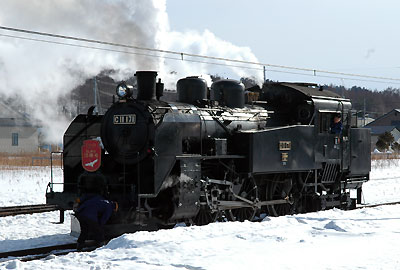
The engine pulls into Shibecha station.
Taking the Fuyu no Shitsugen-go (Winter Bog) is a special event. It's a tourist event for train geeks. The train spotter in me was happy to be riding it.
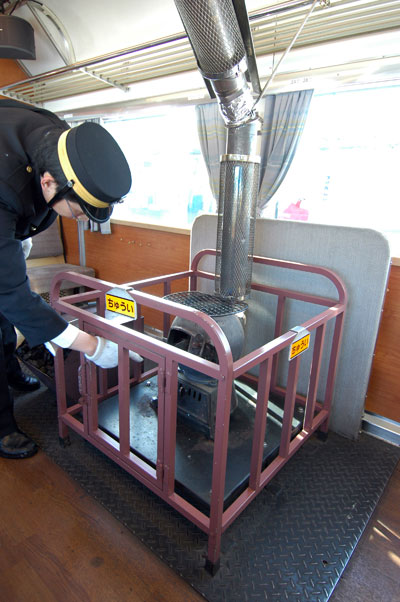
Each car has a "daruma stove" that the conductor kept well stoked with coal.
The cars are decorated with stuffed foxes, deer and owls plus lots of fake branches with polyfil snow draped on them. It's just silly because the real sights were outside: fields full of grazing deer; steam from the engine drifting through the trees; and a fox on the hillside.
Another day, another trip out of Kawayu. We took the train to Abashiri to have a look at the big chunks of ice that float in across the Okhotsk Sea from Russia.
Fields of ice floating on the sea's surface.
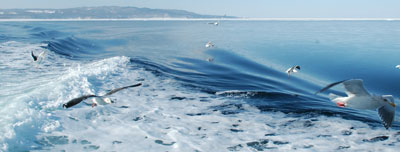
The water is so cold, the waves are viscous and slow.
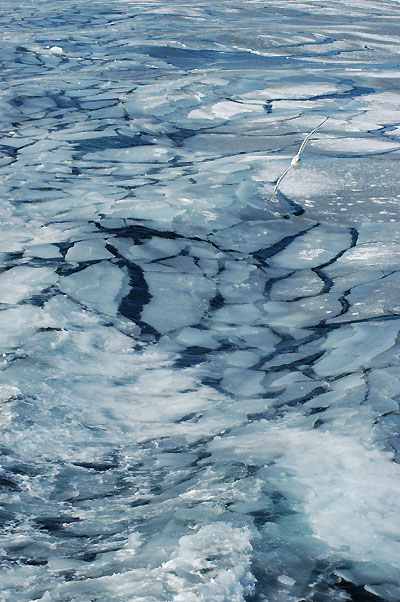
The thinner ice cracks as the ship passes by but quickly refreezes.
Having exhausted the possibilities for local walks and Kawayu entertainments, we signed up to go out for the day with a guide from Doutou Field. We had a day full of adventures with Ando-san, who worked as a policeman in Chiba until the lure of fishing brought him to eastern Hokkaido.
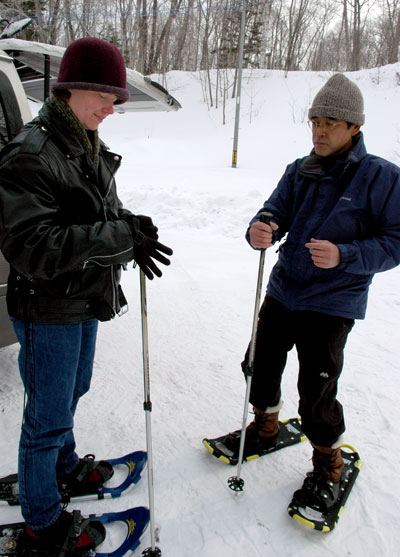
First we went snowshoeing.
Ando-san, knowing that we were foriegners and likely to be big people, brought his largest size snowshoes. He and Tod talked a lot as we went along. I just walked and watched.
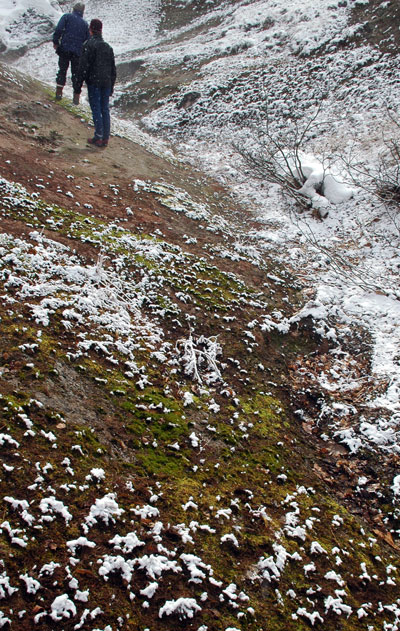
Our destination was Ponponyama, another mountain heated by volcanic forces.
There are crickets hiding under the warm wet leaves here, though we didn't find any. We did see lots of animal tracks on the way in, heard a woodpecker or two, and stumbled across a dead deer.
My best memory of Ponponyama is the colors. The mosses and clay are wonderful red, grey and green colors. The colors of frozen blood and deer fur against the snow were truly lovely. Next website redesign scheme might be "dead deer."
These swans are keeping warm in the sand.
After shedding our snowshoes and warming up with some coffee, we went birdwatching. Along the lake's edge there are places where the water runs warm and birds like to gather. This is Sunayu and it's famous for keeping the swans warm in the winter.
Japanese cranes are huge birds--two meter wingspans.
Tanchou are truly impressive birds--they are very loud and like to flap around at one another. They were thought to be extinct but about 100 years ago someone found a few and started feeding them. Now there are more than 600 at this site. There were nearly as many avid photographers there as birds. You can see them live on the Wild Bird Society Japan webcam.
We made ice cream by filling a fishing float full of salted snow, then tying it to the back of a snowmobile
The most exciting part of the day was making ice cream. Not because of the treat, but because of the snowmobiling. Or rather, the snow mobile accident. Ando-san has a course laid out in front of his house. After Tod went around once without incident, I hopped on the back and rode with him. But on our trip around, he failed to negotiate a curve and we tipped off into the hip-deep snow, landing under the snowmobile. Ando-san brought us a shovel and we dug out the beast while he chuckled and shook the ice cream ball.
I think I got a touch of frostbite from that adventure; my feet got all wet and my ankles look like they are sunburned. The bath felt extra hot that night.

Panorama of Iouzan (click for larger view)
We decided to shake off our sleepy Saturday with a short hike to Iouzan, a mountain a few kilometers from Kawayu.
Yellow sulphur deposits around a vent.
Sulphur hot springs are beneficial for rheumatism, skin disorders and myriad other minor complaints. The source of the sulphur is, of course, the volcanic mountains in the area. Iouzan has several active blow holes that jet hot steam into the air. Kawayu smells like rotten eggs.
Colorful tourists lining up for a commemorative photo.
There's not a lot to do in Kawayu once you've had enough of bathing. Iouzan is a big tourist attraction.
Thanks to a good deal at lastminute.co.jp, we just had a five day holiday in eastern Hokkaido. I didn't post while we were travelling, so these next few entries are backfilled.
After staying up all night to work on a video project for a client with a very tight deadline, I met Tod at Haneda at 6:45 am. There was virtually no hassle getting our tickets; we weren't even asked for ID after we flashed the reciept of our payment. Boarding passes were handed over without question. In fact, for the entire rest of the trip we were never asked to identify ourselves. Maybe that we were the only foreign guests at the hotel--or even in the town--had something to do with it.
The stream that runs through Kawayu is hot.
We arrived at Hotel Kitafukuro (North Owl) in Kawayu mid-morning, settled in, then ventured out for a walk at lunchtime. There was snow everywhere! The hotel staff said there wasn't too much snow this year, but there was stilll more than a meter blanketing the town. It was so bright and shiny that my eyes hurt for hours.
This handsome stranger is warming his feet in an outdoor foot bath.
The town park is full of deer.
Most of the afternoon was devoted to napping--Tod had stayed up all night, too--then a relaxing soak in sulphur baths that tarnished our silver rings and even our gold ones. We topped off the day with a delicious dinner and a long, log-like sleep.
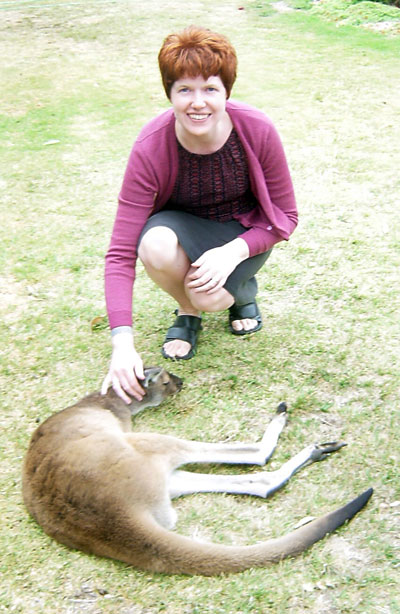
Roo Roo and me. Elliston, South Australia
This kangaroo doe lives on the edge of Elliston. She was bottle-fed by a family who found her after her mother was shot. 18 months old, she spends most of her time in the bush, but comes home for a snack of milk and popcorn every day.
Ah, blessed terra firma, we're back! Australia did not want MJ to leave; it took three days of travel to get home. It was a minor trial of changed plans, delayed flights, and missed connections.
We hopped across the country: Port Lincoln to Adelaide to Sydney to Cairns to Tokyo. We tallied how far we've travelled this past week. Including car travel, we went just about 19,000 kilometers. That's 11,800 miles.
And at the end of our journey, all of our friends were waiting for MJ. Flowers, condolences, food, wine, lots of hugging packed into my living room. Thanks to everyone who came, waited so long for us to arrive, and offered MJ their support.
MJ & I are holed up at the Adelaide Hyatt on North Terrace, whiling away the day between flights by luxuriating in hot baths, fluffy white robes, room service and a good long swim. (Sorry for next month's credit card bill, darling Tod.)
For those keeping track, we'll be back in Tokyo on Friday morning at 6 am. I'm anxious to get back, as is MJ. We miss you all.
Adelaide is full of rednecks.
At midnight, MJ was feeling upset and in need of a walk. We went out to find a coffee shop in Glenelg--the seaside resort area of Adelaide. There were dressed-up couples and groups of youthful friends walking the street, tiddly and having fun.
MJ started to cry and we sat for a while on a bench. I put an arm around her and held her hand. Passersby looked at us curiously. We didn't fit the mood of their evening. When she was calmer, we continued our walk, hand in hand.
There were no coffee shops open at midnight.
But we did find shocking provincial homophobia. At first, I noticed just a gesture: a dark-headed woman hung her head out the passenger window of a passing car and gave us a "hang loose" chaka. OK, whatever.
Then I started to hear people. "Lesbos!" Mutterings as we passed by. "Lesbians, go home." "Gay girls!"
Two men in a white hatchback threatened to beat us to death.
When some drunken kids on a hotel balcony demanded "Kiss! Kiss!" MJ ripped into them and they backed down.
We giggled all the way back to the hotel.
MJ & I pelted down Glenelg beach into the surf until we were knee deep in ocean water, clothes wet, giggling. Sharks be damned.
The funeral is on Monday morning; we'll drive to Mum's beach house in Elleston to scatter her ashes on Tuesday. Things are as good as you could expect. I'm glad I'm here.
It's embarrassing that my formerly fine and upstanding nation is having its election monitored by the organizations that oversee elections in places like Bosnia, Kazakhstan and Afghanistan. Even US citizens are getting into the monitoring act. The level of trust in the system is low.
IHT: European monitoring group to observe U.S. election
Portsmoth Herald: Monitoring the Nov. 2 election
Mathaba: A Clean Count?
Deutsche Welle: Monitors Criticize US Election Procedures
Some of my friends here in Tokyo are going to Florida to keep an eye on things on election day. They'll be armed with video cameras and cell phones to alert everyone of any problems.
"Sunshine and Gators" is hoping to raise a little more money to fund their flights and equipment costs. If you're up for a good time for a good cause, why not nip over to Nishi-Azabu tomorrow for a Halloween party?

Bush is Scary, Vote for Kerry
Wednesday, 20 Oct, from 7:00 PM
SuperDeluxe
3-1-25 Nishi-Azabu, B1F
Admission is 3000 yen, all going to the "Sunshine and Alligators" activists to cover transportation, vehicle rental, cell phones and other expenses. Live music, DJs, costume contest, door prizes, good food
For more details see www.sunshineandgators.com.
 If you wanted to see more photos (or full-size versions) of Moody's Namena, check out the 728 shots Tod snapped during our vacation. They are unedited so you'll see the good, the bad and the ugly--I even left the ones in where I look fat and dorky.
If you're reading mediatinker via a newsreader, you've may have missed the extended version of my backfilled week of Namena posts which include more stories and pictures. So please click through and have a look; it's such a fabulous place, I hope you won't want top miss anything.
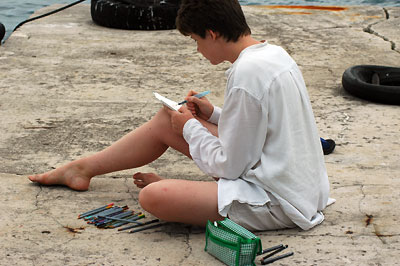
Drawing on the dock.
While Tod snapped 733 photographs (I thank him for the illustrative materials in the previous week's entries!), I spent my time sketching. I wasn't quite so prolific, but I managed almost 2 dozen drawings.
Near the end of our stay, Jone was peeking over my shoulder watching me sketch the clubhouse window and bookshelf, I think it was. So I invited him to draw with me the next afternoon during his break. He and I sat outside and drew flowers. I showed him how to use the watercolor pencils I'd brought along. Soon we were joined by Benny, Maria and her sisters. It was really fun to watch them work. Benny drew a fabulous leaf. The girls drew flowers on the bushes around us. They are all very natural artists.
Jone has an untapped gift. His watercolor of hibiscus showed a delicate touch and a good eye. It was every bit as good as mine and he swears he hasn't drawn before. I was so pleased! We gathered again the next day. "We should have started this sooner," he commented. He was so delighted with drawing that I left the pencils, brush and the remainder of my watercolor paper for him.
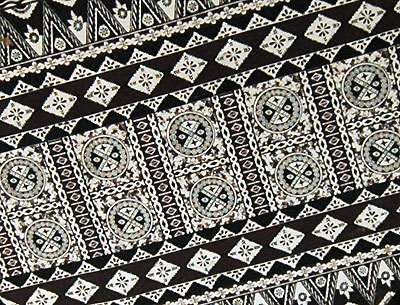
Tapa patterns on cloth in the clubhouse.
There are traditional geometric patterns laid out in lines called tapa that are used in textiles and as decorative elements. They pop up everywhere on Namena--the bed canopies, the ceilings, the table mats, even the battle hammers that decorate one wall. I spent a lot of time examining them.
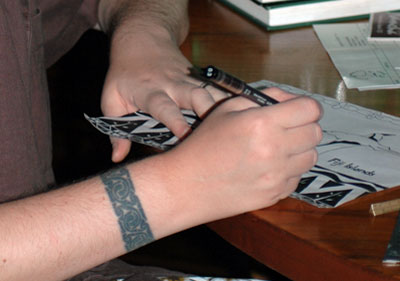
The sulu design in progress
So when Joan asked if I would draw them a logo to use for their new sulu and t-shirts, I incorporated tapa into the design. Moody's Namena have a tropicbird as their mascot, so the bird flies over three rows of tapa: one neat geometric that Benny likes from the fabrics in the clubhouse; one of my own design that symbolises the plants on the island (and the male/female triangle symbols since I'd just finished reading The Da Vinci Code); and a wave pattern on the top so the bird soars over the ocean. I was pleased with the result; Joan loves it and gave me a big hug when I presented it to her. I'm happy that a little bit of me will be on Namena for a while.
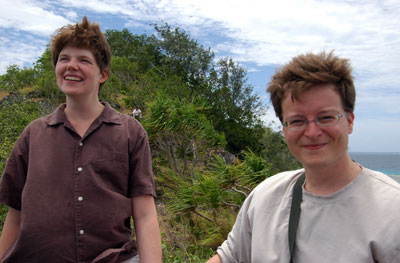
Us on the head of Namena's dragon. (Photo by Deborah Nation)
Our excuse for visiting Namena was to celebrate our 15th wedding anniversary. We wanted a relaxing week away from the busy city. It proved to be so leisurely and laid-back that I nearly forgot our anniversary.
I could have sworn the 13th was on Thursday. I was so sure of it that on Wednesday I was writing out postcards and dating them 12 October. But Wednesday evening, as we gathered for pre-dinner drinks in the clubhouse, Tod looked at the handwritten chart of tides which carried the date as well as the tidal hours. He raised his glass and wished me a happy anniversary. What a surprise!
The next night, we all celebrated with a bottle of champagne and a toast to happy relationships at dinner. The staff brought out a cake with candles, luscious tiara flower garlands, and a gift of Fiji-made frangipani bath products. They serenaded us with ukulele, guitar and voice. We danced and my sulu (the traditional wrap around skirt worn by men and women) nearly fell off. Tom joked that I needed a staple gun.
Thanks to everyone for making our nearly forgotten 15th so completely memorable!
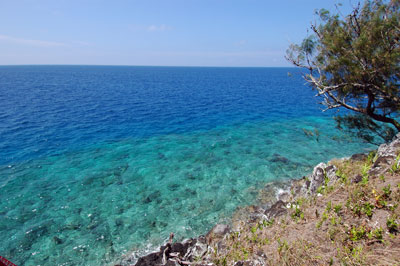
The island is surrounded by a coral reef and so has a plethora of fishes and underwater wildlife. The water is turquoise over the reef and bommies and it is as clear as the sky.
The reef is a protected marine reserve, thanks to Joan's intervention. All divers have to buy a $20 "reef tag" that gives them permission to dive. The money goes to maintaining the reef environment and to scholarships for the children in Savusavu.
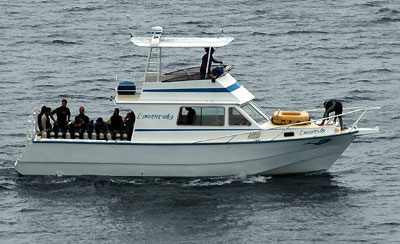
Divers on boats like this one dive up to six times a day; that's bad for the reef.
Joan had petitioned the government for protected status for their reef, to no avail. One of her friends who works for the UN dismissed her attempts at conservationism. "You won't be able to do it," he advised. That got Joan's Sicilian blood pumping and she initiated a grassroots effort by the local islanders. "I told our men, 'Go tell your fathers, your brothers, your uncles that the reef is being overfished and destroyed. This is your land, your heritage. You should preserve it.'" And it worked.
So what are they preserving? An astonishing array of fish--particolored parrotfish, surgeon fish with long snouts, puffers, damselfish, sardines, and dozens of others. I saw sleeping reef sharks and just missed a glimpse of a manta--Vijay pointed it out but it moved too quickly! There were so many fish I can't keep track of them all, though I tried to look up the ones I remembered in the reference books in the lounge.
School of yellowish spotted fish; me snorkeling; striped fish of unknown type.
We only snorkelled out at the reef one afternoon, but spent time in nearer the island gawking at the underwater beauty. Even near the dock there were schools of colorful fish and live corals in vivid blue and pale purple, swaying orange tendrils, big expanses of green-grey swirls. The ocean is better than a paintbox.
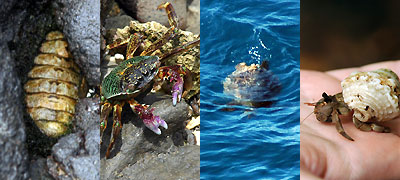
A chiton, formerly prized for jewelry; green shore crab; our shy turtle firend; a hermit crab.
Close to the shore we saw sea snails, chitons, anenome, starfish, hermit crabs (Tod's favorite) and brilliant green shore crabs. Blennies hopped around in the tide pools. Turtles migrate to nest on the island and we saw one of the three resident turtles swimming around our bure one afternoon.
Tod delighted in photographing birds. And there were many to choose among.
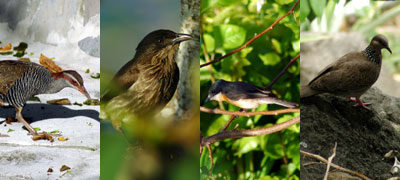
Banded rail; Pacific starling; unidentified little bird; spotted dove.
Around the bures we saw banded rails including three fuzzy black chicks, swifts, white-collared kingfishers, orange-breasted mylomeza (honey catchers), Fiji white-eyes, Pacific starlings, spotted doves, friendly ground doves, and the pesky mynahs that migrated from a passing ship and are eating all the white-eye eggs.
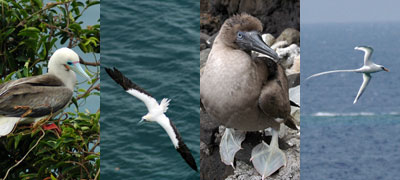
Red-footed booby; masked booby; baby booby; white-tailed tropicbird.
Over the sea we watched frigate birds chasing the boobies. There are red-footed boobies, masked boobies and brown boobies nesting on Namena. Terns skimmed the water and a reef heron appeared on the rocky shores from time to time. A magnificent white-tailed tropicbird flew around our bure.
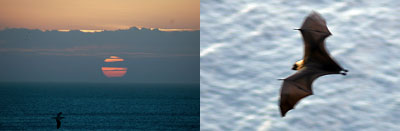
At sunset we watched for the green flash and for the flying foxes. These beautiful bats have a wingspan of about a meter. They are huge and they feast on fruits.
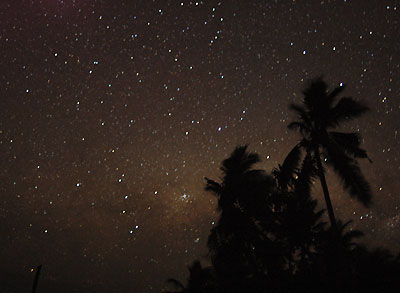
Looking towards Scorpius and Corona Australis.
After the birds and bats had gone to bed, the stars appeared. Only one night of our stay was perfectly clear, but we took good advantage of it. After dinner we carried the camera, tripod, start charts and laser pointer to the beach for some fun. The Milky Way was bright across the sky. I saw nine shooting stars in the two hours we were on the beach.
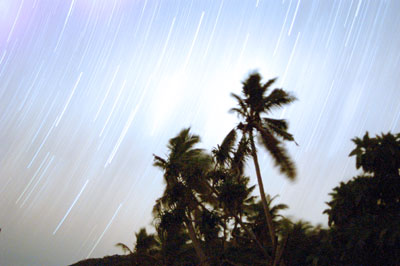
The stars move quite a bit in 30 minutes!
I was so excited to see the southern constellations for the first time. We didn't stay up late enough (or get up early enough) to see the Southern Cross, but I identified Grus, Pavo, Eridanus, Horogulum, Triangulum Australe, Scorpius, and Corona Australis. We took one 30 minute exposure (too long really, as it's too bright) to capture the star trails around Scorpius.

The Magellanic clouds.
I was perplexed by two hazy patches due south. They weren't part of the Milky Way and they weren't clouds in the sky. A little research revealed that they are the Magellanic Clouds--galaxies in our own astronomical neighborhood.
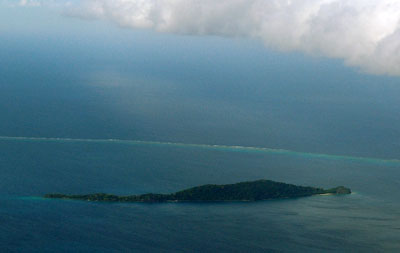
Namena from the air
The island is shaped like a mile-long dragon--a triangular head towards the west, a lumpish body in the center and a long sloping tail pointing east. There are three main beaches with smaller beaches and rocky coastline accessible at low tide. The north is the leeward side, facing the distant island of Vanua Levu, where we started our sea journey. To the south, you can see the even more distant islands of Koro and the former leper colony of Makogai.
Namena wasn't always uninhabited. There was once a small tribe living there. Tom estimates the island would have supported about 18 people. There is rocky fortification built on the highest point of the island. It affords good views to the sea towards the only opening in the reef. There are several round wells or fire pits built along the hill. Where the volleyball court is not, was once a village. Tom and the men have found scores of pottery shards and other artifacts there and had them dated to 2000+ years old.
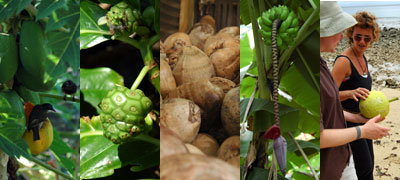
Birds enjoy a ripe papaya; the mysterious medicinal noni; coconuts in storage; bananas; Sara and I examine a fresh breadfruit.
Namena has numerous native food plants. We enjoyed the island's produce of papaya, coconut, breadfruit, and bull's heart along with some delicacies Tom imported--bananas, pineapple and Joan's delicious tomatoes. There's a vine-y pepper that grows like a weed, pandan (which Fijians don't eat, though other islanders do), and noni, a medicinal fruit that smells like stinky French cheese when it's ripe.
I was surprised at how familiar the island's jungle looked. Aside from the vines, it could have been Mt Takao or the hills of Pennsylvania. There were deciduous trees, jutting rocks, and shrubby undergrowth. My idea of jungle was shattered.
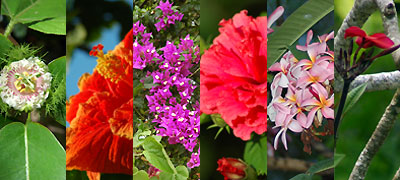
A jungle vine; hibiscus; borganvillea; a viciously red flower; frangipani; tiara
Flowers are Fijians favorite decoration and for good reason. Bougainvillea, frangipani, hibiscus, and tiara grow in abundance. Outside our bure was a stalky varigated plant with red flowers that the honey catchers liked to visit.
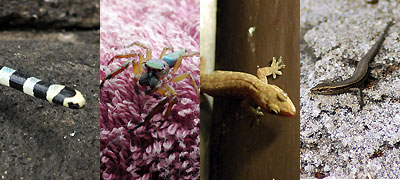
A poisonous seasnake; the spider that jumped on Tod's nose; a gecko; a blue-tailed skink.
There's not a lot of fauna on the island, aside from birds (see tomorrow's entry). We encountered a venomous sea snake, lots of geckoes and blue-tailed lizards, and a rat.
There are plenty of hungry mosquitoes, which contrary to our expectations, are active during the day. Moths and butterflies flutter around. Spiders, pale brown crickets, beetles large and small, and jillions of ants make up the remainder of the island insects.
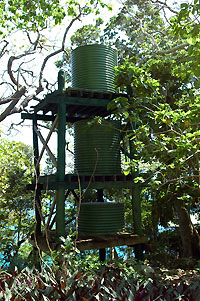 One thing that Namena lacks is fresh water. All the water we drank on the island was rainwater. And Namena doesn't get a lot of rain, so you want to be conservative in your use.
An Australian man who came to Namena after WWII to try to recover from his shattering war experience lived on the island for a few months and dug a clever system of channels in the rock cliffs to route rainwater into a holding basin. Tom says that when he first arrived on Namena and camped out to explore the land, he discovered the excavations, cleaned them out and found them quite effective for collecting water. But these days he uses metal and plastic tanks for his water system.
Moody's Namena was a deserted island 20 years ago. Every man-made thing that exists on the island has been brought by boat, hauled by men up a steep hill and assembled by hand.
Supplies and mail arrive with the guests on the boat or in the sea plane. Namena have a small cargo boat (the generous gift of a wealthy guest) that makes the journey to Savusavu for fuel, tools, supplies, and food.
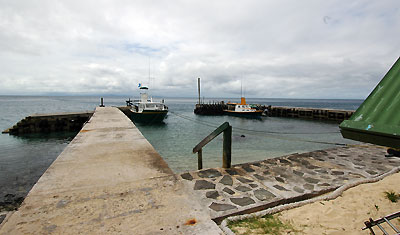
Namena's dock.
We were greeted at a concrete dock (the original dock was blown away during a cyclone shortly after it was built) and taken up to the top of the island in Tom's Polaris utility vehicle. They built the roads just five years ago. Before that everyone made the trip up and down 106 wooden steps.
Inside our guest house; a view from the veranda.
The guest houses, called bure in Fijian, are hexagonal structures of wood beams (telephone poles carried by hand up the hill before the stairs were built) and boards. They feature high ceilings, doors on four sides that open to a wrap-around veranda with ocean and forest views, and wooden floors made of a tree related to rosewood that is no longer logged. There is no electricity--we lit gas lamps in the evenings, and read in bed by the light of solar powered lights. Water is collected when it rains and gravity fed to sink and shower. The toilets use salt water. Each bure has a gas burner and kettle for making tea, two generous closets, built-in desks and a mosquito-netted bed. What more could you need? I wanted for nothing.
Guests get together for meals in the clubhouse
Meals are served in the clubhouse, constructed like the bure, but on a larger scale. A gas powered fridge supplies ice and keeps the mixers cool (bring your own booze from the duty free). Two round tables seat six people each and there are comfy chairs drawn up neatly around a large coffee table littered with reef identification books. Bookshelves line two walls under the large picture windows which are glassless to allow the breezes to flow through. Birds sometimes fly through, too.
An adjoining kitchen and office, a boat house near the dock, and the staff quarters at the other end of the complex complete the buildings on the island.
Staff outnumber guests on the volleyball court; I'm resting!
Down at one of the beaches, there's a grassy volleyball court, some hammocks, and a barbecue area. Trails crisscross the island for hikes from head to tail of the dragon.
That's about all on the island that's been touched by man. Tom designated 10% of the land as "developed" and leaves the rest wild. Nothing is off-limits at Namena; guests have the run of the place.
Namena was uninhabited 20 years ago when Tom Moody signed a 99 year lease from the native land board. In fact, namena means uninhabited in Fijian.
These days, Namena is lightly inhabited. Tom & Joan Moody live there year round, along with 12-18 staff (depending on how busy the resort is) and no more than 12 guests.
Tom & Joan (pronounced Jo-ann, I kept embarrassing myself by forgetting and calling her Joan) are native Pittsburghers, but have lived outside the US for over 40 years. They founded a posh resort in Panama in the 70s, but were chased out in a horrific incident in 1991 that ended with Tom in the hospital for two months and the resort abandoned in haste. Undaunted, they started over and after scouring the South Pacific, found Namena.
Tom's 76 now, and starting to slow down a bit (the shooting in Panama didn't do him any favors) but he was a motorcycle hellion and an avid diver back in the day so he has a lot to slow down from! He has more stories and tales than anyone I've ever met. Tom spends his days directing improvements and maintenance and enjoys meals with the guests.
Joan manages the business end of things. She's got a computer, runs the communication systems, handles reservations and local transfers to the island, and has a lot of connections around Fiji. Joan took her meals away from us, as she was suffering a cough and didn't want to infect the holidaymakers. So we didn't get to spend too much time with her, but I think she has nearly as many stories as Tom!
Jone plays ukulele; M'bola flanked by two "boat guys"; Victor the dive master
The staff are fabulous. Tom calls them kids, but they're not really all that young. Jone (pronounced Johnny) is the "waiter" and seemingly uncle to most of the rest of the staff. The three girls on staff are sisters and Jone's nieces. Everyone else is a cousin in some fashion. Which is good, because this working family doesn't get off the island too often. They have to get along or they'd be miserable.
Cook mixes up some kava; Vijay nimbly scales a coconut palm; a "boat guy" watches the dock.
Despite the fact that we were there for a week and there are only 12 people taking care of us, I still didn't learn everyone's name. Victor is the cheeky dive master. Don drives the boat. M'Bola and Vijay do everything that's required--from loading boats to leading the guests on jungle treks. Benny's the kitchen boy who is a great dancer and has a shy smile. There is also a cook and several "boat guys" seemed to hide behind the scenes to get things done.
And of course there were other guests on the island. Our stay was divided neatly into two sections by the departure and arrival of guests. Everyone we met was memorable and interesting.
Bradley on the launch ready to leave; Mike and Kim enjoying kava; Nancy on the launch.
The first group was two diving couples: Nancy and Bradley from Santa Cruz, and Mike & Kim from Auckland. Mealtime conversations were lessons in oceanography, conservation and diving lore. I am keen to learn to dive now.
Deborah in the window at sunset; Sara and Jerry wave goodbye to us; Gerard contemplates departure.
They left on Monday and Tuesday and were replaced by Sara and Jerry, married filmmakers from Melbourne who were decompressing after the Athens Olympics, and Deborah and Gerard from New Zealand who were there to work (!) gathering material for a program for Radio New Zealand and an article, respectively. We talked world politics and a little shop over dinner.
People have rarely figured so prominently in my holidays. I enjoyed it very much. Namena's remoteness attracts unusual travelers.
Air Pacific flies direct Tokyo to Nadi every day.
Getting there is not really half the fun. It's not really much fun at all.
Traveling to Namena from Tokyo is quite a trek. An 8 hour "red eye" flight to Nadi on Air Pacific, Fiji's national airline. Follow this by an hour on a tiny plane to Savusavu. Then a 90 minute boat trip across 25 miles of choppy sea to Namena's dock.
This Sun Air plane was like a minivan with wings.
Transstar Charters, owned and operated by Terry and Davina, was the final leg of the trip to Namena.
I was exhausted, even though we weren't doing anything but sitting and waiting. We arrived safely after about 15 hours of non-stop "getting there" and settled in for a week of "being there."
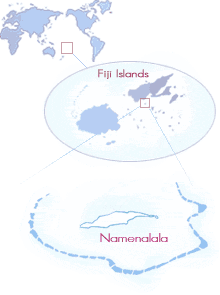 I'm about to hand over a wad of cash for some airplane tickets to Fiji. We leave tomorrow.
Moody's Namena is a tiny island resort where Tod & I will swim among the fishes, hike through the tropical forest, and lounge in hammocks while we read books. For some people, this would be a terribly dull holiday. But not for me. I'm packing art supplies, star charts, a bathing suit and not a whole lot else. Aaaaaah!
Which is all by way of saying there won't be any updates here for a little while, but I promise to backfill with photos of sand, sun and etc. as soon as we return.
My absentee ballot arrived in a charmingly hand-addressed envelope from the Allegheny County Board of Elections. Tucked inside were return envelopes and instructions, plus the most poorly pasted-up and over-copied sheet of paper I've seen in decades.
Look, Ma, I made it myself!
It's all very homespun, including the apology from the Division Manager of the Department of Administrative Services Election Division:
Because there is insufficient time to print and distribute the official absentee ballot for the November 2, 2004 Presidential Election, we have prepared the enclosed Write-In Ballot for you to vote and return by the October 29, 2004 deadline.
OK. Fair enough...no fancy printing. But doesn't Allegheny County have word processors?
At the minimum, you think they could have at least lined up the boxes and hidden the lines from the scotch tape. Shoddy workmanship doesn't instill a lot of confidence in the electoral process.
Hey, what's this typed at the bottom of the ballot?

But, no. There is nothing "over." And no information in the instructions, cover lettor or list of candidates. I wonder what the special question was supposed to be? And more importantly, does its absence invalidate my ballot??
Reuters is reporting on a study by the Center for the Advancement of Collaborative Strategies in Health that says many Americans will act on their own in a terrorist emergency, rather than following the government's instructions:
Americans Suspicious of Terror Plans, Survey ShowsAn in-depth survey found that the people do not trust the federal government to take care of them during an attack, and would take many matters into their own hands -- endangering themselves and their families.
[...]
"People did not respond irrationally. Rather, they made rational, logical choices," Glied said.
For instance, many of those surveyed feared they could go to a smallpox vaccination site, get exposed to people who already had smallpox, and then be told they could not safely get the vaccine because they were pregnant, had eczema, AIDS or some other condition.
And people asked to think about a dirty bomb explosion said they would try hard to get to their children or other family members, even if told to stay put by authorities.
"Only 59 percent would stay in the building," said Dr. Roz Lasker, who led the study.
"Assuring the safety of people who depend on them is more important than their own safety," Lasker said.
The full study is good reading. Redefining Readiness: Terrorism Planning Through the Eyes of the Public
 What the U.S. government needs is less press freedom (not that it's much more than lip service anyway), more lethe in the water to keep people complacent, and some really good propaganda.
You've seen ready.gov; does it compel you to follow its instructions? Compare duck-and-cover drills in the 1950s to looking contemplatively at dead fish. Backyard fallout shelters have more cachet than plastic sheets and duct tape.
Cruising through the Prelinger Archives, I found these gems of emergency preparedness from the US Civil Defense:
- What To Do In A Gas Attack (37 MB MP4) 1943. Presented in association with Clorox.
- Duck and Cover (10 MB MPG4) 1951. The children's classic.
- Survival Under Atomic Attack (22 MB MPG4) 1951. Could you be this calm?
- What You Should Know About Biological Warfare (19 MB MP4) 1952. Toxins with a smile.
- About Fallout (20 MB MP4) 1955. Atomic science for the concerned citizen.
It wasn't the whole country that blew up, but something big exploded in northern North Korea near the China border on Thursday. News is just filtering out to the world now with reports saying there was a 3-4 km mushroom cloud spotted and a crater visible on satellite photos.
Thursday was North Korea's 56th anniversary of founding. Did they detonate a nuclear bomb to celebrate?
Yonhap news agency has the most detailed report I've found so far:
Mushroom Cloud Spotted at North Korean Border: SourcesA reliable source in Seoul's diplomatic community said Sunday that a mushroom cloud with a radius of 3.5 to 4 kilometers was spotted, along with a massive explosion, in Kimhyongjik County in North Korea's northernmost inland province of Yanggang on Sept. 9.
"The Sept. 9 explosion occurred at around 11 a.m.," the source said. "But it is not clear yet whether the explosion is related to an intentional nuclear experiment or a simple accident." He noted that the site of the explosion and mushroom cloud is not far from the North's Daepodong missile base.
Similar reports are coming from Beijing sources, but some are saying that the blast occurred in the south, near the DMZ. Others claim that large expanses of smoke indicate a forest fire.
There's a lot of confusion, significant delays in reporting and not a lot of clear facts. Typical for N. Korean news. How very 19th century...
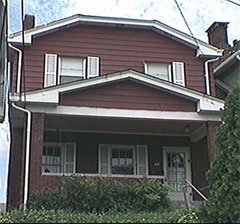 Looking for a property in Pittsburgh, PA? We're selling our lovely 1920s Mt. Washington bungalow on Winton Street. I adore this house, but know we'll likely never move back to Pittsburgh, so it's time to sell.
Brick and wood frame. 1470 sq ft. 3 bedrooms, 1 bath, walk-in closet, finished attic, antique gas fireplace, privacy fenced back yard, full basement. First floor interior was redesigned by local architect to create an airy, open greatroom with wood floors and views straight through to the back.
New shingle roof in 1996; new gas furnace in 1996; new bath unit in 2004.
Very convenient commute to downtown. The house is within walking distance of South Hills Junction (T and busway) and the local bus stop is only 2 blocks away. There is a grocery store, restaurants and other useful amenities a short walk away. Easy access to supermarkets and shopping malls by car.
All the assessment details are available at the Allegheny County website.
For a tour or more information, please contact Collyer Realty, 308 Boggs Avenue, Pittsburgh, PA 15211 (412) 431-0500
How do I influence others in a way that changes the world? This is something I've been thinking about lately.
My personal effect on the working of our world seems pretty insignificant. I have no progeny (human or creative) and I can think of nothing I've done that will live on after I die. Nothing sticks out as me having changed someone's opinion or actions. At least as far as I am aware...
When I consider it that way, it seems that only a handful of people have any real influence on the world--the leaders and luminaries we read about in the news, for example.
But for each newsworthy leader, there are levels upon levels of people who influenced him. And sometimes you just can't know that you'll be one of those influential people. As far as I know, there's no way to predict what effect you're going to have on the world through your actions. It's the butterfly effect on a human scale.
As a fictional example:
President John Doe makes the news when announcing a new government policy to build a colony on Mars. Who influenced him in launching the program?
- Sam Smith, his speechwriter, puts the words in his mouth that will be echoed in the media.
- Bill Johnson, a lawyer and lawmaker, helps him to draft the new policy.
- Jane Riley, his chief science advisor, meets with him for hours to discuss the possibilities, risks and rewards.
- Vladmir Morovsky, Russian premiere, announces a program to send men to the Moon and to Mars.
- Bricker Sloan, a lobbyist for the aerospace industry, arranges campaign funds and support.
- Millicent Harvey, an actress and personal friend, plays a space heroine in a film and relates the experience of making the movie.
- George West, supervisor at his first job, talks to him about the company's goals of corporate dominance in the widget market and jokes about dominance throughout the solar system.
- Betsy Doe, his mother, sends a care package of rocket-shaped cookies to his graduate college dorm on July 21, 1969.
- Mr. Wilkins, his 6th grade English teacher, reads aloud to the class from his favorite book, Edgar Rice Burroughs' Princess of Mars.
- Bob Doe, his grandfather, shows him the planets through a telescope when he's a boy.
So even though most of us are not the luminaries we read about in the papers, we do have influence on things those luminaries do. But maybe not the way we imagine.
All these thoughts raise more questions: Is there a way for an ordinary person to cut a wider, more obvious swath through the world? Is it important to do so? Do we need more luminaries? What the most important contribution you, personally, can make to the world?
The US president doesn't have to abide by international treaties and his own federal laws? Isn't that sort of like saying the Pope doesn't have to follow the ten commandments?
WASHINGTON (Reuters) - President Bush, as commander-in-chief, is not restricted by U.S. and international laws barring torture, Bush administration lawyers stated in a March 2003 memorandum.
The 56-page memo to Defense Secretary Donald Rumsfeld cited the president's "complete authority over the conduct of war," overriding international treaties such as a global treaty banning torture, the Geneva Conventions and a U.S. federal law against torture.
"In order to respect the president's inherent constitutional authority to manage a military campaign ... (the prohibition against torture) must be construed as inapplicable to interrogations undertaken pursuant to his commander-in-chief authority," stated the memo, obtained by Reuters on Tuesday.
Source: Reuters
anomie (n.) Personal state of isolation and anxiety resulting from a lack of moral standards in society.
bonhomie (n.) A pleasant and affable disposition; geniality.
Anomie is a fashionable word these days. I don't know who started its revival, some media pundit in America I surmise, but I keep running across it in commentary and news articles.
Anyway, anomie wasn't familiar to me and every time I read it, I thought of bonhomie. Taking in the context, 'geniality' wasn't even close to the right meaning. So I referred to the dictionary. As it turns out, I'm glad I looked it up because it's one of those philosophical words that refuses to stick in my vocabulary. (For a good laugh, go ahead and ask me the difference between sophist and solipsist.)
But my twisted brain was making a valid connection--anomie and bonhomie are the only two words commonly used in English that end in 'omie.' At least that I can find.
So here's a new philosophy (call it what you will): If people would embrace bonhomie as their personal standard, the world would have a lot less anomie.
In another lifetime, or so it seems, I spent a lot of time with sheep and goats.
My dear friends, Frank and Louise, raise wool sheep, angora goats, and herds of cats on their small farm south of Pittsburgh. From the time I dated Frank's son, Sam, at university until I left for Japan, I spent many weekends on the farm helping with the fencing, mucking barns, cleaning goats' feet and chasing sheep around the pastures to give them medicine.
It was hard physical work, but never too hard--mainly tiring, satisfying and fun. We cooked crazy foods, drank a lot of bourbon, and generally enjoyed life in the very best ways. I love Frank & Louise and the farm and I miss those weekends.
As I read this article on NEWS.com.au, I recalled a lot of happy memories:
Hermit sheep loses years of wool
A VERY woolly New Zealand sheep that survived six years in the wild was today heading back into the hills near naked after his heavy fleece was shorn off on live worldwide television.
The merino wether was shorn of nearly 27 kilograms of fleece now being auctioned for the cancer charity Cure Kids.
Owner John Perriam said today that after the experience the sheep, named Shrek, was in "fine fettle".
"He's quite incredible. His personality has changed, he's almost saying 'thanks mate, I want to go back to the hills now' and he was pawing at the doors of the shed this morning," Perriam told Radio New Zealand.
Merinos, which produce a fine wool used in clothing, are usually sheared once a year, but Shrek had managed to avoid muster for six years until found in a remote part of Bendigo Station in Central Otago near the Southern Alps in New Zealand's South Island.
Shearer Peter Casserly, 56, took more than 20 minutes to take the fleece off.
"The fleece was very heavy and pulling the skin up so it would have been very easy to cut him; that's why I was only snipping away slowly. I couldn't put in many long blows," he said.
Casserly, who has been shearing since he was 17, holds the world blade shearing record of 353 sheep shorn in a nine-hour day.
27 kg is a lot of fleece. The average merino fleece is around 7 kg and fills the volume of about three fluffy bed pillows.
After shearing, Louise always had a few greasy fleeces wrapped in sheets tucked up into the loft above the kitchen. I never got to shear the sheep. Louise claimed that as her right--I think she worried that anyone else might nick the sheep.
But I did wash, card, comb and dye wool, make felt, and spin lumpy yarn. Never managed to get the hang of knitting, though.
Today I registered to vote. I don't know exactly who I will be voting for; most definitely not Bush, but whether I vote for the opponent most likely to win or someone I would prefer to see in office, I don't know. But now I have the chance to choose.
My state's instructions for the Federal Post Card Application require you to state the last time you voted...it was 1990, I think. I wanted to vote the local councilwoman out of office--she had made some really bad decisions for the city. Voting was not a hassle at all as the polling place was conveniently located at the middle school across the street from where we lived.
That was way back in the early days of my marriage, when the neighborhood kids would shout "Fake yuppies!" at me and Tod in the evenings when we came home from our entry-level office jobs to our falling-apart $260/month apartment. We weren't fake yuppies at all; we truly were Young Urban Professionals although on a very modest scale.
Time has passed. I haven't voted in 14 years and have shrugged off all acronyms and labels. I may not be able to regain my youth, but I can still vote. And I will.
We're off today on one of my "I have got to get out of the city" trips. The urge comes infrequently, but it's very strong. I need to see something new, smell some fresh air, and sleep in an unfamiliar bed.
After a quick check of Shinkansen timetables and weather reports, I realise that the entire country is due for rain tomorrow with the exception of Yamanashi-ken which expects only clouds. But the mountains and lakes of Yamanashi-ken do not appeal, so I think we'll brave the bad weather elsewhere.
Our umbrellas will go north to Sendai and tomorrow I will photograph what we do--get wet, visit museums, ride the train home--to celebrate Leap Day.
I am a slack citizen. I haven't voted in a Presidential election since...um...well, it's been a long time. Libertarian Party candidates never win much more than seats on the school board.
The Libertarian Party advocates personal responsibility, individual liberty, a free-market economy and a peaceful foreign policy. If those principles were adopted by the US president, I'd be proud to be an American.
I want to do something to change the direction the US government has taken on almost every issue. I just don't know what to do, exactly. My friend, Terri, flew from Tokyo to freezing cold Iowa to knock on doors for Howard Dean. I guess I could start "Libertarians Abroad" or something...
But the main (and easiest) action I can take is to vote, and I just can't rouse myself to register because it feels like my vote is useless. Any candidate whose platform I admire doesn't stand a chance, and I won't vote for a candidate I don't like simply to dislodge a worse one.
This is a defeatist attitude and nothing gets done by defeatists. So I'll think about it some more. If I do summon the enthusiasm to vote, I can get a downloadable absentee ballot request.
In case you're not sure of where you stand in the political spectrum, here are two online surveys to try:
World's Smallest Political Quiz -- only 10 questions
Political Compass -- a more thorough look at your leanings.
It pisses me off when politicians and activists go on about "gay marriage."
My view: people who make a lifelong commitment deserve recognition as partners whether they have the blessing of a god, the signature of a judge, or simply publicly pronounce their commitment. No matter what the method, the results are the same. A stable and committed relationship.
Maintaining a stable relationship is hard work, regardless of the sexes involved or the method used to create it. It should be treated with respect and given legal status.
People on both sides of the issue freak out over the wording. But it's just a label. A lifelong commitment is not an easy thing--the label is a throwaway.
Call all committed relationships "unions."
If "marriage" is reserved for religious unions, then Tod & I have a union, not a marriage. Does it matter? No. We mark our 15th anniversary this year and a label doesn't convey anything at all about our experience together.
My message to the politicians and activists: Ignore the labels and support all committed relationships.
As of December 12, 2003, as part of the Public Health Security and Bioterrorism Preparedness and Response Act of 2002 (the Bioterrorism Act), all food shipped into the US must be pre-cleared by registering the package with the FDA before mailing it. (fact sheet)There is no exception for quantity; even gifts of candy and snacks sent by international mail must give prior notice (no more than 5 days and no less than 4 hours).
So if I want to mail my niece a couple packs of the Japanese gum she likes, I have register myself with the FDA then fill in a form. Repeat as needed every time I want to mail some food.
The form requires you to identify each item by manufacturer (including the address and mfg registration number, if known), an FDA product code, the common name of the item (please select one from the FDA's preapproved list), a harmonized tarrif code, quantity, and so on. Seemingly ad infinitum but really only 45 steps as enumerated in the instructions.
There are three main exceptions to the prior notice system: 1) food you are carrying on your person for your personal consumption as you enter the United States, 2) meat and eggs under import control of the USDA, and 3) food made by an individual in her own kitchen and sent as a personal gift.
#3 is a giant loophole waiting to be exploited. Grandma Terrorists (tm) worldwide are perfecting their recipes for Anthrax Fudge, Botulism Brownies, Vanilla Plague Cookies, and Smallpox Surprise. Snow White's apple is on the way, but a box of factory manufactured chocolates has to go through hoops... Ridiculous.
Considering the upwardly spiraling precautions and paranoia concerning travel to the US, I think that other nations could turn this into an advantage for themselves. Think of the fun ad campaigns:
Freedom Flies In France
Come to Australia; we were criminals once, too.
Viva Mexico!!! Cheap overnight travel by truck!!! No delays!!!
Travel Canada, so close and yet so far...
Israel, where air security was invented
Visit Russia (we already know who you are...)
I'm sure you can think of others. :-)
The US is going crazy. Shouldn't this be in The Onion, and not on CNN where I found it this morning?
FBI urges police to watch for people carrying almanacsWASHINGTON (AP) -- The FBI is warning police nationwide to be alert for people carrying almanacs, cautioning that the popular reference books covering everything from abbreviations to weather trends could be used for terrorist planning.
In a bulletin sent Christmas Eve to about 18,000 police organizations, the FBI said terrorists may use almanacs "to assist with target selection and pre-operational planning."
It urged officers to watch during searches, traffic stops and other investigations for anyone carrying almanacs, especially if the books are annotated in suspicious ways.
"The practice of researching potential targets is consistent with known methods of al-Qaida and other terrorist organizations that seek to maximize the likelihood of operational success through careful planning," the FBI wrote.
The Associated Press obtained a copy of the bulletin this week and verified its authenticity.
Next week: FBI alerts police to maps, phone books, encyclopedias, all non-fiction books, and people carrying library cards. Special caution urged with people who can read and write.
My sister, Jennifer at Wild Mushrooms, tells an exceptional story about how nature and poetry collaborated spontaneously for a once-in-a-lifetime event during a class she was teaching.
October's holiday saw a lot of things that began with O. Here's a list by city.
Oita
Oasis Tower Hotel
Onsen
Ocean
On (a favor or kindness)
Oita-ben book from Sayaka
Onomichi
Outdoors
Orchard
Otera (temples)
Observation tower
Oven (a wood fired pizza one at La Porto)
Owls (marking theDokohaku tourist info)
Omelette
Osaka
Oden
Ouen (assistance) from strangers
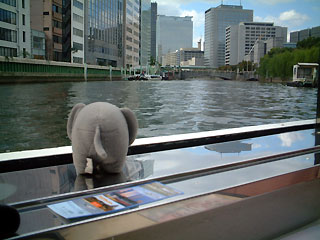
One final leisurely morning and a scenic boat ride around Osaka's waterways, then we were on the Hikari shinkansen and on our way home from our vacation.
We had a fabulous time touring the O cities. I haven't returned from a holiday this relaxed and happy in years. Why was it so good? I'm not sure, but here's a clue: unless you count the interactive museum displays, I didn't touch a computer for 8 days.
Of course, here I am freshly returned and already at the console, but even 2049 spam messages or the pile of work that awaits my attention can't dampen my happy mental state.
I tried to jot notes while I was on the road but my handwriting is wretched. Still, I will get the backlog of weblog entries done shortly, so look for photos and tales of Oita, Onomichi and Osaka.
Today we finally met Niko, Zoupi's host in Belgium last summer. We met him for lunch and he spent the day doing silly things with us.
First we went to the Osaka Sewerage Science Museum. Sounds weird but we wanted to visit the last time we were in Osaka, but didn't make it. So of course it was on the top of our sightseeing list this time.
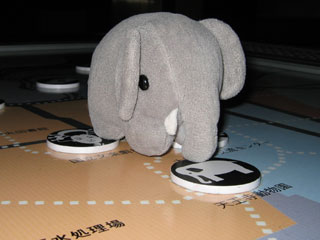
Zoupi liked this exhibit--it shows where the zoo sewage is.
What else is at the Sewerage Science Museum? Explanations of how Osaka treats its wastewater, examples of how it's reused after it's cleaned, and a lot of exhibits feature water--vortex spinners, rain simulators, wave motion generators and a quiz at the end.
Probably better than the museum was where we ended up afterwards. The train dropped us back in Umeda, the same area we'd had dinner the night before. Rather than head into the tick of things, we threaded our way into the back alleys behind a temple. And found a wonderful little izakaya presided over by this man:
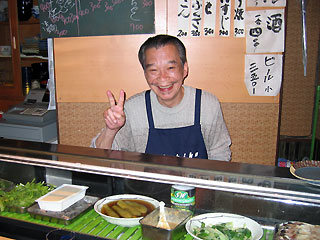
His wife called him "Master" and he certainly was an excellent cook. We went in for oden, and ended up with a variety of foods, included the best goma-ae I've ever had. He served it over simmered greens and chilled green grapes. I regret not asking him for the recipe.
Here is some of the Osaka-style oden that I was eager to taste. It's a big block of tofu, simmered in a lightly seasoned broth and topped with a sheet of paper-thin seaweed. Yum! We also had simmered diakon served with grated yuzu, and a kyouimo a greyish, sticky potato I'd never had before.
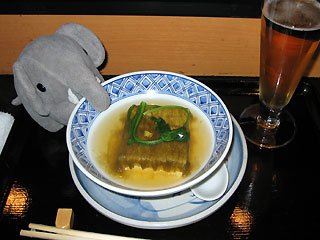
I was having such a good time that I failed to take any photos of Niko. But he took one of us (in fact all the photos in this report are his) at our nijiikai. Tod is looking up the kanji on the waribashi wrapper. Tod looked up the kanji on everything during this trip--he even had to change the batteries in his electronic dictionary. He loves kanji and never passes up the opportunity to look them up. I try to be patient...can you tell in the picture?
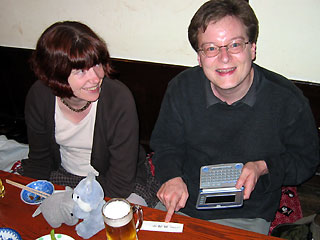
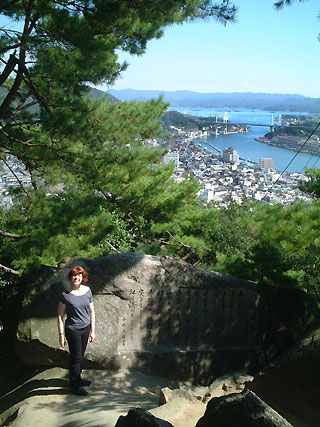
We made one last trip up the hillside in Onomichi, then boarded the Shinkansen for Osaka.
Upon arrival, we alighted the subway at Temmabashi station. As we looked at our map, trying to decide which station exit was closest to our hotel, a woman asked if we needed help.
She was not the last person to kindly offer assistance while we were in Osaka (something that rarely happens in Tokyo), but her directions were the most striking:
"Go up those stairs there, and turn right. Then another set of stairs and turn left and go into Matsuzakaya. Go up to the seventh floor and the hotel entrance is there. Or maybe it's the sixth floor..."
Hotel on the 7th floor of a department store? Well, why not. We lived above a shopping mall in Singapore. When we got to the seventh floor, we had to ask a sales girl where to go, but sure enough, back behind the children's books was the entrance to the hotel.
After checking in and asking the front desk staff to look up a phone number for us (I saw the concierge Googling and felt nostalgic for my computer), we went out wandering. Tod had the brilliant idea to go buy a gourmet guide book at the convenience store. We made very good use of it. We found an Indian restaurant for dinner and searched out lunch the next day with the book. Yeah for Tod! Yeah for Hanako restaurant navi books!
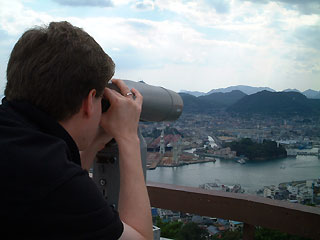
Onomichi is one of my favorite places in Japan. It's just a little town, with a harbor on the Seto Inland Sea, a run down shopping arcade, and a hillside dotted with temples and monuments, but it speaks to me. I like the atmosphere of slow decline, the cracks in the tiles underfoot, the slow pace of life, the sea air.
And I love the view. We spent the greater part of the day gazing out from vantage points on the hillside--the ropeway to the hilltop, observation platform, the lobby of the art museum, an abandoned carnival, the literature museum, the street above an old pagoda--and catching glimpses between houses and trees as we walked back into the lower part of town. Then we sat at the quay and watched the ferries before retiring for dinner.
I think the view speaks for itself. Click to get a much larger version:
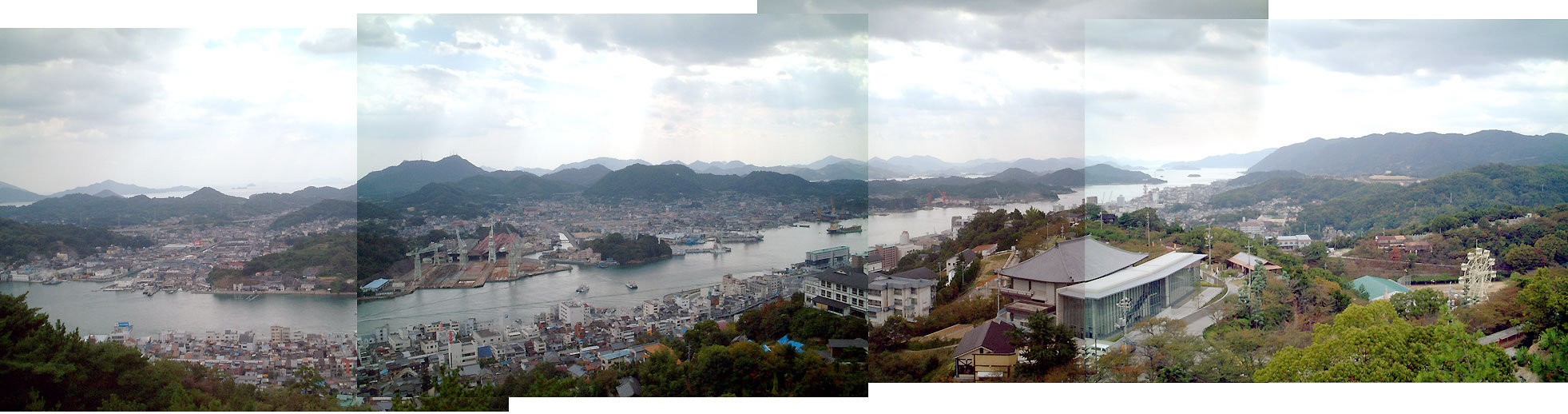
 Today we went mikan hunting.
I'd seen a sign for mikangari when we were driving around Oita and it struck me a fun activity. The Seto area is known for its mikan farms, so upon arriving in Onomichi yesterday, we went to the tourist information center to ask. They gave us a map and some phone numbers for the mikan farms on Mukaishima, the island across the harbour.
This morning after breakfast, Tod called around to find one that was open, and we took the ferry over. It was a longish walk out of town to the mikan farm and we might have been the only people on the island who were walking. Everyone else had a car or a bicycle, but I was not going to spoil my holiday by riding a bike.
An older couple was sitting in a shed, weighing, trimming and taping bundles of aonegi, green onions. They were prepared for our arrival, but I don't think that a lot of Westerners arrive on foot at their farm to pick oranges. But we did and they were gracious. The woman handed us short, curved blade scissors and a plastic bag as the man explained that he'd take us up to the grove.
"It's 500 yen for all-you-can-eat, and 600 yen if you want to take them home in the bag." he told us. Then he straddled his bicycled and rode slowly up the lane, asking a million questions to Tod. The mikan grove was at the top of a hill overlooking the sea. It was fabulous.
 After a quick lesson on how to select and cut the mikan, we were on our own. We spent a very happy half hour crawling under the diminutive trees hunting for the tastiest mikan. As they ripen, dark green gives way to brighter green and yellows, then becomes progressively redder until reaching a brilliant orange. Fortunately for us, partially ripe mikan are also delicious, if not quite as sweet, and we gathered a half a bag to carry back with us.
Instead of walking straight back to the ferry, we opted to make a loop around part of the island. It turned out to be a long dull walk, but enjoyable for the exercise and the chance to breathe fresh air. Tod kept hoping for a bus, but they only run four times a day, and there wasn't one when we needed it.
By late afternoon we were back in Onomichi, and visited the Motion Picture Museum, which features the films made locally. All of the tourist maps have the key roke, filming locations, marked on them but they are all for films we've never seen--old Japanese dramas and period pieces. The museum wasn't much, but it had photos from all the films and a display of old cameras and projectors. The museum's own theater (ironically, the only theatre in Onomichi) screened some clever short films made in a local contest, and a history of film in Onomichi. Made me wish I'd brought my video camera.
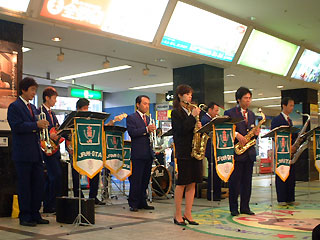
It's Rail Transportation Day and the nation's railways are celebrating. We joined in the fun by taking trains from Oita to Onomichi.
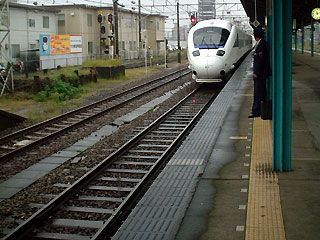
First we travelled on the Sonic to Kokura. The Sonic has one of the nicest interiors I've ridden in. The seats are taupe leatherette, there's plenty of legroom and the windows are nice and big. Yesterday, we rode on the "Family Wonderland" version of the Sonic between Beppu and Oita, and the interior was done up in primary colors but just as posh.
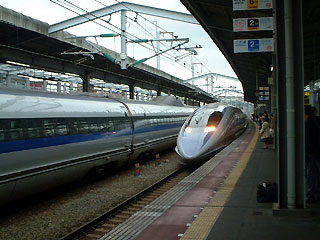
At Kokura, we transferred to the Shinkansen. From here to Hiroshima, we rode on the sleek Nozomi. It announced when it was going 300 km/hr (186 mi/hr). The landscape flew past so quickly. We were in Hiroshima in no time. Actually, it was about 45 minutes but it seems like no time at all.
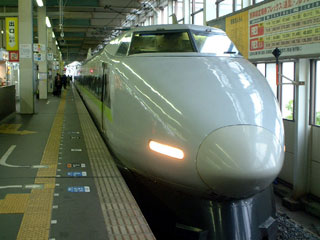
Our journey continued on another Shinkanesen, the Kodama. The Kodama trains are the slowest of the Shinkansens, and they stop at all of the stations. This one took us to Shin-Onomichi. We had Car 4 to ourselves for about half of the 45 minute trip.
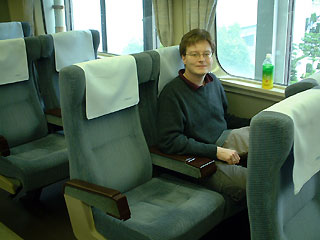
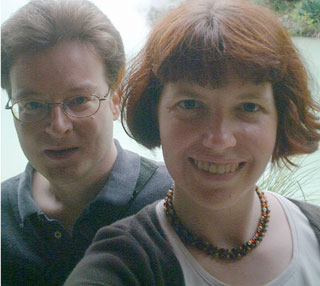
We celebrated our 14th wedding anniversary by being buried in very hot sand. Suna yu is a sand bath, and there are several in Beppu, the famous hot spring town nearby Oita. I was eager to try this but Tod wasn't so sure. He agreed to come along and wait for me while I bathed. But when we arrived and he saw the charming seaside location he relented. It turned out that he liked it. Lying under a heavy pile of 41 degree sand is utterly relaxing. Ten minutes passed in the blink of an eye (or 40 winks in my case), and then we had to wiggle our way out to make room for the next people.
After our sand bath, we walked up the hill to the jigoku. Jigoku means hell, and it's what the very hottest springs are called. There are 9 of them in Beppu. All are too hot to bathe in, and have been turned into tourist traps. But interesting ones...this one says "Danger, if you fall in the pond you will be boiled."
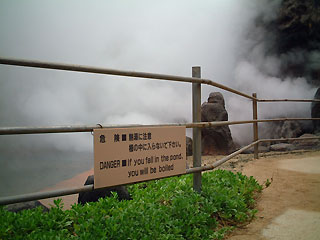
We visited three of the jigoku. At the first one, the steaming water turns white in contact with air; at the second the water was salty and claimed to prevent you from going to hell if you drank it (I had to think a long time about that, but took a tiny sip to taste it so I'll probably end up in purgatory); the third boiled like mad and threatened to splash anyone who got too close.
When we'd had our fill of Beppu's hot water, Tod treated me to a delicious and luxurious French dinner on the 21st floor restaurant of our hotel. There were five pairs of silverware bracketing our plates. We love to eat well, but don't often splash out on a ritzy meal like that. It was a treat. And the bottle of 2000 Chateauneuf du Pape was a very good wine to toast our long marriage.
Sayaka and her husband Masahi picked us up from the airport and chauffeured us around their prefecture for Saturday afternoon and all of Sunday. I could hardly believe their generosity. Although Sayaka and I have a very friendly correspondence, we've only met once. She really is a fantastic person.
Masahi works for the Oita department of agriculture and fisheries, so he is familiar with the loveliest parts of the countryside. We drove around the Kunisaki peninsula on Saturday afternoon. The color of rice as it matures for harvest is the most vivid yellow-green.
We stopped at several old temples and drove through countless tunnels and admired all of the farms and local produce. We even went past Usa, where legend has it that the clever Japanese had a lot of manufacturing plants in the 1950s. Instead of stamping their plastic toys "Made in Japan" they put "Made in Usa" before exporting them to America.
Sayaka came out to dinner with us and introduced us to several Oita specialties: toriten, tempura-style fried chicken; kabosu, a sour citrus fruit that's great in sauces or in drinks; and chicken sashimi. I was really surprised at how delicious raw chicken is...actually it's cooked tataki style, seared on the outside and raw in the middle, then sliced very thin. Mmmmm.
Sunday was a day of intermittent, intense downpours, but it didn't stop us from heading to the Oita coast. Masahi drove us to Saiki and then we boarded a ferry for the tiny island of Oonyujima. We drove around the island twice, stopping once for a terrific seafood curry lunch (We had to wait a while as we arrived two minutes after a group of 30 who had been on a fishing tour) and once for soft cream (soft-serve ice cream) while we waited for the ferry back to Saiki.
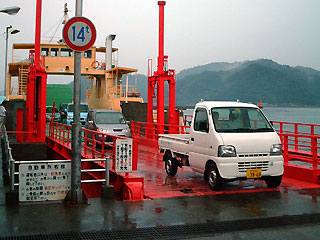
Sayaka and Masahi treated us royally. They came prepared with maps, guidebooks and pamphlets for everything in English. It was truly a treat to see so much of the countryside, though I'm afraid I was a terrible conversationalist during our rides. I was too entranced with gazing at and thinking about the passing landscape to devote much brain power to talking. If I had talked I would have been babbling all the things I was thinking--memories of other rural places, wondering about growing seasons, comparison of architecture. I think it was better for everyone that I kept all that in my head. :-)
Back in Oita city,Tod & I decided to go for a walk after dinner and while we were out, encountered a grandmother and her two grandchildren catching crabs along the castle moat. She showed us her technique: quickly press down on the back of the crab, then pick it up by the sides of the shell. I was too slow to get the pressing part, but she was really skilled at it and caught one for me that I got to hold. I'll bet she's been doing this since she was a kid. It was heartwarming to see her passing the torch to her granddaughter and grandson. And to us...
Our unusual household schedule works pretty well under normal circumstances. Tod works into the wee hours so that he can connect with colleagues in London; I rise early because I function best in the morning. We each get some quiet time alone to focus on our projects and we enjoy lunch and dinner together on most days.
But today we begin our holiday. Tourists in Japan are expected to rise early, see the sights before 5:00 when temples and museums shut their doors, then retire for drinks and dinner.
So in about 60 minutes, Tod will be wrenched back into the local time zone. I'll try to do it gently, with a hot mug of coffee and a kiss on the forehead, but it's going to be a rude awakening regardless. Tod will be sleepwalking until we reach Oita, and feeling jetlagged for a couple of days even though we're not leaving Japan.
We figured out that Tod lives on India time. Maybe next year, we'll travel there and I'll be the one making the adjustment.
Soon Tod & I will be taking our autumn holiday. This year, we're staying in Japan and touring cities that begin with O--Oita, Onomichi and Osaka. We'll fly to Oita, then take trains on the way back towards Tokyo.
Having just paid for our tickets and hotels, and thinking that it was an awful lot of money for domestic travel, I was wondering what a comparable itinerary in the US would cost.
So using Pittsburgh as our starting point, I priced a trip to Chicago, Indianapolis and Cincinnati with 8 nights in hotels similar in quality to the places we'll stay in Japan.
| Japan (yen) | USA (dollars) | |
| Airfare | 60,600 | 344 |
| Trains | 56,740 | 362 |
| Hotels | 141,000 | 900 |
| Total | 258,340 | 1,606 |
If you convert the yen to dollars, then it's easier to see that our Japan holiday will cost about $750 more than a comparable trip in the US. Pretty crazy...but the experiences will be worth the money. I love getting away from Tokyo and seeing other parts of the country.
And of course, if we wanted to travel to the US, it would set us back a few thousand dollars, so in the end, it's less expensive to travel domestically for our holiday.
Setting: a community of penguins working together
Time: present day
 Linux is a computer operating system developed by a lot of volunteers--some of them are geeky boys and girls; others are big companies. IBM loves Linux and has devoted a lot of resources to it, including donating bits of code to make it better.
Linux is free, "open-source" software and it's distributed under a special license agreement called the GPL. The GPL says that you must pass the software along with its source (the human-readable code that allows anyone to make changes to it) and that you are not allowed to add any more restrictive license requirements than the GPL.
In other words, if you add something to Linux, you can't require anyone to put your logo on it and you can't start charging people to use the part that you created. You give it for free, or you don't give it at all.
Enter the villain, twisting his mustache.
SCO was an important player in the Unix world but have gone downhill somewhat since its glory days. In fact, a few years ago, they bought a small company that had a beef with Microsoft so they could sue Microsoft. SCO won.
Now SCO is back at the judge's bench. They claim that Linux incorporates some of the Unix code that they own the intellectual property (IP) right to. They say that code entered Linux via IBM's donation.
The Unix world is filled with people buying and selling rights to bits of code, so it's not a surprise that IBM had some of SCO's old code. IBM and SCO worked together on Project Minerva in 1999, but abandoned the project in 2001. SCO says IBM stole their ideas and recycled them into Linux.
The good guys speak up
Now if it's true that Linux includes SCO's code, it isn't really a big deal. The Linux volunteers could remove the SCO code and write new bits to do the same things. The IP infringement ends when the code is removed. Problem solved.
The plot thickens
But SCO isn't saying exactly what parts are theirs and that means they can't be removed. If they aren't removed, then the IP infringement is still on and SCO can go to court. In March they sued IBM. The suit began with 1 billion dollars and currently seeks 3 billion dollars in damages.
SCO is a small company at the end of its life. Maybe what it wants is to create a nuisance and get itself bought out. IBM wasn't taking the bait. They prepared to go to court. Now there are two countersuits against SCO.
The villain wrings his hands...
Perhaps SCO worried that IBM would win. Last week, SCO demanded $699 for every CPU running Linux and $32 for every device with Linux embedded, like your TiVo and internet phone. This fee licenses the SCO proprietary code; anyone who doesn't pay faces a lawsuit.
Naturally, they are looking for companies that have lots of Linux computers. And of the Fortune 500, one company has agreed to pay up. Terms are not disclosed, nor the company.
The barbershop quartet sings a funny song
Ironically, and a very key point, is that SCO is a founding member of UnitedLinux, a consortium of companies promoting and distributing Linux under the GPL.
They have been distributing the disputed code under the GPL for over a year. By demanding a licensing fee, SCO violates the GPL they agreed to follow. So, according to the GPL, they can't distribute Linux anymore. But neither can anyone else.
Choose your own ending
A) Someone finds and removes all the SCO code from Linux. (read here)
B) Investigators uncover a SCO-Microsoft conspiracy to discredit Linux (read here)
C) Linux dies of lawsuit-itis (read here)
D) SCO loses the lawsuits and goes bankrupt, giving their IP to IBM to cover costs.
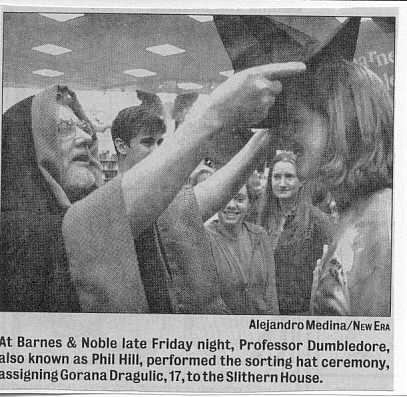
Dad sent all the older kids to Slytherin. (Funny how the newspaper can't spell.)
 My sister, Jennifer, is a poet.
Last October she organized a poetry workshop in Ireland that I attended along with my entire immediate family.
It's on again for this October 11 - 18.
I highly recommend it. Not just because it features a talented poet that I used to play Barbies with...though that might have a little bit to do with it.
During our week's stay in Ireland, I learned huge amount of stuff--from practical writing tricks on how to create metaphor and write concrete descriptions to revelations of my personal inner strife that writing poetry seemed to bring to the surface.
And the rugged western coast of County Cork, Ireland, is a beautiful place. It's easy to see why people think Ireland is magical. Rainbows, beautiful skies, so much green. Just like they always say, only better. Not to mention the only-in-Ireland beers in the local pubs.
If you're looking for an interesting, educational and uplifting week's holiday this year, please take a look at the details for the 2003 Anam Cara Poetry Workshop.
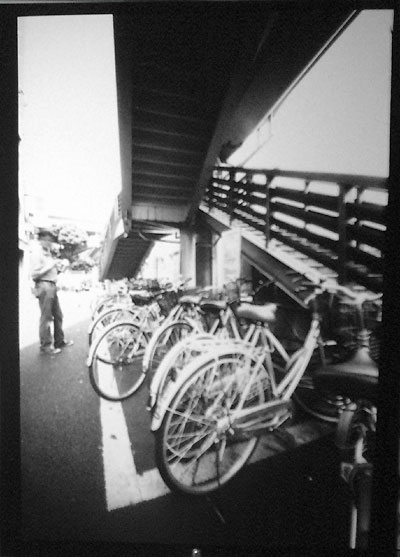 Today is Worldwide Pinhole Photography Day. Thanks to lil's excellent photoblog, esthet, I found out in time to sign up for a pinhole photography workshop here in Tokyo.
Last night was a talk by Edward Levinson, our instructor, and then we made our cameras. Today we took pictures and developed them.
Pinhole cameras are lensless, so they have no focus--or rather they have infinite focus. And becasue the apeture is small, they have great depth of field. Everything is in focus from close up to far away. Unless it moves...
We made our cameras from boxes and cans, painted black on the inside and taped to keep light out. We punched pinholes through aluminum, then attached the pinholes to the boxes with tape. Another bit of tape covered the hole.
That's all there is to it. You stick in some film or photographic paper, peel off the tape, count the seconds (or minutes) until you've properly exposed and then you put the tape back on. That's what we did all day today, interspersed with running up to the darkroom to develop out images.
 It was my first time in a darkroom, believe it or not ,and I loved it. It's like magic to see the images develop. Photoshop is great but I learned to dodge for real!
Sometimes the negatives turned out better than the positives. I like the negative of this image, taken with Ed's three-hole camera. The lines from the shutter I sat in front ove overlap nicely. But the positive reveals entirely too much facial detail.
One photo I took (and one of Tod's, too) will be in the online event gallery which includes photos from all over the world. You can see the photos from our workshop in person in at Tokyo Photographic Culture Centre (Akasaka 3-9-1) from May 10 - early June.
(click the images here for larger versions)
From a report on news.com.au
"The Iraqis could use Western journalists as hostages, Defence force spokesman Brigadier Mike Hannan has said. "
Doesn't that sound as though the Brigadier is giving permission to use Western journalists as hostages? "Well, they could use the journalists, or we could let them use the supply seargants. Either way, we think that these populations make good hostages."
Journalists really have been getting themselves in harm's way which is either extremely admirable or quite stupid. 21 journalists have died in this conflict. I don't know how many are out there overall, but it can't be that many can it?
I've been feeling pretty helpless lately. The war is hard to swallow. What can I do?
Protests do nothing to sway the madmen who are running the show. They couldn't care less if a 100,000 people wave banners peacefully or play dead in the streets.
I have no Congressmen to appeal to, and even if I did, Congress gave up its power regarding wars to the president after 9/11, if not before, but that's another blog.
I could write articles (well-reaasoned or ranting) about how wrong the war is, how it hurts the stability or the entire world, how foolish I think Bush is. How America is going down the tubes. But there are scads of them out there all being read by people who agree. It's like preaching to the choir.
 But I can do something.
I will boycott American and coalition products.
Maybe a boycott will gain the attention of the corporations that usually wield so much power. Perhaps they can pressure the coalition into stopping the war.
At first, I thought this might be a no-pain gesture for me, since I live in another country anyway. Then I started to think about it, and there's more American, Britsh and Australian stuff in my life than I expected. So no more American junk food, no British tea or Australian cookies. No Autralian wines. No properly-sized American clothes. No new computer hardware or software. No English-language books or movies.
We could sell off our American-based investments. Not that it would make much of a difference to the market, but it might feel good. There are other places to put our money.
I could take it a step farther and stop using what American things I already own--but that would mean no computers. And I'd be going around more or less naked. Since I like being dressed in public and I like working, I have to think more about that before acting.
But it's an empty gesture if I'm the only one doing it.
If lots of people take a small stand against American and coalition economics, then there's some power there. On the other hand, it's probably futile. But it makes me feel a little better and a touch more powerful, so I'm going to do it anyway.
And I'm not the only one. There are quite a few similar boycotts going on around the world. They take a lot of different forms--boycotts of big brands only, not watching TV, boycotting oil companies and defense contractors, avoiding American entertainment and fast food.
Boycott Brand America 33,000 people
Boycott lists from an Aussie peace group
Consumers Against War in Germany
Boycott Bush
I think this is a gesture that you can make at a level of self-sacrifice that feels right to you. Care to join me?
I don't often write about politics because mine are wooly at best and extending to wacky. But I have a question that maybe you can help me think through.
Bush issued a 48 hour "get out of Iraq or else" ultimatum to Saddam Hussein today. Bush must think that Hussein's not going to leave because Hussein's repeatedly said he's not going to be exiled. So it's a pretty sure thing that this ulimatum will be ignored.
But what if Hussein, his family and his ministers and generals did go? Then what?
Where would they go? Set up a government in exile in the mountains of Afganistan, maybe? Team up with the other members of the "Axis of Evil" in a remote, hidden headquarters?
What would they do? Gather followers? Build some weapons?Wage a guerrilla war? Form a terrorist cell? (guerrilla vs. terrorst vs. freedom fighter is a blurry line)
Does anyone think that by accepting exile, Hussein's core philosophies and tactics are going to change? It's not like he's going go to Elba and wither away or find a happy like on Niijima, the exiles' island south of Tokyo.
Nima is my travel agent.
He's also Tibetan--one of 40 Tibetan exiles in Tokyo. That's a pretty small community--a slim .00033% of Tokyo's population. When the Dalai Lama comes through Tokyo on his travels, all of the Tibetans know it and go to see him.
Talking with Nima over dinner last night, I discovered that he lived in Pittsburgh for a while when he was a kid. His sister still lives there. She runs an Indian/Nepalese store in Oakland and a few years back she had a restaurant called Himalayan Tibetan Restaurant.
I ate there quite a few times. In fact, it was from pamphlets there that I first learned about Tibet, its plight and the movements to save Tibet. And, of course, its food.
Who'd ever think that I'd do business with the brother of the Tibetan woman who owned a restaurant I'd eaten in 6,000 miles away and ten years ago?
Discoving quirky connections among people makes me grin from ear to ear. I love being an expatriate in this truly small world.
 I seem to be anti-adjusting to the time here.
When you travel to Japan from the US, jetlag tends to make you wake up extra early. That's one of the reasons Tsukiji Fish Market is in all the travel guides--it's one of the few things to do before 10 am in this city.
So when I woke at 5:30 on Monday I was expecting it. But yesterday I got up at 5 and here I am, writing this at 4:06 in the morning--50 minutes after I woke up.
I'd hoped to go back to sleep, but my brain is working and sleep's not going to happen. I think I'll make some coffee now. And take a nap this afternoon.
Finally back in the right time zone--all my clocks and timepieces agree with the local time. My kitchen clock and my system clock are in agreement. I don't have to add 3 and switch day for night. Unfortunately my body clock is just plain confused.
There is nothing nicer than coming home. I knew I was missing Japan, but I didn't realise how much until we got off the train and I saw the neon and crowds and bustle of Ueno. Ah, home!
Of course, now I will miss all of my family and friends, but since most of them have agreed to come visit "soon" I won't miss them for too long.
I don't sleep well before I travel. Even though I'm mostly packed and ready to go at 9:30 for our 12:40 flight, I'm still wide awake and ready for action at 6:00 this morning.
It's really quiet here as I sit on the sofa bathed in the blue light of my laptop and the the city-orange glow of the still dark morning. I can hear the fridge whining and the server in the laundry room is doing something with its disks. John just coughed and I hear his feet padding down the hall to the bathroom. My keypresses are explosions.
To pass the time until everyone else gets up, I will blog, check my mail, maybe read news until the sun comes up. It's really nice to be alone for a few minutes.
My computer says it's 5:28 on Thursday morning. The clock on the stove across the room says 2:28 in the afternoon on Wednesday. Kris is climbing the stairs to the apartment--coming home early from work. John is telecommuting on a conference call in the other room. Tod is working on a programming project. I am in my pajamas having just finished some work of my own.
Time is topsy-turvey. I think I blogged for Tuesday on Monday night, when it was already Tuesday in Tokyo. Have I blogged for today yet?
Since the US increased its terrorist alert to "orange" level, there's been lots of news about what to do in the event of a terrorist attack.
One thing that's being sugested is to have an action plan for the family in the event of an attack. Identify meeting points; know your local emergency evacuation points for schools and so on; keep a kit of emergency rations and blankets handy.
It really seems like they stole the earthquake disaster plans from Japan and stuck "terrorist attack" in them in place of "natural disaster."
So where do you meet your people in the event of a disaster?
We've reached the last leg of the trip. Now we're in Chicago and it's really cold here: 9 F (-16 C). By the time we'd taken the unheated train into the city and waited on the corner of a windy street for the lights to change, I was so cold my hands were blue and my body was shaking.
I do not like winter anymore.* It used to be my favorite season but what was I thinking? Give me autumn or spring, please. Maybe short term extremes--a week of cold and a nice juicy snowstorm--would be OK.
*I will recognise these advantages to winter: roaring fires, hot chocolate, cuddling under the covers on a chilly morning.
While I was on the train to Pittsburgh, the space shuttle Columbia failed to land. This news was delivered to me by my in-laws when they picked me up at the station.
Had I been at home, I would have known minutes after it happened and probably would have had as much information as anyone could as the story unfolded. As it is, I have only heard the news through 3rd parties and haven't even checked for myself.
I'm obviously on vacation now.
Why is that although the news says Americans support Bush and America's aggressive war dance, nobody I've spoken to here thinks this coming war is a good idea. Except maybe my father, who is cryptic about military things in general.
There have been anti-war protests and demonstrations but I think they are ineffective. We can complain all we like, but generals, advisors and others in power are not influenced directly by thousands of rallying citizens. The masses are too easily dismissed, even when they have a good point. If you don't agree, think for a minute of how you disdain groups you don't belong to--football fans, country music listeners, Republicans, cat lovers, customers at the store where you work, clueless computer users...
So what can we do? Think ahead and act now before it's too late. How do we prevent a future conflict? Change attitudes--our own, our friends, and most importantly, those of the people in power. Become the people in power.
The only way to change attitudes is to think carefully and form new opinions. So here is a question to start with: Is "the American way of life" better than the lifestyle in a country you've never been to and only know though media reports? Why? Should "American values" be globally adopted? Do we have the right to impose our lifestyle on others?
Discuss this over dinner with your friends tonight. See what happens.
Part of the daily routine at my parents' is watching Jeopardy on TV, so I've been hanging out questioning the answers along with them. I'm really bad at it. "The author of this 17th century novel wrote about his scurvy." I'm amazed the the contestants know the answers.
I'm more astonished by the ads that air during Jeopardy. 80% of them are for prescription medications. "Ask your doctor if Premoxolipicidil is right for you." Dorothy Hammill plays crack the whip with a passel of kids while talking about arthritic joint pain; old men walk dogs while voice overs explain that their life is improved by a specific brand of anti-depressant; smiling women show off their soft-focus children and good blood pressure thanks to some drug or another.
These are not over-the-counter medications. They are probably not used by more than a very small percentage of the population. Take high blood pressure as an example. The CDC says that 25% of Americans experience it during their lives, but most can control it through exercise and diet. Why advertise something that the general population doesn't need? It's not like advertising a new toy or a food that's unnecessary but might become a fad. This medication has to be prescribed. Do these ads have a good return for the drug manufacturers?
"Oh, my diagnosis is arthritic joint pain? Can I take the same stuff as Dorothy Hammill, please? I love those ads!"
OK, for all you who say I shouldn't hate the US for its inflexible rules, irresponsible people, fatness, lack of privacy, horrifying overuse of cars, and the 45 other things that are on my "Why America SUCKS" list--there is one thing that I like about the US. It has good bookstores.
I was in an enormous Barnes & Noble today that kept me entertained for nearly three hours. I bought 2 novels, two technical books, and a picture book for under $100. And I had lunch there, too.
Unfortunately, what should have been a bit of relaxation with my sandwich and latte was marred by the very loud (#6), mindless chatter and bickering of the cafe employees.
(And a side note: why is it so hard to find gloves in late January? I could have had flip flops and short sleeved t-shirts at three stores, but only one had any gloves--in two colors and two styles.)
Jenn is doing a poet-in-residence program at Heights Terrace Elementary in the Hazleton Area school district where I when to school. Tomorrow she has two long sessions with 4th graders and I was going to go in and help her do renga, Japanese chained poetry, with them.
Only I don't have an Act 34 clearance so I'm not allowed. Act 34's basically a certificate from the police saying you don't have a criminal record. I had one a long time ago when I was doing my student teaching and when I was certififed to teach here in PA, but it's long expired.
I can understand Act 34 clearances for classroom teachers who have regular contact with the kids, but for guests? I suppose the public schools don't let uncleared parents come in to volunteer. And they must not invite businessmen to speak or have famous people give presentations. That's madness.
Yet another reason to dislike the US. My list is growing...
 Today I spent the day at St. Nick & Mary Elementary. I'm exhausted but the kids were so much fun.
They were a bit wigged out by the nori and I was surprised that they didn't really like the green tea (sweetened, even). We learn some soroban basics; took pictures with the digital camera; tried writing our names with katakana. I told them stories and we wrote kanji. It was a day full of Japan and Japanese things. I hope they had a good time; I definitely did.
I had lunch in the cafeteria--hamburger, fries, overcooked beans and canned apricots. School lunches have not changed in the last 20 years.
Will today's activities help me get over jet-lag? Probaly not. I'm feeling that dead tired drag right now. My brin is melting and my body is cold to the core. Must go have some more of the leftover green tea, I think.
Yesterday, I posted a peevish, anti-US policy rant on a webboard I belong to. It was part of a longer thread on the Homeland Security Act and I was one of the dissenting voices. I'm sure very few people there read it; certainly noone replied.
It was one of the first times I've dissed the US government in a public forum, though if you see me face-to-face you probably already know how I feel about the current administration, the apathy of US citizens to the erosion of their privacy and freedoms, the cringing horror I feel when I think about someday returning, etc.
But in terms of what I can do to change things, I'd say "not too much." Run for office? Write letters to the editor? Be the editor? Spread dissent though my weblog? Ha. I wish I had the cunning.
Why is it just a tiny bit unnerving, then, that 15 hours after I posted my little rant, a good friend in the States was approached by an FBI agent? They went to lunch together. The agent said she was actually hoping to have lunch with one of my friend's colleagues who wasn't in. And she assured him that she's not investigating him yet (said with a grin and a wink).
But in the words of another friend, "Dude, the 'not yet' ploy is literally right out of the handbook, as is the 'I was looking for so-and-so, but...' gambit."
Food for conspiracy theory thoughts, I guess.
I don't feel jet lagged at all today. I slept for 12 hours and woke up with my headcold still raging. Maybe I am jetlagged, but I can't tell becasue of the coughing.
To kill time until I could go to bed again, I took Ferry, my laptop, to have her broken CD-R/DVD drive replaced. Now I'm upgrading her to Mac OS X. Tomorrow I'll install applications. The fun never ends.
A ten day vacation away from Japan is 40% travel. I've just ended a 25 hour door-to-door travel day and am looking forward to a long bath, dinner and a good night's sleep.
Once I'm rested and caught up, I'll fill in the missing entries (Oct 12-19) with all my Ireland exploits & the poetry I wrote at the workshop.
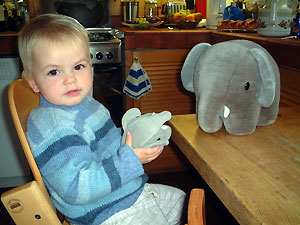 We're off to Ireland for a week-long poetry workshop taught by my sister and her colleague, Jack McGuigan.
The trip to London was one of physical challenges. I bruised a toe while making the bed before we left. On the plane, the people sitting behind me dropped their bag on my head instead of putting it into the bin. Later in the flight, the drunken woman in front of me tipped her ice into my shoe, then, not realising that the stuff under her seat was not hers, she tried it on.
Once we arrived in London, we had a better time. Our friends Moritz and Franziska hosted us for the night. We had a wonderful paella. Their daughter loved her omiyage--a brand new Zou, of course--and may have loved Zoupi even more. I had to hide him before we left the next morning.
Our flight to Cork was uneventful but after we arrived, we learned that the bus to Anam Cara was overbooked--we didn't have a seat. A flurry of questions and phone calls had us on a bus to Glengariff (where's that!?) and Jenn & Jack drove out to pick us up at "the pub down the road from where the bus drops you--it has a man's name Johhny D's, maybe?" It was John Barry's and we were very grateful to have a pint after the long trip!
Is it safe to read news yet? I stopped a few days before "the anniversary of the tragic event" and I do not relish seeing any nationalist, patriotic aftermath. Would someone check to see if all the flag-waving, teary-eyed reportage is over?
Love,
Your Cynical Friend
I am not sure what to think about America's changing immigration policies. Beginning next month, aliens entering from "high risk" countries are to be fingerprinted at their port of entry. If they remain in the US longer than 30 days, they must register at an INS office and check in annually.
Here in Japan, all resident aliens register with their town office and must renew their registration if they move or after 5 years. When we arrived, fingerprinting was required but was dropped about two years ago. I don't mind being registered with my ward because every alien is treated equally. And, after all, I'm a guest here and I have no rights, really. However, if I were being subjected to a policy that applied only because I am a (insert characteristic here), I would be annoyed.
Which is why I think the new policy of US Immigration and the DOJ is a little creepy--no, it's a lot creepy. They are targetting just the people that are fashionably suspicious.
Sadly, that's always been the case--the US's immigration policies are historically reactionary. Anarchist killed our President--no more anarchists allowed! Chinese laborers took over gold panning and railroad jobs--Asians are restricted from becoming citizens.
Where does it end? What's coming next?
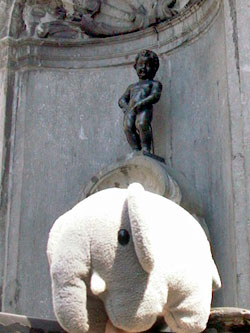 Zoupi is still enjoying his vacation in Belgium. He's travelled all over and amassed an extensive photo album. Here he is in Brussels with Manneken Pis, the famous fountain that inspired the funny Suntory Dakara commercials. (Click on the videotape, then navigate the menu to choose MPG or animated gifs--you don't really need to understand the Japanese to see the humor).
I can't believe my stuffed elephant is having a summer holiday and I'm not! But I'll get my turn eventually. If not soon, then in the autumn when we go to Ireland for my sister's poetry workshop.
Since there's no summer vacation for me, this wretched season could end itself any day, thank you. We're having a 35 degree heat wave this week. I wilt in heat, just like my plants. I've started the countdown to October, when the weather will be nice again--53 days.
 Washington state in the northwest US has passed a law banning the use of the word Oriental. "There is a need to make clear that the term 'Asian' is preferred terminology, and that this more modern and nonpejorative term must be used to replace outdated terminology," the law says.
Yes, 'oriental' is outdated when referring to people from Japan, China, Korea and the scads of other Asian countries. Most people who keep up with these things use Asian instead. But is it necessary to pass a law to ban an unfashionable word? What words are next in line for being outlawed? Dude. Hottie. 'Rents.
If you really want to change vocabulary, you must manipulate the media or infiltrate popular culture. Make the use of 'oriental' embarrassing, painful, or otherwise personally disadvantageous and it will slowly disappear. Introduce Asian as the latest buzzword and it will spring to everyone's lips. "That cafe is so Asian; I could spend hours relaxing there!"
 I'm itching to get out of Tokyo for a daytrip.
In the first two years we lived here, we often went for hikes or short trips on the weekends. We travelled all over Japan on these little jaunts.
But the last two years have been more settled--on the weekends we have social engagements, work commitments, volunteering activities, meetings. So we don't just go away any more.
But I miss travelling and seeing new things. There are so many places in Japan that I haven't been and many that I'd like to revisit. I must start planning now...
 OK, these folks are just reinforcing the stereotype of clueless Japanese tourists. In a report from the BBC, we discover:
"Two tourists engrossed in their guidebooks and heading for the birthplace of Jesus Christ unwittingly wandered into the centre of a war zone on Tuesday.
"The Japanese couple were amazed to find that Bethlehem's Church of the Nativity was at the centre of a 16-day old siege between Israeli soldiers and Palestinian gunmen.
"Palestinian residents of Bethlehem looked on in disbelief as Yuji Makano and his girlfriend Mina Takahashi walked through the debris towards the church seemingly oblivious to the evidence of war."
TheJapanese couple explained that they'd been travelling for six months and hadn't kept up on the news. Hello? Bullet holes! Tanks! Journalists in flak jackets! Look around you, world travellers. Geeez.
Getting away from Tokyo gives me a chance to make comparisons when I return.
For example,Tokyo has much better subways and trains. London's Tube is small, dirty, and subject to lots of delays as old switching equipment fails regularly. The Tokyo subway system is efficient, clean and relatively inexpensive. But London's trains aren't as crowded as Tokyo's.
Water pressure in Tokyo is better than in London. Apparently, the London mains have fine pressure, but buildings don't use the mains--they put water in tanks on the roof and use that. So the pressure is pretty poor, especially in upper storey flats. This may not mean much to the casual vistor, but living without good water pressure makes showering and dishwashing lothesome chores.
Food is a draw. Althought British food has a reputation for being bland and fatty (and it's a well-earned reputation), London has a great variety of restaurants from around Europe. Japan has better native cuisine, but it's hard to find Polish or Greek food here.
Overall, with only a week's experiences, I certainly prefer Tokyo to London.
 Home again, home again.
London has really great sandwiches; British women all wear cosmetics; the Tube is ridiculously expensive; salaries are not commensurate with the cost of living in London; the ham in Buckingham (and Hampstead, Nottingham, West Ham) is from the Old English word for home; the growl of a Lancaster bomber flying over the city is ominous; multiculturalism and the class system exist side-by-side; candy vending machines are evil temptations; nobody else gardens like the British; police have a sense of humour and humanity unmatched elsewhere.
And I did speak Japanese. On purpose. Once.
I'm off to London this morning. The car to the airport is due to arrive in just over an hour. I'm ready, but now begins the race to get Tod up, dressed and out the door on time. He has coffee at his bedside, but I'm afraid it isn't working yet. In a few minutes I will break out the heavy artillery--English muffins.
I'm looking forward to escaping Tokyo for a little bit but it's odd to realise I'm traveling to a foreign country where I won't have to struggle with the language. I wonder if I'll speak Japanese by accident?
Japan's government has pledged $500 million dollars to help rebuild Afganistan, 1/3 of the total pledges received at this week's meeting of Afganistan leaders and various nations here in Tokyo. Afghanistan would like to receive $15 billion in aid over the next ten years, and this meeting has given them 10% of their goal.
Japan isn't allowed to participate in wars, according to its postwar Constitution and is often seen (domestically and internationally) as a bit player on the world political stage as a result. Maybe they are trying to buy their way into a bigger role.
After two weeks of relatively frugal vacationing on Maui, Tod & I treated ourselves to one blow-out night in Waikiki before boarding the plane back to Tokyo. We stayed at a hotel called W. After showering with all the hotel beauty products, we wrapped ourselves up in fluffy hotel robes and ordered what turned out to be the most fabulous room service meal I've ever eaten. We set ourselves up for a wake-up call and a taxi to the airport in morning, then curled up in bed and watched a movie.
This morning, there was a limo waiting for us. Not just a fancy four-door car, but a stretch limo with seats for seven, tasteless white piping on the black leather interior, and empty cut glass liquor flasks sitting on the shelves that ran under the dark tinted windows. I've never been in such an over-the-top vehicle. It was great fun to pretend I was a rock star.
So the vacation is over; we're home again in Tokyo and life is back to normal. For now.
The Hawaiian language is integrated into everyday speech here. Aloha replaces hello and goodbye. Mahalo (thank you) springs up on signs--Mahalo for not smoking--and in announcements--Passenger Smith please pick up the blue courtesy phone, mahalo. Kapu (private) enhances the no tresspassing signs posted on fences. In the real estate listings, I discovered that an ohana is a cottage.
But the phrase I like most is Maui no ka io--Maui is the best. So true.
Sea kayaking is great fun. This morning, we joined a kayak/snorkel trip with South Pacific Kayak. Our guide, Lee, paddled with extreme grace making us look like the clumsy amateurs we are. Tod & I paddled right into a big wave.
We headed out to the Coral Gardens to snorkel. After the big wave, the sea was very calm and paddling for half an hour was easy. With goggles and fins on, I hopped overboard and spotted a ray, several interesting corals and hundreds of colorful fish.
But even more impressive were the whales we watched as we paddled back in. They were at a distance but leaping friskly with lots of flukes flying and huge splashes. These humpback whales, Lee informed us, come to Hawaii to calve. When the babies are big enough to take a trip, they head to Alaska to feed (they don't eat here). A mother humpback can lose up to 3500 lbs of body mass here in Hawaii. What a shame I'm not a humpback!
We trekked through a forest of dense bamboo, splashed across a chilly, knee-deep stream, and clambered over rocks to reach the waterfall.
We weren't the only visitors to hike in. Eight well tanned, mud smeared naked people were perched on the boulders surrounding the swimming hole. We watched as they stretched arms to the sun, then dived from their perches into the water below.
Now if that's not extremely intimidating to a pasty-white, pudgy girl, I don't know what is. I left my swimsuit on when I waded into the pond and swam over to the waterfall. Climbing the rock face to stand in the waterfall and then ducking in under the veil of the falls, I sureptitiously and enviously watched the naked people cavorting.
The trail was a bit rough, but the view was worth it.
To celebrate the equinox, we drove to the top of Haleakala, Maui's 10,023 foot volcano.
Above the clouds, we saw the landscape change from lush tropical greenery to sparse shrubs and rocks. An endemic plant, the silversword, which looks like a cross between an aloe and an artemsia, captured our fancy. It grows for twenty years before flowering and dying. 70 years ago it was near extinction but it has made a comeback, with several thousand plants growing in the harsh environment of the mountaintop.
No tropical holiday is complete without plenty of fruity drinks. Every afternoon, we fill our daily quota of blended fruit ice and rum.
We've made the classics, most remarkably pina coladas with a coconut from a tree on the property, and we've invented some of our own. As the sun set yesterday we sipped cantaloupe, pinapple and orange juice spiked with vodka.
This evening? Probably something with the papayas we picked from our tree and the bananas that are ripening in the basket on the counter. Mmmmm. Happy Equinox!
Uluhe is an indigenous groundcover that has the most unusual growth pattern.
It unfurls, fernlike, into two leaves. Each of those spreads two additional leaves and so on until it reaches its end where the leaves branch out to form a pointy-ended fern shape.
These plants cover everything that isn't forested. Roadsides, clearings, recovering lava flows. They tangle into impenetrable brambles and their dead leaves create a fire hazard when the weather turns dry. Forestry services consider them a nusiance but I think they are pretty.
The mysterious boat comes by every morning.
It cruises past quickly at a distance about 3/4 of the way to the horizon. There's no sense of scale--it could be a twenty person yacht or a radio-controlled toy. Our binoculars bring it into clear focus but there is nothing to see that indicates how big it is. No people are visible and only waves surround it. How big are those waves, anyway?
Our watery view is punctuated by creatures that like to leap. Yesterday morning a school of fish came jumping along. Again this morning. The fish are sleek and pale grey and are accompanied by a bright blue spot that swims along with them.
We've been debating what the spot is attached to. I think it's a blue fish. John thinks it's the underbelly of a shark or a dolphin. No way to tell for sure, yet, but we'll keep watching.
It rains often here. Every evening, the clouds roll in from the south and we have a nice downpour while we cook dinner. Then the clouds break up and the sky is full of stars. Every other day, we see more clouds than sun.
But this is good. Not only does it fill the catchment that provides water for the house, but it offers opportunities to see rainbows (so far I've spotted four) and even a moonbow.
I thought moonbows were legend but they are real. A pale shining arc of light comes from nowhere and leads to heaven. There are no colors, just soft white light. Incredibly lovely.
Flock of Parrots. Great name for an 80's pop/Jimmy Buffet cover band. Also an actual sight and sound at our Hawaiian retreat.
Parrots are noisy squawkers when they fly but they sure are pretty. Their green plumage with red and pink on the head and yellow beaks makes quite a spectacle as they wing across the cliffside in a gang of 20 birds.
Whales! Yesterday morning, I swore I saw a black fin arcing up out of the water, but I was the only one who saw it. Later in the afternoon, I spotted another. Once again, I was the only one.
But I wasn't halucinating. Within the hour we were standing at the railling of the lower deck of our house, cheering on the three small, black whales who were flapping their tails and spouting water. They were playing in the inlet 100 meters from where we stood. What a sight!
How can I be here in Italy and have nothing to say?
I'm not sure, but I think jetlag has finally hit me. I could curl up under the table and sleep now (it's 11 am here). My powers of observation are limited to Internet points and caffe bars. Please, more caffeine and a 'Net connection.
Of course this is an art mecca and there are hundreds of famous paintings and statues within a 500 meter radius of my seat at this Internet station. Sure, there's plenty of glorious architecture just waiting to be viewed. But I'll skip it all for a nap and a book.
Don't let anyone fool you; travel is tiring. Caffe espresso, anyone?
Rome is amazing.
Layer upon layer of history. We came across an aquaduct last night whose ancient water line was at street level. It's supporting arches were excavated to a depth of about 10 meters below the street.
Everywhere we turn there are more old things to see. Churches, temples, scavenged columns, Bernini churches and sculptures, Baroque and Rennaissance buildings side by side. History really comes alove here. It's bewildering but beautiful.
Rome is also a city for coffee lovers. We've already been into three bars this morning (coffee bars, not pubs) for caffe--a single shot of espresso. A mere 1,200 lira (about 60 cents) gives us enough caffeine to help counter the weird jet lag we're experiencing.
This afternoon we visit the Vatican. Tomorrow we're off to Florence.
I miss rice.
I can understand why Japanese people seek out Japanese restaurants when they travel abroad. I am so sick of American food. Please, some miso soup and tsukemono!
Alas, it is not to be. I leave America tomorrow for Italy. In fact, for the next week postings will be erratic. I'll be in Italy and although there are plenty of cafes and coffee bars (I'm looking forward to that heavenly Italian espresso), I don't know how many of them have Internet access.
So pop in to check. I'll post if I can.
Shoppping in America is really fun.
We've travelled back to the States for a family wedding and I spent my afternoon in a mall.
Ostensibily, we were buying things for the bride but I had a bit of a spree, too. I couldn't help it. Everything fits and it's all so inexpensive. I bought shoes today--a pair of clogs and some dress boots--and paid just a little more than what I'd pay for a single pair in Tokyo (assuming I could find ones to fit my long feet).
It's tempting to snatch up all sorts of bargain goodies. But I have only one small suitcaes with me, so I must show some restraint!
